Breaking News
Breaking News
from Washington and beyond

“F*cking B*tch”: What ICE Agents Did Right After Minnesota Shooting

Spoiler alert: It was not to rush over and provide Renee Nicole Good medical aid.

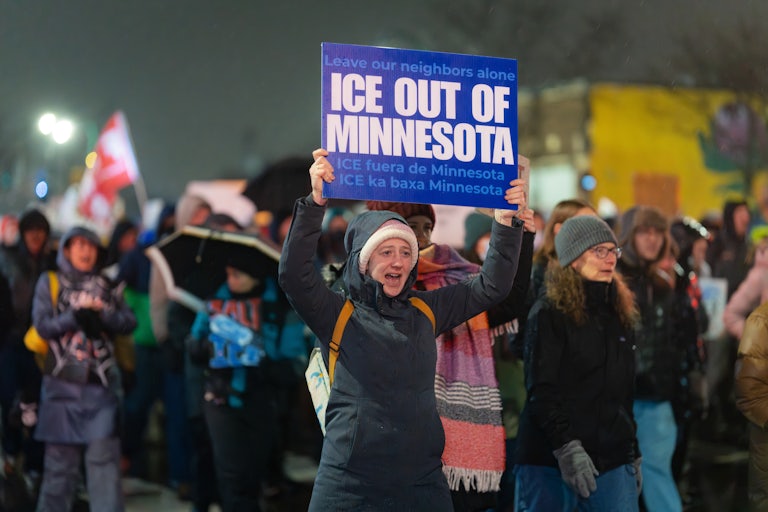
People protest in Minnesota, Minneapolis, after an ICE agent shot Renee Nicole Good dead
Ben Brewer/Bloomberg/Getty Images

A newly released camera perspective of the ICE shooting in Minneapolis has shed additional light on the moments leading up to Renee Nicole Good’s death.

The previously unseen cellphone footage, obtained and published by Allen Analysis Newsroom, depicts a federal agent’s vantage point of the lethal encounter, and captures audio of at least one ICE agent calling Good a “fucking bitch” after they shot and killed her.

The exchange, as captured in the new video, begins with a 360 degree shot of Good’s red Honda Pilot, with the agent walking from the passenger side to the front to the rear of the SUV, presumably documenting the vehicle and its license plates. In doing so, the agent filming captures video of Good’s dog in the backseat, his large, black head hanging out of the open window.

As the agent passes in front of the driver’s side window, Good can be seen and heard telling him: “That’s fine, dude. I’m not mad at you.”

“I’m not mad at you,” she shouts again as he walks behind her car.

The agent’s masked reflection is caught in the glass of the backseat windows as he moves away.

Another woman—presumably Good’s wife, Rebecca Brown Good—is filming the agent while standing next to the rear of the SUV. Her voice can be heard over a long shot of the vehicle’s license plate.

“Show your face,” she said. “It’s OK, we don’t change our plates every morning, so it’ll be the same plate when you come talk to us later. U.S. citizen, former fucking veteran—disabled veteran. You want to come at us? I say you go and get yourself some lunch, big boy.”

Someone can then be heard telling Good to “get out of the fucking car,” when she reverses and then pushes the vehicle forward. As she does so, several shots can be heard. The image loses focus. When the camera stabilizes, Good’s car can be seen careening away.

“Fucking bitch,” an agent said.

In a paltry attempt to defend the agents’ deadly actions, Trump officials have branded Good a domestic terrorist for moving her car, and have suggested that defying the barked orders of masked individuals that evade identification is a crime punishable by death.

Yet other video footage of the incident illustrates that Good did not hit the agent who killed her, identified by the Minnesota Star-Tribune as Jonathan Ross.

Still, within moments of the new video’s release, Vice President JD Vance and White House press secretary Karoline Leavitt breathlessly rushed to mold the clip to their political narrative, excoriating media coverage of Good’s death and claiming that the national outrage is little more than a Democrat-fueled smear campaign.

“The media dishonesty about this officer is an all-time moment in shameless press propaganda,” Vance posted on X Friday.

This story has been updated.
New Details Emerge on ICE Agent Who Shot a Woman in Minnesota

Jonathan Ross in his own words.

People protest ICE's presence in Minnesota after an agent shot dead a woman in Minneapolis
Ben Brewer/Bloomberg/Getty Images

Jonathan Ross, the ICE agent who shot and killed Renee Good, reportedly had a history of escalating arrests with violent tactics. 

Ross, a 10-year law enforcement veteran, was injured in June during the chaotic attempted arrest of Roberto Carlos Muñoz, an undocumented immigrant from Guatemala with prior convictions for criminal sexual conduct, who drove off during a traffic stop in Bloomington, Minnesota. 

Ross and another agent pulled in front of Muñoz’s vehicle to force him to stop. The two officers exited their vehicle and aimed their firearms at Muñoz, demanding he provide documentation, which he did, according to the affidavit. When the officers demanded that Muñoz roll down his window, he refused. Ross pulled out his taser, which he aimed at Muñoz’s chest, and the officers warned Muñoz that they would break the window if he did not comply.

Ross used a spring-loaded window punch to break the rear driver’s side window, and reached in to try and unlock the driver’s side door. Muñoz put the car in drive and dragged Ross roughly 100 yards, while Ross fired his taser “at least twice,” according to the affidavit. The agent later testified that he fired his taser 10 times.  

Eventually, Ross was shaken loose from the window, falling into the street. “The agent suffered serious lacerations on both arms, which required 33 stitches in total to close,” the affidavit said. 

“I was fearing for my life. I knew I was gonna get drug,” Ross said, according to a transcript of his court testimony from December. “And the fact I couldn’t get my arm out, I didn’t know how long I would be drugged. So I was kind of running with the vehicle.”

The claim that an officer was “fearing for their life” is a common phrase used by officers to justify their use of deadly force—and has become a familiar refrain for ICE agents who claim protesters’ vehicles were “weaponized” against them.  

Vice President JD Vance delivered a full-throated defense of Good’s killing Thursday, while botching some of the details of Ross’s backstory. 

Complaining about a CNN headline that described the incident, Vance said: “What that headline leaves out is the fact that that very ICE officer nearly had his life ended, dragged by a car six months ago, 34 stitches in his leg, so you think maybe he’s a little bit sensitive about somebody ramming him with an automobile?” 

Setting aside the fact that it was Ross’s arm, not his leg, that was injured, Vance’s remarks also absurdly suggest that any officer hurt in the line of duty has a free pass to remain in the field and shoot dead civilians if they get scared. That’s exactly why desk duty exists, right?

It’s hard not to see the parallels between Ross’s interactions with Muñoz and Good. Not in the fact that Ross was in any danger from Good, but that in both cases, he drew his weapon in order to threaten his target when they did not immediately comply with his commands. In one case, that decision was deadly. 

The court documents involving Muñoz’s arrest also contained other information about Ross. He described himself as an Indiana National Guard veteran who served in Iraq from 2004 to 2005 before joining Border Patrol. In 2015, he joined ICE and was assigned to the Enforcement and Removal Operations special response team, where he pursued “higher value targets.”

Trump Has Bonkers Plan to Make Sure White House Matches New East Wing

Apparently, demolishing the East Wing isn’t enough to satisfy Donald Trump.

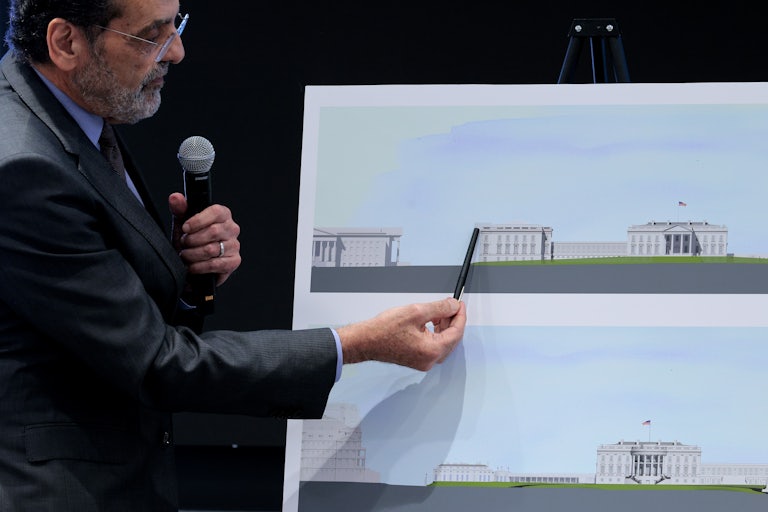
Architect Shalom Baranes shows his plans for Donald Trump’s White House renovation
Chip Somodevilla/Getty Images
Shalom Baranes

The White House ballroom project is about to get even bigger.

East Wing ballroom architect Shalom Baranes revealed new plans for the executive mansion Thursday, showcasing a previously unreported, one-story addition to the West Wing that he claimed would balance out the 90,000-square-foot development.

Screenshot of a tweet
Screenshot

The expansion, which would take place after the ballroom is completed, would “restore a sense of symmetry around the original central pavilion,” according to Baranes.

Responding to questions from members of the National Capital Planning Commission, Baranes said that the potential West Wing project would affect the West Wing colonnade but not the building proper, reported ABC News. The architect did not offer a timetable for its completion, and did not say if the West Wing’s proposed growth would add to the redevelopment plan’s $400 million price tag. (The project was, initially, supposed to cost $200 million before Donald Trump decided to tack on extra construction.)

Baranes also offered more details on the magnitude of Trump’s highly controversial ballroom, projecting that the new building will have 40-foot ceilings, be able to accommodate up to 1,000 seated guests, and would constitute just 22,000 square feet of the 90,000-square-foot development.

Baranes took over the ballroom project after Trump fired the original architect in early December. Despite handpicking James McCrery II to lead the renovation, Trump soon began clashing with McCrery after he disagreed with Trump’s desired size for the new East Wing.

A White House official who aided the presentation, Josh Fisher, said that the administration is also considering changes to Lafayette Square, which is located due north of the White House in the President’s Park.

Will Scharf, a senior White House official on the NCPC, claimed that the myriad changes to the White House were necessary in order to bring it up to snuff with the residences of other world leaders, comparing the symbol of democracy to the sprawling estates of King Charles of England.

But Trump also has his eyes set on spending heaps of taxpayer money on other portions of Washington.

The “Arc de Trump” is expected to be erected near the Arlington Bridge, opposite the Lincoln Memorial. It will be modeled after the Arc de Triomphe in Paris, the historic monument that commemorates those who fought and died for France during the country’s revolution and the Napoleonic Wars—though the president’s arc is, by its namesake, expected to honor just him.

Trump also renovated Jackie Kennedy’s famous Rose Garden, mowing down flowers in order to literally pave paradise. He gutted the Lincoln bathroom, transforming it from Lyndon B. Johnson’s favorite office into a marble-slathered eyesore, and swapped the historic Palm Room’s lush green tones and tall ferns for white paint and framed photos of plants.

Meanwhile, his administration is doing some demolition of its own, reportedly planning to destroy some 13 historic buildings on the grounds of former psychiatric hospital St. Elizabeths in order to expand facilities for the Department of Homeland Security.

Jobs Numbers Hit Record Low as Trump’s Economy Craters

One economist said 2025 was the worst year for hiring, outside a recession, since 2003.

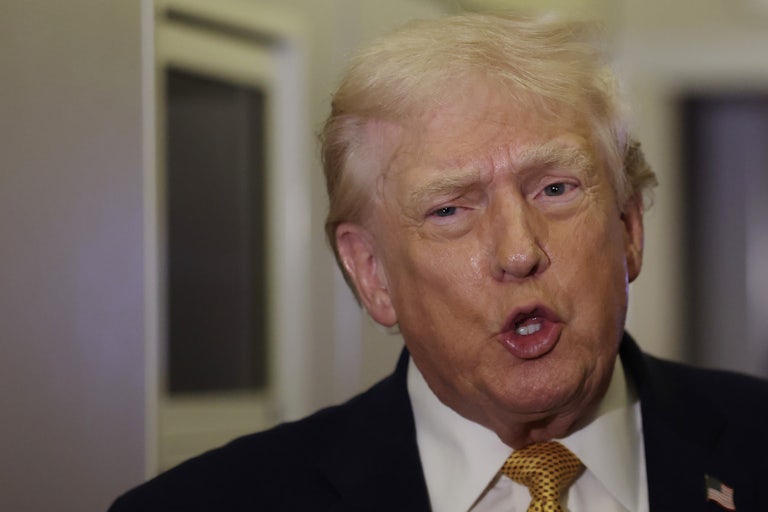
Donald Trump speaks on Air Force One
Joe Raedle/Getty Images

Donald Trump’s so-called “Golden Age” is seriously screwing American workers, according to the latest jobs report.

The U.S. economy added just 50,000 jobs in December, according to the Bureau of Labor Statistics, underperforming expectations from Wall Street. December’s meager job offerings capped off total job creation in 2025 at roughly 584,000 total jobs, making it the worst year for hiring since the Covid-19 pandemic that ravaged the American economy. 2025 also saw the weakest annual job growth since 2003

Since Trump’s Liberation Day tariffs announcement, job growth has screeched to a halt—and may even be in decline, according to economist Justin Wolfers

Heather Long, the chief economist for Navy Federal Credit Union, pointed out that the bulk of hiring last year happened in April, when 158,000 jobs were added to the economy. 

The worst month for job creation was October, when the market lost a staggering 173,000 jobs (revised up in the latest release from 105,000) as federal workers ousted by Elon Musk’s DOGE departed their government roles. November gains were also revised down from 64,000 to just 56,000. 

Meanwhile, the unemployment rate fell slightly to 4.4 percent, after reaching its highest rate in four years. The unemployment rate was overall up from 4 percent in January 2025. 

The first year of Trump’s so-called “Golden Age” has been a rough one. 2025 ended with the number of people employed part-time for economic reasons up by 980,000,  the number of long-term unemployed people up by 397,000, and the number of people not in the workforce but wanting a job up 684,000.

Mayors Warn You Can’t Trust Trump After Second ICE Shooting in Days

As George Orwell said, “The Party told you to reject the evidence of your eyes and ears. It was their final, most essential command.”

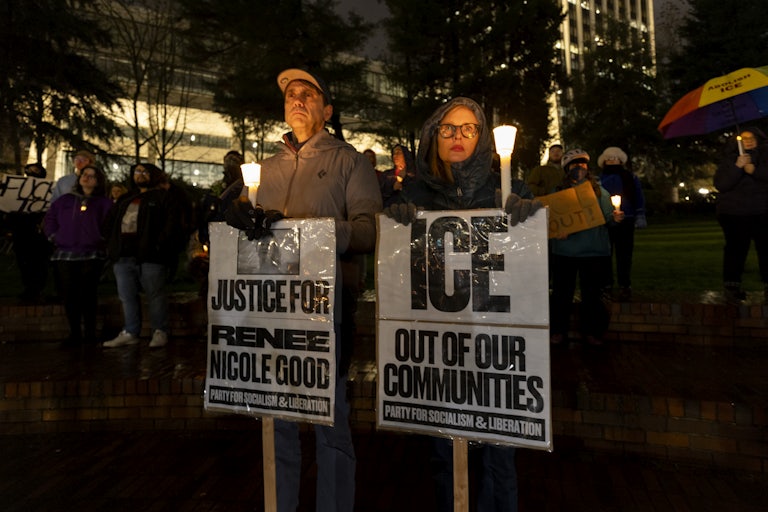
People hold anti-ICE protest signs at a vigil in Portland, Oregon, for Renee Good, who was shot dead by ICE in Minneapolis, Minnesota
Natalie Behring/Getty Images
A vigil in Portland, Oregon, for Renee Nicole Good

National trust in federal authority has plummeted in the wake of several ICE shootings, leading at least two mayors to denounce the government.

Two people in Portland, Oregon, were shot by Border Patrol agents during a traffic stop Thursday evening, leading Mayor Keith Wilson to acknowledge that federal agents have made American towns less safe.

Speaking at a press conference late Thursday, Wilson called on the Department of Homeland Security and ICE to quit “all operations in Portland”—but not before he called out the Trump administration for twisting the reality that Americans are experiencing with their own eyes and ears.

“We know what the federal government says happened here. There was a time when we could take them at their word,” Wilson said. “That time is long past.”

Oregon Governor Tina Kotek was in lockstep, claiming at the same press conference that “federal agents at the direction of the Department of Homeland Security are shattering trust.”

“They are destroying day by day what we hold dear,” Kotek said.

The current status of the two shooting victims is not currently known, according to state and city officials in Oregon.

The shooting occurred just one day after an ICE agent killed 37-year-old Renee Nicole Good in Minneapolis shortly after she dropped off her 6-year-old child to school. Her death sparked national fervor, particularly after the Trump administration vehemently defended the agent with an explanation of the incident that did not line up with video footage of the assault.

Penning a New York Times op-ed Thursday, Minneapolis Mayor Jacob Frey argued that Donald Trump was lying to the country about what had taken place in his city. He cited the escalating violence that ICE agents had enacted against the Minneapolis community in recent months, including incidents in which ICE agents dragged a pregnant woman through the street, sparked chaos at libraries, and hurled chemical agents at high school students on school grounds.

But further still, Frey argued that the president and his officials had undermined public safety by deliberately dividing the public on a federally sponsored killing, caught on tape.

“The actions of the ICE agents deployed to my city are dangerous, and now, even deadly,” Frey wrote. “But that danger has been compounded by the administration’s claim that the victim committed an act of domestic terrorism.”

Video evidence of the incident suggested Good was letting other vehicles pass her on the road before she attempted to get out of the officers’ way, in an attempt to comply with ICE’s orders. However she was momentarily halted when the masked agents approached her window.

As she began to move her vehicle away from the agents, an officer standing in front of her red Honda Pilot sidestepped the car, moving toward the driver’s side before he pulled the trigger multiple times through her open window, video recording illustrates.

The officer then extended his arm and chased after Good as her SUV accelerated down the road, seemingly uncontrolled, before smashing into a utility pole and several parked vehicles.

Somehow, Trump officials have interpreted the clip as an act of aggression, in which they claim that the attacking ICE agent—identified by the Minnesota Star-Tribune as Jonathan Ross—was acting in self-defense. Trump claimed that Good “behaved horribly,” while Vice President JD Vance argued Thursday that Good’s death was effectively her own fault as he believed she had been “brainwashed.”

But after watching “multiple videos from multiple perspectives,” Frey wrote he agreed with eyewitnesses that “it seems clear that Ms. Good, a mother of three, was trying to leave the scene, not attack an agent.”