Breaking News
Breaking News
from Washington and beyond

Trump Team Scrambles Over Rubio’s Admission About Israel and Iran

Even Secretary of State Marco Rubio tried to claim he’d never made the statement.

Secretary of State Marco Rubio speaks to reporters in the Capitol
Graeme Sloan/Bloomberg/Getty Images

State Secretary Marco Rubio just ate his own words.

The White House is scrambling to find a palatable explanation for U.S. involvement in the Iran war after Donald Trump rejected Rubio’s public rationale.

During a visit on Capitol Hill Monday, Rubio suggested that the U.S. jumped to action due to intelligence that indicated Israel was going to strike Iran. U.S. involvement was, according to Rubio, necessary to thwart retaliation against U.S. interests.

“It was abundantly clear that if Iran came under attack by anyone … they were going to respond and respond against the United States,” Rubio said. “We knew there was going to be an Israeli action. We knew that would precipitate an attack against American forces. And we knew that if we didn’t preemptively go after them before they launched those attacks, we would suffer higher casualties.”

But that was apparently not the pitch that Trump approved. Responding to questions from reporters at the White House the following day, the president rejected any indication that Israel had pushed the White House to act.

“No. I might have forced their hand,” Trump said. “We were having negotiations with these lunatics, and it was my opinion that they were going to attack first. They were going to attack. If we didn’t do it, they were going to attack first. I felt strongly about that.”

Hours later, Rubio also changed his tune—though his tone was noticeably more stressed.

“Yesterday, you told us that Israel was going to strike Iran and that’s why we needed to get involved. Today the president said Iran was going to get—” started a reporter, before Rubio interjected.

“No. Were you there yesterday? That’s false. I was asked very specifically—were you there yesterday?” said Rubio.

“Yes, I asked the question,” responded the reporter.

Eventually, Rubio relented that the White House “knew the attack was going to happen anyway.”

Mike Waltz, the U.S. ambassador to the U.N., also tried to downplay Rubio’s comments. “[Rubio] clarified that those comments, those clips, are being taken out of context,” Waltz told CNN Tuesday night. “He was answering a very narrow operational question.”

So far, six U.S. soldiers have been killed in the conflict, as have more than 20 Iranian officials, including Supreme Leader Ayatollah Ali Khamenei. Eighteen American soldiers have also been seriously injured. More than 1,000 Iranian civilians have been killed, including 176 children, dozens of whom were at a girls’ school in the country’s south.

Meanwhile, more than a dozen countries have been roped into the conflict since the U.S. began bombing Iran—including France, the U.K., and Greece—effectively destabilizing the entire region while disrupting global markets and oil production.

Why Texas Republicans Want to Halt All Immigration Into the Country

State lawmakers demanded a change to vetting protocols.

Texas state Representative Cole Hefner speaks while standing in the state Capitol. He holds a cell phone in one hand and gestures with the other
Aaron E. Martinez/The Austin American-Statesman/Getty Images
Texas state Representative Cole Hefner

A contingent of Texas Republicans are pushing for an immediate pause on all immigration into the U.S. after local authorities revealed a naturalized citizen was their primary suspect behind a mass shooting that rattled downtown Austin Sunday.

More than 70 Texas state House Republicans tacked their names onto a letter to Congress demanding that U.S. immigration services immediately halt operations until “proper vetting protocols” were put in place to waylay broad concerns of terrorism, reported The Texas Tribune.

“The American people—and the people of Texas—demand immigration policies that place the safety and welfare of Americans first,” reads a copy of the letter shared by state Representative Jared Patterson.

That’s just one of four possible options the state GOP offered to alter America’s current immigration process.

The caucus also included a demand to fully fund the Department of Homeland Security. Funding for the agency lapsed on February 13, sparking a partial government shutdown that has singularly affected the agency. Republicans and Democrats in Washington have been unable to reach a bipartisan consensus on whether to reform the violent department, which is still struggling after unwarranted violence by ICE agents in Minnesota that ultimately saw federal officers kill two U.S. citizens.

Democrats have agreed to pass the package so long as Republicans concede to 10 demands on how to reel in ICE agents, such as requiring them to identify themselves, take off their masks, and obtain judicial warrants before forcing their way onto private property. GOP congressional leadership, however, has not been willing to change the status quo at all.

Second on the Lone Star Republican agenda to rehab DHS is guidance to “immediately freeze all H-1B Visas” until the federal agency can conduct a “comprehensive audit of existing visa holders.”

Finally, conservative state lawmakers asked that the country “redirect resources toward identifying threats” within American borders.

“This requires a concerted, well-funded effort to cross-reference immigration records, law enforcement databases, and intelligence reports to identify individuals who pose a credible threat to American citizens,” the letter reads. “This is not optional—it is essential.”

State Representative Cole Hefner, chair of the House’s Homeland Security, Public Safety & Veterans’ Affairs Committee and lead signatory, told the Tribune that the letter was a team effort by the entire House caucus.

These Six House Democrats Want Another Month of War With Iran

They’re pushing a more lenient war powers resolution—and all of them get money from AIPAC.

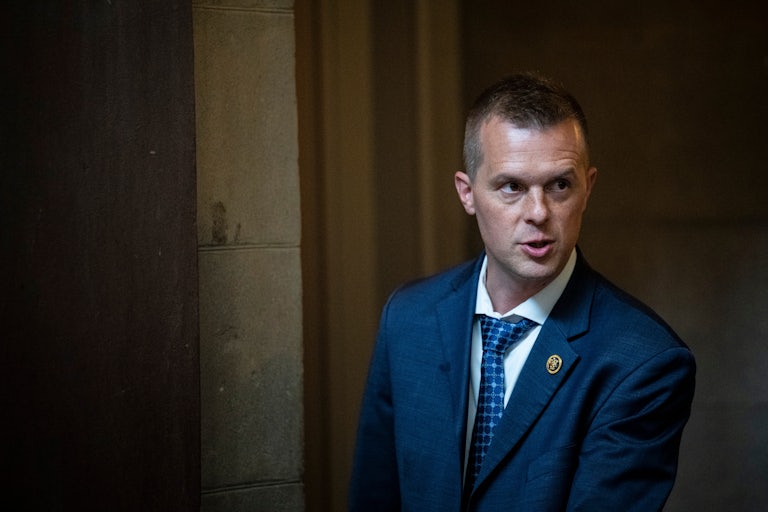
Representative Jared Golden, a Democrat from Maine
Graeme Sloan/Bloomberg/Getty Images
Representative Jared Golden, a Democrat from Maine

Six House Democrats are breaking with their party to support a different, more lenient war powers resolution that would grant President Trump a 30-day extension on his war on Iran, according to Punchbowl News. Each of those six Democrats has received somewhere from $300,000 to $3 million from the American Israel Public Affairs Committee, or AIPAC. 

The Democrat representatives voting for another month of war are:

  • Josh Gottheimer (New Jersey)
  • Jimmy Panetta (California)
  • Henry Cuellar (Texas)
  • Greg Landsman (Ohio)
  • Jared Golden (Maine)
  • Jim Costa (California)

“Our war powers resolution allows for the short-term, targeted strikes on the regime’s missiles and bombs, requires Trump to come to Congress for a vote, and specifies ‘no ground troops,’” Representative Landsman wrote Tuesday. “Destroy the regimes [sic] ability to destroy more lives or cause any more mayhem or violence. Nothing more.” 

The sentiment was not a popular one. The initial war powers resolution, co-sponsored by GOP Representative Thomas Massie and Democrat Ro Khanna, would immediately block any U.S. military action without congressional approval under the 1973 War Powers Resolution. It is set for a  Wednesday vote, but it doesn’t stand a chance of becoming law. Even if it passed both chambers of Congress, it doesn’t have sufficient support to override a Trump veto. 

“I truly cannot understand how anyone could decide, sure I trust Donald Trump and Pete Hegseth to wage a regime change war in Iran,” Pod Save America host Tommy Vietor wrote Tuesday on X. “Have at it for 30 days, fellas, the[n] we’ll check back in. Mindbogglingly stupid.”

“NEWS: six democrats introduce alternate war powers resolution that is not a war powers resolution, but instead maintains the status quo while looking Vaguely Concerned in the event the war becomes politically toxic which it already is,” Citations Needed host Adam Johnson wrote sarcastically. 

“There is not by any reasonable measure ‘a discomfort with the @RoKhanna resolution among House Dems,’” the Center for International Policy’s Dylan Williams said. “This is the pro-war fringe of the caucus giving themselves a phony oversight vehicle to point to. No one should be fooled by it. A vote against Khanna-Massie is a vote for war.”

In just four days of bombing, the Trump administration and the Israeli government have killed at least 787 Iranians, including about 180 children at an elementary girls’ school. Now six Democratic hawks want to give them 30 more days. 

Trump Desperately Tries to Control Global Chaos Unleashed by Iran War

Donald Trump is trying to calm oil and gas shipping companies after Iran warned it could start attacking ships in the Strait of Hormuz.

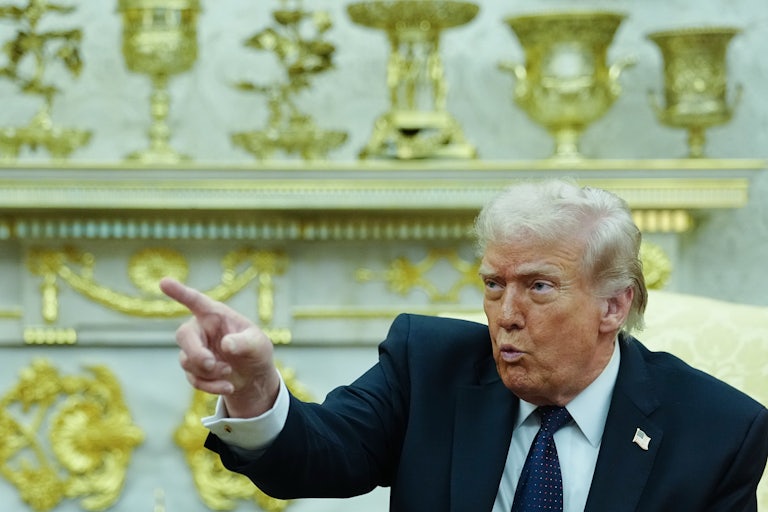
Donald Trump puckers his lips and points while sitting in the Oval Office
Kay Nietfeld/picture alliance/Getty Images

Donald Trump is offering a Band-Aid to fix the broken global supply chain as his illegal war with Iran spirals out into a regional conflict—but is it just another moneymaking scheme?

The president announced on Truth Social Tuesday that he’d ordered the U.S. Development Finance Corporation, or DFC, to provide political risk insurance “at a very reasonable price” to “ALL shipping lines”—but “especially Energy”—traveling through the Persian Gulf.

Trump’s announcement comes after the price of gasoline spiked 11 cents overnight and the price of natural gas increased 5 percent. As part of a series of retaliatory strikes on nearby nations, Iran struck energy facilities in Qatar and Saudi Arabia and disrupted traffic through the Strait of Hormuz, where a fifth of all oil trade must pass through, causing crude oil prices to jump 7 percent.

Trump had a solution to that too, it seems, and not a good one. “If necessary, the United States Navy will begin escorting tankers through the Strait of Hormuz, as soon as possible,” he wrote. “No matter what, the United States will ensure the FREE FLOW of ENERGY to the WORLD.”

Trump is casually suggesting that the United States direct millions of taxpayer dollars to fund military protection for ships carrying oil and gas, amid an ongoing major combat operation that most American taxpayers do not support and their representatives did not authorize.

At the same time, Trump’s offer for cheap insurance doesn’t quite pass the smell test.

The president did not specify how he would ensure the insurance would be reasonably priced. His post could indicate that the U.S. government plans to subsidize the insurance, which could mean spending even more taxpayer dollars.

The DFC offers investors political risk insurance to protect assets lost due to a range of conditions including “declared or undeclared war.” Those funds are held by a Corporate Capital Account used for the DFC’s investments and operating expenses, but excess collections are typically credited to the Department of the Treasury, according to a congressional research report from 2022.

In essence, Trump helped to start a war in the Middle East, and then offered to sell insurance to anyone afraid their stuff might get destroyed. That sounds like what some might call a racket.

France and U.K. Get Roped Into Trump’s Iran War

Both nations have sent ships to the region.

A screen displays French President Emmanuel Macron sitting at a desk and speaking
SEBASTIEN BOZON/AFP/Getty Images
French President Emmanuel Macron addresses his country

France and the United Kingdom have entered the Iran conflict.

French President Emmanuel Macron ordered France’s nuclear-powered aircraft carrier, the Charles de Gaulle, to move from the Baltic to the Mediterranean Sea.

In a prerecorded speech that aired on French television Tuesday afternoon, Macron told his countrymen that he had also deployed Rafale fighter jets, air-defense systems, and airborne radar systems in the preceding hours to aid the Middle East offensive.

“This requires our support. That is why I have decided to send additional air-defense assets there as well, along with a French frigate, the Languedoc, which will arrive off the coast of Cyprus later this evening,” Macron said. “And we will continue this effort as much as necessary.”

Hours earlier, British Prime Minister Keir Starmer announced that his country would send a warship and helicopters to Cyprus, where a drone hit an outlying U.K. military base. The development occurred around the same time that Donald Trump said he was “not happy” with the U.K.’s decision to withhold base access on the island from U.S. military forces.

“This is not Winston Churchill that we’re dealing with,” Trump told reporters at the White House, seated beside German Chancellor Friedrich Merz.

The U.S. and the U.K. had clashed on the issue over the weekend, though Starmer capitulated to Trump’s demands by Sunday, permitting U.S. forces to use U.K. bases to strike Iran. British officials believe that the drone strike on their base in Cyprus occurred before Starmer’s revised guidance was issued, reported The Wall Street Journal. British forces have so far been unable to note with certainty which government was behind the drone strike.

“The strike on RAF Akrotiri last night is deeply concerning, an example of the dangerous and indiscriminate attacks by Iran & its proxies,” British Defense Secretary John Healey wrote on X, noting in another post that there were no casualties on the island and damage was minimal. “Our best assessment is that the drone was fired before the Prime Minister’s statement last night on the US use of UK bases.”

Greece also issued military support to Cyprus after the airstrike, ordering two frigates and a pair of F-16 fighter jets to the island on Monday.

“Following the unprovoked attacks on the territory of Cyprus, Greece will … contribute in every possible way to the defense of the Republic of Cyprus in order to address the threats and illegal actions taking place on its territory,” Greek Defense Minister Nikos Dendias said in an address on Monday.

More than a dozen countries were roped into the conflict just 72 hours after the U.S. began bombing Iran, effectively destabilizing the entire region while disrupting global markets and oil production.