According to American publishing mythology, there was a time when giants bestrode Midtown Manhattan. They came from Chicago, from Oregon, from Pennsylvania, from nearby New Jersey, or from the outer reaches of the city itself: Coney Island, the Bronx. Bellow, Kesey, Updike, Roth, Heller, Doctorow. Gardner and Barth, Pynchon and Coover, Mailer and Malamud. They did battle with editors Gottlieb, Giroux, Straus, Epstein, Lish, Cowley. From the rubble of their contests rose great and enduring monuments that won plaudits from Manhattan to Stockholm. But nothing lasts forever. The bean counters and synergists came to the towers; and the age of heroes passed, and the age of widgets began.
Or so the story goes. And in many ways, it’s true: The U.S. publishing industry flourished in the 40 or so years following World War II, both economically and creatively. Serious writers were also blockbuster sellers, and even their agents became celebrities. But beginning in the mid-1960s, the major trade houses that published these writers were acquired by larger, diversified companies—at first, industrial conglomerates like Gulf+Western, and later, media corporations like Disney, News Corp, and Paramount. Books, literary ones especially, are only a minor and unimportant portion of these companies’ “content,” to use a term this era has dumped on us, and they don’t even make much money.
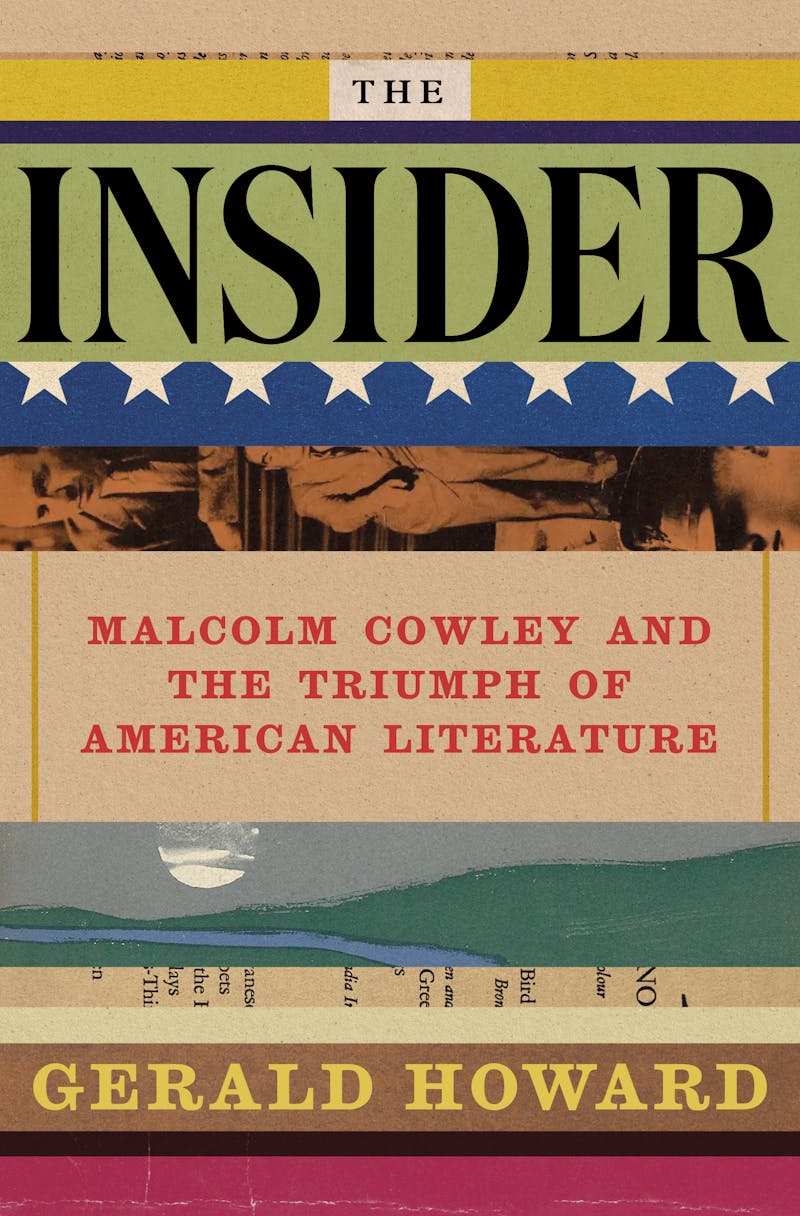
This isn’t really the story that Gerald Howard tells in his The Insider: Malcolm Cowley and the Triumph of American Literature, a biography of the memoirist, critic, editor, teacher, and general “middleman of letters” who orbited the nucleus of American writing for almost 60 years. But at the same time, it is. Despite the fact that less than a third of The Insider concerns that golden age, the “triumph of American literature” that Howard exalts in his book’s subtitle is just that: the period when the publishing industry’s fortunes and the prestige and international reputation of American writing thrived in tandem. The story of Cowley’s career is a story not just of the convergence of generational literary talent but of a country refining the image it would present to the rest of the world.
Cowley usually isn’t counted among the colossi of the Great American Novel and its broad-shouldered editors. But Howard has made a canny choice in proposing Cowley as the key figure in legitimizing American writing, one that complicates this golden-age legend. For more than almost anyone except the novelists themselves, Cowley was the bridge between the Lost Generation writers of the 1920s and their successors in the 1950s and 1960s. And without those Lost Generation modernists’ ability to sweep away European prejudices about the puerility of American writing, our golden-age giants never would have trodden the earth.
Born in 1898, the aspiring poet Cowley grew up primarily in Pittsburgh and went to Harvard as a scholarship boy, where he had his first encounters with past and future literary celebrities: John Dos Passos, Amy Lowell, and Robert Hillyer, who would later figure in the cultural wars over Ezra Pound and modernism. In 1917, he joined the American Field Service as a camion and ambulance driver on the Western Front of World War I and, after what he called a “long furlough,” returned to France in 1921, this time armed with an AFS scholarship to pursue graduate study at the University of Montpellier.
He didn’t stick around the South of France for long. By the following year (1922, the annus mirabilis of modernism), he was already enough of a Lost Generation scenester that Ernest Hemingway referred to him as “the American poet with … a stupid look on his potato face” and Robert McAlmon called him “the young intellectual fairly slow on the uptake.” But by the time he returned to the U.S. in 1923, he had met and won over almost everyone in Paris who mattered.
Out of this experience came one of the essential memoirs of the period, 1934’s Exile’s Return. Despite its focus on Harry Crosby and Cowley’s close friend Hart Crane, rather than on better-known writers like F. Scott Fitzgerald or Hemingway, Exile’s Return made Cowley into one of the most influential portraitists of a period that was already passing into gauzy memory. For in the intervening years, Cowley had become one of the most visible critics in American literary life, writing with confidence and authority about these figures and contemporary authors (primarily in this magazine, where he served as literary editor throughout the 1930s). And, in keeping with a general leftward lurch in the American literary scene, Cowley began raising the Red flag. He had, Howard says in an apt image, transformed himself into “a literary action figure, a man in ceaseless motion riding a wave of cultural and political revolution.”
Although Cowley’s communism came from a genuine commitment to social activism, he did himself no favors by reflexively toeing the party line. Through almost every one of the crises and exposures that peeled more leftists away from the party—from the show trials to the Ukrainian famine to the Ribbentrop-Molotov Pact—Cowley sided with Stalin, even if he always remained merely a fellow-traveler. Cowley’s belated noster culpa—issued in 1940 in, and on behalf of, The New Republic—came too late. He was demoted at TNR and lost his job in the wartime Office of Facts and Figures. For decades, reviewers of his books would use their column inches to slash at his inexcusable political judgment. Howard duly rehashes these spats between the Partisan Review left and the dwindling rump of Soviet apologists perhaps too thoroughly, given that the real story here is the building of American literary reputations.
Shut out of the plum positions because of his political sins, Cowley became a triple-threat hired gun: reporting, reviewing, editing. And it’s here, Howard argues, that Cowley’s skill set brought about “the triumph of American literature.” Booming after the war, in part because the public-private Armed Forces Editions had turned millions of soldiers into avid readers, the publishing industry rolled out innovations like the trade paperback and, at Viking, the “Portable Library” series, one-volume pocket anthologies of a major writer’s major works. Cowley assembled the Portable Hemingway in 1944, contributing an introduction that, for the first time, laid out the “subterranean, symbolic, and even mythic” dimension of Hemingway’s work. These weren’t just fishing stories!
Five years later, working closely with the author, Cowley edited The Portable Faulkner, a brilliant selection demonstrating how William Faulkner, whose books were almost all out of print at that time, had created a cunning little universe in Yoknapatawpha County, Mississippi, in which the sins of the South and of the nation as a whole were laid bare. And while he didn’t edit the Portable Fitzgerald (that job went to Dorothy Parker), in 1951 Cowley put together Scribner’s Short Stories of F. Scott Fitzgerald, which brought into relief all the depth beneath the champagne frivolity.
Cowley combined his cultural credibility, his editorial skills, and the particular affordances of the postwar publishing industry to help turn three writers—none of whom were considered particularly important, and only one of whom was widely read—into Serious Authors, at the very time when the U.S. was engaging in a broad cultural-diplomatic campaign to convince skeptical European intellectuals that “American culture” wasn’t an oxymoron. These three monuments, or “interventions in the great game of literary reputation and advancement,” as Howard calls them, packaged a prehistory that made the golden age possible.
In his next act, Cowley chaperoned two counterculturists into the club. In a delicate yearslong dance, in 1957 Cowley persuaded Viking to take a chance on the seemingly formless and definitely obscene travelogue On the Road, by a vagabond named Jack Kerouac, which Howard counts as Cowley’s most significant achievement. Five years later, he plucked one of his students in the new MFA program at Stanford out of obscurity, and made Ken Kesey’s One Flew Over the Cuckoo’s Nest an “immediate hit” and Kesey “a genuine literary star.” Kerouac and Kesey “were as influential in defining the culture of the sixties as F. Scott Fitzgerald and Ernest Hemingway were in the twenties,” Howard concludes. And, I would add, Cowley’s work as a “literary bureaucrat” had an immeasurable effect on the reputations of all four, with Faulkner thrown in as a chaser.
The generation that followed Cowley would preside over an extraordinary flowering of American literature, often invigorated by talented and entrepreneurial figures from the margins, which a number of recent studies have joined Howard in documenting. Shut out of publishing until the early twentieth century, Jewish bookmen like Alfred A. Knopf, Ben Huebsch, and Horace Liveright had to start their own firms and take chances on untested new writers. The bets, both financial and literary, paid off, and in The Literary Mafia: Jews, Publishing, and Postwar American Literature, Josh Lambert details how next-generation Jewish editors like Jason Epstein and Robert Gottlieb became such heavyweights in postwar book culture that critic Richard Kostelanetz, in 1974, credited them with having “unprecedented power to determine what writing might be taken seriously and what would be neglected or wiped out.”
Earlier accounts of this era have tended to overlook the work of women writers and editors. Fortunately, this is changing. In The World She Edited: Katharine S. White at The New Yorker, Amy Reading details White’s editing of John Cheever, John Updike, Vladimir Nabokov, and other giants of the golden age. But its greater interest is in the women she encouraged, such as Janet Flanner and Kay Boyle, whom she helped reach the kind of broad audience that trade publishing denied them. White even rescued Elizabeth Bishop from the slush pile: Her predecessor as poetry editor, Charles Pearce, had rejected 13 consecutive poems, and upon taking up her new position in 1945, a horrified White had to “engag[e] in relationship repair” to persuade Bishop to send in more work. Knopf’s Judith Jones is best known for bringing Julia Child and Anne Frank to the world, but in The Editor: How Publishing Legend Judith Jones Shaped Culture in America, Sara Franklin shows that Jones had a sharp ear for poetry as well, cultivating Sharon Olds and snapping up Sylvia Plath’s first collection, The Colossus—although she inexplicably turned down The Bell Jar, one of the most reliable sellers of postwar American literature. No editor can get everything right.
Even though Toni Morrison is best known as a Nobel-winning novelist, she was also one of the “hidden figures” of publishing, as the Howard University scholar Dana A. Williams makes clear in her Toni at Random. Morrison’s work from 1971 to 1983 as a fiction editor at Random House gave Black writers such as Lucille Clifton, Toni Cade Bambara, and Leon Forrest access to the most prestigious imprints. Deeply influenced by the Black Arts Movement’s insistence that Black art should stem from Black cultural roots and not aim for validation by white cultural institutions, Morrison took on as her first editorial project an anthology, Contemporary African Literature, whose contributors “were talking to other Black people, not to white colonialists to whom the authors had nothing to prove.”
Ultimately, these heroic writers and editors were not primarily responsible for this golden age of American literature and literary culture, which was in truth the product of much broader trends: near-universal literacy, the dramatic expansion of higher education, widespread economic prosperity, a growing middle class with lots of leisure time and money to spend on it, and a nation desperate to prove to the world it now led that it had a culture worthy of respect. These monuments, these novels, both documented and were the expressions of this new America.
Today’s corporate publishing landscape isn’t just different in degree from that time. It’s an entirely new world, one in which, as Dan Sinykin has documented in his study Big Fiction, a truly independent literary culture, and truly independent editors, cannot thrive. The relentless logic of capitalism is certainly in part to blame, but the novel is just no longer the axis around which the cultural conversation rotates. Indeed, there is no longer a cultural conversation but myriad cultural conversations, monologues, debates, cacophonies happening in forms much shorter and more kinetic and spectacular, forms abjectly unsuited for the kind of genuine contemplation and empathy that is the novel’s forte. And those recent novelists whose works have driven cultural conversation—Karl Ove Knausgaard, Elena Ferrante, Chimamanda Ngozi Adichie, Sally Rooney, Sayaka Murata—are often not American.
Perhaps the conglomerate era is to blame for the decline of America’s centrality to world literary culture, as Sinykin implies. Just as important, perhaps, is that the U.S. today has shakier infrastructure to support writers than many other countries—less affordable housing, a dwindling supply of day jobs in adjacent creative fields. And at the same time, its literary culture became ever more inward-looking and complacent about its own preeminence. Seventy years ago, Cowley helped establish American literature’s legitimacy, which gave cultural and intellectual heft to America’s audacious Cold War–era assertion of primacy on the world stage. This project, one might dryly observe, is no longer a national priority. And over the last year, we have learned what follows a golden age: an age of DGAF.