giphy

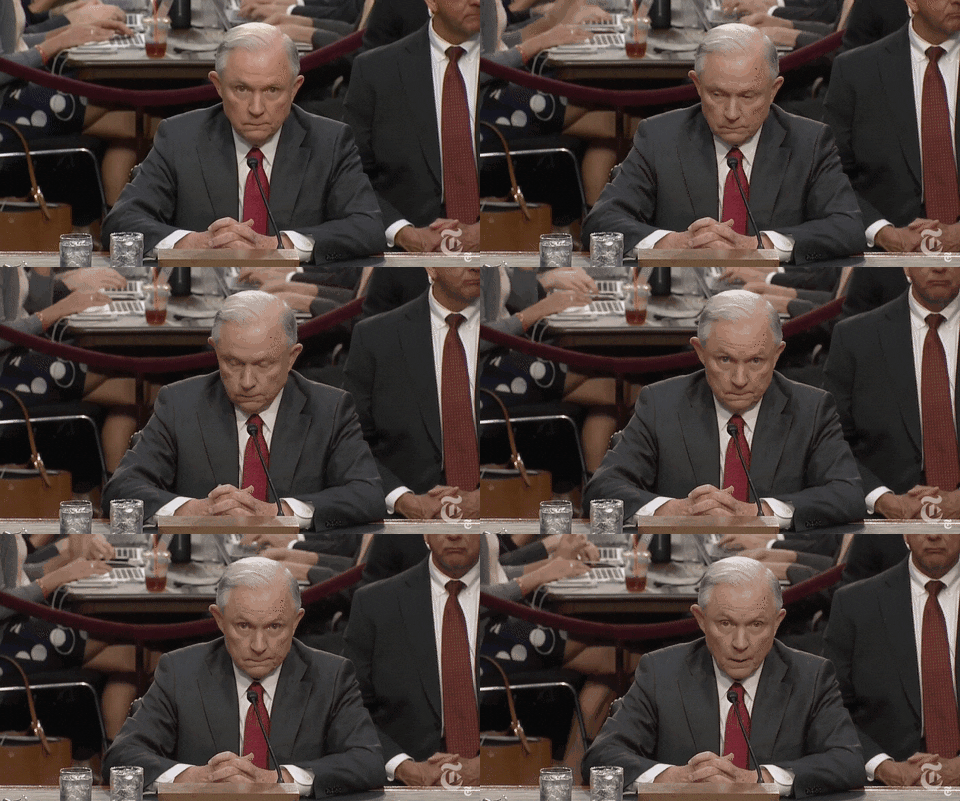
Looks like Jeff Sessions perjured himself.

Robert Mueller’s investigation into Russian interference in the election has entangled the attorney general. In his sworn testimony during his confirmation hearing in January, Sessions was asked by Senator Al Franken, “If there is any evidence that anyone affiliated with the Trump campaign communicated with the Russian government in the course of this campaign, what will you do?” Sessions responded: “Senator Franken, I’m not aware of any of those activities. I have been called a surrogate at a time or two in that campaign and I didn’t have—did not have communications with the Russians, and I’m unable to comment on it.”

But George Papadopoulos’s guilty plea indicates that there were attempts in the Trump campaign to arrange a meeting with Putin, and that Sessions was aware of them. As CNN reports this morning, “The chairman of Trump’s national security team, then Alabama Senator and now Attorney General Jeff Sessions, shut down the idea of a Putin meeting at the March 31, 2016, gathering, according to the source. His reaction was confirmed with another source who had discussed Sessions’s role.”

The good news for Sessions is that he can plausibly claim to have opposed any Russian collusion. The bad news is that, in making those claims, he opens himself up to charges of perjury.

July 09, 2018

Dan Kitwood/Getty Images

Theresa May gambled on Boris Johnson and lost.

On Monday, Boris Johnson resigned as foreign secretary of the United Kingdom. There is some ambiguity about whether he actually quit or was forced to resign. Johnson’s leave-taking, whether voluntary or not, follows the footsteps of David Davis quitting as Brexit secretary. Both resignations indicate the deep crisis faced by Prime Minister May as she tries push through Brexit while straddling a party that has sizeable factions that both want “hard Brexit” (a complete withdrawal from the European Union) and no Brexit at all. 

May has tried to balance the contending forces in her party by pushing for “soft Brexit” which would see the UK formally leave the EU but stay within the customs union and common market. In pursuing soft Brexit, May took the bold step of appointing advocates of hard Brexit, including Davis and Johnson, to key roles. The thinking was that if they were inside the government, Davis and Johnson would have to sign on to soft Brexit and couldn’t agitate against it. 

This gambit was always risky. Johnson, in particular, has shown no compunctions about sabotaging the policies of the very government he was serving under. Amber Rudd, the Home Secretary, once described Johnson as  “not the man you want driving you home at the end of the evening.”  He is a notoriously reckless adventurer, ambitious to become Prime Minister and willing to adopt nationalist demagoguery in pursuit of that goal. In September 2017, Johnson published a 4,000 word article in The Daily Telegraph making the case for as absolute a Brexit as possible, a deliberate attempt to undercut Prime Minister May. 

As Ian Birrell wrote in The Daily Mail, “This act of sabotage against fellow Ministers was jaw-dropping on so many levels – even for a politician for whom ambition is like a flesh-eating disease coursing through his body.” The surprise is not the Johnson has left his post, but that he stayed on it for so long.

PETER PARKS/AFP/Getty Images

Is Elon Musk’s “kid-sized submarine” a gimmick?

The second successful day of rescue operations to free a Thai soccer team trapped in a cave for two weeks ended on Monday. Eight boys have been rescued thus far, leaving four and the team’s coach in the cave.

A day before the rescue operation began, PayPal founder Elon Musk tweeted that he was building a “tiny, kid-sized submarine.”

Engineers from three of Musk’s companies—SpaceX, Tesla, and Boring Company—were planning on traveling to Thailand to assist with “location tracking, water pumping, or battery power,” but their trip was cancelled when rescue operations began on Sunday.

The impulse to help is good, but what Musk and his engineers can actually do in this situation is unclear. “With all due respect to Mr. Musk, I am not sure that he or his engineers have a real good handle on exactly what they’re dealing with in this particular situation,” Anmar Mirza of the National Speleological Society’s National Cave Rescue Commission told Slate. “The teams working are already doing as much pumping as can feasibly be done in there. They have enough pumping power.” Other experts have cast doubt on the submarine’s ability to withstand water pressure or “survive being swept or banged against the rough surface of the cave system.”

It’s hard to imagine that the Thai government would risk the lives of these boys on a prototype submarine that had been invented days earlier. Though its mission is risky, it has placed its trust in expert divers and so far it has been successful. For now it’s hard not to see the mini-submarine as anything more than a publicity stunt.

Jim Watson/AFP/Getty Images

Why all the anti-Catholic conspiracy-mongering?

Daily Beast writer Jay Michaelson is worried about the outsized power Donald Trump’s advisor Leonard Leo will have on the Supreme Court pick and the broader American judiciary. This is a worthy topic for discussion, since Leo is in fact drawing up the shortlist for Supreme Court nominations and has been a key player in The Federalist Society, an organization which is the gatekeeper for Republican court nominations. 

Unfortunately, Michaelson presents Leo’s actions through the prism of anti-Catholicism. Leo, we’re told,  is a “Catholic fundamentalist” who “belongs to the secretive, extremely conservative Knights of Malta, a Catholic order founded in the 12th century that functions as a quasi-independent sovereign nation with its own diplomatic corps (separate from the Vatican), United Nations status, and a tremendous amount of money and land.” 

Tom Carter, a former associated of Leo’s, is quoted as saying, “Leonard is very good at staying in the shadows.” Leo, we’re informed, likes to go to mass every day. 

Michaelson does include a proviso which both spells out and tries to ward off the conspiracy theories being evoked by his article. “To be sure, none of this is to repeat the odious claims of anti-Catholicism of papist conspiracies and dual loyalty,” Michaelson writes. 

But the weight Michaelson gives to Leo’s Catholicism does, despite this disclaimer, replicates the anti-Catholic conspiracy theories of yore. It also significantly distorts the story of the conservative take-over of the courts.

American courts have been moving to the right since the 1970s, but that’s because of broad political push by the Republican Party, not just a small cabal of Catholics. To be sure, conservative Catholics are a part of that Republican coalition, but a much smaller part than white evangelical Protestants. The Federalist Society is a secular organization which includes people of many religious faiths, as well as agnostics and atheists. The main impulse of The Federalist Society is economic conservatism, which has little or nothing to do with Catholic teaching. 

Many devout Catholics, including liberals and leftists, try to go to church everyday. Leo’s attempt to pack the court with rightists deserves criticism, but overemphasizing his Catholicism ignores the fact that he’s simply the spearhead of a larger social movement, of which conservative Catholics are a minority. 

ROMEO GACAD/AFP/Getty Images

The Trump administration takes a bold stance against mother’s milk.

On Sunday, The New York Times revealed that the Trump administration conducted extensive hard-ball diplomacy to stop an effort by Ecuador to secure a World Health Organization resolution promoting breast feeding.

“Based on decades of research, the resolution says that mother’s milk is healthiest for children and countries should strive to limit the inaccurate or misleading marketing of breast milk substitutes,” The Times reported. “Then the United States delegation, embracing the interests of infant formula manufacturers, upended the deliberations.”

The American push against the resolution targeted Ecuador for punishment. As The Times notes, “The Americans were blunt: If Ecuador refused to drop the resolution, Washington would unleash punishing trade measures and withdraw crucial military aid. The Ecuadorean government quickly acquiesced.” An Ecuadorian official told the newspaper, “We were shocked because we didn’t understand how such a small matter like breast-feeding could provoke such a dramatic response.”

The resolution did eventually pass, thanks to support from the Russian government.

The use of American military and economic might to protect corporate interests has ample precedence of course. Indeed, Huffington Post reporter Zach Carter specifically cites the Clinton and Obama administrations as precursors:

Carter is right to place the current story in a broader context of American trade policy. Still, even with that context, the Trump administration’s action are extreme. According to The Times, “The intensity of the administration’s opposition to the breast-feeding resolution stunned public health officials and foreign diplomats, who described it as a marked contrast to the Obama administration, which largely supported W.H.O.’s longstanding policy of encouraging breast-feeding.”

July 07, 2018

ENS WOLF/AFP/Getty Images

Steve Ditko, the co-creator of Spider-Man and Doctor Strange, is dead.

Ditko lived and died in obscurity, yet evidence of his work is everywhere. Millions, perhaps billions, of images of the superheroes he helped create have proliferated in countless forms all over the world. Yet Ditko lived in the shadows, even more than most cartoonists. 

When organized comics fandom started to take off in 1964, at the very period when Ditko was most popular and influential, he attended one comic book convention and decided he didn’t like it. After that, he was notorious for shunning requests for interviews or even photographs, earning the reputation of being the J.D. Salinger or Thomas Pynchon of comics. Yet it’s possible to reconstruct the shape of his life from his published work and occasional essays (which were ocular but full of information if you were willing to work through the thickets of his obscure prose).

He was born in Johnstown, Pennsylvania in 1927, and belonged to the first generation of kids who grew up on super-hero comic books, able to get the adventures of Superman and Wonder Woman for a dime a piece. From the start, Ditko seemed to be drawn to noirish artists who filled the page with black ink to capture the shadowy underworld. His early work bore the influence of Jerry Robinson’s Batman,  Will Eisner’s The Spirit and Joe Kubert’s Hawkman. 

Ditko moved to New York in 1950 upon learning that Robinson was teaching at the Cartoonists and Illustrators School  in the city. Robinson became a mentor, getting the intense young student a scholarship and introducing him to an editor at Timely Comics named Stan Lee. By 1953, Ditko was an active freelancer, working in a variety of genres but with a special penchant for horror comics.

He was quick artist, a hard worker and had a distinctive style but he entered the world of comics in a difficult period.  Publishers tended to be sleazy, fly-by-night operations that didn’t always pay. Crime and horror comics were widely criticized as promoting juvenile delinquency. A 1954 Senate investigation led to a purge of the industry, with many of publishers going out of business and most of the surviving firms adopting a strict code of self-censorship.

It’s a mark of Ditko’s commitment to the field that he continued working even as hundreds of artists left the industry for less forbidding pastures. The comics industry limped along until the great super-hero revival of the late 1950s and early 1960s. Ditko, along with writer Stan Lee and writer-artist Jack Kirby, was a key player in the revival, doing a remarkable body of work that created Marvel Comics in its modern form. 

Just slightly before the super-hero revival, the trio of Lee, Kirby and Ditko had already assembled at Atlas Comics (the corporate precursor of Marvel) where they specialized in monster comics (essentially Godzilla knock-offs) and supernatural tales. These monster and supernatural comics were a pivotal building block for Marvel Comics, which essentially re-cast monsters as heroes. The Marvel heroes were all really anti-heroes, full of angst, given to fighting each other, and often monstrous in form. During the rebellious 1960s, they became emblems of alienation and social discontent.

Kirby, as creatively fertile a cartoonist as ever lived, was the essential sparkplug, coming up with the basic concepts and designs for the Fantastic Four, the Hulk, Thor, the X-Men, Black Panther, and scores more. Kirby dynamic, muscular art, rich in cosmic space fantasy, also became the bedrock Marvel style, which all the other artists were told to imitate, with one big exception: Steve Ditko.

“Stan wanted Kirby to be Kirby, Ditko to be Ditko...and everyone else to be Kirby,” remembers artist Don Heck, who himself had to evolve from his lush romance comics art to adopting a Kirbyesque two-fisted style. 

Ditko was the only Marvel artist given the licence to not draw like Kirby because his signature style -- moody, off-kilter, wirey, and sometimes psychedelic -- possessed an originality that couldn’t be streamlined. Ditko, in the words of historian Sean Howe, “imbued Spider-Man with melancholy soul and Doctor Strange with hallucinatory verve.” At Marvel, Lee brought jazzy verve with his dialogue, Kirby a promethean cosmic imagination, and Ditko an idiosyncratic visual elan. 

Marvel Comics had a unique production method. Artists didn’t work from a script, but rather were expected to draw out an issue (sometimes after a discussion with writer/editor Lee) to which dialogue was added after the fact. Especially after the first few issues, Ditko and Kirby were effectively the co-writers, coming up with the story and often providing detailed notes for Lee’s dialogue. 

Ditko and Kirby increasingly felt that they were being taken advantage of Lee and by Marvel Comics, since they were not just denied acknowledgement of their role as co-creators but also not given any royalties as Marvel Comics became a licensing bonanza. Ditko and Kirby were mere freelancers as they created characters and stories that would go on to make hundreds of billions of dollars for other people. 

For Ditko, who came under the influence of Ayn Rand’s objectivism in the early 1960s, his situation was an intolerable exploitation of creativity. 

Ditko quit Marvel comics in 1965. On leaving the company, he wrote a letter to Kirby urging him to quit as well. Unlike Ditko, Kirby had a family so he had to continue working for Marvel, although he also ended up exiting five years later.

After freeing himself from Marvel, Ditko developed a two-pronged career. He started to do personal creative work for fanzines (often self-published or published by friends). These were works he owned himself. Often they were didactic Randian tracts about the importance of private property and the absolute division between good and evil (as in his vigilante series Mr. A). 

But Ditko also continued to do commercial work for bigger companies, which he didn’t own. He eventually returned to Marvel as well. But for his commercial work, he never invested in that work the energy and inventiveness he applied to Spider-Man and Doctor Strange. Although done with flair, these were strictly jobs, with his main energy in problem solving the layout of a page. 

He continued with his small press publishing until shortly before his death. These quirky personal comics are often enigmatic, reading like parables written in an alien tongue. But there’s a mysterious energy to this work which might win them a posthumous fame, of the sort enjoyed by William Blake or Henry Darger. 

As an artist, his lasting influence was among cartoonists working in the tradition of alternative comics and graphic novels: Jaime Hernandez, Gilbert Hernandez, Ben Katchor, Charles Burns and Daniel Clowes. 

Ditko changed global popular culture by creating Spider-Man and Doctor Strange but it could be that his real work is yet to be discovered. 

July 06, 2018

Scott Heins/Getty Images)

Alexandria Ocasio-Cortez is driving conservatives ’round the bend.

Ocasio-Cortez has only won a primary, but she’s already being treated as a national figure by the press. To be sure, her defeat of longtime Democratic Congressman Joe Crowley was impressive, and is widely being treated as a harbinger of a more robustly left-wing Democratic Party. 

But for conservatives, Ocasio-Cortez isn’t just a rising star but something more ominous, a bogeywoman worthy to join the pantheon including Hillary Clinton, Maxine Waters, and Nancy Pelosi. 

Breitbart has devoted nearly 30 articles to documenting Ocasio-Cortez’s alleged perfidy with headlines like “Fact Check: ‘Girl from the Bronx Alexandria Ocasio-Cortez Grew Up in One of Richest U.S. Counties.” National Review describes Ocasio-Cortez as “a chic and photogenic former bartender and Democratic Socialist who advocates for a federal employment guarantee and single-payer Medicare for all” and goes on to link her rise with millennials not having children. For The Washington Free Beacon, there is something childish about Ocasio-Cortez. “Her picture of democratic socialism is all rainbows and unicorns, platitudes and aspirations,” a columnist snorts

American Conservative columnist Rod Dreher devoted a lengthy post to quoting a long letter from a reader who lives in the district Ocasio-Cortez will be running in. “Ocasio-Cortez’s far-left politics are the future of the Democrats, and if they get their way, America will be well on its way to becoming a third-world banana republic (not that the Republicans are any better),” the reader complains. “Make no mistake.  This country is in big trouble.  There is a lot more I can say about why I’ve come to these conclusions, but in the last three years, I’ve seen enough to believe that some sort of civil war in America is inevitable.” 

The reader had elaborate thoughts on how this civil war would unfold: “First, it’ll happen along political lines, and then it will morph into a conflict along racial/ethnic lines.  I expect that we’ll see clashes between right-wing and left-wing groups in the streets that will be very reminiscent of the bloody left/right battles that defined Turkey in the late 70s and early 80s.”

To be sure, Dreher doesn’t endorse this paranoid fantasy that Ocasio-Cortez’s ascension is the beginning of mass bloodshed ending in a race war. But the columnist does offer the letter, from a reader whose writing Dreher describes as “intelligent,” as something meriting a respectful reading. 

This sort of conservative reaction is understandable, from a certain perspective. The Democratic politicians who previously served as bogeywomen are now either retired (Hillary Clinton) or in the twilight of their careers (Nancy Pelosi, Maxine Waters). Ocasio-Cortez is young, Hispanic, working class, female, and socialist. Where her supporters see a new hope and a fresh direction for the Left, her critics see a ready-made foil.

Joe Raedle/Getty Images)

Why Trump will never be an infrastructure president.

As a candidate, Trump boasted about his record as a builder and promised he’d bring about “the biggest and boldest infrastructure investment in American history,” with $1 trillion in spending on “gleaming new roads, bridges, highways, railways and waterways.” This infrastructure pitch was one of the pillars of Trump’s claim to be a different sort of president, a non-ideological dealmaker who could work with both parties.

The hope that Trump would be an infrastructure president has turned out to be a fantasy, for reasons Michael Grunwald explains in a deep-dive investigation in Politico into the stalled efforts to fund the much-needed Gateway tunnel between New Jersey and Manhattan.

Gateway has faltered for two reasons. One is Trump’s temperament: When he couldn’t make a deal with Senate Minority Leader Chuck Schumer to get Democratic support for funding for the Mexican border wall in exchange for Gateway, Trump adopted a vindictive approach to deny Democrats a win. He went from an enthusiastic supporter of Gateway to being intent on sabotaging it.

Trump’s personal grudge fused with the ideological commitments of Republican policy wonks and lawmakers who were loath to spend money on a public project, especially in Democratic states.

Trump might want to be a builder, Grunwald notes, “But inside his administration and much of his party, there’s a genuine belief that the federal government should pay less for public works, especially urban transit projects for Democratic cities in Democratic states.” Those with ties to Trump dating from his pre-political days, Grunwald observes, believe “he truly wants to be a bipartisan builder but that Republican ideologues in Congress and his administration have maneuvered him into a narrow conservative lane.”

As an example of the Trump administration’s preference for private funding solutions, Grunwald points out that “The heads of Trump’s short-lived infrastructure advisory council, his fellow New York developers Richard LeFrak and Steven Roth, once startled Gateway’s backers in a meeting by suggesting New York and New Jersey finance the project by selling off one of the area’s airports.”

A vengeful president who heads a hyper-partisan party ideologically opposed to government spending is unlikely to rebuild America’s infrastructure.

Spencer Platt/Getty Images

Is the Trump administration keeping its promise to reunite migrant families?

Today is the court-ordered deadline for the government to stop breaking up migrant families and to ensure that separated parents are able to contact their children. According to CNN, the Justice Department has told a federal judge that the administration has met those requirements, but may request an extension this afternoon of two other deadlines. The government has until July 10 to reunite children under 5 with their parents, and July 26 to reunite children over 5.

Alex Azar, the secretary of Health and Human Services, says that about 3,000 children—100 of which are under the age of 5—are still in federal custody. To speed up the reunification process, the department has begun using DNA testing and recruiting volunteers to review case records. “Records linking children to their parents have disappeared, and in some cases have been destroyed, according to two officials of the Department of Homeland Security, leaving the authorities struggling to identify connections between family members,” The New York Times reported.

The stories of some reunited families have become national news. Angelica Gonzalez-Garcia and her eight-year-old daughter hugged at Boston’s Logan Airport on Thursday, 55 days since being separated at a detention center in Arizona. “Forgive me for leaving you all alone,” said Gonzalez-Garcia, crying. “Forgive me, my daughter. Forgive me.” Many families, however, remain separated. The six-year-old girl heard wailing on a famous audiotape released by ProPublica last month is still 1,000 miles away from her mother, who speaks to her daughter in twice-weekly phone calls.

Peter Macdiarmid/Getty Images

Is Amazon doing enough to stop the sale of white supremacist propaganda?

White supremacists have long used Amazon Marketplace for third-party sellers to make money. Back in 2015, for instance, the Southern Poverty Law Center found a number of racist products for sale, including music, clothing, and toys. In December of last year, the Anti-Defamation League reported that white supremacist groups were using Amazon’s Associates program to fundraise.

Amazon has moved to block these attempts to use its platform; its policies prohibit “products that promote or glorify hatred, violence, racial, sexual or religious intolerance or promote organizations with such views.” But a new report from the Action Center on Race & the Economy and the Partnership for Working Families has found that white supremacist paraphernalia is still being sold on Amazon. According to The Washington Post, “shoppers can purchase Amazon.com merchandise displaying symbols of white supremacy, such as a swastika necklace, a baby onesie with a burning cross, and a child’s backpack featuring a neo-Nazi meme.” Dozens of e-books from the neo-Nazi publishing house Counter-Currents were also being sold.

“It’s clear that Amazon is bringing in money by propping up these hate organizations and allowing them to spread these messages in a moment of rising white nationalism and violence,” the Partnership for Working Families’s Mariah Montgomery told the Post. Large tech platforms, most notably Twitter and Facebook, have been dealing with this problem for years. The efforts to remove Nazis and white supremacists from social media platforms have largely been inadequate. Amazon’s problem is of a smaller scale, but it’s still very important. As with Twitter and Facebook, more investment in monitoring the products for sale is necessary. That requires hiring monitors, something that these tech companies are not always eager to do.

Alex Edelman/DPA/Alamy News

The new EPA chief has his first controversy.

Ever since Scott Pruitt announced his resignation as head of the Environmental Protection Agency on Thursday—in fact, ever since he became embroiled in scandal—the press has scrutinized the agency’s number-two official, former coal lobbyist Andrew Wheeler. Would Wheeler, as the acting administrator, be any different than Pruitt when it comes to running the EPA?

A Politico report on Friday hints at an answer. Pruitt’s “top advisers” have been suppressing a scientific report warning that “most Americans inhale enough formaldehyde vapor in the course of daily life to put them at risk of developing leukemia and other ailments.” The story does not directly implicate Wheeler in the study’s suppression, but notes that he “has a history” with the chemical. “He was staff director for the Senate Environment and Public Works Committee in 2004, when his boss, then-Chairman Jim Inhofe (R-Okla.), sought to delay an earlier iteration of the formaldehyde assessment.”

Under Pruitt’s reign, the EPA was known for trying to prevent the release of scientific studies on the harmful effects of pollutants. Earlier this year, Pruitt’s aides tried to block publication of a study showing contaminated groundwater across the country was more toxic than the government realized. Pruitt also instituted an EPA-wide policy in April that effectively prevents the agency from using research showing that pollution is bad for your health.

Pruitt may be gone, but the aides who attempted to suppress these studies remain. Those aides include Wheeler, who was confirmed as deputy administrator in mid-April and will be acting administrator for months (and could become the new chief, if Trump nominates him). It’s already been reported that Wheeler has many of the same policy deregulatory priorities as Pruitt. It remains to be seen whether he’ll continue his former boss’ policy of keeping inconvenient scientific evidence in the dark.