The TNR Blue Book, Your daily deep dive into the news from blue Washington and America.

What SCOTUS’s Campaign Finance Ruling Means for Democrats

One possible, overlooked implication of the Supreme Court’s finance ruling would be giving political parties an advantage over PACs when it comes to political spending.

The Supreme Court building is seen from an angle.
Chip Somodevilla/Getty Images

“This is Citizens United 2.0,” Representative Greg Casar said Tuesday about the Supreme Court’s ruling allowing political party campaign committees to coordinate directly with campaigns without a cap on spending. Republicans praised the decision, while Democrats issued dire warnings about the fate of democracy.

But behind the partisan divide, there’s an interesting disagreement about what, exactly, the ruling will do: Some analysts say this decision could weaken the power PACs have over elections, making political parties the dominant spending force. Unfortunately for Democrats, though, the decision will probably heighten a fundraising advantage Republicans already have this year.

Then-Senator JD Vance, then-Representative Steve Chabot, the National Republican Senatorial Committee, or NRSC, and the National Republican Congressional Committee, or NRCC, first brought National Republican Senatorial Committee v. Federal Election Commission to federal court in 2022. They argued that the court should overrule its 2001 decision restricting the amount of money political parties can spend in coordination with candidates—particularly via committees like the Democratic National Committee, Republican National Committee, or House and Senate campaign committees. The petitioners argued that these limits violated the First Amendment.

Due to Tuesday’s ruling in favor of Vance and his associates, political parties can now both coordinate with candidates and raise unlimited funds—giving them an advantage over PACs, which can raise unlimited funds but cannot coordinate directly with candidates.

Super PACs have become a dominant force in campaign spending since 2010, when the Supreme Court struck down caps on independent spending by corporations in Citizens United. That decision gave corporations immense power to influence elections, but with the important caveat that super PACs aren’t able to coordinate with campaigns. (Campaigns have found creative ways to get around this, namely by putting “red boxes” on their websites that instruct PACs how to spend their money without directly communicating with them.) Super PACs will remain important forces in elections. But after Tuesday’s decision, political parties may once again have an advantage over super PACs.

Democrats are concerned about both the short- and long-term impacts of the decision. In the short term, they say, this could deal a blow to vulnerable House and Senate candidates, since the RNC has a major fundraising advantage over the DNC. At the end of May, the RNC reported its highest-ever cash-on-hand total, $125 million. In comparison, the DNC had just $14.4 million on hand and was $18 million in debt.

On the Senate side, candidates in competitive races like Mary Peltola in Alaska and Sherrod Brown in Ohio may face better-funded opponents this fall. The Democratic Congressional Campaign Committee’s “frontline” candidates, incumbents running in swing districts, could face a similar challenge from their Republican opponents. The ruling could throw a wrench into the Democratic Party’s confidence that they will be able to retake the House, and perhaps the Senate, this fall.

In a statement, Democratic Senatorial Campaign Committee, or DSCC, Chair Kirsten Gillibrand, Democratic Congressional Campaign Committee, or DCCC, Chair Suzan DelBene, and DNC Chair Ken Martin downplayed the threat to Democratic candidates. “In November, voters will reject Republicans’ toxic agenda and efforts to rig the system and weaken our democracy by electing a Democratic House and Senate majority,” they wrote.

In the long term, Democrats say the ruling will make elections more corrupt and flooded with dark money. Casar called the decision an example of the “hyperpartisan donor-purchased Supreme Court” reversing one of the landmark campaign finance wins of the post-Watergate era. “It’s essentially legalizing corruption in our political system,” he said.

Senator Sheldon Whitehouse, the ranking member of the Senate Judiciary Subcommittee on Federal Courts, had a similar view. “Republicans would get laughed out of Congress if they tried to repeal the few remaining guardrails against dark money and special interest influence,” he wrote in a statement. “So instead, Republicans run to their captured Supreme Court to do the democracy-damaging work for them.”
The Bill That Pits House Against Senate Against Big Tech

The KIDS Act passed the House. But some worry differences between the House and Senate version could be exploited by tech companies.

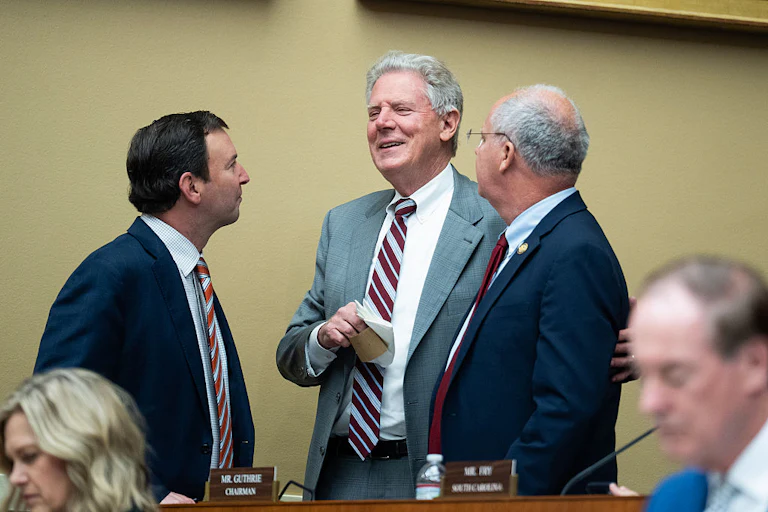
Frank Pallone Jr., Craig Goldman, and Brett Guthrie talk in a huddle while standing, with others' heads visible in the foreground.
Tom Williams/CQ-Roll Call Inc./Getty Images
Representatives Craig Goldman, Frank Pallone Jr., and Brett Guthrie

On Monday night, the House passed a weaker version of the Senate’s Kids Online Safety Act, or KOSA, aimed at regulating the tech industry and protecting children online. Whether this is a good thing or not depends on whom you ask.

House leaders have taken four years to reach a compromise on their own version of KOSA, which the Senate passed in 2022. The House version, called the Kids Internet and Digital Safety, or KIDS, Act, passed by 267–117 on Monday night.

Representative Frank Pallone Jr., the Democratic co-sponsor of the KIDS Act, lauded it as an example of bipartisan cooperation last week. “This agreement proves Congress can come together to deliver real online protections for our nation’s young people,” he said in a statement.

But Senate Democrats have suggested that they won’t advance the House version. “We’re not going to go with some weak standard,” said Senator Maria Cantwell on Friday. “We are going to go with a law that can be enforced and accountability, and we’re not going with a study, we’re going on with something that holds them accountable.”

Senator Richard Blumenthal, a co-sponsor of KOSA, even suggested that passing the weaker House version could give tech lobbyists ammunition to “exploit the kind of misunderstandings that can occur” between the two chambers and kill provisions they don’t like. “We need to stop this bill in the House and we need to prevent the White House from forming an alliance with Big Tech,” Blumenthal said.

Cantwell, Blumenthal, and their allies say the KIDS Act doesn’t include the strongest parts of KOSA, like the “duty of care” provision, which makes tech companies legally responsible for the well-being of children on their platforms, or the stipulation that KOSA doesn’t preempt states, allowing them to pass stricter measures in the future. The KIDS Act, on the other hand, includes federal preemption language that opponents say could harm states’ ability to enforce tech regulations themselves. In late May, 44 state attorneys general sent a letter to Congress opposing the KIDS Act on the grounds that it would preempt their legislative and legal efforts.

“This bill has no real duty of care. In other words, it has no standard to hold accountable the Big Tech companies that can drive addictive, toxic content through their algorithms and other technologies at children,” Blumenthal said in a press conference on Friday.

On Friday, nearly 100 digital- and kids-safety groups sent a letter to House leadership and the sponsors of the KIDS Act urging them to reject the bill on the grounds that it doesn’t go far enough to protect children from Big Tech. In addition to the “duty of care” issue, the authors noted that the KIDS Act drops the requirement that tech platforms offer a chronological feed rather than an algorithmic, engagement-maximizing one. The authors are also concerned that the KIDS Act defines social media platforms too narrowly, leaving out apps and websites like Roblox, which has exposed some children to sexual and financial exploitation.

But others think both acts are a bad idea—that the provisions in KOSA and KIDS, instead of protecting kids, could harm their ability to engage in free speech and access resources for mental health, addiction, and other social issues. Groups like the American Civil Liberties Union and GLAAD say that measures meant to protect kids could push tech platforms to set age limits and push younger children off of their websites, harming LGBTQ+ kids or others who are looking for community and resources online.

“Maybe by different routes, [the bills] accomplish the same objective,” said Aaron Mackey, the deputy legal director of the Electronic Frontier Foundation. “They’ve pushed online services to have legal obligations to police their content and exclude kids from vital places and space.”

Tech companies have pushed against both the House and Senate versions, but have spoken more favorably about the House bill. Zach Lilly, the director of government affairs for NetChoice, a tech industry group, said that the House bill “is a real effort to improve upon the disastrous censorship regime being championed in the Senate.”

After Monday’s House vote, it remains to be seen which bill will ultimately come out on top and head to the president’s desk—and whether the tech lobby will be able to exploit the rift between House and Senate.

A Michigan Dem Just Dropped an AI Plan Even Tougher Than Bernie’s

Abdul El-Sayed, a contender in the Democratic senatorial primary, says he’s not afraid of AI companies retaliating against him.

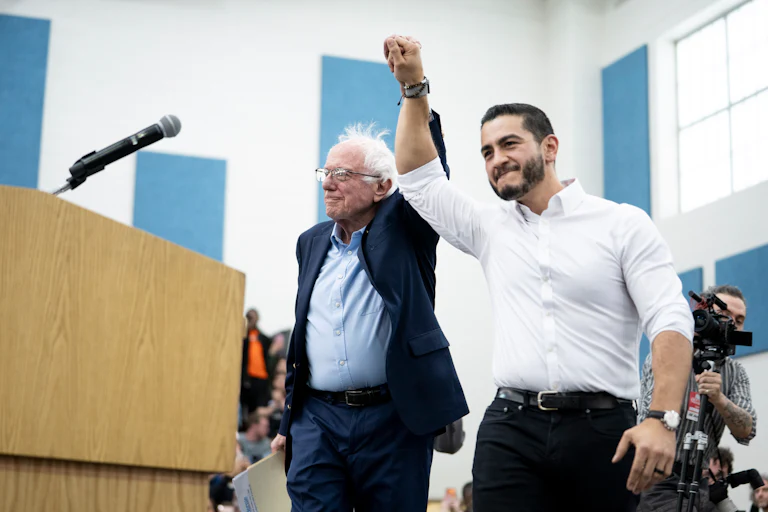
Bernie Sanders and Abdul El-Sayed hold hands in the air in a victorious gesture.
Sarah Rice/Getty Images
Senator Bernie Sanders and Senate candidate Abdul El-Sayed in Detroit, in May

Abdul El-Sayed, a primary candidate for U.S. Senate in Michigan, released an ambitious AI policy platform Monday, joining other progressives like Senator Bernie Sanders in a push for regulation and public ownership. But El-Sayed’s proposal also goes a step further: not just public ownership, but also public governance.

Earlier this month, an AI super PAC spent millions to ensure that Alex Bores, the author of a comparatively weak New York state AI accountability law, wouldn’t make it to Congress. El-Sayed’s proposed changes to the AI industry go far further than Bores’s legislation. When asked whether he was worried about industry political action committees targeting his campaign over his new proposals, El-Sayed shrugged it off. “I’m just not afraid of them or AIPAC or any of the others. What’s another hundred-million-dollar super PAC, I guess?”

El-Sayed’s policy proposal, which he shared exclusively with The New Republic ahead of its release, has three key components: democratic governance of AI, public ownership of AI companies, and safety requirements. His proposal takes inspiration from Sanders’s American AI Sovereign Wealth Fund bill, proposed earlier this month—and like Sanders’s bill, calls for the creation of a sovereign wealth fund to distribute AI companies’ cash into Americans’ pockets. Sanders envisions establishing that via a one-time 50 percent tax on the country’s biggest AI companies, generating an estimated $7 trillion for social safety net programs, plus a yearly dividend for Americans. El-Sayed proposes using that money to fund education and job training, increase unemployment benefits, and boost small business loans.

“I love the senator’s point that we need to own the outcomes of this, in part because it is our data and our knowledge that went into creating it,” El-Sayed said about Bernie’s proposal. They both reason that, since AI has been trained on human writing, research, and collective knowledge, it is a good that belongs to all Americans. “But I think the ownership part needs to go a step further, because we also need some control,” El-Sayed added.

To get that control, he proposes democratic governance of AI companies. He proposes that frontier AI labs be chartered as public benefit corporations, legally mandating them to balance public interest with profit margins. Additionally, he suggests that a majority of board seats at these companies should be democratically elected or publicly appointed, rather than selected by shareholders. And, importantly, he calls for major tech companies like Amazon, Microsoft, Google, and Meta to divest from frontier AI companies. El-Sayed also recommends the establishment of a Food and Drug Administration–style agency to evaluate models before they’re deployed, a ban on AI-generated political media, and requiring companies to work with the Centers for Disease Control and Prevention, National Institutes of Health, and Federal Emergency Management Agency to protect against biosecurity breaches.

El-Sayed’s breezy response to TNR’s question about possible industry retaliation—“What’s another hundred-million-dollar super PAC, I guess?”—references the unrelated money that the American Israel Public Affairs Committee, or AIPAC, has already spent on the race. Through United Democracy Project PAC, AIPAC has spent over $2 million to support one of El-Sayed’s opponents, Representative Haley Stevens, who is the Democratic establishment’s favored candidate. El-Sayed has repeatedly criticized both the Israeli government and AIPAC’s influence in politics. El-Sayed is also facing State Senator Mallory McMorrow, though polls suggest the race is largely between El-Sayed and Stevens.

McMorrow released an AI policy proposal last month that focuses on creating a professional apprenticeship program funded by a token tax, which would charge by the number of tokens used (tokens are the basic units of data that AI models use). Stevens has not released an AI policy plan.

Despite a broad consensus among voters that politicians should regulate the AI industry, few bills have actually been passed. Following AI industry super PACs’ massive spending to defeat Alex Bores in retaliation for the RAISE Act, some feared politicians might become even more reluctant to try.

El-Sayed is hopeful that American voters are ready to push back against money in politics. “We live in an era right now where people are really smart to the old system of money coming in to buy elections. They see the wool being pulled over their eyes and they don’t like it,” he said.

He also doesn’t think politicians have the luxury of time when it comes to regulating AI. “We need to act yesterday,” he said, “and at best, we can act tomorrow.”

What’s Going on With the Big Housing Bill, Exactly?

Here’s where things stand since Trump refused to sign it.

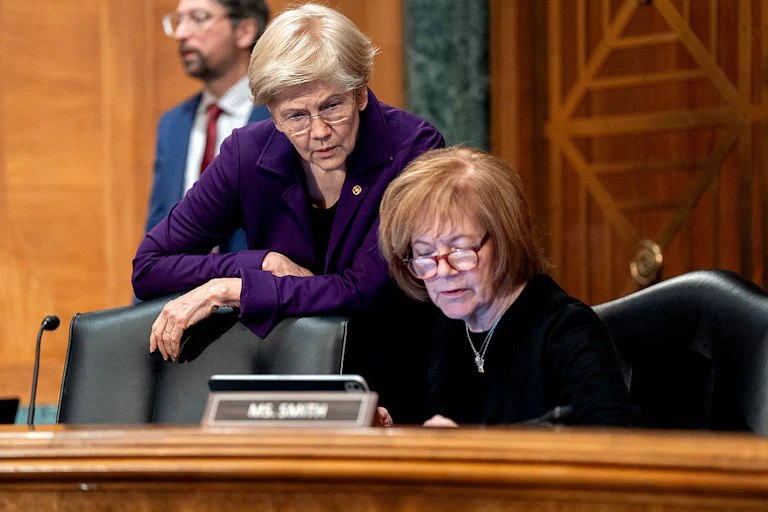
 Elizabeth Warren and Tina Smith
Kent Nishimura/Bloomberg/Getty Images
Senators Elizabeth Warren and Tina Smith

As President Trump holds a popular bipartisan bill hostage, Democrats say that the issue is out of their hands, and that the onus is on Republicans to stand up to the president and get the legislation signed.

On Wednesday Trump was set to sign the 21st Century ROAD to Housing Act, which had passed the Senate and House easily. On the Hill, Speaker Mike Johnson was preparing to tout the legislation. But by lunchtime, Trump had thrown a wrench into the works, announcing on Truth Social that he wouldn’t sign the bill into law until Congress passed the Safeguard American Voter Eligibility, or SAVE, America Act. That afternoon, Democrats held a press conference urging Trump to pass the bill. None of their Republican colleagues joined them.

“What a mess,” Senator Tina Smith said on Thursday.

The SAVE America Act would require voters to provide proof of citizenship when registering to vote and a photo ID when voting. Trump has claimed that the bill will prevent noncitizens from voting in elections (an illegal and incredibly rare phenomenon), while opponents of the bill say it would functionally disenfranchise citizens who don’t have passports or other eligible documentation. The bill passed the House in February, but has stalled indefinitely in the Senate and is widely viewed as unpassable. Senator Jon Ossoff called it a “poison pill” that sinks any legislation it’s attached to.

On Thursday, Democratic lawmakers emphasized that dealing with Trump is Republicans’ job.

“We have to just keep on pounding on the idea that you need to sign the damn bill,” Smith said. “I don’t have a lot of clout with the President, but I believe that Senator Scott does, and others who worked so hard to get this bill passed.” Republican Senator Tim Scott sponsored the bill alongside Senator Elizabeth Warren.

Reporting suggests that Johnson might be working on a solution. On Thursday afternoon, he headed to the White House to speak with Trump about the SAVE Act. “We passed the SAVE Act three times in the House. We’ll do it again. We’re working on that, and I’m going to talk with the president about these issues and how to get the agenda moving again. It’s going to be very productive,” Johnson said.

At least one Democrat, Representative Maxine Waters, the ranking member of the House Financial Services Committee, expressed hope that Johnson will find a work-around and get Trump to sign the housing bill: “Mr. Johnson has a bill, he has to get it to [Trump]. I think he’s going to get it to him, and that they’re going to work it out,” she said. “I’m very optimistic.”

There’s a clock ticking in the background. When a bill passes both houses, the president has 10 days to sign it before it automatically becomes law. The 10-day countdown only starts once Johnson officially presents the bill to Trump—which on Thursday evening he said he would do, but as of early Friday it was unclear whether he had actually done so yet.

Warren says that it’s up to Republicans to officially present the bill and start the clock. “There’s plenty that the Republicans in Congress could do if they have the backbone to,” she said.

But there’s also a second complicating factor. If both chambers aren’t in session when the 10 days expire, the bill is automatically pocket vetoed. It’s legally ambiguous whether the recess in early July counts as an adjournment and would trigger a pocket veto. If it does, the bill will be killed. Congress cannot override a pocket veto, and would have to reintroduce and revote on the legislation.

When asked if they thought a pocket veto was Trump’s ultimate goal, Warren and Smith had similar answers. “You’re asking me to get in Donald Trump’s head and figure this out. Sorry, that’s a crazy place,” Warren said.

“I am so not qualified to look into this man’s mind and understand what it is that he is trying to accomplish,” Smith said. “But what he did was sabotage a bill that was strongly supported by Democrats and Republicans in some sort of a fit, because he was mad about the War Powers Act and the Reflecting Pool, and the fact that Republicans don’t support his voter suppression bill.”

Hakeem Jeffries Downplays Socialist Wins. Others Aren’t So Sure.

Progressive analysts and politicians hope the New York primaries could be the start of something. They have some data to back that up.

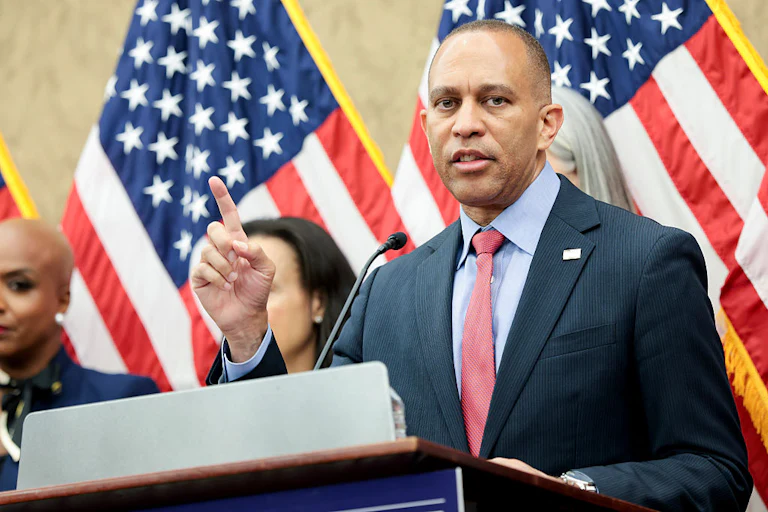
Hakeem Jeffries gesticulates while speaking at a lectern, with other people and American flags behind him.
Anna Moneymaker/Getty Images
Hakeem Jeffries

Some are calling it the Democratic Tea Party. While establishment Democrats are still downplaying Tuesday night’s primary wins by democratic socialists, progressives say that the New York victories of Claire Valdez, Brad Lander, and Darializa Avila Chevalier represent a new era in Democratic politics.

“I think this is a preview for the national Democratic Party,” said Usamah Andrabi, the communications director for Justice Democrats, a progressive group that endorsed Valdez in New York’s 7th district and Avila Chevalier in New York’s 13th. “Democratic leadership needs to wake up to the fact that they are clearly out of step with their most active, vocal, and energized base of voters.”

House Minority Leader Hakeem Jeffries, on the other hand, spent Wednesday trying to downplay the fact that candidates endorsed by democratic socialist New York City Mayor Zohran Mamdani beat the ones Jeffries had endorsed.

“The mayor and I agree to strongly disagree about some of his endorsements, and he’s got work to do in terms of the conversations that he’s going to have with members of Congress moving forward,” Jeffries told reporters on the Hill on Wednesday.

Jeffries backed incumbent Representatives Adriano Espaillat and Dan Goldman, who lost to Avila Chevalier and Lander, respectively.

The results are arguably personal for Jeffries: On Tuesday night, a group of DSA members chanted “You’re next,” threatening to run a socialist against him in 2028. In fact, the socialist organization almost challenged Jeffries this cycle, but Mamdani said that trying to unseat Jeffries would be a distraction from DSA’s “affordability agenda.”

When asked if he was concerned about being unseated in 2028, Jeffries said: “When you ask me a serious question, I’ll give you a serious answer.”

Representative Rashida Tlaib, a democratic socialist herself, told The New Republic that she’s looking forward to having new allies in Congress. “I welcome them, and I’m looking forward to working with them to get Medicare for All passed, to try to get clean water and clean air for our families,” she said. “I’m proud of them,” she added.

Other Democrats’ reactions might best be described as circumspect. Representative Ro Khanna, a progressive who didn’t endorse in the New York races, gave an optimistic, if vague, statement to The New Republic when asked about the results. “We need a bold progressive vision for 2026 and 2028 and a new deal for our time,” he wrote in a message.

The jury is still out on whether Tuesday’s results are isolated to New York or indicative of a broader shift in the Democratic Party. Progressive strategists are hoping it’s the latter.

“I think this meaningfully advances an entire progressive agenda,” said Andrabi, pointing to how the soon-to-be House members could push for Medicare for All and block military funding to Israel.

“New York City Democratic primaries are a specific thing in that New York DSA has an incredibly strong ground game, Zohran Mamdani is incredibly popular, and it’s a very blue area,” Ryan O’Donnell, the executive director of Data for Progress, admitted. “But I think there’s also a lot of things that can be extrapolated nationwide.”

O’Donnell cited Data for Progress polls that found that voters see candidates who don’t stand up to the American Israel Public Affairs Committee, or AIPAC, as untrustworthy on other issues and that democratic socialist policies like Mamdani’s have nationwide appeal.

He shared Andrabi’s optimism that these victories would push the direction of the party: “When you see victories as large as these, and when you grow your numbers in Congress, it tends to change parts of the party more broadly.”