The Democrats Face Another Divisive Vote on Military Aid to Israel

The House is expected to vote Wednesday on a measure that would cut off aid completely, and Minority Leader Hakeem Jeffries isn’t telling his caucus how to vote.

House Minority Leader Hakeem Jeffries and Reps. Jasmine Crockett, Greg Casar, and Al Green
Tom Williams/CQ-Roll Call, Inc/Getty Images
From left: House Minority Leader Hakeem Jeffries and Representatives Jasmine Crockett, Greg Casar, and Al Green at a news conference in 2025

A legislative amendment that would block U.S. security aid to Israel has split Democrats in Congress to such an extent that House Minority Leader Hakeem Jeffries has decided not to urge his party to oppose it. Instead, he told Democrats to vote their conscience, setting up an opportunity for lawmakers to go on the record about their views. Some are already doing so.

“The Democratic Party as a whole needs to shift its policy on Israel and Palestine,” Representative Greg Casar, the chair of the Congressional Progressive Caucus, told me. “I think that was clear during the last presidential election. I think it’s clear to me as a moral issue. And I think that [Wednesday’s] vote could be one step towards us beginning to shift our position as a party.”

The amendment in question, brought by GOP Representative Thomas Massie, would cut $3.3 billion in security assistance that the U.S. has pledged to Israel between 2019 and 2028 and further stipulates that “none of the funds made available under this Act shall be obligated or expended for Israel.” Lawmakers are expected to vote Wednesday on the amendment, which Massie is hoping to attach to a $47 billion foreign affairs spending bill.

On Tuesday, Jeffries wrote in a “Dear Colleagues” letter that he was planning to vote against the amendment but had decided not to whip the caucus into joining him, underscoring how divided the Democrats have become on the question of America’s relationship with Israel.

In his letter, Jeffries wrote that he opposes the amendment because it is “overly broad,” prohibiting the use of funds for nonmilitary activities like U.S. embassy operations and humanitarian aid. He also expressed concern that Republicans will “weaponize” the amendment against Democrats—a potential reference to Republicans accusing Democrats of antisemitism for opposing aid to Israel.

Even though Jeffries will vote against the amendment, his letter calls for a “change in direction,” signaling how much Democrats have changed their views toward aid for Israel. “Israel has an advanced economy and is capable of paying for its own sophisticated weapons,” he wrote. Future security agreements between the two countries, he wrote, should “strictly adhere to our human rights laws and values.”

Representative Ocasio Cortez, who plans to vote “yes” on the amendment, told me that she thinks Jeffries’s decision not to whip “no” votes provides “flexibility” for Democrats to vote their conscience.

Jeffries’s letter mirrors the advice given by J Street, the liberal Zionist advocacy organization. In a statement on Tuesday, J Street President Jeremy Ben-Ami wrote that the amendment is “poorly drafted, overly broad and being used by Republican leadership to divide Democrats rather than advance a serious debate about US policy.” Despite that, Ben-Ami wrote, the organization supports whatever votes members choose to cast. Some Democrats will likely vote “present” to avoid a hard “yes” or “no” vote, a decision J Street says it supports.

Casar weighed in on the amendment in his own letter, explaining why he plans to vote for the amendment and encouraging the caucus to do the same. “The Democratic Party needs a new approach to Israel and Palestine,” Casar wrote. “I hope you will join me in beginning that process by voting yes on this amendment.”

Casar said that winning over Democrats who have previously supported aid to Israel will be critical to the amendment’s passage. “For us to achieve the goal of restricting military aid to the Israeli military, we have to have members that previously voted for aid, and I expect that you’ll see that if we have the vote,” he told me.

Though elected Democrats are divided on the issue, the party faithful’s views are clearer. According to a New York Times/Siena poll from May, 74 percent of potential Democratic voters oppose “providing additional economic and military support to Israel.” Just 20 percent support it.

Despite this, the Massie amendment is still expected to fail, as nearly all Republicans are expected to vote against it.


She Wants to Win Lindsey Graham’s Senate Seat—and Impeach RFK Jr.

After Graham’s death, Democratic pediatrician Annie Andrews doesn’t know whom she’ll be running against this fall. So she’s focusing on her message.

Dr. Annie Andrews during a debate with Rep. Nancy Mace
Brad Nettles/The Post And Courier/AP, File
Annie Andrews during a debate with Representative Nancy Mace in 2022

Senator Lindsey Graham’s death on Saturday shocked Washington, D.C. It also upended the race for Senate in South Carolina, where the longtime incumbent was facing a Democratic challenger in Dr. Annie Andrews, a 45-year-old pediatrician. Now Andrews doesn’t know whom she’ll face in November, but she still knows exactly why she’s running. She wants to help fix the health care system—and to start by getting rid of Robert F. Kennedy Jr., the anti-vaxxer in charge of Health and Human Services. 

“The day that RFK Jr. was nominated to lead HHS was the day that I really seriously started considering running for this seat,” she told me on Monday. “RFK Jr. has been my professional archnemesis for decades, and there are thousands of pediatricians across the country who would say the same thing.”

Andrews was born in Kentucky and raised in Indiana before moving to South Carolina in 2009 to work at MUSC Children’s Hospital in Charleston. But she didn’t get involved in politics until the Parkland school shooting in 2018 moved her to join Moms Demand Action, the gun violence prevention group. In 2022, she challenged House Representative Nancy Mace but lost by 14 points.

Her race against Graham was looking to be closer. A November poll had Graham up six points, and the margin was only three in a poll last month. Now it’s unclear who her Republican opponent will be. The state GOP will hold a primary on August 11, with a runoff on August 25 if no candidate reaches 50 percent of the vote. 

Andrews says she plans to run a positive campaign focused on the issues she cares about. “I’m thinking about how we move forward as a state together, how we can get past this hyperpartisan, divisive moment and era, frankly, of American politics,” she said. “I don’t want to be a career politician. I see politics as a path to efficiently and effectively solve my patients’ and their families’ problems.”

Andrews said that when she started her career as a pediatrician, it was a given that her patients were fully vaccinated. In recent years, she has had to brace herself when asking parents about their child’s vaccination status. She pointed to the April 2025 measles outbreak of nearly 1,000 cases in South Carolina as one example of how the Trump administration has harmed children.

“South Carolina is a state that never expanded Medicaid. We have 15 counties without an ob-gyn, we have multiple rural hospitals on the chopping block because of the impending Medicaid budget cuts. We have federally qualified health centers that have already closed their doors. So no matter where I am across the state, that issue comes up in every conversation I’m having with voters,” she said.

Andrews argues that she’s the right candidate for a moment when health care access and affordability are top of mind for South Carolinians. “You cannot fight bad politics by staying apolitical. So the only way to fight back against the politicization of pediatric health care and health care as a whole in this country is by engaging in politics on the other side,” she said. Andrews says she wants to lower the cost of prescription drugs, get private equity out of health care, and impeach RFK Jr.

In recent years, a number of Democratic physicians have decided to run for office, and many of them have origin stories that echo Andrews’s. In Michigan, public health professional Abdul El-Sayed has made Medicare for All a crucial part of his policy platform. Adam Hamawy, who won his primary in New Jersey’s 12th congressional district, is a former combat surgeon who saved Senator Tammy Duckworth’s life and treated patients in Gaza.

Andrews attributes her strong polling numbers to her political identity as a no-nonsense medical professional. She’s trying to stay away from tensions in the Democratic Party between the progressive and centrist wings. “I don’t identify on any particular part of the political ideological spectrum because to me it’s about naming the problem and solving the problem, and it’s about being pragmatic about it,” she said. “Regardless of who my opponent is, there’s something about me and our campaign and my candidacy that is breaking through those typical partisan voting patterns.”

Now she’s looking ahead and doesn’t seem too troubled by whoever her opponent will be. Among the names being floated are  Lieutenant Governor Pamela Evette, Representative Ralph Norman, and Graham’s most recent primary challenger, Mark Lynch. Mace, who sparred with Andrews during the 2022 election, has also expressed interest in running.

“Nancy Mace likes to make news cycles about her, and I wouldn’t at all be surprised if she does end up getting in this race, despite the fact that she just came in fifth in the Republican gubernatorial primary here in South Carolina just a little over a month ago,” Andrews said. “I’m sure there’s a lot of folks here in the Low Country who would be intrigued to see a rematch of me and Nancy Mace.”

The Race to Replace Graham Platner Is Heating Up

Maine Democrats plan to stage a nominating convention to select their Senate nominee. They’ve already got a lot of options.

Former State Senator Troy Jackson, who once campaigned alongside Graham Platner, is one of several Democrats now vying to replace Platner as Senate nominee.
Sophie Park/Getty Images
Former state Senator Troy Jackson, who once campaigned alongside Graham Platner, is one of several Democrats now vying to replace Platner as Senate nominee.

With Graham Platner bowing out of the race for U.S. Senate in Maine following allegations that he raped his former partner, the scramble to replace him is well underway—and the field of possible alternatives is starting to get considerably crowded.

Since the allegations that essentially ended Platner’s campaign came out, on Monday, the Maine Democratic Party has been constructing a plan to select another candidate. The party has landed on hosting a nominating convention, which will include 500 delegates elected proportionally by county committees and a preexisting 100-person state committee. Together, those 600 delegates will decide which of the many potential Platner replacements will face Republican Senator Susan Collins in November. They have until July 27 to officially nominate Platner’s opponent. (The convention has not yet been scheduled.) Meanwhile, Platner still has business to attend to—he has until Monday at 5 p.m. to officially withdraw his name from the ballot.

The delegates will have a wide field of candidates to choose from—so far, seven have declared their candidacy. To be eligible for nomination, candidates must garner 500 signatures, a potential barrier to entry for some of the lesser-known candidates.

Broadly speaking, the candidates who have announced their desire to run have been emphasizing their progressive and working-class credentials in an effort to hew as close as possible to the policy platform that lifted Platner to his primary victory, while distancing themselves from his scandals.

Still, there are distinctions to be made among the would-be players in this burgeoning field. Here is an early guide to who the seven candidates currently vying to take on Collins are—and where they stand on some critical policy questions.

Troy Jackson: Jackson’s name was one of the first floated after the allegations against Platner came to light. An anonymous memo circulated among some progressive strategists emphasized “his authentic working class bonafides” and said that his “anti-establishment message [contrasts] effectively against Collins as a swamp creature.” Jackson is a fifth-generation logger from Allagash and the former president of the Maine Senate.

Recently, Jackson came in third place in the state’s Democratic gubernatorial primary. In that race, he was endorsed by Senator Bernie Sanders. Before running for governor, he served in the Maine state Senate from 2008 to 2014 and again from 2016 to 2024.

Jackson supports Medicare for All, has called Israel’s actions in Gaza a genocide, and says he’ll never vote in favor of taxpayer-funded aid to Israel. In recent days, he has been endorsed by Representative Ro Khanna and the Maine AFL-CIO.

Nirav Shah: Shah is another 2026 gubernatorial candidate. He garnered the highest number of votes but ultimately lost the primary to Hannah Pingree due to ranked-choice voting.

Shah is a public health official who served as director of the Maine Center for Disease Control and Prevention from 2019 to 2023 and the principal deputy director of the U.S. Centers for Disease Control and Prevention from 2023 until 2025.

“The other thing that voters in Maine are clearly looking for is someone who is an outsider. I come to this race not having been part of the political establishment in Maine or indeed even in the United States,” Shah said in a CNN interview.

Before serving in Maine and at the CDC, Shah was director of the Illinois Department of Public Health. During his tenure, an outbreak of Legionnaires’ disease killed 13 people. This has recently come back to haunt him: When Shah announced his bid to replace Platner, Senator Tammy Duckworth wrote in a post on X that she “strongly [opposes]” his run for Senate due to his handling of the outbreak.

Shah supports Medicare for All, says that ICE “in its current form” cannot continue, and has described Israel’s actions in Gaza as a genocide.

In a poll released Thursday, Shah showed the best chance of beating Collins in November, though the poll had him winning by just one point.

Shenna Bellows: Bellows came fourth in this year’s gubernatorial primary. She is currently Maine’s secretary of state. She has run for Senate before—in 2014, she went head-to-head with Susan Collins and lost in a landslide, notching only 32 percent of the vote against Collins’s 68 percent share. This was a wipeout: Collins carried every county in the state. Before entering politics, Bellows served as the executive director of the American Civil Liberties Union of Maine from 2005 to 2013.

Bellows has scrubbed the policy pages of her gubernatorial campaign website, but has explained some of her policy positions in interviews during her run for governor. She proposed creating a Maine Housing Corps to increase the supply of housing in the state, and suggested that Maine “work toward universal, single payer healthcare.” In an X post announcing her run for Senate, Bellows said she supports Medicare for All.

Jordan Wood: Wood ran for the House seat in Maine’s second congressional district this year, garnering just shy of 29 percent of the vote. Wood was former Representative Katie Porter’s chief of staff and vice president of End Citizens United, a group that seeks to end the influence of money in politics.

Like most of the other candidates, Wood supports Medicare for All and believes that Israel is committing a genocide, and that any U.S. aid to the country must come with conditions. In an interview with The New Republic, Wood also emphasized his support for universal childcare, said that the Senate needs new leadership, and said that the Senate should get rid of the filibuster.

He expressed concern that the other candidates for the Senate seat haven’t yet explained their views on national policy: “I don’t have any idea what they think of future leadership. I don’t know what they think about the filibuster. You wouldn’t ask those questions at a debate for the governor’s race,” he said.

Dan Kleban: Kleban is the co-founder of Maine Beer Company in Freeport. He ran for Senate in late 2025, but dropped out of the race to support Governor Janet Mills just one month later.

In a Substack post announcing his candidacy on Wednesday, Kleban emphasized his status as a political outsider but didn’t share any policy proposals. “I’ve spent years talking to Mainers over a beer in our taproom and throughout the community. We’re all sick and tired of a system that’s been rigged by corporate interests, and we’ve had enough meddling from Washington establishment insiders and New York City consultants trying to dictate who represents us,” he wrote.

Paige Loud: Loud is a social worker who, like Wood, ran for the House seat in the second district. She received 10 percent of the vote. Loud has a progressive platform that emphasizes health care and food security. She supports Medicare for All, raising and tying the minimum wage to inflation, and eliminating the Social Security income cap. She has called for an end to the genocide in Gaza and for a block on all U.S. weapons transfers to Israel.

David Costello: Costello ran in the Democratic primary for Senate and received 8 percent of the vote (Platner received 72 percent).

Costello shared a list of his policy priorities with The New Republic. They include Medicare for All, universal childcare, an elimination of the payroll tax cap, judicial and legislative term limits, and a ban on gerrymandering (among other proposals).

He’s also called for an “end to presidential wars of choice and holding allies and foes accountable for war crimes, crimes against humanity, genocide, and other human rights violations.”

In an email, Costello emphasized his experience in government, having served as an aide to Maine’s secretary of state, the mayor of Baltimore, and the governor of Maryland.

Poll: Swing Voters Want Progressive Populism

A new Data for Progress survey found that Medicare for All, regulating AI, and taxing the rich were the top issues that would convince these undecided voters to back Democrats this fall.

A protester holds a sign that reads, ''Texas Proud: Medicare for y'all''
Reginald Mathalone/NurPhoto/Getty Images

A new report from Data for Progress spells good news for Democrats—particularly those running on a message of economic populism. DFP surveyed 447 swing voters between May 15 and June 21 and found that they favor Democrats over Republicans on the generic congressional ballot by a 12-point margin, though the plurality of swing voters (46 percent) are unsure which party they prefer.

What were the top issues that would move swing voters to vote for a Democrat? Raising taxes on the wealthy, instituting Medicare for All, and banning artificial intelligence from using personal data to set wages or prices. Economic issues like these have been embraced by progressive candidates, such as Abdul El-Sayed in Michigan, Randy Villegas in California, and Sam Forstag in Montana. Villegas and Forstag both won their House primaries against opponents who ran to the center, and El-Sayed’s Senate primary against an establishment centrist will be held on August 4.

“I think the big takeaway from this report is that swing voters who could decide the midterms are not asking Democrats to sound more like Republicans,” said Ryan O’Donnell, DFP’s executive director.

DFP ran a similar survey in 2024. At that time, swing voters tended to be younger and more racially diverse. Today, DFP found that there aren’t significant demographic differences between swing voters and other likely voters. Despite the change in demographics, economic issues have consistently remained a top priority for swing voters. “Even though the electorate’s changed, the fact that their focus on economic populism has stayed so consistent is something to consider,” O’Donnell said.

Other findings in the report support that notion. DFP asked respondents what issues they consider most when deciding which candidates to vote for. The top three issues were “economy, jobs, and the cost of living,” which 38 percent of respondents selected; “programs like Social Security and Medicare,” which 17 percent selected; and “health care,” which came in at 6 percent. So-called culture-war issues ranked far lower: Only around 3 percent of respondents selected “LGBTQ+ issues” as their top priority, and around 1 percent selected “race relations and racism.” Notably, “immigration” was the third-highest issue in 2024 but has fallen to twelfth in this year’s survey.

Swing voters also shared what they find most concerning about the Democratic Party, and the results echo what many progressive members of the party have been saying for years: 32 percent of respondents said that “leadership is too old and out of touch,” and another 32 percent said that the party is “not doing enough to lower costs.”

Some economic populists have rejected the Democratic Party brand and are running instead as independents, like Senate candidate Dan Osborn in Nebraska. “He’s doing a great job at pushing that message in Nebraska,” O’Donnell said. “Swing voters in general largely reject partisan and ideological labels, so it reflects that, as well.”

Overall, the poll helps dispel the popular wisdom that running a conservative, centrist campaign is the best way to get the support of those in the middle. “If I were a Democratic leader reading this, I would say that these results indicate that taking a more conservative stance is not the way to win over the voters you need to win,” he said.

Who Benefits From Mallory McMorrow’s Exit in the Michigan Senate Race?

It’s now a two-way contest between progressive Abdul El-Sayed and centrist Haley Stevens.

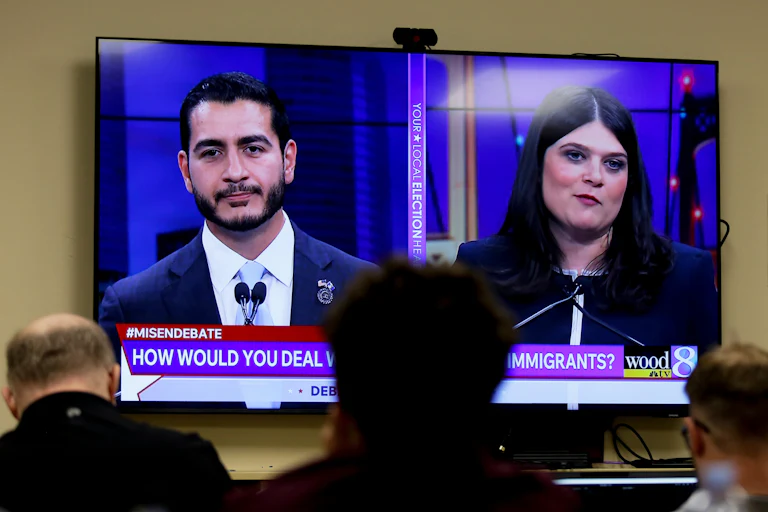
Michigan U.S. Senate candidates Abdul El-Sayed and Rep. Haley Stevens during a debate on Tuesday night
AP Photo/Kristen Norman
Michigan U.S. Senate candidates Abdul El-Sayed and Representative Haley Stevens during a debate on Tuesday night

In Michigan’s Democratic race for U.S. Senate, state Senator Mallory McMorrow was caught in the middle of—and ultimately squeezed out by—centrist Haley Stevens and progressive populist Abdul El-Sayed. Now, with McMorrow having suspended her campaign on Sunday, Stevens and El-Sayed are both vying for her supporters ahead of the August 4 primary—a head-to-head contest that reflects the growing division between the party establishment and the left. “The battle for the Democratic Party that we see nationally has come to Michigan,” said David Dulio, a professor of political science at Oakland University.

So far, McMorrow has not endorsed either candidate for the seat. One Michigan political organizer shared a text conversation with The New Republic in which McMorrow confirmed she had no plans to endorse. Kelly Neumann, the former financial co-chair of McMorrow’s campaign, has the same impression. “I think she wants the people to make their own decision,” she said about McMorrow’s plans. “I think everybody knows in their heart where, where she would vote,” Neumann added. McMorrow didn’t respond to an inquiry.

“Whoever wins this primary on August 4th will have my full support,” McMorrow wrote in a statement on X announcing her withdrawal from the race.

El-Sayed, a former state public health official and TNR contributor in 2021–22, is running on a platform that includes Medicare for All and getting corporate PAC money out of politics. He’s picked up a number of progressive endorsements, including the likes of Senator Bernie Sanders, Representative Alexandria Ocasio-Cortez, and the United Auto Workers.

Stevens is backed by Senate Minority Leader Chuck Schumer, Speaker Emerita Nancy Pelosi, and the EMILY’s List PAC, which endorses pro-choice women running for office. She’s focused on her legislative experience, having been a member of the U.S. House of Representatives since 2018.

In a debate between the two on Tuesday night, they pushed each other on the role of money in politics. El-Sayed asked Stevens about the money her campaign has received from AIPAC, while Stevens pushed El-Sayed to release his tax returns. The two also sparred over energy costs. Both bemoaned that Michiganders have experienced power outages and high utility bills, but El-Sayed pointed out that Stevens has received tens of thousands of dollars in campaign contributions from Detroit Edison, the major utility company in southeastern Michigan; its PAC contributed $35,000 to Stevens’s campaigns for House, as well as $10,000 to a PAC associated with her.

In their closing statements, they made their priorities clear. El-Sayed hammered on his economic populist message. “We need to take on oligopolies and billionaires,” he said. “We need to guarantee health care through Medicare for All.” He invited people to join his campaign, saying, “It’s the many versus the money.” Stevens made the pitch that she’s the right candidate to take down Republican Senator Mike Rogers in the general election: “I am fed up and fired up. Let’s go beat Mike Rogers, send him back to Florida a second time, and make sure that Michigan shines at the lawmaking table.”

El-Sayed is hoping for a windfall of McMorrow supporters, writing on Sunday: “I welcome her supporters to our movement to stand up against money in politics, to put money back in pockets, and pass Medicare for All.”

In a statement, Stevens praised McMorrow but didn’t explicitly ask McMorrow’s supporters to join her campaign. “Anyone who raises their hand to serve the people of Michigan and puts forward thoughtful ideas for how they would lead earns my respect,” she wrote. Caitlin Legacki, a spokesperson for her campaign, told me, “Now that it’s a two-person race, we have a chance to really go out and consolidate Haley’s voters, which includes Mallory’s remaining supporters who we’re all working really hard to try and woo.”

Some Michiganders say that, anecdotally, McMorrow’s decision to drop out of the race has been a boon for El-Sayed. “We’re getting a lot of new Mallory people coming to the group,” said Wanda Hammoud, the board chair for One Fair Wage Action, about a pro-El-Sayed Facebook group she started. The group has over 21,000 members, and Hammoud said it jumped by 2,000 in just one day this week.

“I’ve been pretty much an establishment Democrat, quite honestly,” said Neumann. Despite that, she said, “right off the bat, I knew immediately when I received the news that [McMorrow] was going to suspend her campaign that I was going to go to Abdul El-Sayed. I just knew that’s where I had to go. I’m looking for change.” (Neumann and the Stevens campaign sparred earlier this year when an old, controversial social-media post of Neumann’s resurfaced. Neumann blamed the Stevens campaign for publicizing the post to hurt McMorrow’s campaign.)

El-Sayed has led in most polls since April. Most recently, a late-June Quantus Insights poll surveyed 433 likely voters and found 41 percent supporting El-Sayed, 36 percent supporting Stevens, 8 percent supporting McMorrow, and 16 percent undecided.

“If endorsements from this point pretty much break equally, the tie goes to Abdul, because he was already leading in the polls,” said Adam Green, co-founder of the Progressive Change Campaign Committee. “He just needs to keep the dynamics the way they were.”

Since McMorrow dropped out, El-Sayed has received endorsements from Representative Analilia Mejia, Michigan state Senator Stephanie Chang, and Representative Maxwell Frost. On the day McMorrow left the race, Stevens received an endorsement from Attorney General Dana Nessel. Green expects more endorsements to come this week. He specifically has his eyes on Senator Elizabeth Warren, who endorsed McMorrow, and Jewish politicians like Andy Levin, who Green says could help draw Jewish voters to El-Sayed. Stevens, backed by the American Israel Public Affairs Committee, has called herself a “proud pro-Israel Democrat.” Meanwhile, El-Sayed is critical of Israel’s government and outspoken about the genocide in Gaza.

If Warren endorses El-Sayed, Green said, “that would be a very high-profile, newsworthy signifier that McMorrow world is going Abdul’s direction.”