Life in a Warming World
A weekly reckoning with our heated planet—and the fight to save it

How Kids Pulled Off a Climate Sneak Attack in Montana

Montana wasn’t prepared to face climate science on trial.

The Washington Post/Getty
Grace Gibson-Snyder, one of the 16 youth plaintiffs in Held v. Montana

Chris Dorrington has been the director of the Montana Department of Environmental Quality since January 2021. In an age when wildfires are chewing up the West and searing heat is toppling records across the country, a top environmental official like Dorrington should be at least somewhat familiar with major groups working on climate—including the U.N.’s Intergovernmental Panel on Climate Change, or IPCC, the world’s leading body on climate science and projections. 

But Dorrington had never heard of the IPCC until a climate lawsuit against his state by a group of young people went to trial in June. The IPCC was such an unfamiliar term to Dorrington, in fact, that he kept messing up the acronym during his testimony. In a later cross-examination, the state asked for IPCC reports to be dismissed as “hearsay.”

Last week, the judge in Held v. Montana handed down a victory for the 16 young plaintiffs, who argued that the state’s continued production of fossil fuels violated their constitutional rights. Advocates say the landmark ruling could have broad ramifications for future climate litigation. But it’s also clear that Montana was woefully unprepared to face climate science on trial.

Part of the reason this case was so unique—and one of the reasons that its outcome is so extraordinary—is that it’s the first climate case brought by young people to go to trial, and one of the rare times that a case concerning climate has actually had its day in court. That’s partially by design, says Karen Sokol, a professor at Loyola University New Orleans College of Law. Polluters, and the states that sympathize with them, have developed a heretofore reliable strategy to stop climate litigation: Get cases thrown out before they even go to trial.

 “The defendants, whether they’re governments, like in this case with Montana, or private actors like fossil fuel companies—they really seem to think that they’re going to be able to get these cases dismissed on procedural grounds,” Sokol said. “There’s an overarching message that climate doesn’t belong in the courts.”

The Montana case followed this pattern. The initial suit was filed in early 2020, and the defense team—representing the state, Governor Greg Gianforte, and several state agencies—filed a number of petitions and motions over the next few years to try and gum up the process. By the time the trial began, the defense had twice attempted, and failed, to get the state Supreme Court involved to stop the trial. 

Given how long Montana had to prepare, its argument in June was pretty pathetic. The state only put three people on the stand, including Dorrington, a paltry showing compared to the 21 witnesses provided by the plaintiffs. A fourth state witness—Dr. Judith Curry, a former professor at the School of Earth and Atmospheric Sciences at the Georgia Institute of Technology and a frequent critic of climate science—pulled out of the trial at the last minute. 

According to Curry, who published a blog post that she calls her “post-trial statement,” the state changed legal teams at least twice in the past year. Their original witnesses, whom Curry was brought on as part of a team to replace, were “pretty subpar.” During the trial, the state’s lawyers, Curry wrote, showed they were “totally unprepared for direct and cross examination of climate science witnesses.” Curry claims she withdrew her own testimony out of concern for how the defense’s lawyers, not the plaintiffs’, would handle her questioning. 

It’s not unreasonable, Sokol told me, to assume that fossil fuel sympathizers are taking notes about what happened here. In addition to the various kids’ cases, which tend to be filed against governing bodies, there are around two dozen lawsuits brought by cities, states, and counties against multiple private oil companies, which are working their way through various courts. The industry has long shared tactics to fight lawsuits; given the close relationship between some states’ attorneys general and oil and gas interests, it wouldn’t be surprising if those strategies are also making their way into state legal briefs. In the future, Sokol said, defense teams may be better prepared for an actual trial, putting on the stand deniers and skeptics like Curry who are well versed in casting doubt on climate science—and who actually know what the IPCC is.

Still, even if oil companies and their allies are taking careful notes from Montana’s flop, it might not make much difference. 

“What the defendants are realizing, and are going to have to come to terms with, is that climate in the courts is no longer exceptional,” she said. “It’s going to become increasingly ordinary because that’s our reality. Courts deal with facts and reality. It’s going to become harder and harder to stop that from happening.”

And while it’s one thing for a climate skeptic to use rhetorical arguments to undermine science in a podcast interview or an appearance on Fox News, it’s quite another to try those strategies in a court of law, where evidentiary standards are much higher and cross-examination much more aggressive.

“That’s why defendants have been willing to go years and spend an incredible amount of money to keep [these cases] from getting to the merits,” Sokol said. “The information landscape has been in their control. The courtroom is designed to find the truth.”

Good News, Bad News

Ecuadorians voted Monday to stop oil drilling in Yasuní National Park, an incredibly diverse region in the Amazon that’s also home to some of the world’s last uncontacted Indigenous groups.

About 850 people are still missing, nearly two weeks after a wildfire devastated the town of Lahaina in Maui, Hawaii.  

Stat of the Week

That’s how long it’s been since a tropical storm like Hilary has hit California. Factors including warmer than usual waters in the Gulf of Mexico led to this week’s historic storm. 

Elsewhere in the Ecosystem

The tragedy in Hawaii this month was one that people living in Lahaina have been afraid could happen for years, Grist reports

[David] jumped in a car with a panicked driver who drove the wrong direction, straight into the flames, where she got stuck in back-to-back traffic along the highway. David clutched the door handle to get out but it was so hot that it burned his fingers. The flames were 60 feet high and five feet away on either side of them. The cars in front of them were on fire. He yelled that they should run but he was the only one in the car who jumped out. Everyone else was frozen. He threw open the door and ran until the flames were far behind.

In the days since, he hasn’t been able to stay still. Every day he cries and keeps moving, sleeping along the road, by the park, at a friend’s and in a shelter. He can’t stop thinking about what he saw and questioning if he could’ve done more.

No one he was with that day survived—not his roommates, none of the other passengers in the car, not even the dog with whom he had been sleeping before waking up to a literal nightmare.

Read Anita Hofschneider’s full piece at Grist.

This article first appeared in Life in a Warming World, a weekly TNR newsletter authored by contributing deputy editor Molly Taft. Sign up here.

Should Climate Protesters Be Less Annoying?

Activists interrupted a pro tennis tournament in Washington, D.C., last week—and reignited a debate about how best to wage the climate fight.

Just Stop Oil protesters throw soup on at Vincent van Gogh’s “Sunflowers.”
Anadolu Agency/Getty
Just Stop Oil protesters throw soup on Vincent van Gogh’s “Sunflowers.”

American tennis pro Taylor Fritz beat Andy Murray at the D.C. Open in Washington last Friday. But he was not in a celebratory mood after the match, which had been interrupted by climate protesters who unfurled banners, shouted slogans, and threw oversize tennis balls decorated with flames onto the court.  

“It’s ruining everyone’s time,” Fritz told The Guardian. “Everyone wants to watch the tennis. I jokingly said, ‘Honestly, this makes me want to go fly on jets more.’ I think they’re supporting a good cause, but the way they’re doing it.… Who’s going to want to listen when they’re just annoying everybody?” Fritz’s feelings seem to have been pretty representative: Fans booed the protesters and then cheered their ejection from the stadium. 

The theatricality of the protest reminded me of last year’s Vincent van Gogh debacle. In October, climate activists made worldwide headlines for throwing soup and other foods on famous paintings in museums, including van Gogh’s Sunflowers. The demonstrations were, literally and figuratively, splashy, and generated a debate about whether these types of protests are productive. That debate—which threatens to overshadow the problem the protesters are trying to draw attention to—was revived again after the D.C. Open disruption. There’s a sense from many pundits that extreme climate activists are losing out on public support for their cause by being, well, really annoying.

The idea that the climate movement is reacting with too much panic is one that’s baked into a lot of mainstream coverage these days. Center-right thinkers like Matt Yglesias have repeatedly critiqued left-wing climate activists for “losing the plot.” A  Reuters columnist called Greta Thunberg’s critique of the 2021 U.N. climate summit “bad vibes” and “overblown.” (At that summit, fossil fuel interests were ultimately able to hijack the global agreement and leave room for the industry to continue to flourish.) Even climate scientist Michael Mann, who has devoted much of his career to effectively communicating the climate crisis, wrote a lengthy piece for Time on why the art protests were a bad idea and why protesters should “[choose] sensible actions and appropriate targets.” 

There’s little that individual people can do to stem the tide of the climate crisis. Government action, especially in the United States, is inexcusably slow. Meanwhile, we’re living through the hottest summer in Earth’s history. It’s not surprising, then, that climate protesters—the ones who are actually doing things—become the subject of our discussions. Instead of real conversations about the massive systemic changes that are needed to save our planet, we turn over endless debates around how people are expressing their fear and rage. Calm down, columnists like Yglesias seem to say. This is not how change is made.  

I’m actually not sure what would be defined as an appropriate or effective protest to an increasingly urgent global emergency, or what, exactly, would be the magic action that will change more hearts and minds. At this point, people have literally set themselves on fire to draw attention to the climate crisis; high schoolers have staged hunger strikes and gone to the hospital. The powers that be have responded to these actions with, largely, a yawn. Meanwhile, activists who turn to actual tangible tactics to destroy fossil fuel infrastructure—like blowing up pipelines—have been targeted and jailed with draconian sentences. Fossil fuel–friendly states have moved lightning fast to adopt legislation to define these people as terrorists and make sure this never happens again. 

What is the right way to protest climate inaction? I’m not sure the goal should be to engender public sympathy, anyway. If activists only demonstrated in ways that mannerist pundits consider appropriate, they’d be meekly waving signs outside the Environmental Protection Agency. 

Living through a time of continual ecological panic, when we can do little as individuals to change what’s happening, is an extremely mentally weird place to be, and we’re all still learning how to handle ourselves. If I was in that stadium last Friday, I’m sure that I would have been miffed too, wishing the protesters would go away so I could enjoy the match after a long day. But in a big-picture sense, I’m glad people were annoyed. At least they’re feeling something.

Good News, Bad News

Following a breakthrough last December, scientists this week repeated a nuclear fusion reaction that produced more energy than was put into it—a major development for fusion technology.

Florida’s Department of Education has officially approved materials from a right-wing video production company for public schools, meaning that climate denial videos could soon be shown in state classrooms.

Stat of the Week

That’s how much of the world’s population experienced hotter than usual temperatures in July, a new analysis finds.

Elsewhere in the Ecosystem

The EPA approved a boat fuel that is so toxic that every person who is exposed to it over an extended period of time is at risk of developing cancer, ProPublica reports:

Federal law requires the EPA to conduct safety reviews before allowing new chemical products onto the market. If the agency finds that a substance causes unreasonable risk to health or the environment, the EPA is not allowed to approve it without first finding ways to reduce that risk.

But the agency did not do that in this case. Instead, the EPA decided its scientists were overstating the risks and gave Chevron the go-ahead to make the new boat fuel ingredient at its refinery in Pascagoula, Mississippi. Though the substance can poison air and contaminate water, EPA officials mandated no remedies other than requiring workers to wear gloves, records show.

ProPublica | Sharon Lerner

This article first appeared in Life in a Warming World, a weekly TNR newsletter authored by contributing deputy editor Molly Taft. Sign up here.

What Boiling Oceans Will Do to Life on Land

“We knew this would happen, but the difference is that we thought it would be a little bit later.”

Joe Raedle/Getty
The sun rises over the Atlantic Ocean on July 13, in Miami Beach, Florida.

It’s difficult to describe the insanity of what’s happening off the coast of Florida right now. A sensor in the Keys last week recorded water temperatures of more than 101 degrees—about the same as a hot tub—in what could be one of the highest ocean temperatures ever recorded; at this time of year, they should be in the 70s and 80s. Corals are bleaching and dying at previously unheard-of rates, thanks in part to the water’s steamy conditions.

And it’s not just Florida. Across the world this summer, heat waves are gripping the world’s oceans—and marine experts are sounding the alarm.  

It’s easy to think of the oceans as a separate entity, but conditions in them matter a lot to life on land. These Jacuzzi temperatures are another example of how badly climate change is altering the entire balance of our world as we know it—not just under the sea.

The earth just lived through its hottest month on record—but if we didn’t have the power of the oceans on our side, things could have been even more catastrophic. Since the 1970s, the world’s oceans have absorbed 93 percent of the excess heat in the atmosphere generated by burning fossil fuels and about one-third of the carbon dioxide emissions released into the atmosphere.

Regina Rodrigues, a professor of physical oceanography and climate at the Federal University of Santa Catarina in Florianópolis, Brazil, specializes in marine heat waves. Oceans, she told me, act as a buffer against the most extreme heat for those of us on land. 

“If the ocean wasn’t absorbing this excess heat, we would be in a much worse situation,” Rodrigues said. “It’s great for us, but all of this comes at a price.” That price is a steady increase in sea surface temperatures: The world’s oceans have warmed by around 0.13 degrees Celsius (0.23 degrees Fahrenheit) per decade over the past 100 years

The unbelievable temperatures recorded in waters across the world this summer aren’t all thanks to climate change. The El Niño effect is also helping to heat the tropical North Atlantic, Rodrigues said, and could be impacting the jet stream, which is triggering heat waves around the Florida area. “There’s several different things all happening in the same spot at the same time,” she said. “That’s maybe why we’re getting these real extremes.” 

All this ocean warming has real impacts for life on land. Warmer waters accelerate the melting of the world’s glaciers and sea ice, supercharging the rate of sea level rise. Many of the corals that are struggling to survive act as important natural barriers for coastlines, protecting them from storms and floods. Hotter waters can decrease oxygen and key nutrients in the ocean and change the balance of ecosystems, seriously impacting larger species we rely on for food. 

We could also be in for some monster storms this year. Warmer sea surface temperatures give hurricanes more ammunition to strengthen before they hit land; warmer air also allows more moisture to form, juicing up these storms. These extreme ocean temperatures are coming right as the Atlantic’s hurricane season hits its peak. “Maybe the El Niño will counteract that, but if it doesn’t, we could have a very busy hurricane season,” Rodrigues said.

In the longer term, the overheating ocean could change weather patterns around the globe. Scientists have long been worried about the functioning of a key ocean current known as the Atlantic Meridional Overturning Circulation in a warming world. The AMOC, which moves warmer water around the Atlantic Ocean, is already slowing down, thanks at least in part to climate change. A study released late last month predicted that, in an absolute worst-case scenario, the AMOC could collapse in as little as two years. While we simply don’t know when—or if—the AMOC will collapse or what exactly may happen when it does, the results could be enormous shifts in worldwide temperatures and precipitation—potentially catastrophic changes. 

I asked Rodrigues how she was feeling about all this. Even for those of us who cover the climate crisis regularly, that 100-degree-plus reading in Florida was truly shocking—was she feeling that way too? 

“It’s not that we didn’t know extremes would happen, but … what’s more surprising is that they’re coming faster than what we previously projected in models,” she told me. “When scientists say this is ‘shocking’—we knew this would happen, but the difference is that we thought it would be a little bit later, not so quick. But these extreme events are coming really hard, and really quick.”

Good News

Coal-heavy Wyoming is making a big bid to move into wind energy this year.

Bad News

At least 20 people are dead and thousands forced to evacuate as devastating floods hit Beijing this week. 

Stat of the Week

$100 billion

That’s how much lost productivity due to heat exposure reportedly cost the U.S. economy in 2020.

Elsewhere in the Ecosystem

How Florida’s insurance crisis is haunting Ron DeSantis’ campaign

Republican opponents are beginning to use Florida’s insurance crisis—some companies are ending coverage in the state thanks to climate change—against Governor Ron DeSantis on the campaign trail, ABC News reports

With hurricane season looming this summer, DeSantis is now being pressed to answer for the issue: from Trump, the race’s frontrunner, who has begun to regularly repeat the insult during his rallies on the national campaign trail, and from other politicians in Florida.

“Governor, come home and take care of your state,” said Democratic State Sen. Tracie Davis, who is asking DeSantis to call a special session and provide immediate financial relief for policyholders, during a recent news conference. “We all know that he’s running for president, but we have real problems, real issues.” 

While the problem predates DeSantis’ time in office, it marks a moment of irony for the presidential candidate who made a name for himself dismissing climate-informed financial decision making as a “woke” ideological ploy, rather than a reasoned response to the physical reality of climate change, which scientists believe is making precipitation from hurricanes more intense.

Read Laura Gersony’s full report at ABC News

This article first appeared in Life in a Warming World, a weekly TNR newsletter authored by contributing deputy editor Molly Taft. Sign up here.

What Will Twitter’s Death Mean for Climate Disaster Information?

It remains the most useful social media platform during a climate crisis. But its days seem numbered.

NurPhoto/Getty Images

When you think of Twitter, natural disaster response probably isn’t the first thing that comes to mind, but the microblogging platform for years has been perhaps the most useful social media tool in a crisis. That’s thanks to its unique community (journalists, scientists, meteorologists, public officials, eyewitnesses), format (short text posts can be quickly created and shared), and algorithm (which favors breaking news).

“Twitter is, in some ways, democratizing how people are able to share information in an emergency,” Samantha Montano, an assistant professor of emergency management at Massachusetts Maritime Academy, said. “It’s creating an opportunity for the folks who are a part of the formal response working in emergency management agencies and other responder agencies to capture information from people in all of these walks of life.”

Montano, who is also the author of Disasterology: Dispatches From the Frontlines of the Climate Crisis, told me this back in November, after Twitter had one of its first Elon Musk–influenced meltdowns. Its decline has only hastened since then. As more of its users leave to open accounts at Bluesky, Mastodon, or Threads, it’s worth asking: Could one of these sites be the future of disaster response if and when Twitter finally fails?

To test that question, I looked for information on three fires burning right now in Oregon: the Bedrock, Golden, and Flat fires, which collectively have burned tens of thousands of acres and dozens of homes and have closed roads, befouled the air, and forced evacuations.

Plugging the fires’ names into Twitter yielded plenty of helpful results. The official account of the National Weather Service’s Portland office has posted photos from the fires and retweeted more regular updates on containment efforts from the Willamette National Forest account. Accounts like the Oregon State Fire Marshal, the Northwest Interagency Coordination Center, Oregon Smoke Information, and the National Weather Service’s Incident Meteorologist Operations all had helpful updates. Additionally, many local media outlets, meteorologists, scientists, fire crews, and residents of the area have posted footage of or information about the fires in recent days.

Next, I checked Bluesky and Mastodon, two decentralized platforms that allow users to search by phrase or hashtag, like Twitter. But just because they have similar functionality does not mean they have similar information. A search on Bluesky turned up zero posts on the fires, while on Mastodon, searches for the fires yielded just one or two posts that simply linked to other sources. NWS Portland does not have an official account on either platform, nor does the National Weather Service or any of the state entities I had found so helpful on Twitter.

This wasn’t terribly surprising. While both platforms have reported seeing record-high sign-ups in recent weeks, their user bases are still tiny compared to Twitter’s. Mastodon is a notoriously confusing platform, which until recently required users to choose a server when signing up. Bluesky, while much more intuitive for a Twitter user, is still invite-only. And Bluesky has the additional disadvantage of not supporting video uploads, inhibiting real-time reporting from disaster sites.

Finally, it’s on to Zuck’s creation. Threads has a huge advantage over both Bluesky and Mastodon in terms of its user base, since Instagram users can simply transfer their accounts and follow lists. Threads also allows users to post video. After debuting on the App Store, Threads reached 100 million sign-ups in just five days. If the only limit to using social media as an effective disaster communication tool is the number of available users, Threads should be able to scale that problem.

Unfortunately, the app’s search function is garbage. Much like Instagram, Threads only lets you browse for accounts, not keywords. And because the community is built entirely on the back of a visual app—one that is not particularly useful for rapid, text-based updates—it tends to be popular with cultural and visual creators. Thus, finding any information about the fires was nearly impossible. I searched high and low to see if any of the helpful Twitter accounts also had accounts on Threads; I couldn’t find any. The National Weather Service has no Threads profile at all, let alone local affiliates. In desperation, I simply searched “Oregon” to see if I could find any fire news from the accounts affiliated with the state. I didn’t see any posts, but I did see some lovely flower footage on the Visit Oregon account.

In my weeks of using Threads, I’ve found that the algorithm seems to prioritize serving me verified users who are popular in sports, culture, and art, rather than news sources. According to Meta executives, this is on purpose: The head of Instagram said earlier this month that Threads would purposely not try to cultivate hard news but focus more on “sports, music, fashion, beauty, entertainment.” If this is really going to be the positioning of Threads moving forward, that’s not only bad news for media accessibility but also for disaster response. Important posts about fires or floods seem doomed to take a back seat to Dane Cook’s musings.

This is not to say that there won’t one day be a natural disaster big enough to break through the Threads algorithm, or that one of the other platforms will become popular enough to supplant Twitter. But the power of Twitter—or X, as Musk has rebranded it—was never its popularity. Even at its zenith, Twitter was much less commonly used than Facebook and Instagram. But in a media landscape where local coverage is dwindling by the day, it was an invaluable tool for spreading news.

“There’s so much turnover with the journalists, in my experience, who are covering disasters,” Montano told me in November. “It’s not like you can just rely on the contacts you already have. Twitter is where we very often learn that a disaster has happened. That’s a piece the general public really does not understand—how much of media coverage is originating, in various forms, from Twitter. And I do not at all know how to replicate that.”

Even if Twitter remains the best choice for sharing information about disasters, Musk has irrevocably changed the way the site functions, for the worse. Reports from the past few months have confirmed that climate denial—along with Nazism, racism, and vitriolic transphobia—has risen on the site.

I saw this firsthand when searching for information about the fires. One of the first posts recommended to me was a blue-check account that showed photos of smoke. “Driving home looking at the Bedrock fire smoke on the other side of the 2020 Holiday Farm fire damage in the foreground,” Nicole De Graff tweeted. “🙏 not climate change. Arson.”

Arson is a common misdirect among those who deny global warming’s role in extreme wildfires, and a search of De Graff’s timeline revealed that she’s a climate denier who, as an apparent school board member in Oregon, has lobbied against climate education in schools. Yet her posts about the fires were being recommended to me before those from meteorologists and official agencies. I can only guess why: De Graff has the paid blue check next to her name.

Good News

Seattle University said this week that it had completed its divestment from fossil fuels, which began in 2018 following years of student activism.

Bad News

The Atlantic Ocean has warmed so much that one of its major currents could seriously weaken or shut down by the end of the century, producing widespread and potentially catastrophic effects to the climate, a new study has found.

Stat of the Week

Once every 7.5 million years

That’s the likelihood of Antarctica experiencing a winter this low on sea ice if the climate weren’t changing, oceanographer Edward Doddridge told the Australian Broadcasting Corporation this week. It’s so low that “unprecedented isn’t strong enough” to describe it, he said.

Elsewhere in the Ecosystem

Billions of snow crabs are missing. A remote Alaskan village depends on the harvest to survive.

A huge drop in snow crab populations has permanently altered the way of life for an Indigenous village in Alaska, Grist and the Food & Environment Reporting Network report:

If you layer climate-related disruptions—such as changing weather patterns, rising sea levels, and shrinking populations of fish and game—on top of economic troubles, it just increases the pressure to migrate.

When people leave, precious intangibles vanish as well: a language spoken for 10,000 years, the taste for seal oil, the method for weaving yellow grass into a tiny basket, words to hymns sung in Unangam Tunuu, and maybe most importantly, the collective memory of all that had happened before. St. Paul played a pivotal role in Alaska’s history. It’s also the site of several dark chapters in America’s treatment of Indigenous populations. But as people and their memories disappear, what remains?

There is so much to remember.

Read Julia O’Malley’s full piece at Grist.

This article first appeared in Life in a Warming World, a weekly TNR newsletter authored by contributing deputy editor Molly Taft. Sign up here.

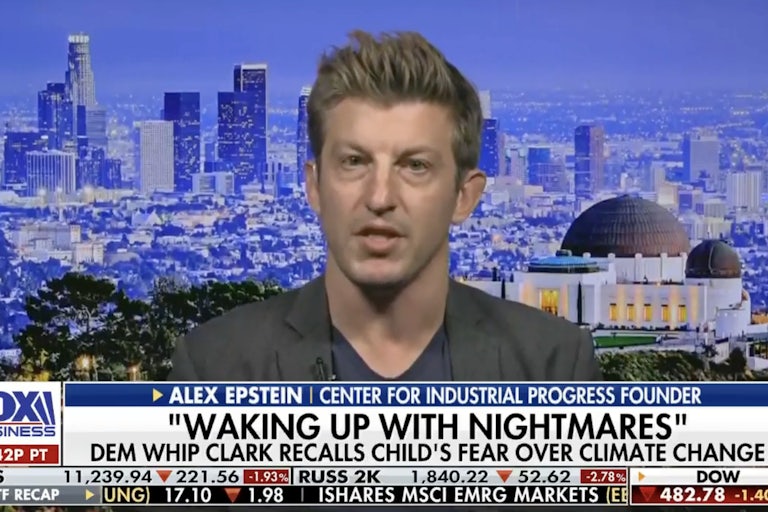
The GOP Darling Who Claims Fossil Fuels Are Good for Humanity

The time is ripe for Alex Epstein’s particular brand of fossil fuel boosterism to become the GOP’s mainstream climate talking point.

Fox Business

Last week, a group of Republican senators gathered for a special closed-door lunch on Capitol Hill with author Alex Epstein, who distributed signed copies of his newest book to attendees. After the lunch, Senator Kevin Cramer of North Dakota told E&E News that Epstein was “brilliant,” adding, “He made the case that fossil fuels contributed more to people getting out of poverty than the other way around.”

Epstein’s name may not be recognizable to most Americans, but his star has been rising on the right for quite some time. We may all start hearing about him more often because the time is ripe for his particular brand of fossil fuel boosterism to become the GOP’s mainstream climate talking point.

Epstein began his career at the Ayn Rand Institute, where he rose to prominence with op-eds on subjects like abortion, animal rights, and keeping the United States hooked on oil, which he described in 2006 as “a wonderful, life-sustaining product.” In 2011, after leaving the organization, he founded the Center for Industrial Progress; per its website, CIP is devoted to “helping industry fight for its freedom, with new ideas, arguments, and policies that will improve our economy and our environment.” Since then, he’s written two books (2014’s The Moral Case for Fossil Fuels and 2022’s Fossil Future). He’s been on countless right-wing media shows extolling the virtues of fossil fuels, and debated climate activist Bill McKibben on the topic in 2015. Despite his carbon-loaded arguments, Epstein famously does not want to be called a climate denier, claiming that he “explicitly acknowledge[s] the phenomenon of global warming.”

CIP’s financial activities are harder to track than those of other right-wing organizations working against climate action. Epstein’s organization openly bills itself as a “for-profit foundation,” claiming on a (now-deleted) part of its website that it is “proudly not a 501c-3 non-profit.” Still, even without this financial information, it’s clear from the company Epstein keeps that he’s become a darling of groups with deep ties to the fossil fuel industry. This year alone, he’s spoken at two organizations that are members of the State Policy Network, a cluster of groups that work with the Koch-funded American Legislative Council, or ALEC, and gave a keynote address at the Heartland Institute’s annual climate conference. Heartland has received hundreds of thousands of dollars from oil and coal giants to push climate denial.

There’s a big difference, however, between the rhetoric of these old-school organizations—which, traditionally, have challenged the science behind climate change—and Epstein’s schtick. While Epstein does his fair share of bad-faith science (like promoting the idea that carbon dioxide is necessary as a plant food), his central point is that using fossil fuels is a moral imperative. Because humans have achieved so much in the past using coal, gas, and oil, his thesis goes, we should keep using them. By contrast, stopping fossil fuel use will do nothing but stifle human “flourishing” and end up only hurting the world’s poor.

“The fastest way to decrease energy poverty and overall poverty is to end all favoritism for wasteful, unreliable solar and wind schemes,” he writes. “And above all reject any proposal to outlaw reliable fossil fuels and nuclear in favor of unreliable ‘renewable’ energy.”

This is, obviously, a colossal misdirect. People who are advocating that the world must transition off fossil fuels are not saying that we should all go back to less efficient forms of energy, like burning firewood, or that the poor must stay poor. The whole idea is to develop new technologies, curb some of our enormous energy use, and beef up alternate forms of energy like wind and solar. These emissions cuts, in turn, can protect the world’s most vulnerable, whom Epstein professes to care so much about, from the impacts of climate change.

But for Epstein, there’s no future in which we’re able to divorce ourselves from fossil fuels; no possible world where reducing our energy consumption and putting guardrails on our natural tendencies to use and produce more could be beneficial. This is an argument that Ayn Rand herself probably would have loved: Letting a gargantuan industry like oil or coal run wild with zero government intervention would, in a book like Atlas Shrugged, probably fix all sorts of societal ills. In the real world, it’s gotten us into a catastrophic mess.

But Randian rhetoric also makes Epstein an ideal tool for the GOP’s new approach to attacking climate policy. I’ve written before about how the age of old Republican climate denialism—embodied most famously by Senator Jim Inhofe, of snowball fame—is over. In this summer’s intense heat, with temperature records being smashed left and right, insisting that absolutely nothing is wrong with our planet is ludicrous. For a GOP politician focused on keeping fossil fuels in business, especially in the face of the rapid expansion of cheap renewable alternatives, squabbling over numbers and charts is counterproductive. It’s all about repackaging fossil fuels, turning them from the problem to part of the solution.

Speaker Kevin McCarthy demonstrated some of this new rhetoric this week. When a reporter asked him at an event about wildfires and climate change, McCarthy didn’t waste time denying them. Instead, he proposed planting a trillion trees, which the AP notes “would also require a massive amount of space—roughly the size of the continental United States,” and lauded “American natural gas” as having a key role in “a cleaner world.”

Epstein’s arguments are also an attempt to turn the tables on Democrats’ push for environmental and climate justice—the idea that cutting emissions is crucial to keeping people, especially Black and brown communities, safe and healthy. In Epstein-land, fossil fuels are the good guy. It’s climate “alarmists” who are the racists, who want poor people to suffer without energy access. It’s no wonder that in addition to right-wing dark money groups and traditional climate deniers, he’s also gained favor with conservative technocrats like Peter Thiel and “thinkers” like Jordan Peterson, who make scoffing at social justice the entirety of their brand.

This wasn’t Epstein’s first visit to Congress, but given the glowing reviews from the book signing, it definitely won’t be his last. In the Biden era, as temperatures keep getting hotter and climate action finally becomes federal policy, the GOP and its fossil fuel allies need a new savior—and Epstein is gunning for the job.

Good News

The Environmental Protection Agency said last week that it would be making $20 billion available from a specially earmarked “green bank” fund established by the Inflation Reduction Act for clean energy projects, especially those in disadvantaged communities, across the country.

Bad News

We’re still a few months away from the end of hurricane and fire seasons, but the federal government might have trouble helping with disaster. Officials at the Federal Emergency Management Agency said this week its disaster fund would run out of money by late August.

Stat of the Week

$300 million

That’s how much a yacht vandalized by climate activists in Ibiza this weekend is worth. Activists posted a video on Twitter showing them spray-painting the boat, reportedly owned by a Walmart heiress, and holding a sign reading, “You Consume, Others Suffer.”

Elsewhere in the Ecosystem

Energy industry uses whale activists to aid anti-wind farm strategy, experts say

The fossil fuel industry is enlisting whale lovers in the fight against offshore wind, The Guardian reports:

In the classroom, Roberts and his students have been studying how such rhetoric can stop renewable energy projects in their tracks—despite experts who say recent whale deaths have no connection to wind power. That night at the town hall, Roberts also spotted Elizabeth Knight, who founded Green Oceans earlier this year, another anti-wind organization in Rhode Island. Roberts said he felt compassion for Knight.

“She thinks a train wreck is coming,” said Roberts, referring to Knight’s fears of how wind power will push right whales to extinction. “And when you see that, you want to do all you can.”

But he is concerned that Knight and Chalke are falling into a trap laid out by rightwing interests that are sowing doubt to fuel public discontent over renewable energy projects.

Read Shanti Escalante-De Mattei’s full report at The Guardian.

This article first appeared in Life in a Warming World, a weekly TNR newsletter authored by contributing deputy editor Molly Taft. Sign up here.