Breaking News
Breaking News
from Washington and beyond

DOJ Dropped Charges Against Indian Billionaire After He Met Trump Jr.

The Department of Justice had previously registered criminal fraud charges against Gautam Adani.

Gautam Adani, chairman of Adani Group, makes a prayer gesture with his hands
Indranil Aditya/Bloomberg/Getty Images
Gautam Adani, chairman of Adani Group

Indian billionaire Gautam Adani was facing federal fraud and bribery charges in the U.S. Then he met privately with Donald Trump Jr.

Adani is the second-richest Asian in the world with an estimated net worth around $88.6 billion, according to a Forbes analysis. In November 2024, Adani and two other executives at the Indian Energy Company were indicted in Brooklyn for allegedly bribing Indian government officials in order to secure large solar energy projects and lying to U.S. investors about it, according to a Justice Department press release.

Adani and his co-conspirators were charged under the Foreign Corrupt Practices Act, an anti-bribery statute passed in 1977 that Trump paused for “national security” purposes in February 2025.

Adani’s fortune changed after he met with the president’s son, Donald Trump Jr., in Ahmedabad, India, last November. What was discussed during the meeting is not known, but the meeting itself was not previously reported until Bloomberg got the scoop Tuesday.

Seven months later, in May 2025, the DOJ dropped its charges against Adani. In a brief filing, prosecutors wrote that the department had “reviewed this case and … decided, in its prosecutorial discretion, not to devote further resources to these criminal charges against individual defendants.”

The billionaire’s sudden good luck was met by an excited market, which surged stocks in his companies and temporarily skyrocketed Adani’s wealth, pushing him into top spot as the wealthiest person in Asia.

A spokesperson for Trump Jr. told Bloomberg that the meeting had “zero to do” with the DOJ’s decision to drop its case against Adani.
Trump Launches AI Surveillance of Reflecting Pool as Disaster Grows

Is the Trump administration doing anything other than obsessing over the Lincoln Memorial Reflecting Pool?

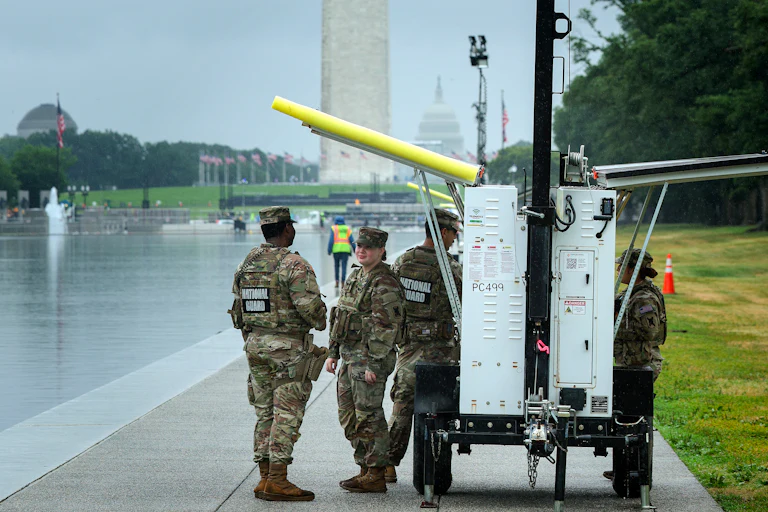
U.S. Army National Guard troops take shelter from the rain underneath a mobile camera trailer’s solar panels while guarding the Lincoln Memorial Reflecting Pool. The Washington Monument is in the background.
Chip Somodevilla/Getty Images
National Guard troops take shelter from the rain underneath a mobile camera trailer’s solar panels while guarding the Lincoln Memorial Reflecting Pool, on June 23.

Federal law enforcement agents were spotted installing AI-powered surveillance towers at the Lincoln Memorial Reflecting Pool in the latest escalation of President Donald Trump’s weird obsession.

In one video shared by TMZ Tuesday, U.S. Marshals escorted an LVT Mobile Security Unit to the edge of the Reflecting Pool.

In another video a day earlier, Daily Mail reporter John Michael Raasch witnessed a surveillance tower being towed in circles around the supposedly embattled landmark by U.S. Parks Police.

These towers do more than just record passersby: They automatically detect and alert so-called threats and use AI-powered audio alerts, strobes, and a powerful spotlight to deter crime. Most likely, they will just catch tourists.

The installation of security equipment is a significant escalation after several people, including a former U.S. Olympian, were arrested for allegedly vandalizing the Reflecting Pool. Trump has nonsensically claimed that vandals cut a massive slit in the bottom of the pool, but has refused to provide any evidence of the crime, which no one else has spotted. Now it seems that he doesn’t want anyone to get too close.

Trump has directed more than $16 million in renovations toward the Reflecting Pool, but just days before the country’s 250th anniversary, it was once again filled with algae and appeared to be literally falling apart.

Size of “Gash” in Reflecting Pool Keeps Changing, as Told by Trump

The president keeps raving about vandalism even though he’s responsible for the pool’s issues.

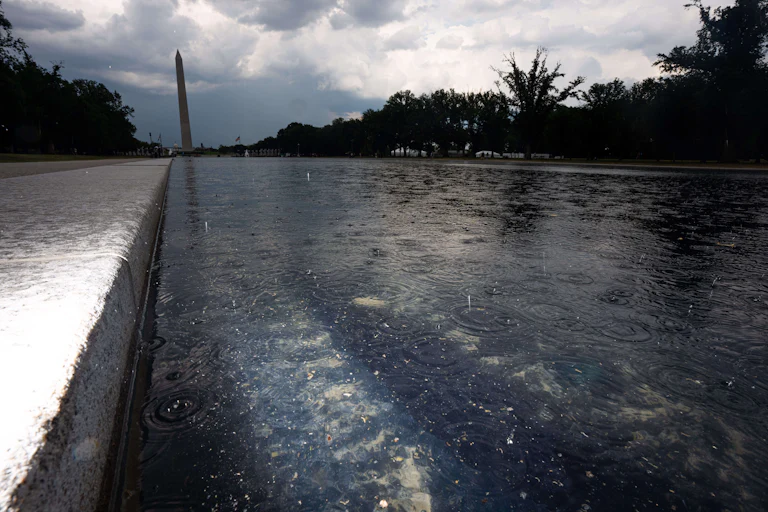
A low view of the Lincoln Memorial Reflecting Pool in the rain, with chipped paint and algae visible. In the background, the Washington Monument can be seen.
Aaron Schwartz/Bloomberg/Getty Images
Chipped paint and algae can be seen in the Lincoln Memorial Reflecting Pool in Washington, D.C., on June 22.

The size of the “slit” cut into the bottom of the Lincoln Memorial Reflecting Pool just keeps growing, according to President Trump in interviews and his own social media posts. But so far, no one has been able to find any evidence that it exists at all.

On Saturday, Trump posted on Truth Social that “vandals” had damaged the pool, and that they would now have to drain it in order to make repairs. He claimed it “worked perfectly” before it was attacked.

“They took some form of knife or blade, and put a 250 foot long gash into the beautiful facade of what took so much work,” Trump wrote.

But by Monday, the size of the “gash” had grown to 300 feet, according to another post. And on Tuesday, the president said that the cut was 350 feet long.

Though Trump’s claims keep getting more and more outlandish, he refuses to share photos of the problem, or any evidence that anyone vandalized the pool. CBS News went and inspected the pool and found no evidence of the gash, whether it be 250, 300, or 350 feet.

“One thing we still can’t find is any evidence of a gash along the floor of the pool,” said CBS’s Ed O’Keefe Tuesday morning. “Despite that, the Interior Department is taking steps to drain the pool again, and fix it again.”

Trump has already spent over $16 million renovating the pool—who knows how much it will cost to drain and repair it all over again? American taxpayers continue to shoulder the financial burden of another of Trump’s slapdash vanity projects.

Trump Had Bonkers Plan to Add Giant Fist to National Arch

A new book reveals how the president is obsessed with the construction of a national arch in Washington, D.C.

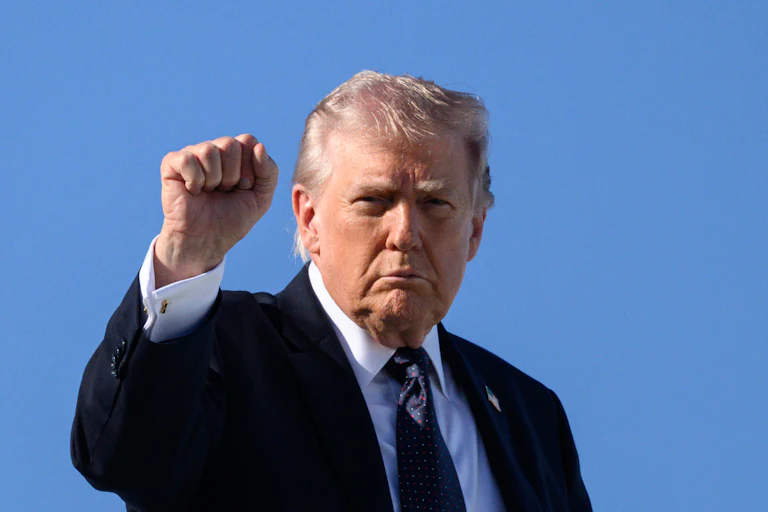
Trump holds up a fist
Mandel NGAN/AFP/Getty Images

The “Arc de Trump” could have had a giant fist attached to it.

One design that President Donald Trump proposed for his $15 million glamor project involved placing an enormous fist atop the 250-foot Arc de Triomphe dupe, according to a new book by New York Times reporters Maggie Haberman and Jonathan Swan titled Regime Change: Inside the Imperial Presidency of Donald Trump.

The fist would have served as a visual reminder of Trump’s response to his attempted assassination at a campaign rally in Butler, Pennsylvania, in July 2024.

“As the president showed off his models to a visitor one day in October, he puzzled over the details, including whether the arch should include a platform to take in the view,” Haberman and Swan wrote.

“Privately, he had also been asking confidants what he should have on top of the arc,” the section continues. “Should it be, he mused, a large replica of his ‘Fight, fight, fight!’ fist?”

The book also highlights the arch’s enormous size, which would “dwarf” both the original, 162.5-foot arc in Paris, which was built at the direction of Napoleon Bonaparte to commemorate the military achievements of the French empire, and the 200-foot Arch of Triumph in Pyongyang, which was erected to commemorate the 70th birthday of North Korea’s totalitarian founder Kim Il Sung, as well as the nation’s resistance to Japanese occupation during World War II.

Other suggestions that have been since removed from the proposed design include a replica of Lady Liberty and a pair of eagles sitting atop the proposed arch, which would have added to its height.

The project is still going through a review cycle, but Trump officials have indicated that they want the site up and running by July 2028, six months before Trump’s term is set to end.

Trump’s arch has faced enormous opposition. If it breaks ground, it will physically situate Trump’s legacy between the Lincoln Memorial and Arlington National Cemetery, interrupting a hallowed conversation between the president who ended slavery and the soldiers who sacrificed their lives in order to do so.

DHS Changes the Rules for Iran’s World Cup Team Yet Again

The team can now enter the U.S. a day before their matches, but they still face a ton of restrictions.

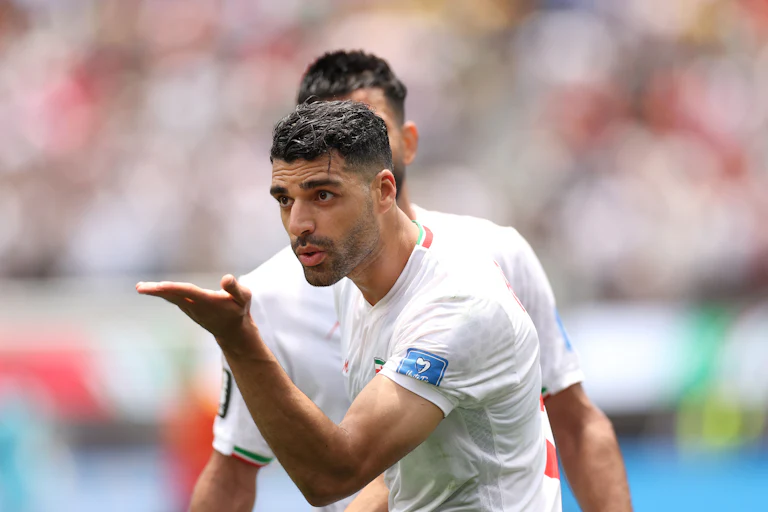
Mehdi Taremi holding his palm out, wearing Iran's white national soccer team jersey, with another obscured player behind him.
Stu Forster/Getty Images
Mehdi Taremi, a striker for Iran’s national soccer team

The Department of Homeland Security is finally allowing the Iranian World Cup soccer team to travel to match locations a day early—something that nearly every other participating country in the tournament has been able to do. But they still won’t be allowed to stay overnight after their games on U.S. soil.

“Ahead of the match in Seattle on June 26, the Iranian team will be allowed to come in match day minus two, so two days before the match. They’ll be asked to leave the day that the match wraps up, so the evening of the match,” a DHS spokesperson told NBC. “Again, the President wants to make sure that we’re talking about what actually happens on the pitch.… A lot of that is making sure that things are safe and secure, not just around the stadiums, but around base camps and training sites.”

This decision comes after the Trump administration first denied the visas of 15—then 11—team assistants, blocking them from entering the U.S. The team itself was essentially booted from the country right after their matches in Los Angeles on June 15 and June 21, forcing them to stay in Tijuana, Mexico, rather than their abandoned base camp in Tucson, Arizona, as originally planned, or anywhere near the city they were playing in. The team also still has to go through hours of security checks each time they enter the U.S. from Mexico.

This constant back-and-forth is detrimental to both the performance and the morale of the players, who have nothing to do with America’s ongoing war on Iran.

“I think it’s not good for the football,” said team captain Mehdi Taremi last week. “In [the] World Cup, you have to prepare good for the next game, which is a lot of stress for the players and the staff and everyone. But we don’t have that support, and I think FIFA have to help us more than this. Let’s see what’s going to happen in the future.”

Iran qualified for the World Cup in the spring of 2025, months before the joint U.S.-Israeli attack that started the war in February.