
Three Keys to a Democratic Victory in Maine

Welcome to The TNR Blue Book. Today, read about Troy Jackson, Dems’ soul-searching on the Massie amendment, and more ...

Troy Jackson holds a microphone in front of a lectern saying "Solidarity!" Numerous supporters stand behind him.
Graeme Sloan/Getty Images
Troy Jackson

Editor’s Note: Welcome to The TNR Blue Book. It’s our new daily newsletter that covers Congress and much more, but with a distinctly TNR twist: Our focus will be strictly on Democrats, liberal and progressive groups, and the fight to take back power and save democracy. Every morning, you’ll get a rundown of late-breaking news, what Democrats on Capitol Hill are thinking, quick hits on what you need to know nationally, the latest on what’s coming out of the think tanks and activist groups, short interviews with progressive newsmakers and authors, and more (including some humor and political trivia!). There’s nothing else out there like it.

Inside Washington

The three keys to a Jackson victory in Maine

Today we’re focused a bit north of Washington, D.C., where Maine Democrats are rallying around a new presumptive nominee for U.S. Senate to replace disgraced Democrat Graham Platner: logger and former State Senator Troy Jackson. Maine political insiders see some positive signs in how quickly the party has resolved the chaos surrounding Platner’s exit. But Jackson, they add, now has a tough task ahead.

Over the weekend, the state Democratic Party’s delegates election process delivered Jackson a majority of the 601 delegates who will officially nominate the Democratic candidate for Senate, making Jackson’s victory in the official nominating convention on Saturday all but certain. Anthony Emerson, a 31-year-old Portland resident who’s been active in Maine politics since middle school, was running to be a delegate for Cumberland County, but wasn’t selected. When we spoke on Saturday, Emerson still thought Nirav Shah had a decent chance of winning a formidable number of delegates. By the time Monday rolled around, Jackson’s main opponents had dropped out and coalesced around him. That’s a good thing, Emerson told me. “It shows enthusiasm for his campaign, and that his campaign can organize people efficiently,” he said.

Emerson said that the energy at the virtual Cumberland County delegate election meeting was slightly anxious. “But I feel like that’s just Democrats for you,” he added. “We’re always worrying. Especially because Collins overperformed expectations so much in 2020.”

Collins’s decisive, nine-point victory over Democratic state Representative Sara Gideon in 2020, despite trailing in every major poll in the lead-up to the election, is the stuff of Democratic nightmares. But David Farmer, a Maine political analyst I spoke to, said 2026 could be different—if Jackson manages a few key tasks. Here are the ones he highlighted:

1. Get Democrats to turn out. It sounds obvious, but voters are less likely to cast ballots during a midterm election than a presidential election. Getting Democratic voters to the polls should be possible: Democrats in the state have been activated by the two-week process of finding a replacement for Platner, and the party has a monopoly on attention. The murder of Johan Sebastián Durán Guerrero at the hands of an ICE agent in Biddeford, Maine, on July 13 will also likely galvanize pro-immigrant Democrats to head to the polls.

2. Pick up independents in Portland and surrounding suburbs. In 2020, Gideon received 67 percent of the vote in Portland, a deep blue city that Farmer says she should have performed better in. He attributes that underperformance to Lisa Savage, who was running as an independent and picked up nearly 11 percent of the Portland vote. “Those Lisa Savage votes came straight off of Sarah Gideon,” Farmer said. “In a two-way race, [Jackson] has the opportunity to pick up thousands of votes just in Portland.” Jackson won the plurality of the Portland vote, 28 percent, in the gubernatorial election this June, a good sign for his prospects in the city.

3. Win over undecided female voters. Farmer suggests that independent female voters could be key to Jackson’s win. Collins was a pivotal vote to confirm Supreme Court Justice Brett Kavanaugh in 2018. When Roe v. Wade was overturned in 2022, Collins called the decision “ill-considered.” But Democrats are emphasizing Collins’s role in confirming a crucial vote in the 5–4 decision overturning Roe, hoping to pick up pro-choice female voters who otherwise might stay home.

“It’s always going to be tough. There’s a reason that she’s won for 30 years,” said Farmer about Collins. But Jackson still has a path to victory. If Democrats can harness the attention and energy around his nomination, and strategize carefully from here, the Maine Senate seat could still be in play.

—Emma Janssen

Would Dems pass a different version of the Massie amendment?

Democrats aren’t even close to finding a sustainable path forward on Israel, following a seismic House vote splitting the party down the middle on aid to the country. But all signs point to a sea change in how the party talks about the Middle East.

On July 15, representatives voted on the Massie amendment, which would cut $3.3 billion in unconditional aid to the country. The amendment failed, but in a major shock, 103 Democrats—even some who have previously received funding from pro-Israel organizations—voted for the amendment. Even Representative Thomas Massie, the Republican who brought the amendment and the sole “yes” vote in the GOP, was shocked by how many Democrats supported it. “I thought we might get 24, and 60 in my mind would have been a tremendous victory,” he told me on Thursday.

Democrats who voted for the amendment say they did so because there was no better way to express their dissatisfaction with Israel’s war in Gaza and actions during the war in Iran. “Israel has a right to defend itself. Israel is an ally. Israel does not have a right to buy F-35s on its ally’s credit card,” Representative Jake Auchincloss told me.

Auchincloss has been a beneficiary of funding from the American Israel Public Affairs Committee, or AIPAC, and received $10,000 from the group during the 2025–26 cycle. After his “yes” vote, though, the option to donate to him disappeared from AIPAC’s website, along with the other Democrats the group supports who voted for the amendment.

Representative Sarah McBride is another typically pro-Israel Democrat who voted for the amendment. “It was a hard decision to come to,” she said. “The language was poorly written. The vehicle was deeply imperfect. But when the question is called, you have to decide: What is the message you want to send?”

Many of the 98 Democrats who voted “no” on the amendment emphasized that their vote wasn’t because they support the actions of the Israeli government. Representative Rosa DeLauro, for example, pointed to the amendment’s broad language as the reason that she couldn’t vote for it. “Its vague wording gives the Trump Administration broad leeway to determine which programs are defunded and how,” she wrote in a statement.

In her statement, DeLauro signaled that she wants to set stronger restrictions on Israel in the future. “We must ensure that any future security relationship with Israel is structured similarly to defense agreements with our Western and democratic allies,” she wrote. “A new defense agreement must be based on respect for human rights and allow for a route to Palestinian sovereignty.”

Auchincloss also has a vision for future legislation on Israel: “It needs to provide for Israel’s qualitative military edge,” he said. “But it also needs to represent the profound concerns of the American public about further conflict in the Middle East.”

I asked him if there’s a middle way forward for Democrats on Israel, and whether the party would be able to coalesce on a policy toward the country. “Is there a middle way? There needs to be, both in terms of individual policies that point Congress in that direction, and also as we start to architect the next memorandum of understanding,” he said, referencing the Obama administration’s agreement that guaranteed Israel $38 billion in military aid between 2019 and 2028.

Even though Democrats haven’t come to any concrete solutions to their Israel problem, the votes on the amendment signal that a shift is coming. “Number one: Public opinion is changing. Number two: It’s being reflected here in Washington, D.C. And number three: AIPAC’s grip, at least on one party, has been severely diminished,” Massie said of the vote.

—Emma Janssen

Outside Washington

Warren enters the fray in Michigan

There are just two weeks to go until Michigan’s August 4 primary, and the big battle between progressive Abdul El-Sayed and moderate Representative Haley Stevens over who gets to replace retiring Democratic Senator Gary Peters shows zero signs of calming down. Monday morning, Senator Elizabeth Warren became the latest sitting progressive to back El-Sayed, despite Senate Minority Leader Chuck Schumer having endorsed Stevens.

“Michiganders deserve a senator who will fight for you, not for special interests running millions of dollars in TV ads to buy this seat,” Warren said in a subtextually spicy video posted to X. Warren also touted El-Sayed’s union credentials, and insisted that El-Sayed was the “only candidate in this race who can build the grassroots movement needed to win in November”—a not very thinly veiled rebuttal of establishment Democrats’ view that El-Sayed is too far left to defeat a Republican in the general election. Senator Bernie Sanders and Representative Alexandria Ocasio-Cortez are also backing El-Sayed and appeared at a rally with him in Lansing on Sunday.

The context for that line about special interests: Pro-Stevens TV ad buys have outpaced pro-El-Sayed ad buys by a 12-to-one margin, The Detroit News’s Craig Mauger reported last week. The American Israel Public Affairs Committee and its affiliates alone have dropped almost $30 million. (Stevens recently voted against a proposal to cut off military aid to Israel.) But also, “a group called A Stronger Michigan, which hasn’t reported its donors’ names to the Federal Election Commission, has spent $12.1 million in support of Stevens,” Mauger wrote. The Detroit Free Press’s Todd Spangler, who calculated the spending ratio as more like 13 to one, noted that both A Stronger Michigan and Center Forward “have been linked to Jefferies Murray, a corporate lobbyist in Washington whose firm has represented defense contractor Northrop Grumman and Facebook parent Meta, among others.”

Last week, El-Sayed took to social media to ask his supporters to stop taking potshots at Stevens over things like her speaking voice, and instead “focus on the issues,” like the “corporations and special interests” who “support her.” Warren’s video would seem to fit the bill. It also hits many of the same notes AOC and Sanders hit over the weekend.

So who’s ahead? Recent polls are oddly split on the question. A Detroit News poll last week had Stevens up seven points. Then Data for Progress found El-Sayed up 13 points. On Monday, Tulchin Research released another poll finding El-Sayed up 16. And they were all in the field at more or less the same time. Obviously, they’re making pretty different guesses about who the electorate is going to be.

Elsewhere:

  • Gas prices are up above $4 again due to renewed hostilities between the U.S. and Iran. Last week’s optimistic reads on consumer spending—and thus the economy in general—after gas prices fell in June sure didn’t last long.

  • Analysis from CalMatters’ Digital Democracy project finds that current members of the California legislature have, on average, only broken from their party majority 1 percent of the time. But some are more open to bucking the party line than others. Republican Greg Wallis, representing the swingy 47th district, has strayed in 8 percent of his votes. Democrat Jasmeet Bains—who ran for Congress this year but lost the June “top-two” primary to progressive Randy Villegas and Republican incumbent David Valadao—defected “just under 2 percent of the time since she was elected to the Legislature in 2022.”

  • South Carolina Republicans continue to hurl their hats into the ring for the August 11 primary to replace late Senator Lindsey Graham. On Monday, Graham’s sister Darline Graham Nordone (backed by Trump) and Representative Russell Fry joined a field that already includes Representative Ralph Norman, businessman Mark Lynch, former Governor Mark Sanford, and lawyer Duke Buckner. Don’t forget that two sources have said former Representative Nancy Mace is “strongly considering” a “YOLO” run, too. Watch this (crowded) space to see who Democrat Annie Andrews will be facing in November.


—Heather Souvaine Horn

The Ideas Factory

A new poll from Data for Progress and the Center for Climate Integrity finds that voters “strongly support legal action to hold oil and gas corporations accountable for misleading them about the harms of natural gas, whether in the context of climate change or public health.”

July 21 is Equal Pay Day for Black women—the day marking the extra days in 2026 that a Black woman would have to work in addition to all of 2025 to earn the same amount for the year as a white man. At the Century Foundation, Janelle Jones, Michelle Lavere, Michaela Minnis, Tiara Moultrie, and Lea Woods write about the various policies that might help close the gap. These include paid leave; “direct public investment” in childcare, both to lower costs and to “[raise] wages for early educators, 16.7 percent of whom are Black women”; reducing the cost of higher education; tracking Black employment in Fed data to “resist declaring full employment until Black workers experience it too”; and more.

Tuesday at 10 a.m., the Urban Institute hosts a hybrid event titled “Mobilizing Community and Economic Development to Address Climate Change: Paths for Transformative Action.” Speakers will include Jobs for the Future’s Madeleine Chaisson, Urban Institute’s Oriya Cohen, Hive Fund for Climate and Gender Justice’s Stuart Clarke, the Tucson, Arizona, city manager’s chief of staff Lane Mandle, and more.

Wednesday at 12:30 p.m., the Center for American Progress hosts an online conversation with Senator Chris Murphy titled “Stopping Trump’s Crypto Corruption,” focusing on “why stronger oversight and anticorruption rules for cryptocurrency markets are essential to protecting U.S. national security and our democracy.”

—Heather Souvaine Horn

Four Questions For: Aaron Reichlin-Melnick

Interviewed by Matt Ford

Q: Who are you, and what are you working on right now?

A: I’m currently senior fellow at the American Immigration Council, where I’ve been for almost 10 years now. I started my career as an immigration lawyer, but these days, rather than explaining immigration law and policy to a single client, I spend my days explaining immigration law and policy to the general public, policymakers, and the media. Right now, with the imminent loss of Temporary Protected Status for hundreds of thousands of people, I’m diving into co-writing a new publication looking at the Trump administration’s broader “de-legalization” campaign, which is shaping up to be the largest in modern American history.

Q: What is the most difficult thing about your line of work?

A: The most difficult thing about tracking immigration law and policy is the sheer volume of changes, which keeps accelerating. Statements which are true on Monday may be false by Friday. Protections which lasted for generations can end in a heartbeat. If the first Trump administration was like running a marathon, the second one feels like trying to run a triathlon when the water’s covered in an oil slick, the bike has two flat tires, and every other competitor gets to take shortcuts.

Q: What was your biggest success in the last year or two?

A: It’s been a whirlwind couple of years. But the work I’m most proud of recently is our May publication “Restoring Credibility and Humanity to Immigration Enforcement: A New Framework for Interior Immigration Enforcement.” At a time when the need to make major changes to ICE has never been more clear, I think we offer a uniquely positive vision for fixing what is broken; one that offers high-level solutions, messaging, and concrete policy ideas that are usable for anyone looking to answer the question of what to do with ICE.

Q: What keeps you going in these stressful times?

A: It’s a cliché, but spending time with friends and family has never been more important to me, and I’ve been prioritizing that whenever possible. Beyond the directly personal, I keep coming back to the community response we saw in Minneapolis; how people came together to respond to Trump’s shock and awe campaign leveled against an American city. That level of mutual aid and community support is a model for an American future that is not as atomized and divided as our social media feeds want us to feel, and reminds us that basic human decency and a love of our neighbors makes us far stronger than stigmatizing immigrants ever could.

This state didn’t elect its first Democratic senator until 1974. What’s the state, and for bonus points, who was the senator? (Sign up for The Blue Book to find the answer in tomorrow’s newsletter.)
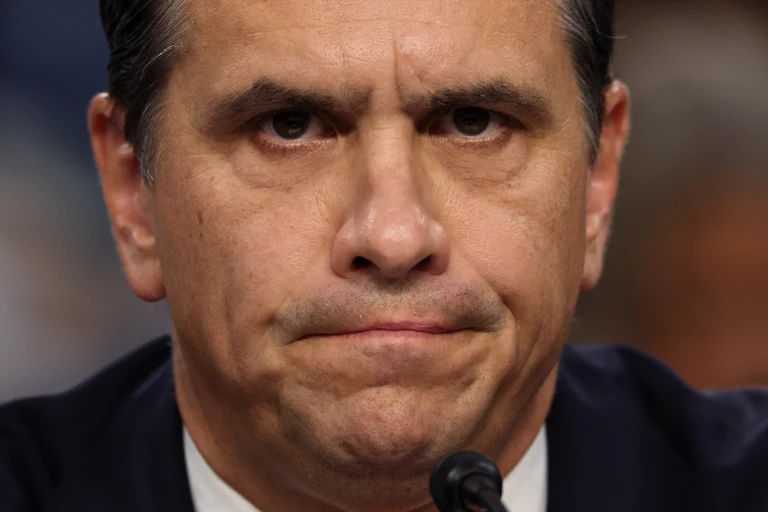
Will Any Republican Senators Vote Against Todd Blanche?

The Democrats appear united against the attorney general nominee. Meanwhile, outgoing GOP Senator John Cornyn said, “I’m not going to make that decision until I need to.”

Todd Blanche at Wednesday’s confirmation hearing
Win McNamee/Getty Images
Todd Blanche at Wednesday’s confirmation hearing

Democrats on the Senate Judiciary Committee on Wednesday pressed attorney general nominee Todd Blanche, President Trump’s former lawyer, on a range of controversies and came away even more convinced that he’s not fit to lead the Justice Department. But will any of their Republican colleagues come to the same conclusion?

Senator Richard Blumenthal, who sits on the committee, was alarmed by Blanche’s responses to questions about Trump’s “anti-weaponization” fund and the president’s self-dealing with the IRS. “He hewed to the standard line and showed that he’s really Donald Trump’s henchman, his mob consigliere, and will enable and promote the lawbreaking that we’ve seen by Donald Trump,” Blumenthal told me. “There’s a chance” that Republicans will defect and vote against Blanche, he said, but he added, “I am certainly not optimistic because, looking at history, they have failed to stand up when it counted, even in the face of lawbreaking.”

Assuming every Democrat on the committee opposes Blanche, who is currently the acting attorney general, he will need every Republican vote to advance to a confirmation vote in the full Senate. (His two-vote cushion was cut to one with Senator Lindsey Graham’s sudden death.)

Another Democrat on the committee, Senator Cory Booker, cited Blanche’s response to questions about the government investigation into the late sexual predator Jeffrey Epstein. “It was outrageous how many times he didn’t even tell the truth,” he said. “Even just about the fact that he said [he] can’t meet with the victims of Epstein.”

During the hearing, ranking member Dick Durbin pressed Blanche to commit to meeting with Epstein’s victims. Ten of those victims were present at the hearing. Blanche said he would ensure that colleagues meet with Epstein’s victims, but didn’t commit to doing so himself.

“You’re dancing on the head of a pin here,” Durbin said.

“I’m not dancing on any pin,” Blanche responded.

In another tense moment, Senator Sheldon Whitehouse questioned Blanche on FBI Director Kash Patel. “How long do you intend to put up with that Kash Patel character?” Whitehouse asked, listing some of Patel’s alleged misdeeds.

“That’s an extraordinarily obnoxious question, senator,” Blanche responded.

Perhaps most significant was GOP Senator John Cornyn’s line of questioning. Both Cornyn and Senator Thom Tillis, who is also Republican, are leaving the Senate in January. Tillis is retiring, while Cornyn lost his primary to Texas Attorney General Ken Paxton, whom Trump endorsed. In recent months, the two senators developed independent streaks, but it’s no guarantee that they will break with the party in this instance. (A Spectrum News reporter said that Tillis is leaning toward “yes.”)

Cornyn questioned Blanche about the anti-weaponization fund and got the acting attorney general to confirm that it is “dead.” Still, Blanche noted, the underlying settlement agreement between Trump and the IRS, which included the creation of the fund, remains an “enforceable document.”

“His claim that the weaponization fund is a dead doornail is not a characterization that I agree with,” Cornyn said, later in the day. But Cornyn remains undecided on whether he’ll vote for Blanche. “I’m not going to make that decision until I need to,” he said.

Though Senate Democrats said they’re unsure where their Republican colleagues will fall on Blanche, they see cracks in the wall. “You didn’t see defections of any significance at the beginning of the Trump term, but you’re starting to see [them now],” Senator Tim Kaine said.

The Democrats Face Another Divisive Vote on Military Aid to Israel

The House is expected to vote Wednesday on a measure that would cut off aid completely, and Minority Leader Hakeem Jeffries isn’t telling his caucus how to vote.

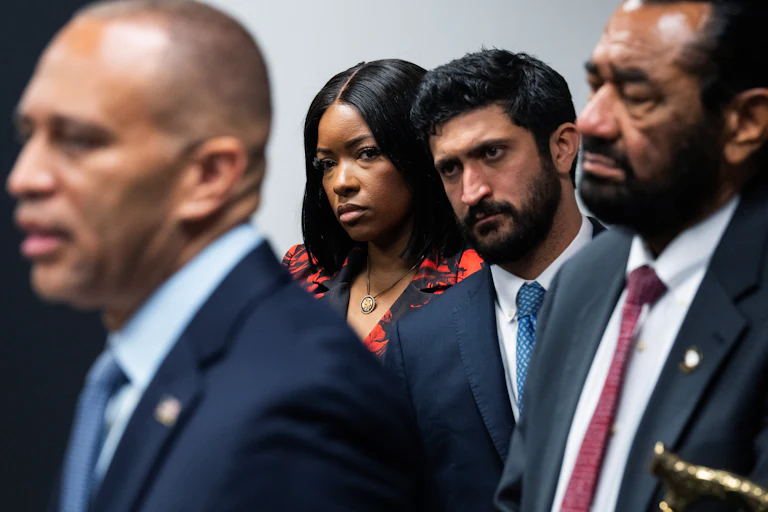
House Minority Leader Hakeem Jeffries and Reps. Jasmine Crockett, Greg Casar, and Al Green
Tom Williams/CQ-Roll Call, Inc/Getty Images
From left: House Minority Leader Hakeem Jeffries and Representatives Jasmine Crockett, Greg Casar, and Al Green at a news conference in 2025

A legislative amendment that would block U.S. security aid to Israel has split Democrats in Congress to such an extent that House Minority Leader Hakeem Jeffries has decided not to urge his party to oppose it. Instead, he told Democrats to vote their conscience, setting up an opportunity for lawmakers to go on the record about their views. Some are already doing so.

“The Democratic Party as a whole needs to shift its policy on Israel and Palestine,” Representative Greg Casar, the chair of the Congressional Progressive Caucus, told me. “I think that was clear during the last presidential election. I think it’s clear to me as a moral issue. And I think that [Wednesday’s] vote could be one step towards us beginning to shift our position as a party.”

The amendment in question, brought by GOP Representative Thomas Massie, would cut $3.3 billion in security assistance that the U.S. has pledged to Israel between 2019 and 2028 and further stipulates that “none of the funds made available under this Act shall be obligated or expended for Israel.” Lawmakers are expected to vote Wednesday on the amendment, which Massie is hoping to attach to a $47 billion foreign affairs spending bill.

On Tuesday, Jeffries wrote in a “Dear Colleagues” letter that he was planning to vote against the amendment but had decided not to whip the caucus into joining him, underscoring how divided the Democrats have become on the question of America’s relationship with Israel.

In his letter, Jeffries wrote that he opposes the amendment because it is “overly broad,” prohibiting the use of funds for nonmilitary activities like U.S. embassy operations and humanitarian aid. He also expressed concern that Republicans will “weaponize” the amendment against Democrats—a potential reference to Republicans accusing Democrats of antisemitism for opposing aid to Israel.

Even though Jeffries will vote against the amendment, his letter calls for a “change in direction,” signaling how much Democrats have changed their views toward aid for Israel. “Israel has an advanced economy and is capable of paying for its own sophisticated weapons,” he wrote. Future security agreements between the two countries, he wrote, should “strictly adhere to our human rights laws and values.”

Representative Ocasio Cortez, who plans to vote “yes” on the amendment, told me that she thinks Jeffries’s decision not to whip “no” votes provides “flexibility” for Democrats to vote their conscience.

Jeffries’s letter mirrors the advice given by J Street, the liberal Zionist advocacy organization. In a statement on Tuesday, J Street President Jeremy Ben-Ami wrote that the amendment is “poorly drafted, overly broad and being used by Republican leadership to divide Democrats rather than advance a serious debate about US policy.” Despite that, Ben-Ami wrote, the organization supports whatever votes members choose to cast. Some Democrats will likely vote “present” to avoid a hard “yes” or “no” vote, a decision J Street says it supports.

Casar weighed in on the amendment in his own letter, explaining why he plans to vote for the amendment and encouraging the caucus to do the same. “The Democratic Party needs a new approach to Israel and Palestine,” Casar wrote. “I hope you will join me in beginning that process by voting yes on this amendment.”

Casar said that winning over Democrats who have previously supported aid to Israel will be critical to the amendment’s passage. “For us to achieve the goal of restricting military aid to the Israeli military, we have to have members that previously voted for aid, and I expect that you’ll see that if we have the vote,” he told me.

Though elected Democrats are divided on the issue, the party faithful’s views are clearer. According to a New York Times/Siena poll from May, 74 percent of potential Democratic voters oppose “providing additional economic and military support to Israel.” Just 20 percent support it.

Despite this, the Massie amendment is still expected to fail, as nearly all Republicans are expected to vote against it.

She Wants to Win Lindsey Graham’s Senate Seat—and Impeach RFK Jr.

After Graham’s death, Democratic pediatrician Annie Andrews doesn’t know whom she’ll be running against this fall. So she’s focusing on her message.

Dr. Annie Andrews during a debate with Rep. Nancy Mace
Brad Nettles/The Post And Courier/AP, File
Annie Andrews during a debate with Representative Nancy Mace in 2022

Senator Lindsey Graham’s death on Saturday shocked Washington, D.C. It also upended the race for Senate in South Carolina, where the longtime incumbent was facing a Democratic challenger in Dr. Annie Andrews, a 45-year-old pediatrician. Now Andrews doesn’t know whom she’ll face in November, but she still knows exactly why she’s running. She wants to help fix the health care system—and to start by getting rid of Robert F. Kennedy Jr., the anti-vaxxer in charge of Health and Human Services. 

“The day that RFK Jr. was nominated to lead HHS was the day that I really seriously started considering running for this seat,” she told me on Monday. “RFK Jr. has been my professional archnemesis for decades, and there are thousands of pediatricians across the country who would say the same thing.”

Andrews was born in Kentucky and raised in Indiana before moving to South Carolina in 2009 to work at MUSC Children’s Hospital in Charleston. But she didn’t get involved in politics until the Parkland school shooting in 2018 moved her to join Moms Demand Action, the gun violence prevention group. In 2022, she challenged House Representative Nancy Mace but lost by 14 points.

Her race against Graham was looking to be closer. A November poll had Graham up six points, and the margin was only three in a poll last month. Now it’s unclear who her Republican opponent will be. The state GOP will hold a primary on August 11, with a runoff on August 25 if no candidate reaches 50 percent of the vote. 

Andrews says she plans to run a positive campaign focused on the issues she cares about. “I’m thinking about how we move forward as a state together, how we can get past this hyperpartisan, divisive moment and era, frankly, of American politics,” she said. “I don’t want to be a career politician. I see politics as a path to efficiently and effectively solve my patients’ and their families’ problems.”

Andrews said that when she started her career as a pediatrician, it was a given that her patients were fully vaccinated. In recent years, she has had to brace herself when asking parents about their child’s vaccination status. She pointed to the April 2025 measles outbreak of nearly 1,000 cases in South Carolina as one example of how the Trump administration has harmed children.

“South Carolina is a state that never expanded Medicaid. We have 15 counties without an ob-gyn, we have multiple rural hospitals on the chopping block because of the impending Medicaid budget cuts. We have federally qualified health centers that have already closed their doors. So no matter where I am across the state, that issue comes up in every conversation I’m having with voters,” she said.

Andrews argues that she’s the right candidate for a moment when health care access and affordability are top of mind for South Carolinians. “You cannot fight bad politics by staying apolitical. So the only way to fight back against the politicization of pediatric health care and health care as a whole in this country is by engaging in politics on the other side,” she said. Andrews says she wants to lower the cost of prescription drugs, get private equity out of health care, and impeach RFK Jr.

In recent years, a number of Democratic physicians have decided to run for office, and many of them have origin stories that echo Andrews’s. In Michigan, public health professional Abdul El-Sayed has made Medicare for All a crucial part of his policy platform. Adam Hamawy, who won his primary in New Jersey’s 12th congressional district, is a former combat surgeon who saved Senator Tammy Duckworth’s life and treated patients in Gaza.

Andrews attributes her strong polling numbers to her political identity as a no-nonsense medical professional. She’s trying to stay away from tensions in the Democratic Party between the progressive and centrist wings. “I don’t identify on any particular part of the political ideological spectrum because to me it’s about naming the problem and solving the problem, and it’s about being pragmatic about it,” she said. “Regardless of who my opponent is, there’s something about me and our campaign and my candidacy that is breaking through those typical partisan voting patterns.”

Now she’s looking ahead and doesn’t seem too troubled by whoever her opponent will be. Among the names being floated are  Lieutenant Governor Pamela Evette, Representative Ralph Norman, and Graham’s most recent primary challenger, Mark Lynch. Mace, who sparred with Andrews during the 2022 election, has also expressed interest in running.

“Nancy Mace likes to make news cycles about her, and I wouldn’t at all be surprised if she does end up getting in this race, despite the fact that she just came in fifth in the Republican gubernatorial primary here in South Carolina just a little over a month ago,” Andrews said. “I’m sure there’s a lot of folks here in the Low Country who would be intrigued to see a rematch of me and Nancy Mace.”

The Race to Replace Graham Platner Is Heating Up

Maine Democrats plan to stage a nominating convention to select their Senate nominee. They’ve already got a lot of options.

Former State Senator Troy Jackson, who once campaigned alongside Graham Platner, is one of several Democrats now vying to replace Platner as Senate nominee.
Sophie Park/Getty Images
Former state Senator Troy Jackson, who once campaigned alongside Graham Platner, is one of several Democrats now vying to replace Platner as Senate nominee.

With Graham Platner bowing out of the race for U.S. Senate in Maine following allegations that he raped his former partner, the scramble to replace him is well underway—and the field of possible alternatives is starting to get considerably crowded.

Since the allegations that essentially ended Platner’s campaign came out, on Monday, the Maine Democratic Party has been constructing a plan to select another candidate. The party has landed on hosting a nominating convention, which will include 500 delegates elected proportionally by county committees and a preexisting 100-person state committee. Together, those 600 delegates will decide which of the many potential Platner replacements will face Republican Senator Susan Collins in November. They have until July 27 to officially nominate Platner’s opponent. (The convention has not yet been scheduled.) Meanwhile, Platner still has business to attend to—he has until Monday at 5 p.m. to officially withdraw his name from the ballot.

The delegates will have a wide field of candidates to choose from—so far, seven have declared their candidacy. To be eligible for nomination, candidates must garner 500 signatures, a potential barrier to entry for some of the lesser-known candidates.

Broadly speaking, the candidates who have announced their desire to run have been emphasizing their progressive and working-class credentials in an effort to hew as close as possible to the policy platform that lifted Platner to his primary victory, while distancing themselves from his scandals.

Still, there are distinctions to be made among the would-be players in this burgeoning field. Here is an early guide to who the seven candidates currently vying to take on Collins are—and where they stand on some critical policy questions.

Troy Jackson: Jackson’s name was one of the first floated after the allegations against Platner came to light. An anonymous memo circulated among some progressive strategists emphasized “his authentic working class bonafides” and said that his “anti-establishment message [contrasts] effectively against Collins as a swamp creature.” Jackson is a fifth-generation logger from Allagash and the former president of the Maine Senate.

Recently, Jackson came in third place in the state’s Democratic gubernatorial primary. In that race, he was endorsed by Senator Bernie Sanders. Before running for governor, he served in the Maine state Senate from 2008 to 2014 and again from 2016 to 2024.

Jackson supports Medicare for All, has called Israel’s actions in Gaza a genocide, and says he’ll never vote in favor of taxpayer-funded aid to Israel. In recent days, he has been endorsed by Representative Ro Khanna and the Maine AFL-CIO.

Nirav Shah: Shah is another 2026 gubernatorial candidate. He garnered the highest number of votes but ultimately lost the primary to Hannah Pingree due to ranked-choice voting.

Shah is a public health official who served as director of the Maine Center for Disease Control and Prevention from 2019 to 2023 and the principal deputy director of the U.S. Centers for Disease Control and Prevention from 2023 until 2025.

“The other thing that voters in Maine are clearly looking for is someone who is an outsider. I come to this race not having been part of the political establishment in Maine or indeed even in the United States,” Shah said in a CNN interview.

Before serving in Maine and at the CDC, Shah was director of the Illinois Department of Public Health. During his tenure, an outbreak of Legionnaires’ disease killed 13 people. This has recently come back to haunt him: When Shah announced his bid to replace Platner, Senator Tammy Duckworth wrote in a post on X that she “strongly [opposes]” his run for Senate due to his handling of the outbreak.

Shah supports Medicare for All, says that ICE “in its current form” cannot continue, and has described Israel’s actions in Gaza as a genocide.

In a poll released Thursday, Shah showed the best chance of beating Collins in November, though the poll had him winning by just one point.

Shenna Bellows: Bellows came fourth in this year’s gubernatorial primary. She is currently Maine’s secretary of state. She has run for Senate before—in 2014, she went head-to-head with Susan Collins and lost in a landslide, notching only 32 percent of the vote against Collins’s 68 percent share. This was a wipeout: Collins carried every county in the state. Before entering politics, Bellows served as the executive director of the American Civil Liberties Union of Maine from 2005 to 2013.

Bellows has scrubbed the policy pages of her gubernatorial campaign website, but has explained some of her policy positions in interviews during her run for governor. She proposed creating a Maine Housing Corps to increase the supply of housing in the state, and suggested that Maine “work toward universal, single payer healthcare.” In an X post announcing her run for Senate, Bellows said she supports Medicare for All.

Jordan Wood: Wood ran for the House seat in Maine’s second congressional district this year, garnering just shy of 29 percent of the vote. Wood was former Representative Katie Porter’s chief of staff and vice president of End Citizens United, a group that seeks to end the influence of money in politics.

Like most of the other candidates, Wood supports Medicare for All and believes that Israel is committing a genocide, and that any U.S. aid to the country must come with conditions. In an interview with The New Republic, Wood also emphasized his support for universal childcare, said that the Senate needs new leadership, and said that the Senate should get rid of the filibuster.

He expressed concern that the other candidates for the Senate seat haven’t yet explained their views on national policy: “I don’t have any idea what they think of future leadership. I don’t know what they think about the filibuster. You wouldn’t ask those questions at a debate for the governor’s race,” he said.

Dan Kleban: Kleban is the co-founder of Maine Beer Company in Freeport. He ran for Senate in late 2025, but dropped out of the race to support Governor Janet Mills just one month later.

In a Substack post announcing his candidacy on Wednesday, Kleban emphasized his status as a political outsider but didn’t share any policy proposals. “I’ve spent years talking to Mainers over a beer in our taproom and throughout the community. We’re all sick and tired of a system that’s been rigged by corporate interests, and we’ve had enough meddling from Washington establishment insiders and New York City consultants trying to dictate who represents us,” he wrote.

Paige Loud: Loud is a social worker who, like Wood, ran for the House seat in the second district. She received 10 percent of the vote. Loud has a progressive platform that emphasizes health care and food security. She supports Medicare for All, raising and tying the minimum wage to inflation, and eliminating the Social Security income cap. She has called for an end to the genocide in Gaza and for a block on all U.S. weapons transfers to Israel.

David Costello: Costello ran in the Democratic primary for Senate and received 8 percent of the vote (Platner received 72 percent).

Costello shared a list of his policy priorities with The New Republic. They include Medicare for All, universal childcare, an elimination of the payroll tax cap, judicial and legislative term limits, and a ban on gerrymandering (among other proposals).

He’s also called for an “end to presidential wars of choice and holding allies and foes accountable for war crimes, crimes against humanity, genocide, and other human rights violations.”

In an email, Costello emphasized his experience in government, having served as an aide to Maine’s secretary of state, the mayor of Baltimore, and the governor of Maryland.