
Let’s forget about starving artist for a moment and get right to a more accurate, and ominous, conjugation: The artist in America is being starved, systemically and without shame. In this land of untold bounty—what is usually called, in a kind of blustering spasm, the richest empire on earth—the American creative class has been forced to brook a historic economic burden while also being sunk into sunless irrelevancy. When it came to artists, Comrade Stalin knew all about a bounty of a different sort—he stuck it on the heads of those whose pens and brushes might transgress against his galactic hubris. Remember Osip Mandelstam’s quip about how Mother Russia reveres her poets enough to murder them? Well, with our consummate lack of reverence, we in America kill our poets in quite another way: We ignore them to death.
Here’s a paragraph grim enough to wreck your week, a sortie of distressing numbers about the arbiters, facilitators, and creators of culture: Between 2008 and September 2012, there were 66 No. 1 songs, almost half of which were performed by only six artists (Katy Perry, Rihanna, Flo Rida, The Black Eyed Peas, Adele, and Lady Gaga); in 2011, Adele’s debut album sold more than 70 percent of all classical albums combined, and more than 60 percent of all jazz albums. Between 1982 and 2002, the number of Americans reading fiction withered by nearly 30 percent. In a 1966 UCLA study, 86 percent of students across the country declared that they intended to have a “meaningful philosophy of life”; by 2013, that percentage was amputated by half, “meaningful” no doubt replaced by “moneyful.” Over the past two decades, the number of English majors graduating from Yale University has plummeted by 60 percent; at Stanford University in 2013, only 15 percent of students majored in the humanities. In American universities, more than 50 percent of faculty is adjuncts, pittance-paid laborers with no medical insurance and barely a prayer to bolster them. In the publishing and journalism trades, 260,000 jobs were nixed between 2007 and 2009. Since the turn of the century, around 80 percent of cultural critics writing for newspapers have lost their jobs. There are only two remaining full-time dance critics in the entire United States of America. A not untypical yearly salary in 2008 for a professional dancer was $15,000.
Renovate that bromide making ends meet and you might be nearer the mark: Members of the creative class are meeting their ends. What does it mean when the middle-class makers of art are relegated to a socioeconomic purgatory? The dearth of public funding for the arts mirrors the dearth of public ardor for the arts, and yet, somehow, we’re awash in dilettantes decanting their wares on the midden of American culture. Everyone, it seems, is an artist. Toss a stone into any crowd and you’ll hit someone who’s writing a novel. (Yeats once opened his address to the Rhymers’ Club with: “The only thing certain about us is that we are too many.”) The vestal and very simple concept of supply and demand will not be debauched out of its simplicity: When everyone’s an artist and no one spends money on art, art is stripped of any economic traction and serious artists can’t earn a living. Couple that with a population that overwhelmingly doesn’t mind if art and artists go extinct and you have, ladies and gentlemen, what can be fairly called a crisis.
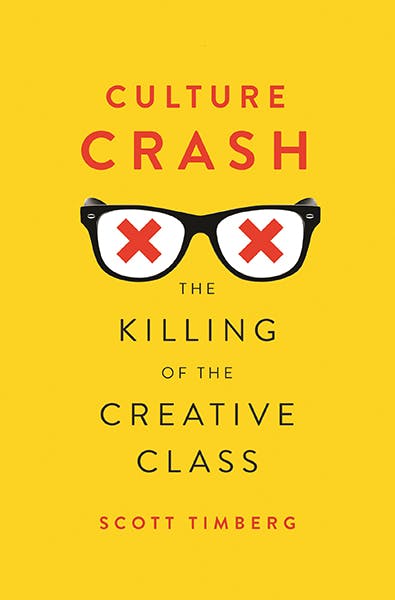
In an important analysis of this mess, Culture Crash: The Killing of the Creative Class, Scott Timberg delivers a potpourri of bleak statistics and appalling personal stories of talented and once-thriving artists reduced to penury or making-do. (All but two of the above statistics are culled from Timberg’s research.) Although Timberg reports no incidents of literal starvation, you shouldn’t doubt that whole throngs of onetime stable middle-class artists have been pummeled into a class where they feel the fangs of hunger. Culture Crash unloads information so soul-stomping that you read on hardly able to suppress barks of disbelief. You begin Timberg’s book suspecting that things are bad—you finish it convinced that they’ve never been worse.
One of the personal stories he relays is his own, the plot points of which have become agonizingly familiar. In 2008, “a risk-taking real-estate mogul” purchased the limping Los Angeles–area newspaper for which Timberg reported, and soon after, this mogul pile-drove the paper into the foreboding nullity of Chapter 11. Then hundreds were laid off, Timberg among them. For several queasy years he hobbled by, writing “for less and less money,” until his tiny home was foreclosed upon by a bank whose girth is global—a bank that was lavishly rescued from oblivion by tax money, and one that wouldn’t stoop to negotiate with a plebeian journalist in order to stay the foreclosure on his home. There’s a gut-jabbing scene in which he has to tell his five-year-old son that they are losing the only house he’s ever known, and the child asks, “But then we’ll come back, right?” Following the foreclosure, the locksmith who showed up to bar Timberg and his young family from their home drove a car “fancier and substantially newer” than Timberg’s own “seventeen-year-old Honda.” This is our shining world now, how we prioritize: Locksmiths earn stabler livelihoods than the makers and chroniclers of our culture.
As a middle-class kid—the grandson of a vaudeville pianist and a Ziegfeld dancer, the son of a writer and a schoolteacher—Timberg considered himself “in the third generation of people who had worked in culture without either striking it rich or going broke.” He didn’t harbor gluttonous ambitions of fame, but preferred this comparatively modest idea of success, one which he was certain would allow him to remain in the middle-class from which he’d sprung: “I could get really good at something if I worked as hard as I could and surrounded myself with what someone once called—in a phrase that now sounds antique—the best that had been thought and said.” It’s pretty to think so, but what artist anymore really believes those American mathematics, education plus hard work equals success? “We are the bastard offspring of Reagan and Warhol,” says Timberg, living in “an age of creative destruction.”
Golden-age nostalgia is usually a ruse we perpetuate upon ourselves. Every era has its own catalog of paranoia, its litany of panic about culture and creativity, and some of that paranoia and panic is cyclical. In Timberg’s above quote, the special someone at the helm of that “antique” phrase is Matthew Arnold1. In the preface to the 1875 edition of Culture and Anarchy, Arnold wrote that culture is “a pursuit of our total perfection by means of getting to know, on all the matters which most concern us, the best which has been thought and said in the world.” That “total perfection” is a characteristically Arnoldian construction and one that couldn’t be penned today without the self-defeating smirk of irony, latte foam on the upper lip.
A poet and critic of unstinting earnestness, Arnold never blushed when asserting his cultural idealism, one tinged with an urgency he knew was needed in a society polluted by modernity, by the spirit-sapping forces of the Industrial Revolution. He denigrates “our worship of machinery” and “our bondage to machinery” and the “faith in machinery,” certain that “culture looks beyond machinery,” that it “has but one great passion, the passion for sweetness and light.” That marriage, “sweetness and light,” reaches our ears as slightly silly, but Arnold, being Arnold, remains wholly sincere: Culture seeks to command ideas “freely—to be nourished and not bound by them.” In The Culture We Deserve (1989), Jacques Barzun points out that for Arnold, culture is still connected to cultivation, to tillage, to agriculture—till, plant, reap, and be nourished. Arnold also couldn’t have failed to have in mind Candide’s final words in Voltaire’s novella: “We must cultivate our garden.”
A generation after Arnold, English philosopher and novelist John Cowper Powys2 penned The Meaning of Culture (1929), an updated version of Arnold’s spiced polemic, one that emphasized the redoubtable benefits and felicities of art among a bloated consumer and populist vulgarity. “The aim of culture,” Powys wrote, “is to nourish within us”—that word again, nourish—“a sturdy yet sensitive organism that shall be able to deal with the eternal recurrences of life and death.” In other words, art and culture are “equipment for living,” in Kenneth Burke’s unimprovable definition of literature, but also equipment for dying, for a dignified acquiescence to the fate of all flesh. Reconcile yourself to your own death and nothing in life can reduce you.
For Powys, “the greatest of all obstacles to any deep, banked-up, sensitive culture is the inability to obtain leisure, the inability to be alone,” and consider, for a moment, the present searing truth of that claim, how insidiously plugged-in we all are, socially networked into an unsocial stupor, a mental truancy that teeters at the lip of catatonia. Powys recognized the necessity of attaining “a mind sensitive to rare and gentle things,” a mind adequately armored against “the frothy nothings of the hour.” Those frothy nothings are no longer of the hour—they are of the second. “There is no escape from machinery and modern inventions,” Powys wrote, “no escape from the dictatorship of the uncultured.” Revolutionary advances in information delivery—the phonograph, the photograph, the radio, the television—have tended to be chaperoned by yelps from the cultured, the bellows of those anticipating an end of books and the introspection they foster. Arnold and Powys had their worrisome inventions that changed the lineaments of civilization, and now we have ours, except all day long ours ding and ring, quack and quake.
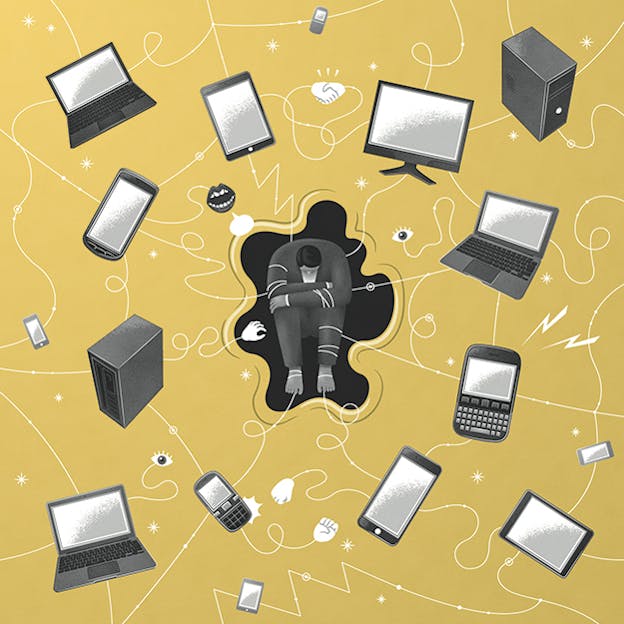
The problems Culture Crash unveils wouldn’t exist in their specific form without the always hungry Hydra of the Internet: “For generations with no memory of a world before the Internet, there is no outside, no independent ledge” from which to assess the madness. The Internet gets a bit of a lashing in this book, to be sure, but it’s not a bloody one. Timberg is aware of how quickly his study could have turned into an anti-Internet diatribe, how instantaneously he’d be branded a hysterical technophobe. And so he’s careful to say, again and again, that although the strafing autocracy of the Internet has led to the necrosis of print and a desperate restructuring of the music and publishing industries, it is not the only bandit guilty of filching livelihoods from middle-class artists. He has no wish to banish our gadgets of distraction or zap us back to a time before our colonization of cyberspace. When Timberg advocates for the virtues of print, he doesn’t mean that all print is sacrosanct while online essays and reportage are organically besmirched, a position he knows is demonstrably false. Rather, he laments the dissolution of the print-publication apparatus that allowed writers, editors, and photojournalists to maintain a middle-class life.
There are a number of culprits here. There are the Hobbesian market forces, the consumer-propelled capitalism so sweet for behemoth corporations who are its lungs and spleen but not so sweet for those artists who need to maintain their integrity outside the corporate sway. There’s the long-standing and nationwide dedication to anti-intellectualism—you can’t read Richard Hofstadter’s3 Anti-Intellectualism in American Life (1963) without pretty quickly coming to the conclusion that an exuberant distrust of the critical mind has been in our DNA since the Puritans. There’s the winner-take-all social credo that kills regard for any place other than first—we imbibe the No. 1 movie, the No. 1 album, the No. 1 book, and then we’re too blitzed and deadened for anything better. (Timberg calls it “blockbuster culture.”) There’s the academic obscurantism in English departments, pesteringly prevalent since the 1960s, that shoves students away from the tonic pleasures of literature just as those students are being seduced by the more practical interests of science, business, and technology. There’s the widespread caricature of artists as eccentric idlers or unstrung cranks, romantic boobs, or sexed-up wastrels we might be better off without.
Timberg sees the Internet as a confederation of all the most diabolical cultural trends of the last 50 years—a confederation that plunders both the wallets of middle-class artists and the minds of everyone else. But would all those who are now microwaving their minds online be under a tree cradling a copy of The Iliad if TMZ didn’t exist? Please do doubt that. Those microwaving their minds online would be microwaving their minds elsewhere, mostly before the quick-fire hues of their television sets. You are now subjected to an in-your-pocket, round-the-clock mental sacking, but 14 consecutive hours of outrageously inane TV is not a rarity among those with dishes on their roofs. There aren’t many books of social criticism that grow more relevant with the decades, but Neil Postman’s4 Amusing Ourselves to Death (1985), about the hourly blitzkrieg of electronic media, is one of them. The Internet didn’t create the human propensities for thievery and indolence, for vitriol and vacuity, for easy distraction and rapid gratification. It certainly capitalizes upon those propensities, but it didn’t build them.
But there remains this egregiously democratizing effect of the Internet: We believe that most online content is ours for the taking. The model of the online marketplace might be the chief obstacle preventing most middle-class writers and musicians from earning a living with their work, but it’s about time we, the users, come around to the moral side of the argument: We should purchase what we read and hear on our computers. “The human cost of ‘free’ becomes clear,” writes Timberg, “every day a publisher lays off staff … or a documentarian finds her film uploaded to YouTube without her permission.” If you care about the increasingly dejected plight of the creative class, there’s nothing stopping you from subscribing to a newspaper or magazine, or from paying for your music and movies online, just as there’s nothing stopping you from snapping shut your laptop and reaching for a hardback of Homer.
You’ve heard of all those shuttered bookstores, the already underappreciated librarians now thought members of the Pleistocene, the thinly attended performances of new musicians and artists, in part because it’s simpler to stay home in front of screens that hawk a deceptive sense of community. The cyberspatial nooks we all live in have begun, says Timberg, “to disregard actual human beings,” and human interaction, its dynamism of merriment and conflict, is crucial for the creation of serious art. Timberg is particularly astute on the thriving art scenes experienced in Boston in the 1950s, Los Angeles in the 1960s, and Austin in the 1970s, the mix of factors needed to converge in order for artists to flourish—including institutional support, low rents, a humming population in urban universities, an inviolable sense of a shared culture—and then on what happens when these cities are infiltrated by Hunnish bankers. When Robert Lowell5 was reconfiguring American poetry in 1950s Boston, “a life of genteel poverty was still possible.” Let me tell you, as a Bostonian—a life of genteel poverty is no longer possible, and hasn’t been for a long time.
American individualism has come to resemble a kind of hermitism, each artist before his own effulgent machine, without taut lifelines to his fellow strivers and makers. The roiling and reciprocal group, so central to the early achievements of Lowell and Plath and Sexton, has been replaced by synthetic socializing online, or by the cloistered academic department, which is how many artists in America, if they’re the lucky ones, are able to remain in the middle class. But when you’re an artist in academia, you’re only a part-time artist, at best. We’ve fled our public places of reciprocity and dialogue, and jettisoned any commitment to a joint culture. “For culture to work, we need a common language,” Timberg writes, “and it’s impossible to have one when we are becoming more culturally and economically divided every day.”
At the hub of this mess is how we as a nation perceive our artists and stewards of culture. Timberg quotes the cretinous views of citizens in Kentucky, who, after the Louisville Orchestra was pestled into bankruptcy, posted comments such as, “Pack up your fiddles and go home boys and girls. Maybe find real jobs,” and this faux commonsensical gem: “Get rid of the Orchestra. It isn’t popular with the residents or they would have packed crowds and not have to worry about $$$.” Timberg urges us out of this bamboozled, depleted mentation with which we permit the market to dictate the worth of things. The ennobling energies of an orchestra will never ring on Wall Street, nor should they.
Of all the realities chronicled in Culture Crash, what would the worst manifestation of the worst realities look like? No new art but corporate-driven celebrity kitsch, essayistic advertisements tapped out by algorithms, the annihilation of independent ideas and the thriving of ideological groupthink, an aesthetical tundra everywhere, a society of philistines that “tranquilizes itself in the trivial,” in Kierkegaard’s phrase. And what is the most we can hope for, what would the best manifestation look like? If worse comes to worst is only slightly more exasperating than if better comes to best and the best is far from good enough. Artists of independence and seriousness must not be debased into having to choose between nothing and nothing much.
Last December, Americans for the Arts emailed its supporters with some buoyant news for a torpedoed ship. The night before, the House of Representatives, in the midst of its trademark convulsions and incompetence, and by dint of some abracadabra, managed to pass a spending bill they dubbed “Cromnibus,” an alloy of the Continuing Appropriations Resolution and an omnibus bill. The $1 trillion in government funding includes nearly $300 million for the National Endowment for the Arts and the National Endowment for the Humanities, $30 million for the Office of Museum Services, $25 million for Arts in Education, and $445 million for the Corporation for Public Broadcasting. If you squinted during the midterm elections last year, you might have spotted some morsels among the famine: Citizens of Utah, the great red bastion of the West, voted for six ballot initiatives that would augment arts programs, and Rhode Islanders voted for $35 million to be distributed to various arts organizations across the state. Anorexic though they may seem and irrelevant as they may be when it comes to individual artists surviving year-to-year, those facts and numbers, nevertheless, look downright miraculous, an indication that perhaps all is not lost.
Timberg has no choice but to end Culture Crash with a modest toll of uplift, just as some have no choice but to find a bit of meaning in life after they learn that the cosmos is an achingly pointless accident. His final lines are a lovely picture of the world he’d like to live in. He can’t be faulted for offering no specific blueprint for betterment: The journalist’s objective is to report from the ditch, to slap us awake to the carnage stacking up around us. Because the artist’s woe has its origin in Washington and on Wall Street, in the very strands of our socioeconomic structure, and in the unkillable throbbing of the electronic marketplace, reversing that woe will take a revolution.
In the meantime, poke your elected representatives on the shoulder and say you won’t be voting for them again unless they have a cure for this pox upon the middle-class artist. Donate to arts advocacy organizations. Buy physical books from independent and used bookstores. Redden in shame should you partake of pirated music. Keep your mouse off Kim Kardashian’s ass. If you believe that the life of your mind is inseparable from the health of your life, that serious art and artists are an essential component to human nourishment, then you have an obligation, to yourself and your children and us all, to read Timberg’s book, and the minute you’re finished, to do something about the scourge it sets before you.
 Matthew Arnold (1822-1888) was one of the most influential English critics of the nineteenth century. With Browning and Tennyson, he comprised a Victorian poetical triumvirate. His masterful poem “Dover Beach,” about the modern retreat of religious sensibility, is at your fingertips in most anthologies of English lit. Arnold was the father of six children whose spirit-strangling day job was Her Majesty’s Inspector of Schools, so it’s something of a miracle that he manged to write anything at all.Photo: The Project Gutenberg EBook of Matthew Arnold, by G. W. E. Russell (via Wikimedia Commons)
 Unjustly forgotten now, John Cowper Powys (1872-1962; pronounced Cooper Pow-iss) was a formidable intellect and magpie with a pen. A bestseller on both sides of the Atlantic, he cranked out novels, short stories, philosophy, poetry, memoir, literary criticism, diaries, and more letters than you have the eye strength to read. Two of his favorite pen pals were Henry Miller and James Purdy, which might tell you something about Powys’s naughty proclivities.Photo: Public Domain, Wikimedia Commons
 Intellectual historian and one-time liberal darling Richard Hofstadter (1916-1970) twice won the Pulitzer Prize. His most popular essay is titled “The Paranoid Style in American Politics,” and if things looked paranoid in 1964, when the essay was published in Harper’s, how do they look now? A professor of history at Columbia University, Hofstadter had dubious views on students, especially those whom he considered mindlessly caught in the jerk and swirl of the ‘60s. His idea of enthralling class time was to read aloud from his own books.Photo: Courtesy of the University of Chicago Press
 Neil Postman (1931-2003) founded the Media Ecology program at New York University and authored more than 20 books on a range of social topics from childhood and language to technology and TV news. In the introduction to the 2006 reissue of Amusing Ourselves to Death, Postman’s son Andrew tells the story of when Postman appeared on “Nightline” with Ted Koppel. Postman was just then becoming famous for decrying our vassalage to TV. He said to Koppel, “For example, Ted, we’re having an important discussion about the culture but in thirty seconds we’ll have to break for a commercial to sell cars or toothpaste.” And Koppel responded, “Actually, Dr. Postman, it’s more like ten seconds.”Photo: Miami Book Fair International, 1999 (via Wikimedia Commons)
 An oft-repeated story about Robert Lowell (1917-1977) and his legendary nuttiness goes like this: Miserable as an undergrad at Harvard, Lowell headed south to Vanderbilt to study poetry with Allen Tate. When Lowell arrived in Nashville, he tried to get Tate to let him live at his house. When Tate wisely demurred, Lowell bought a tent and pitched it on Tate’s lawn. The story, like most outrageous stories, is probably only half true. What’s wholly true is that Lowell was the most dominant and consequential poet of his generation, achieving a celebrity rarely experienced by American poets.Photo: Elsa Dorfman (via Wikimedia Commons)
 Matthew Arnold (1822-1888) was one of the most influential English critics of the nineteenth century. With Browning and Tennyson, he comprised a Victorian poetical triumvirate. His masterful poem “Dover Beach,” about the modern retreat of religious sensibility, is at your fingertips in most anthologies of English lit. Arnold was the father of six children whose spirit-strangling day job was Her Majesty’s Inspector of Schools, so it’s something of a miracle that he manged to write anything at all.Photo: The Project Gutenberg EBook of Matthew Arnold, by G. W. E. Russell (via Wikimedia Commons)
 Unjustly forgotten now, John Cowper Powys (1872-1962; pronounced Cooper Pow-iss) was a formidable intellect and magpie with a pen. A bestseller on both sides of the Atlantic, he cranked out novels, short stories, philosophy, poetry, memoir, literary criticism, diaries, and more letters than you have the eye strength to read. Two of his favorite pen pals were Henry Miller and James Purdy, which might tell you something about Powys’s naughty proclivities.Photo: Public Domain, Wikimedia Commons
 Intellectual historian and one-time liberal darling Richard Hofstadter (1916-1970) twice won the Pulitzer Prize. His most popular essay is titled “The Paranoid Style in American Politics,” and if things looked paranoid in 1964, when the essay was published in Harper’s, how do they look now? A professor of history at Columbia University, Hofstadter had dubious views on students, especially those whom he considered mindlessly caught in the jerk and swirl of the ‘60s. His idea of enthralling class time was to read aloud from his own books.Photo: Courtesy of the University of Chicago Press
 Neil Postman (1931-2003) founded the Media Ecology program at New York University and authored more than 20 books on a range of social topics from childhood and language to technology and TV news. In the introduction to the 2006 reissue of Amusing Ourselves to Death, Postman’s son Andrew tells the story of when Postman appeared on “Nightline” with Ted Koppel. Postman was just then becoming famous for decrying our vassalage to TV. He said to Koppel, “For example, Ted, we’re having an important discussion about the culture but in thirty seconds we’ll have to break for a commercial to sell cars or toothpaste.” And Koppel responded, “Actually, Dr. Postman, it’s more like ten seconds.”Photo: Miami Book Fair International, 1999 (via Wikimedia Commons)
 An oft-repeated story about Robert Lowell (1917-1977) and his legendary nuttiness goes like this: Miserable as an undergrad at Harvard, Lowell headed south to Vanderbilt to study poetry with Allen Tate. When Lowell arrived in Nashville, he tried to get Tate to let him live at his house. When Tate wisely demurred, Lowell bought a tent and pitched it on Tate’s lawn. The story, like most outrageous stories, is probably only half true. What’s wholly true is that Lowell was the most dominant and consequential poet of his generation, achieving a celebrity rarely experienced by American poets.Photo: Elsa Dorfman (via Wikimedia Commons)