
Lucy says she starts early because ICE starts early. It’s around eight o’clock one Thursday morning in late October, at a coffee shop in Back of the Yards, a neighborhood on Chicago’s Southwest Side. Taped inside the shop’s glass door, a sign warns ICE not to enter without a judicial warrant. (The agents very rarely bother to get one.) More signs surround it: “Hands Off Chicago”; “Migra: Fuera de Chicago”; the phone number to report ICE activity. (These are all over town.) Free whistles sit at the register. Lucy buys a black coffee from the barista and joins me at a table, checking her phone for messages about potential sightings—not just of ICE, but also Customs and Border Protection and other federal agencies, such as the FBI and ATF, tasked with arresting immigrants in neighborhoods like this one. She has dark hair and a few tattoos reaching past her shirtsleeves, and, even at this early hour, her eyeliner is precise. As we wait, we stare out the café window at a nearly empty street, toward a candy-colored mural of clouds over a desert sunset. “There should be a street vendor right there,” Lucy says. There should be more than one. “It shouldn’t be this quiet.”
Volunteers like Lucy, doing ICE or migra watch shifts across the city, tend to work in their own neighborhoods. They are part of a network of rapid-response groups that have sprung up over the last few months to protect immigrant communities from the Trump administration’s brutal, far-reaching “mass deportation” program, led by Department of Homeland Security director Kristi Noem. It would easily take dozens of pages to provide a full accounting of the abductions, arrests, and protests that have taken place in Chicago as of mid-November. The Illinois Coalition for Immigrant and Refugee Rights, or ICIRR, posted verified sightings of federal immigration agents nearly every day in September and October. Shortly before I met Lucy, ICIRR identified federal agents in at least nine Chicago neighborhoods and suburbs on a single day: Melrose Park, Oak Park, Cicero, and more, as well as at the Kane County Courthouse and the O’Hare International Airport. At O’Hare, according to reports verified by ICIRR, at least 20 agents shut down exits at rideshare lots, demanded identification from drivers, and detained multiple people. All told, according to the Department for Homeland Security, more than 4,000 people in the city have been taken off the streets by federal agents and held in immigration detention facilities since September, in what the Trump administration calls “Operation Midway Blitz.”
The crackdown is vast, the stakes could hardly be higher, and the response from Chicagoans has been profound and far-reaching. The mayor signed an executive order designating city-owned property as “ICE Free Zones.” A federal judge required some of those overseeing the operation, such as Border Patrol commander Gregory Bovino, to testify under oath, and set schedules for them to update the court on the operation. But neither political nor legal interventions have managed to meaningfully interrupt what’s going on. ICE-free zones, residents report, do not stop ICE. And the slow-moving legal system can’t prevent agents from violating residents’ constitutional rights; indeed, the system largely functions to offer redress after the fact. Even when courts have ordered Immigration and Customs Enforcement or CBP to cease some violent action, such as lobbing tear gas into residential neighborhoods, agents ignored them. The scores of terrifying arrests continued.
The one response that has been genuinely effective has come from community members—ordinary residents who have come together, trained one another, and connected across neighborhoods to form groups like the Southwest Side Rapid Response Team. They have eyes on the street, the trust of their neighbors, and the ability to intervene practically instantaneously, sharing information with the ICE-activity hotline that operates across the state. They can record evidence and pass it along in seconds to rights groups, news media, and social media. Blending protest and direct action, they are offering something concrete to Chicagoans who want to express their opposition to Donald Trump’s war on immigrants. This is true movement-building, a project that may endure after this particular threat to immigrant communities, even after this regime. ICE, CBP, and others have violently retaliated against these groups in part because the agencies correctly understand what many do not: Organized neighbors are mounting an effective defense, and an organized movement is a formidable adversary.
On the far Southwest Side of Chicago, by Lucy’s estimate, hundreds of people have been working together since early September to defend their neighbors, joining thousands across the city. Just outside the parking lot of a nearby Home Depot on Western, a broad street dividing Brighton Park from Back of the Yards, one community group starts its shift at six in the morning: a couple of people with a table, folding chairs, and free coffee. Not far away, ICE uses the parking lot of a strip mall as a temporary base. Enforcement officers gather here, their faces covered in balaclavas, name badges stripped off their uniforms. They idle in their unmarked vehicles, some with the license plates removed. Then they caravan together to pick off people setting up food carts, taking their kids to school, or just out walking alone.
That’s when the notifications will hit Lucy’s phone, as well as hundreds, if not thousands, of other phones, passing messages within neighborhoods. “OK, let’s go to one spot,” Lucy says, grabbing her coffee and picking up a banana for later. She has a report of two suspected ICE vehicles nearby. Now she’ll try to verify the report before it gets shared more widely. If she can, she’ll trail them and report where they’re going, sending word through the network so that others close by can alert the neighborhood with their whistles, follow in their cars, and generally try to make ICE’s work as difficult as possible.
It’s no surprise, then, that these efforts have been cast by Noem and other officials as violent and criminal. Almost all of the people to whom I spoke for this story chose to use pseudonyms, to ensure that they can keep doing community defense work in this environment of new and escalating legal threats. Some are also immigrants or have immigrant family members to protect. People are risking a great deal to defend their neighbors, their students, their co-workers, and their customers, while trying to withstand the chaos caused by armed, masked federal officers operating on Chicago streets with apparent impunity. “What they’re doing is an occupation,” Lucy says. “It’s lawless.” And anybody questioning this reality, she tells me, “is living in their own fantasy land.”
The administration’s attack on Chicago began in early 2025, soon after Trump returned to the White House. Trump dispatched to the city his “border czar” Tom Homan, who belonged to ICE leadership under Barack Obama and was the architect of the family separation policy in Trump’s first term. With him, Homan brought along the television personality Dr. Phil McGraw, who was expected to broadcast the arrests as “exclusive” programming on his own streaming channel (launched when his long-running CBS show was canceled, reportedly for losing advertisers, after McGraw welcomed guests pushing far-right politics and conspiracy theories to his couch). The idea was to hit the streets with geared-up ICE agents and produce COPS-like online content along with terror. But the very public attack backfired: Although it generated news B-roll, it also galvanized Chicago residents, who shared legal resources with their neighbors and whose response may have helped drive down arrests. That’s what Homan seemed to believe. When he was asked about the operation on CNN, Homan complained that Chicagoans pursued by immigration officers were “very well-educated” on their legal rights. “They call it know-your-rights,” Homan said. “I call it how-to-escape-arrest.” It appeared that the agency had backed down on the operation. ICE instead focused on Los Angeles and Washington, D.C., to hone its tactics, giving community organizers in Chicago a few months to prepare.
While many of the rapid-response groups that formed during that period were new, and many people new to community defense work joined, the effort was “not our first rodeo,” as Lucy noted. Chicago is a big city, but the Southwest Side still feels like “an incredibly small town,” she explained, in which many of the community networks now involved in ICE watch already existed. Long before this wave of neighborhood organizing in Back of the Yards, immigrant workers at the Union Stockyards, Chicago’s meatpacking district, organized their own communities. Saul Alinsky’s famed neighborhood-based approach to community organizing took shape here. The European immigrant families are now mostly gone, but the Mexican immigrants who have lived and organized in the neighborhood since the 1920s remain, now joined by multiple new generations, most recently from Venezuela.
Many of the Venezuelan immigrants were forcibly bused to Chicago from Texas by Governor Greg Abbott beginning in 2022. Their arrival increased stress in some communities on the Southwest Side, where work and resources were already strained. But it also tied some communities closer together, with “lots of mutual aid work,” Lucy said. These mutual aid efforts served as a safety net for new immigrants in the city, often before the city offered them resources. Over the years, many were able to establish themselves. “It was honestly very cool,” Lucy remembered, to witness Mexican and Venezuelan food vendors working right next to each other. “It was something that we hadn’t seen.”
These are now some of the immigrants whose neighbors have come out to defend them from ICE. Even those who are at high risk of being detained have joined the rapid-response networks, whether to watch and report possible ICE activity or to visit with neighbors and document what happens after a family member is taken. By the time ICE launched its operation in Chicago in early September, neighborhoods were ready. Homan’s complaints were accurate: They were educated and they were trained. Now, when ICE arrives, “sometimes it’s not even the rapid-response team that starts with the whistles and the honking,” Lucy explained. “It’s the neighbors on the block.”
ICE or migra watch is a practice that grew out of the community defense strategies developed by the Black Panthers in the late 1960s, which inspired cop-watching across the country. It is most visible on the streets, where pairs or teams document law enforcement in their own neighborhoods. Participants used to use handheld video cameras; now their cell phone cameras do the job. But the work extends beyond the moments the officers are recorded. Over time, through direct experience, cop-watch groups come to understand patterns of policing. Some track and request public records of law enforcement activities to learn more. They educate their neighbors about their rights when police stop their cars or come to their doors, and coordinate care and outreach to support neighbors harmed by policing.
During the first Trump administration, immigrant rights groups in Chicago, like Organized Communities Against Deportations, were monitoring ICE and developing deportation defense, said Rey Wences, then a volunteer with OCAD and now the senior director of deportation defense at ICIRR. But it was after working alongside Black-led racial justice groups in the city, such as Black Youth Project 100 and Assata’s Daughters, that migra watch evolved. “We saw the connections,” Wences said, between deportation defense and cop watch, and OCAD asked if it could work with the other groups to build something tailored to watching ICE. The migra watch training ICIRR now leads drew inspiration from all those efforts. In September and October alone, Wences said, ICIRR trained more than 6,700 people. It feels like the organizing has reached “a critical mass,” they said. Indeed, ICIRR was only one of many groups training people up—“like a muscle we all flexed.” As with cop watch, ICE watch is not only a form of protest; it builds and demonstrates a kind of safety net that law enforcement cannot provide—that, in fact, law enforcement actively undermines.
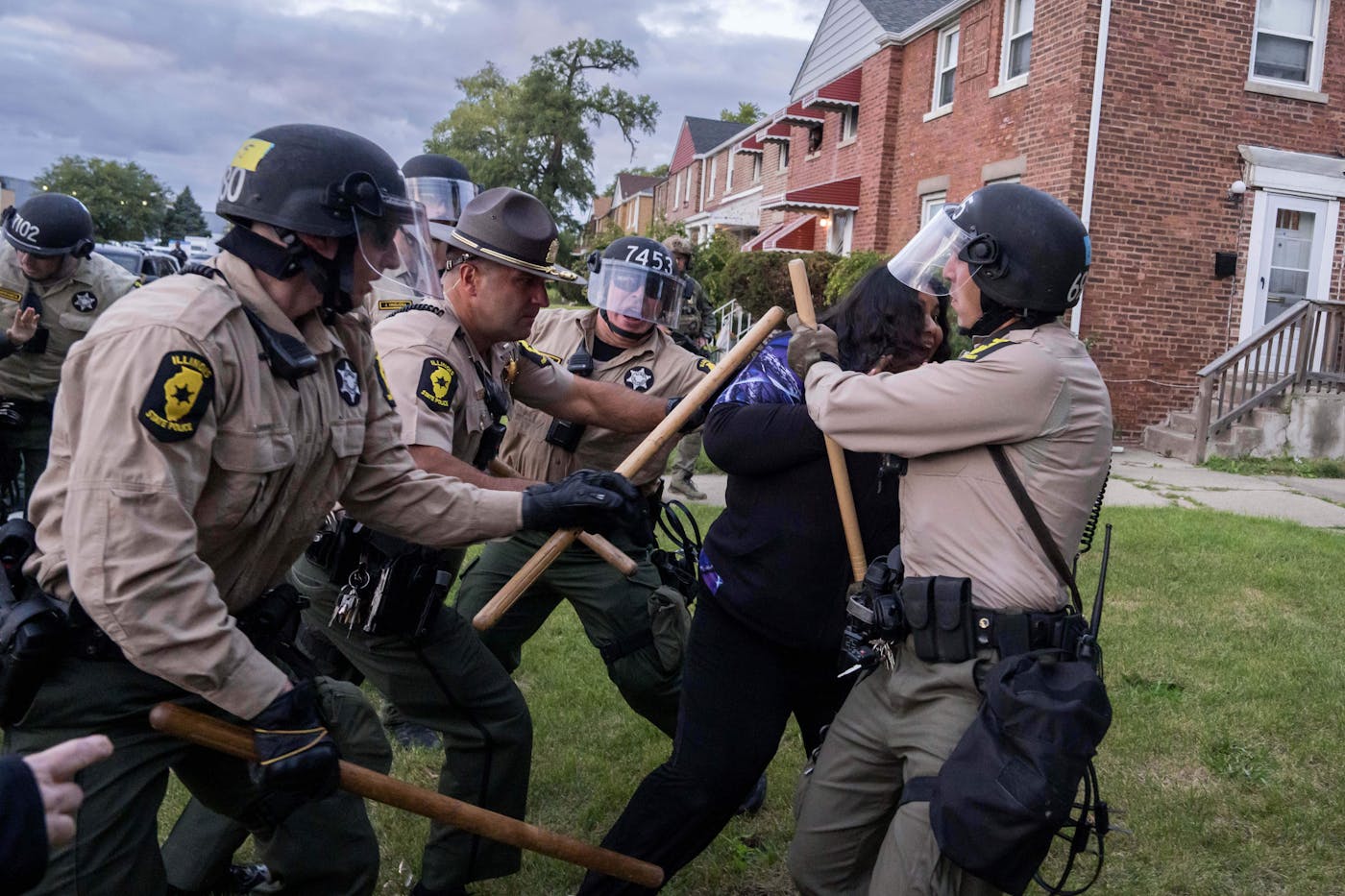
Contrary to the claims of Homan and many others in the Trump administration, federal agents drafted into anti-immigration enforcement operations do not protect residents from crime; they bring violence into communities, targeting not only the people they seek to arrest, but anyone whom they think stands in their way. They have shot tear gas onto residential streets, pepper-sprayed children and bystanders, pepper-balled clergy, and fired “less-lethal” weapons directly at press and protesters alike. In November, U.S. District Judge Sara Ellis issued a preliminary injunction limiting immigration agents’ use of force in Chicago, saying from the bench that their behavior “shocks the conscience.”
The injunction came as a result of a legal challenge filed by demonstrators, religious practitioners, and journalists (including the Chicago News Guild, which is part of the national NewsGuild-CWA, as is The New Republic’s union, the NewsGuild of New York). The challenge argued that federal agents’ use of force violated constitutionally protected protest and religious and news gathering activities. In her ruling, Judge Ellis singled out Border Patrol commander Bovino—who is often the only unmasked and clearly identified federal officer on the scene of ICE abductions and violence against community members—stating that Bovino repeatedly lied under oath about agents’ use of force. Hours later, Bovino was out with a caravan on the Southwest Side, as federal agents fired pepper balls at a moving vehicle in Gage Park and pointed rifles at people in Little Village. The operation, he told the Chicago Tribune, was “going very violent.”
At the Back of the Yards parking lot where ICE and other federal agents had mobilized, community organizers and students at the high school across the street have been pressuring the property owners, Friedman Real Estate, to refuse ICE access to the lot. The volunteers kept showing up, as early as they could, staying as late as they could, to patrol the lot and send the message to ICE agents that they, too, were being watched. They took photos of agents and took down their plates. After their constant patrolling, Lucy said, they saw ICE less frequently at that lot. The empty plaza I had passed that morning was a sign of success.
“I like to say they’re running from us,” Lucy said. “If we’re not already there, we’re coming in like two minutes.”
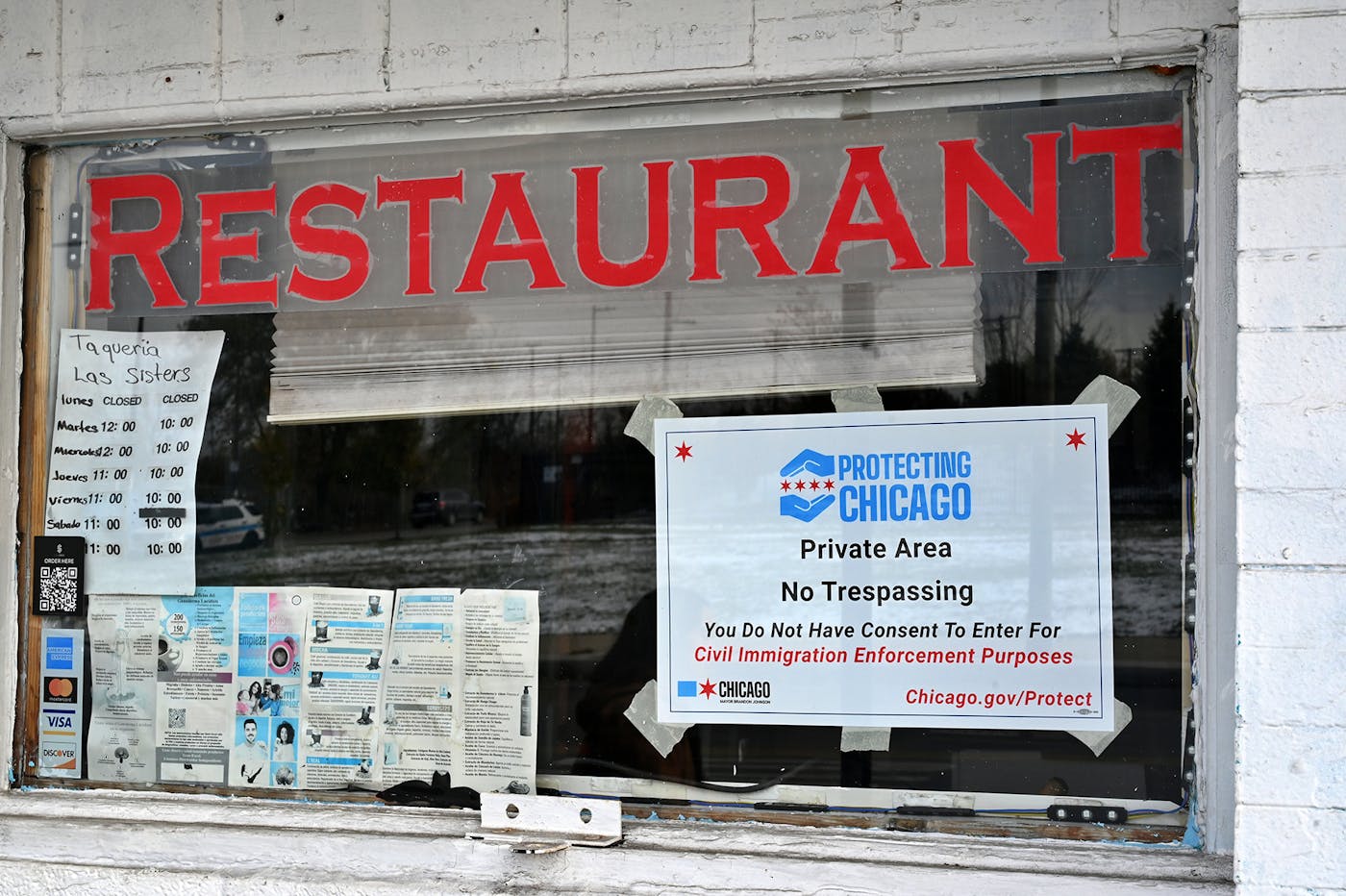
That morning in late October, driving slowly past family homes on tidy, city-size lawns, we see very few people out. Lucy pauses to let an older person pushing a cart of groceries cross the street. We pass “No Trespassing/Private Property” signs, a warning to ICE, and jack-o’-lanterns on porches. We drive by a patch of yellow marigolds pushing through a chain-link fence, a few clusters of banana-leaf plants. Every few minutes, the car’s sound system broadcasts notifications from Lucy’s phone, a specific ringtone she set just for rapid-response messages coming in. She gets updates on the cars we’re looking for: a boxy, oversize Jeep Wagoneer and an extra-large GMC Yukon truck. Over the weeks, the kinds of cars ICE uses have become very familiar.
Inflatable Halloween decorations wave in some of the front yards we pass. Outside of Gage Park High School, we pause to chat with a crossing guard in a yellow vest. Lucy rolls down the window. “I’m a neighbor in the area,” she explains. “We’re doing ICE watch, so just looking out for ICE vehicles.” New message notifications ding again. “We got reports of a Wagoneer, which, you don’t see too many Wagoneers around here, they’re long and boxy…. I figured I would let you know, just in case.” Before she is done, the crossing guard is already repeating, “Just in case. All right. Thank you,” like this happens all the time. It’s not her first rodeo either.
“Operation Midway Blitz” is not merely an immigration enforcement operation; it is a monthslong offensive meant to break down people’s resistance, a deliberate campaign of political violence and social disruption. Such brutal anti-immigration policing itself is not new, even if it may be newly evident to people in Los Angeles, Washington, and elsewhere, who have not experienced their family and neighbors disappearing. But it is new that ICE and Border Patrol are rolling out daily in caravans; it is new that Border Patrol is unleashing tear gas and firing flash-bang grenades at bystanders. It’s also new that all this is happening at once to a whole city.
ICE has also turned on those residents who dare document and track them across the city. On October 20, reported The TRiiBE, a local independent news site, an attorney named Scott Sakiyama, who had been following immigration agents in his car, was detained by them at gunpoint. Sakiyama had defended a man who had faced federal charges for allegedly assaulting a Border Patrol agent outside the immigrant “processing center” in Broadview, an inner suburb of Chicago. The government had already dropped the prosecution. But when Sakiyama spotted armed, masked immigration agents driving in Oak Park and blew a whistle to alert neighbors, agents stopped him. “Exit your vehicle, or we’re gonna break your window and we’ll drag you out,” one said. This all took place across the street from Abraham Lincoln Elementary School, where one of Sakiyama’s kids is a student. He was loaded into the agents’ vehicle and driven to the Broadview detention facility, where he was merely given a citation and returned to his car. “The federal government is intent on abusing its power to kidnap and violate the rights of our friends and neighbors,” Sakiyama wrote in an Oak Park neighborhood Facebook group, “and now, they say it is a crime to tell your neighbors this is happening.” He encouraged people to attend a rapid-response training and start their own whistle brigade. ICIRR now holds virtual trainings every week; the one I dropped in on in late October was attended by more than a thousand people from dozens of neighborhoods.
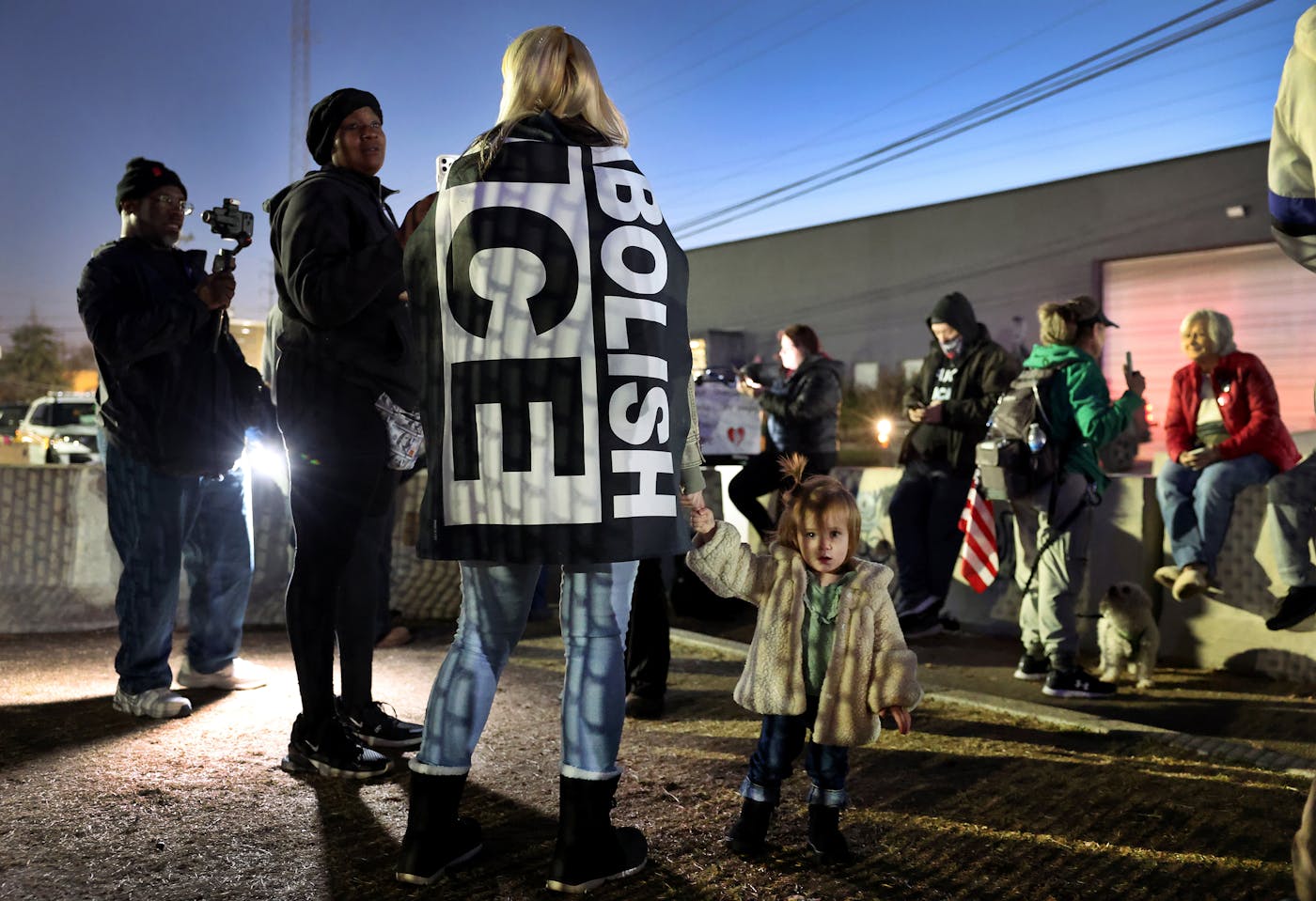
As community-based defense projects have ramped up, some local elected officials have supported them. Some, like Alderwoman Jessie Fuentes, have been detained while defending their constituents. Others have ignored their constituents, or, in the case of Democratic Alderman Raymond Lopez, who represents part of Back of the Yards, welcomed Tom Homan and defended Operation Midway Blitz. On a night in late October when Lopez was scheduled to have open office hours, the doors were locked and the lights were off as community members announced a protest there. Jaime Perez said his girlfriend, a tamale vendor, was taken by ICE near 47th Street and Western, and his calls to Lopez for help were ignored. “He wouldn’t come to the phone,” Perez said. As the sun set, Leslie Cortez spoke about the raid she witnessed on 47th Street. “Our community deserves someone who will fight for us,” she said, “not against us.” Before they left, they taped a letter to Lopez’s office door demanding that he resign.
But among even the more sympathetic government leadership, Chicagoans’ political efforts to protect immigrant communities have only gone so far. Chicago Mayor Brandon Johnson has referred to the protection afforded by the city’s welcoming ordinance, which is meant to prohibit collaboration between immigration officers and Chicago police, but when ICE and Border Patrol roll through city neighborhoods, the police have been right there. Residents have been told that Chicago police are prohibited from engaging in immigration enforcement (unless ordered to do so by a court), when they can see with their own eyes that Chicago cops are clearing roads for the fleets of sports-utility vehicles and oversize trucks used by ICE and Border Patrol to haul people to Broadview. Illinois Governor JB Pritzker has gained a national reputation as a leader who stands up to Trump and his mass deportation machine, but outside Broadview, where activists, religious leaders, and media gather, the officers firing tear gas and pepper balls at them are Illinois State Police, sent there, according to Pritzker, to “ensure people could safely express their rights.”
Some of the time on migra watch, it can look like nothing is happening. We drive in silence, weaving between Back of the Yards, Gage Park, and Brighton Park, past bakeries and salons and auto body shops, looking twice at any oversize car we see. Suddenly, Lucy asks her phone for directions. “So they are here,” she says. “I’ll keep my distance.” More notifications are going off. Lucy sees what might be an ICE SUV, but as she puts on her blinker and turns to follow, a Chicago Police Department car pulls across her car’s path. Local cops are not supposed to be out here. We hear people honking, leaning on their horns, not that far off.“Is the honking because it’s—” I start to ask, and she says it is, as she grabs a few things in case she needs to hop out and starts dictating a message: “I’m pretty sure I saw that large white SUV, no plates in the front, but as I tried to turn, CPD kind of blocked me.” She gives the intersection where CPD still is. Regardless of the reason the police were there, now she’s lost sight of the SUV. She plays back a video from a few minutes ago on her phone, hoping it shows the direction of the SUV, and the honking fills the car speakers. A few other people saw the SUV as well; Lucy is following their directions now. “It seems like there’s a lot of people out right now,” she says, “which is nice.”
As we drive, we see them, more and more people out on the streets, watching. On a corner at a gas station, a small group of people, some in KN95 masks, stand on the grassy strip at the side of the road, watching. At the Home Depot, Lucy parks and hops out to say “hi” to the people at the table near the parking lot, expecting them to shut down for the morning. A new shift of volunteers, however, has come to stay longer. Another small group is out on a side street lined with houses: four young people in hoodies and puffer coats. They repeat the ICIRR hotline number on a megaphone as they walk. Lucy tells them about what she saw, and they head right back out on foot. “Small town, small town,” Lucy says to me, and we drive off.
We loop around a few more times, checking out a nearby park. We’ve been out for 40 minutes; to me it feels like five. The adrenaline, even at this distance from the action, warps time and attention—every siren might be something. A helicopter looms overhead. When we drive past the crossing guard again, she and Lucy exchange friendly waves.
It can feel like ICE agents are everywhere. That, presumably, is how they want it to feel. At the same time, more and more people who have never engaged in anything like these actions before are purposefully running toward the trouble. As much as their resistance can appear organic and spontaneous—and some of it is—it’s supported by deliberate effort, an infrastructure working to help them expand their tolerance for taking risks.
There’s the know-your-rights trainings, which, like ICE watch trainings, long predate this moment. In the past, however, those were typically offered within a smaller community made up mostly of other organizers. Since Midway Blitz, the groups ramped up because ICE ramped up. They had to scale up know-your-rights trainings to work for mass audiences. They needed to do more than just arm people with information about their rights; now they had to teach “what do you do when an agent is right there,” Lucy said, “right outside your door or right in front of you.” Learning that, she said, enables them to walk out the door and “blow their whistle the minute they identify a car.” Once people know how to defend their own rights, in other words, they don’t stop there—as the last months in Chicago have shown, they turn to defending others.
Intentional or not, this way of spreading rapid-response work ensures that there’s no one point of failure. Multiple groups are employing multiple communication platforms, and generating new methods as they go. New people join them, “just coming up with their own ideas on how to defend Chicago,” as Lucy put it. It turns out that you can’t just gas and detain everyone in the streets. There will be more people tomorrow.
On her phone, Lucy sees that Customs and Border Protection are a few neighborhoods away, in Little Village. A video from the scene plays over the speakers as we drive, birdsong and car sounds and a man calling, “Hey, how you doing!” and what might have been someone else yelling “Fucker!” We can’t join; Lucy’s shift is done, and she has to go to work. By the time I could get there, it will likely have ended. She offers to drop me at the train station. On the platform, I watch a Facebook Live video from the scene, streams of hearts and sad crying emojis floating up over an intersection flooded with Chicago police.
Baltazar Enriquez had been recording ICE for almost an hour by the time I tune in. He was following the federal agents’ caravan at the same time that, a few neighborhoods away, we were driving around Back of the Yards. Witnesses hopped out of their cars, turning their phones toward the agents and yelling, “Shame! Shame! Where’s your warrant? Why are you terrorizing us? Why? Why?” They walked toward the agents, phones up. One woman had a megaphone. The agents kept their faces fully covered with black and camo balaclavas and reflective sports sunglasses. They pointed their long guns at the ground as they paced. “Leave! Leave!” A few agents got back into their white SUV. There was Gregory Bovino, standing next to an agent in a gas mask holding a weapon with a tear gas canister. “Don’t do it! Don’t do it, Bovino.” Overhead, a helicopter buzzed. “ICE go home. ICE go home.” Chicago police formed a line as the feds retreated behind them. The people clustered at an intersection. Someone wore an inflatable pink axolotl costume, Mexican and American flags flew, whistles were distributed. I was still on the train when Baltazar, streaming on Facebook, asked some people to walk with him to another neighborhood to patrol—“Gage Park,” he said, where Lucy and I had just been—and logged off. It was hard to reconcile the violence on the live stream 15 minutes away and the quiet around us. No one was taken from any street we passed. It could feel like nothing happened, except for all the people we saw as we were watching, watching, too.


