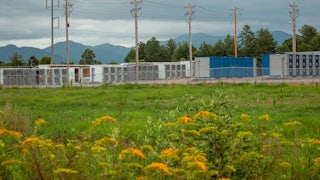
In recent months, a particular word has begun to circulate with striking insistence in press releases across the United States. Technology companies and government officials announce the construction of “data center campuses.” Not plants or factories or warehouses or complexes, but “campuses.”
In October, OpenAI and Oracle unveiled a $7 billion data center in Michigan, celebrated as the state’s first “hyperscale campus.” Last month, officials in Wythe County, Virginia, announced a “data center campus” as a marker of economic progress. This month, AVAIO Digital declared plans for a large-scale AI-ready “data center and power campus” in Little Rock, Arkansas.
None of these projects resemble anything most people would recognize as a campus. These are industrial facilities designed to house computation at scale. They consume immense quantities of electricity and water. They employ very few people on a permanent basis. They are typically insulated from the surrounding community, both physically and economically. To call them campuses is ridiculous—unless, of course, the point is to provide the sheen of civic legitimacy, obscure how few humans are actually involved, and gloss over questions of the true public value of these operations.
The word campus derives from the Latin for “field,” but in English, campus has come to mean far more than a plot of land with buildings. It is a place ordered toward people engaged in shared work. Universities and hospitals are called campuses because they gather persons into long-term relationships of teaching, healing, labor, and deliberation. More than a field between buildings, a campus is the setting for purposive human interactions.
The corporate adoption of the word campus is not new. Technology firms such as Apple and Google have long described their headquarters as “campuses,” as have pharmaceutical companies and government agencies, borrowing the language of universities to describe large, centralized workspaces. These earlier uses still referred to places where thousands of people gathered daily for work—where cafeterias served meals, collaboration happened in person, and the site functioned as a hub of human activity. The word stretched, but it retained a connection to its original meaning as a place of congregation.
Data centers snap that connection entirely. A data center does not gather people. According to a 2024 report by Virginia’s Joint Legislative Audit and Review Commission, these buildings typically occupy hundreds of thousands of square feet on hundreds of acres of land while supporting only a few dozen permanent workers, many of them contractors, with most operations managed remotely. In spaces measured in football fields, the human presence is counted in dozens. Calling such facilities “campuses” does more than extend a metaphor; it normalizes economic activity that requires almost no people at all.
A data center is a highly engineered industrial facility designed to house servers and processing equipment in which digital information is stored and transmitted. Its value, particularly in the age of generative AI, derives from automation, redundancy, and uninterrupted operation rather than human participation. Yet technology companies persist in borrowing the language of communal life to describe facilities that are, by design, indifferent to it. This appropriation is not accidental. It performs political work.
Data centers upend a lot of our background assumptions about how new industrial installations work. A single hyperscale facility can draw as much electricity as a midsize city while employing relatively few people. The Michigan facility, for example, will consume enough power to serve roughly one million homes, while the most generous employment projections suggest a maximum of 450 jobs. Local communities provide land, electricity, water, roads, and public subsidy. The benefits that return are thin, narrowly distributed, and often speculative.
When executives and governors call these facilities “campuses,” they borrow the moral authority of institutions that belong to communities. Universities and hospitals justify their presence through enduring obligations to students, patients, workers, and neighbors. To describe an industrial server warehouse as a campus is to appropriate that legitimacy while bypassing moral obligations.
Language here functions as infrastructure. It shapes how power is interpreted and how consent is secured. In 36 states, legislatures have provided subsidies to facilitate the establishment of data center sites. Here in North Carolina, for example, the legislature has codified in statute tax exemptions on the energy used by qualifying data centers. When a legislature is asked to subsidize a campus, the word itself implies permanence, shared benefit, and civic contribution, even though, in the data center case, the facility may be largely empty of people.
The technology sector has become adept at this: absorbing relational language and redeploying it to describe operations that systematically reduce the need for human presence. Ride-hailing platforms described themselves as part of a “sharing economy” while dissolving labor protections. Social media companies publish “community guidelines” for platforms that frequently unmake actual community. Virtual environments promise presence without bodies and connection without obligation.
The data center “campus” belongs to this same lexicon. It allows political leaders to reassure the public that something recognizably civic is being built, even as the material reality points in the opposite direction. It offers the image of community while delivering only machinery. It suggests development when the truth is extraction. Calling these vast sites “campuses” rather than “data factories” or “computing mines” makes relevant questions less likely to be asked. The word provides a kind of camouflage for tech companies and their governmental collaborators.
If an industrial facility can be redescribed as a campus, opposition begins to sound unreasonable. Who would oppose a campus? The transformation of language precedes the transformation of land and place.
True anchor institutions are difficult to counterfeit. We write this article as professors in a university village and as defenders of our local rural hospitals. In communities like ours across the nation, universities and hospitals are embedded in the places they inhabit. They shape economic opportunities for our neighbors. They require sustained investment in people. Sometimes they generate conflict as well as benefit because they are sites of genuine human encounter.
Data centers, on the other hand, are intentionally placeless, though seizing land in rural counties with little input from the surrounding townsfolk. Their labor requirements are minimal. Instead, they seek cheap power, permissive regulation, and public subsidy—using land more like strip mines or concentrated animal feeding operations than universities or hospitals. Data centers aren’t so much institutions that belong to communities as infrastructure—like a pipeline—that merely passes through them.
The pipeline analogy is telling: Advocates of data center expansion often point to secondary benefits, such as temporary construction jobs or symbolic inclusion in the future of artificial intelligence. But as with pipelines, the benefits are real but fleeting, while the costs endure. Data centers put a long-term strain on power grids and water systems, competing with communities for these resources. They lock in energy-intensive infrastructure at a moment when our places and all their creatures need restraint. They foreclose alternative land uses that might have supported more durable employment or social value. Algorithms and AI increasingly shape our experiences and our relationships at the individual level, while the data centers that birth them erode the natural resources and spaces that make up our communities at a macro level.
Some amount of digital infrastructure is necessary for modern life. But words are not ornamental. They are part of the moral ecology of a place. And with artificial intelligence, we’ve begun to accept a vocabulary that disguises invasion as belonging and automation as community. We’ve begun to allow words that once named shared work and mutual responsibility to be repurposed for projects that actively diminish both.
A campus is a place where people gather. If the place is for machines with just a few people to keep them running, we should say so plainly.