Life in a Warming World
A weekly reckoning with our heated planet—and the fight to save it

Trump’s Terrifying Davos Speech Is a Wake-up Call to the Global Elite

The World Economic Forum has long suggested that its annual lavish party is about saving the world. Trump just shredded that myth.

President Trump is seen in profile as he gestures while speaking at a podium labeled "Annual Meeting Davos 2026." Behind him is a purple screen with "World Economic Forum" printed on it.
Bloomberg/Getty Images
President Donald Trump at the World Economic Forum on January 21

On Wednesday, President Trump traveled to Davos, Switzerland, for the World Economic Forum and delivered a speech that was unusually unhinged, even by his standards.

He claimed to have solved the energy requirements of the AI boom. He said, “There are windmills all over Europe, there are windmills all over the place, and they are losers.” He claimed would-be drillers had come to him asking for his help against the radical left so they could extract oil in the North Sea. He said China sells wind turbines to fools, but “I haven’t been able to find any wind farms in China.… They sell them to the stupid people, but they don’t use them themselves.”

He claimed the United States deserved to get Greenland now after defending it in World War II. He said the U.S. has even better battleships now than it did then. He mixed up Greenland and Iceland, saying Iceland “loved me. They called me Daddy.” He said the U.S. needed ownership of Greenland because “you can’t defend it on a lease.… Psychologically, who the hell wants to defend a license agreement or a lease which is a large piece of ice in the middle of the ocean, where, if there is a war, much of the action will take place on that ice? Think of it, the missiles will be flying right over the center of that piece of ice.”

He talked about young soldiers’ heads being “blown off” in the war in Ukraine. He threatened to prosecute people over the results of the 2020 election. He boasted about his chauffeur being able to do a better job than NATO generals, “and he makes slightly less than 50[k].” He mentioned Emmanuel Macron’s sunglasses, and affected a French accent while relating a conversation he and Macron had about prescription drug pricing. He said he was working “to ensure the U.S. remains the crypto capital of the world.” He said Minnesota Representative Ilhan Omar “comes from a country that’s not a country.” He said he could destroy the U.S. housing market if he wanted to.

It wasn’t so long ago that traditional media outlets felt obligated to pretend that the World Economic Forum meeting in Davos had something to do with saving the world. Even after financial executives crashed the economy into the Great Recession, the technocratic optimism of the Obama years drove the myth forward. (U.S. Treasury Secretary Tim Geithner was treated like something between a genius and a Hollywood philanthropist.) We were meant to believe that the CEOs weren’t there to lobby politicians, the politicians weren’t there to shop for lucrative post-political gigs, and the academics weren’t there for the caviar or to see Charlize Theron. Instead, all of them were there to solve malaria—or global poverty, war, HIV, and the climate crisis.

The climate crisis was always the issue that most thoroughly exposed the absurdity of this conceit. With malaria, poverty, HIV, and world peace, leaders could at least pretend that getting everyone together in the same ski town for a big party was like buying a lot of athletic wear for a New Year’s resolution to go to the gym.

With climate change, however, it was more like buying a lot of athletic wear and then taking a cab across town in the opposite direction from the gym. Oil companies were formal partners for the event, which was marketed as being carbon-neutral while it involved a bunch of corporate and governmental executives flying via private jet to an Alpine town whose signature sport climate change is currently decimating. The confab hyped “solutions” like carbon credits and carbon capture that would allow corporations to keep polluting as usual—even as rigorous reporting showed a lot of carbon credits weren’t backed by real reductions and carbon capture wasn’t yet feasible at scale. Panelists who pointed out the problems with this approach, as TNR’s Kate Aronoff noted in 2023, were patronized and dismissed. The companies that were bragging about their net-zero goals in those years have now abandoned them altogether.

Now Trump has dropped this wild, threat-filled tirade into the mix. He’s demanding ownership of Greenland, threatening catastrophic trade wars, hinting at military takeover, all while asking world leaders to pay $1 billion to join some sort of security racket that’s presumably intended to replace NATO, which he seems determined to destroy. There’s a rich tradition in media of treating Davos as an entertainment story, but that may be hard when there’s a credible risk of armed conflict or economic destruction.

Yet as off-the-wall as Trump’s speech was, it’s hard to argue that he fundamentally misunderstood the assignment. Yes, this is different in kind from what has gone before. But Davos has always been a racket—albeit one that’s usually a little more veiled by civil discussion and closed doors. Maybe this is the year that finally exposes the Davos myth. Trump’s tirade was terrifying, but we all should have been scared much, much earlier.

Stat of the Week
100 million acres

That’s how much extra land would be needed, according to a recent estimate reported by The Guardian, if Americans were to modify their diets even part of the way toward RFK Jr.’s new food pyramid—increasing meat consumption by 25 percent.

What I’m Reading

A California Climate Expert Is Working to Restore Climate Risk Scores Deleted by Zillow

Last fall, the real estate platform Zillow quietly stopped publishing climate risk ratings on its listings. Having one’s home wiped out tends to ruin people when it doesn’t kill them, but talking about that is apparently too much of a bummer for the real estate industry. Now, Inside Climate News reports, there may be a way to DIY it:

Neil Matouka, who previously managed the development and launch of California’s Fifth Climate Change Assessment, is developing a proof of concept plugin that provides climate data to Californians in place of what Zillow has removed. When a user views a California Zillow listing, the plugin automatically displays data on wildfire and flood risk, sea level rise and extreme heat exposure.

“We don’t need perfect data,” Matouka said. “We need publicly available, consistent information that helps people understand risk.” … Both independent academic research and research conducted by Zillow has found that disclosing flood risk can decrease the sale price of a home. “Climate risk data didn’t suddenly become inconvenient. It became harder to ignore in a stressed market,” First Street said.

Read Claire Barber’s full report at Inside Climate News.

This article first appeared in Life in a Warming World, a weekly TNR newsletter authored by deputy editor Heather Souvaine Horn. Sign up here.

Authoritarianism Is Climate Policy

The Trump administration’s imperialist, repressive rampage is a classic response to escalating crisis.

President Trump is seen from the nose up in a white, USA cap.
Mandel Ngan/Getty Images

The Trump administration will stop counting lives saved in its cost-benefit analyses of air pollution regulations, and instead will only consider the cost to businesses. “It’s a seismic shift that runs counter to the [Environmental Protection Agency]’s mission statement, which says the agency’s core responsibility is to protect human health and the environment,” The New York Times reported this week. “The change could make it easier to repeal limits on [fine particulate matter and ozone] from coal-burning power plants, oil refineries, steel mills and other industrial facilities across the country.”

Declaring the demise of climate policy is practically a weekly media event these days. “The climate agenda’s fall from grace over the past year has been stunning—in scale and scope,” wrote Axios’s Amy Harder in this week’s installment, noting that the president recently withdrew from the United Nations Framework Convention on Climate Change. “Whether this collapse in climate-change ambition proves permanent or temporary will shape the planet—which is still warming in unprecedented ways—and trillions of dollars in global energy investment.”

Of course, the “collapse” has not been stunning in any way: It is precisely what the Trump team promised, and the international repercussions are precisely what experts predicted. But more importantly, can one even call it a collapse? The vague phrase “the climate agenda” is doubtless intended to conjure Greta Thunberg and the Green New Deal, and yes, that agenda has been summarily abandoned by a lot of politicians of late. But Trump does have a climate agenda. It’s just a negative and bloody one, as it’s intertwined with his authoritarianism.

Consider the U.S. military invasion of Venezuela. However murderous and abusive Maduro’s regime, killing some 75 people to kidnap him and having no clear plan to stabilize the country—except to exploit oil reserves that would blow 13 percent of the global carbon budget by 2050, making life costlier and more precarious for everyone but oligarchs—is clearly not a humanitarian intervention. It’s an intervention, albeit a very clumsy one, on behalf of the business interests Trump’s chummy with.

It’s the same principle on display with Greenland. Trump is proposing a forced takeover of a sovereign territory in order to dictate the terms of extraction of rare earths and fossil fuels, while seizing a slice of the rapidly melting Arctic pie. The administration claims this is a matter of national security, but it’s hard to see how overturning the NATO table and smashing it to smithereens will make ordinary people safer—particularly if this unleashes Russia and China to pursue similarly imperialist plans. What it will do is enrich the companies that get lucrative contracts.

Authoritarianism is a response to climate change, as numerous people have warned for years. That includes imperialism and the race to secure resources, the criminalization of protest, and anti-immigration policy. It’s not an attempt to prevent global warming, but rather an attempt to protect a chosen few—to build a wall, whether figurative or literal, around a certain class of people.

The new EPA policy, which explicitly rejects lives saved as a lesser concern than business profits, exposes this line of thinking. You’ve heard it before, though. Fighting climate change would be too costly, so the narrative goes. Costly to whom? Not fighting climate change is already very costly to everyone else, whether in terms of affordability or lives lost.

Insofar as there is hope in all this, it lies in the mounting body of evidence that this approach is in fact extremely unpopular. Voters overwhelmingly oppose the Trump administration’s moves to shut down climate research. They oppose gutting the regulations limiting pollution. And they increasingly see the connection between the climate crisis and the cost-of-living crisis. The authoritarian sales pitch has always been about convincing voters that they are to be a part of the protected class. More and more people are now saying they’re not convinced.

Stat of the week
13 percent

Current U.S. plans to exploit Venezuelan oil reserves would burn through 13 percent of the global carbon budget needed to keep warming under 1.5 degrees, the Guardian
reports.

What I’m Reading

RFK Jr. Forgot What Makes Us Healthy

The recently released inverted food pyramid has a lot of problems. Emily Atkin cuts to the heart of the matter.

This is my biggest problem with the new food pyramid. It treats food as a purely biological input rather than a public ecological choice—as if health exists on a separate plane from the land, water, and climate that make nourishment possible in the first place. Thinking this way may make sense for individual bodies in the short term. But in the long term, and in the aggregate, it’s deeply irresponsible.

You cannot build a healthy society on top of an unhealthy biosphere. The climate, water, soil, and land that produce our food are as important to our health as the food itself. Without them, all our talk of “healthy eating” becomes a kind of denial—pretending we can thrive while the systems that keep us alive break down.

Read Emily Atkin’s full essay at Heated.

This article first appeared in Life in a Warming World, a weekly TNR newsletter authored by deputy editor Heather Souvaine Horn. Sign up here.

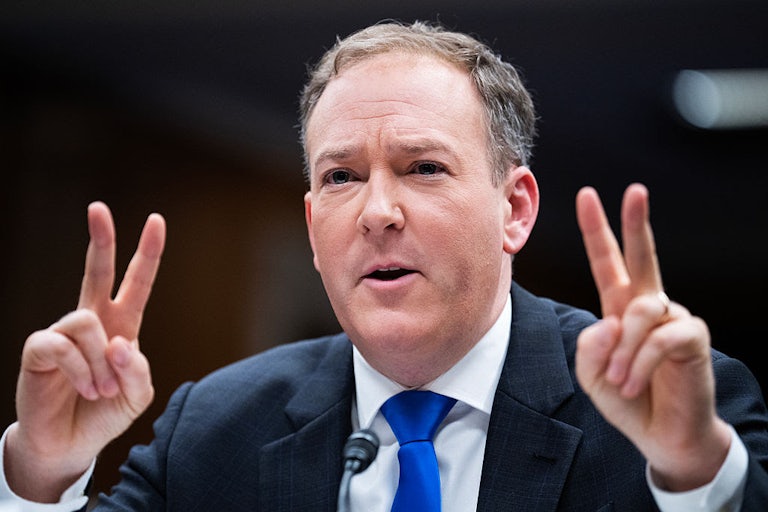
MAHA Is Coming for the EPA’s Lee Zeldin

The EPA chief has angered Make America Healthy Again adherents with his pesticide policies and other positions. Who will win this fight?

Lee Zeldin holds up two fingers on each hand in an apparent "scare quote" gesture.
Tom Williams/Getty Images
EPA Administrator Lee Zeldin

You’d need a full-screen infographic with live updates to keep track of all the MAGA infighting these days. President Trump’s chief of staff, Susie Wiles, is trashing him in a new Vanity Fair interview. Stephen Miller wants to get rid of Kristi Noem. Marjorie Taylor Greene has called Trump’s comments on Rob Reiner’s death “classless” and “wrong,” and warns that the “dam is breaking” in GOP support for the president. Candace Owens, Nick Fuentes, and Tucker Carlson are brawling over their conspiracy theories concerning Charlie Kirk’s death, and also Israel, a topic that likewise divides Tucker Carlson and Ben Shapiro. Shapiro has in turn denounced Heritage Foundation leader Kevin Roberts for defending Carlson after Carlson hosted white nationalist Holocaust-denier Fuentes on his show. Heritage staffers are also angry about this.

But there’s also another feud that’s been simmering quietly for months: The Make America Healthy Again movement has beef with EPA Administrator Lee Zeldin. This was in theory predictable, given that Zeldin has packed the Environmental Protection Agency with chemical- and ag-industry veterans, while MAHA wants to rid the world of environmental toxins. But the fight was brewing for a while, so it’s interesting to see it finally break out in public. And the exact outcome of the conflict remains to be determined.

The MAHA movement associated with Health and Human Services Secretary Robert F. Kennedy Jr. has always had, shall we say, an above-average rate of producing strange bedfellows. In their pursuit of healthy lifestyles, these groups and influencers advocate vaccine and pharmaceutical skepticism; ridding the nation’s water supplies of both fluoride and the abortion drug mifepristone; returning to raw milk; regenerative agriculture; eliminating soda and sweets from SNAP; and stricter regulation or outright bans of food dyes, preservatives, pesticides, PFAS, microplastics, and other pollutants.

Zeldin’s EPA, however, has been steadily rolling back various chemical regulations and clearing the way for expedited pesticide approvals. In late October, several MAHA advocates met with top EPA officials to “express concerns” about pesticide use and contamination of food. “The response,” according to a post by attendee John Klar at The MAHA Report, “was less than impressive.” Then, two weeks ago, MAHA activists put together a petition calling for Zeldin to be fired, writing that he had “prioritized the interests of chemical corporations over the wellbeing of American families and children.”

This got Zeldin’s attention, leading him to go on what The New York Times’ Hiroko Tabuchi described as a “charm offensive.” First, “he made a surprise appearance at a MAHA holiday reception,” reported Tabuchi. “There, he invited activists to visit him at E.P.A. headquarters the following day. There, he introduced them to senior department heads and promised that the agency would adopt a ‘MAHA agenda.’”

This seems to have earned him at least some goodwill. At The MAHA Report, Klar wrote that Zeldin’s MAHA critics were “encouraged” by his efforts, particularly Zeldin’s insistence that he “remains committed to opposing PFAS” and that the EPA favors “​​a polluter pays model for cleaning up PFAS.”

But it’s hard to believe Zeldin will follow through on any of this. The Trump administration was pretty clear from the get-go that it was out to gut environmental regulation and give chemical companies free rein. As Civil Eats’ Lisa Held noted when reporting on MAHA advocates’ October meeting, all of the top officials whom MAHA advocates met with to demand tighter pesticide regulations had “worked for chemical or agriculture industries in the past.” The EPA just approved two new PFAS pesticides in November and has proposed various regulatory rollbacks for the chemicals.

Where does this go next? It might be tempting to respond derisively to a group going by “Make America Healthy Again” whose complaint seems to be that the Trump administration is poisoning the country with pesticides and PFAS faster than it’s bringing back measles by undermining vaccines. But this tension between MAHA and Zeldin is part of a genuine vulnerability in the MAHA-MAGA alliance—as much as they may agree, disturbingly, on other things. Will MAHA ultimately knuckle under, deciding to hold their noses on pesticides while being placated by RFK Jr.’s vaccine rollbacks and food policies? Maybe—they did ally with Trump in the first place, despite having no reason to believe he would do anything other than gut environmental protections.

But then again, they might yet try to take Zeldin out rather than make nice with the MAGA crowd. And that could be why Zeldin’s suddenly in appeasement mode: In Trump’s administration, no appointee is indispensable.

Stat of the Week
Warmest in 125 years

Temperatures in the past year were the highest on record in the Arctic, according to the National Oceanic and Atmospheric Administration’s latest report.

What I’m Reading

Michigan Lawmakers Introduce Bill to Repeal Data Center Tax Incentives

Backlash to data centers and AI is brewing. On Tuesday, democratic socialist Representative Dylan Wegela and Republican Representative Jim DeSana of the Freedom Caucus jointly introduced a new bill into Michigan’s legislature to repeal the tax incentives instituted in 2024 to entice large tech companies to build data centers in the state. These tax incentives were supported by both Democratic legislators and Governor Gretchen Whitmer. But as concern spreads that data centers may threaten the clean energy transition, strain the grid, increase energy bills, pollute water, and more, it seems some are hoping for a mulligan:

Wegela said it is “absurd to be subsidizing some of the wealthiest corporations in the country.”

“If they’re going to be coming here—and I don’t think most people want them coming here, especially at this scale—then at the bare minimum we should be taxing them the same as everyone else,” Wegela said.

The existing data center laws provide sales and use tax exemptions for big tech companies like Google, Microsoft, Oracle, Related and others that are behind many centers. The tax revenue would otherwise go to the state’s school aid or general fund.

Read Tom Perkins’s full report at Inside Climate News.

This article first appeared in Life in a Warming World, a weekly TNR newsletter authored by deputy editor Heather Souvaine Horn. Sign up here.
Nope, Billionaire Tom Steyer Is Not a Bellwether of Climate Politics

You may have read lately that voters don’t care about global warming. These stories tend to fall apart under scrutiny.

Tom Steyer, wearing a blue blazer, light blue dress shirt, and grey pants, holds his hands out while standing at a microphone and speaking, in front of a background reading "Time100 Next."
Mike Coppola/Getty Images
Tom Steyer speaks during the TIME100 Next event on October 24, 2023.

What should we make of billionaire Tom Steyer’s reinvention as a populist candidate for California governor, four years after garnering only 0.72 percent of the popular vote in the 2020 Democratic presidential primary, despite obscene spending from his personal fortune? Is it evidence that he’s a hard man to discourage? (In that race, he dropped almost $24 million on South Carolina alone.) Is it evidence that billionaires get to do a lot of things the rest of us don’t? Or is it evidence that talking about climate change is for losers and Democrats need to abandon it?

Politico seems to think it’s the third one: Steyer running a populist gubernatorial campaign means voters don’t care about global warming.

“The billionaire environmental activist who built his political profile on climate change—and who wrote in his book last year that ‘climate is what matters most right now, and nothing else comes close’—didn’t mention the issue once in the video launching his campaign for California governor,” reporter Noah Baustin wrote recently. “That was no oversight.” Instead, “it reflects a political reality confronting Democrats ahead of the midterms, where onetime climate evangelists are running into an electorate more worried about the climbing cost of electricity bills and home insurance than a warming atmosphere.”

It’s hard to know how to parse a sentence like this. The “climbing cost of electricity bills and home insurance” is, indisputably, a climate issue. Renewable energy is cheaper than fossil fuels, and home insurance is spiking because increasingly frequent and increasingly severe weather events—driven by climate change—are making large swaths of the country expensive or impossible to insure. The fact that voters are struggling to pay for utilities and insurance, therefore, is not evidence that they don’t care about climate change. Instead, it’s evidence that climate change is a kitchen table issue, and politicians are, disadvantageously, failing to embrace the obviously populist message that accompanies robust climate policy. This is a problem with Democratic messaging, not a problem with climate as a topic.

The piece goes on: “Climate concern has fallen in the state over time. In 2018, when Gov. Gavin Newsom was running for office, polling found that 57 percent of likely California voters considered climate change a very serious threat to the economy and quality of life for the state’s future. Now, that figure is 50 percent.”

This may sound persuasive to you. But in fact, it’s a highly selective reading of the PPIC survey data linked above. What the poll actually found is that the proportion of Californians calling climate change a “very serious” threat peaked at 57 percent in 2019, fell slightly in subsequent years, then fell precipitously by 11 points between July 2022 and July 2023, before rising similarly precipitously from July 2024 to July 2025.

Why did it fall so quickly from 2022 to 2023? Sure, maybe people stopped caring about climate change. Or maybe instead, the month after the 2022 poll, Congress passed the Inflation Reduction Act, the most significant climate policy in U.S. history, and people stopped being quite so worried. Why did concern then rise rapidly between July 2024 and July 2025? Well, between those two dates, Trump won the presidential election and proceeded, along with Republicans in Congress, to dismantle anything remotely resembling climate policy. The Inflation Reduction Act fell apart.

I’m not saying this is the only way to read this data. But consider this: The percentage of respondents saying they were somewhat or very worried about members of their household being affected by natural disasters actually went up over the same period. The percentage saying air pollution was “a more serious health threat in lower-income areas” nearby went up. Those saying flooding, heat waves, and wildfires should be considered “a great deal” when siting new affordable housing rose a striking 12 percentage points from 2024 to 2025, and those “very concerned” about rising insurance costs “due to climate risks” rose 14 percentage points.

This is not a portrait of an electorate that doesn’t care about climate change. It’s a portrait of an electorate that may actually be very ready to hear a politician convincingly embrace climate populism—championing affordability and better material conditions for working people, in part by protecting them from the predatory industries driving a cost-of-living crisis while poisoning people.

This is part of a broader problem. Currently, there’s a big push from centrist Democratic institutions to argue that the party should abandon climate issues in order to win elections. The evidence for this is mixed, at best. As TNR’s Liza Featherstone recently pointed out, Democrats’ striking victories last month showed that candidates fusing climate policy with an energy affordability message did very well. Aaron Regunberg went into further detail on why talking about climate change is a smart strategy: “Right now,” he wrote, “neither party has a significant trust advantage on ‘electric utility bills’ (D+1) or ‘the cost of living’ (R+1). But Democrats do have major trust advantages on ‘climate change’ (D+14) and ‘renewable energy development’ (D+6). By articulating how their climate and clean energy agenda can address these bread-and-butter concerns, Democrats can leverage their advantage on climate to win voters’ trust on what will likely be the most significant issues in 2026 and 2028.”

One of the troubles with climate change in political discourse is that some people’s understanding of environmental politics begins and ends with the spotted owl logging battles in the 1990s. This is the sort of attitude that drives the assumption that affordability policy and climate policy are not only distinct but actually opposed. But that’s wildly disconnected from present reality.

Maybe Tom Steyer isn’t the guy to illustrate that! But his political fortunes, either way, don’t say much at all about climate messaging more broadly.

Stat of the Week
3x as many infant deaths

A new study finds that babies of mothers “whose drinking water wells were downstream of PFAS releases” died at almost three times the rate in their first year of life as babies of mothers who did not live downstream of PFAS contamination. Read The Washington Post’s report on the study here.

What I’m Reading

More than 200 environmental groups demand halt to new US datacenters

An open letter calls on Congress to pause all approvals of new data centers until regulation catches up, due to problems such as data centers’ voracious energy consumption, greenhouse gas emissions, and water use. From The Guardian’s report:

The push comes amid a growing revolt against moves by companies such as Meta, Google and Open AI to plow hundreds of billions of dollars into new datacenters, primarily to meet the huge computing demands of AI. At least 16 datacenter projects, worth a combined $64bn, have been blocked or delayed due to local opposition to rising electricity costs. The facilities’ need for huge amounts of water to cool down equipment has also proved controversial, particularly in drier areas where supplies are scarce.

These seemingly parochial concerns have now multiplied to become a potent political force, helping propel Democrats to a series of emphatic recent electoral successes in governor elections in Virginia and New Jersey as well as a stunning upset win in a special public service commission poll in Georgia, with candidates campaigning on lowering power bill costs and curbing datacenters.

Read Oliver Milman’s full report at The Guardian.

This article first appeared in Life in a Warming World, a weekly TNR newsletter authored by deputy editor Heather Souvaine Horn. Sign up here.

A Ray of Hope Amid the Climate Information War

Climate advocates aren’t losing when it comes to information. They’re losing when it comes to money. That’s a totally different problem.

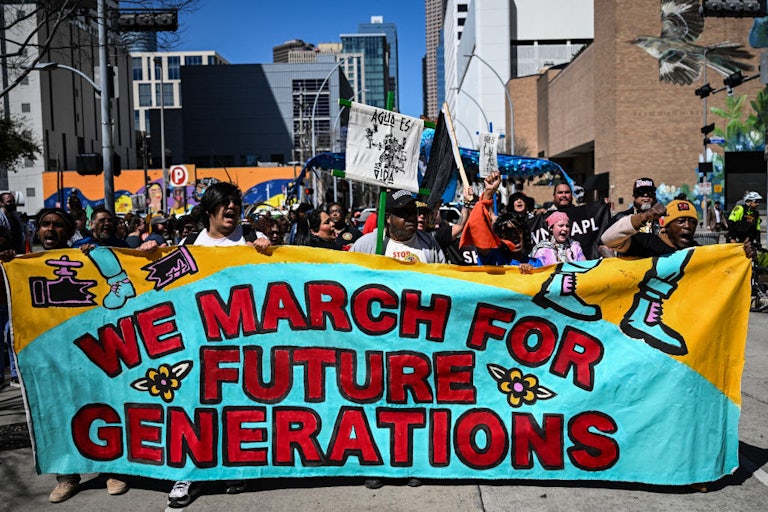
Protesters hold a banner reading "We March for Future Generations."
Ronaldo Schemidt/Getty Images
Demonstrators protesting the Ceraweek by S&P Global energy conference on March 10

Climate advocates “worry they are losing the information war,” The New York Times reported this week. Climate disinformation is pervasive, and “only 21 of the nearly 200 countries that signed the Paris Agreement” signed a declaration at this year’s U.N. climate conference about trying to address that. While polls show the public is concerned about climate change, bogus claims about clean energy being unreliable or damaging are “steadily growing, amplified by social media,” and those urging policy responses to the climate crisis are increasingly “labeled ‘alarmists’ who propose radical solutions,” wrote reporters Lisa Friedman and Steven Lee Myers.

This is depressing, maddening stuff. TNR has been covering climate obstructionists’ transition from straightforward “denial” to these more elaborate forms of disinformation since at least 2020, and in recent years the problem has only gotten worse.

But I have a quibble: Climate advocates aren’t losing the information war. They’re losing the money and power war. That’s an important distinction—not least because it requires a different approach, one focused on radically curbing the influence of money in politics. And while losing the money and power war might seem even grimmer than losing the info war, there’s actually a ray of hope in all this.

It’s not just that 65 percent of Americans say they’re at least “somewhat worried” about climate change. Per the latest large-scale survey from the Yale Program on Climate Change Communication, 48 percent say people in the United States are being harmed “right now,” with 46 percent saying “they have personally experienced the effects of global warming.”

If you say you have “personally experienced the effects of global warming,” you are basing that in part on concrete experience—even if you can be influenced in how you interpret that experience. In the Obama years, the percentage of people who said they personally experienced the effects of global warming was in the 20s and 30s, but it has risen steadily since then, and in the 2020s has never dropped below 40 percent.

The experiences of climate change are going to become easier, not harder, to recognize in coming years. Perhaps the fossil fuel industry and its allies are pushing disinformation so wildly right now because they know this is an uphill battle. Arguably, they have already lost it. They cannot possibly win the information war when the information every day becomes more observable with the naked eye—and in people’s finances. Will people easily dismiss climate and affordability policy as “radical” as their homes tank in value, food and insurance costs spiral, and severe weather destroys their homes, finances, and lives? Maybe not.

Where climate obstructionists clearly are winning is the policy arena—the money, the power. The Trump administration is taking a sledgehammer to nearly every climate-friendly policy enacted by the prior administration. Tech titans and big banks are backing off their once-shiny promises to reduce their emissions, and the race to build more data centers for AI is slowing or even reversing the energy transition. Establishment Democrats are backing away from climate policy out of fear of losing elections to Republicans—even though there’s not a ton of evidence that this is a good strategy, and ample evidence for the opposite strategy.

What the climate obstructionists are also in danger of winning is the nihilism war. As Aaron Regunberg and other writers at TNR and elsewhere have pointed out, the fossil fuel industry is, to a certain extent, counting on people’s limited energy and constant discouragement. “Big Oil wants us to succumb to nihilism when it comes to climate change,” Aaron wrote last week. But they’re conspicuously nervous when people refuse to succumb. The moves that companies are now backing away from all emerged after the 2020 election, when people thought Democrats were going to get serious about climate change and media coverage of Greta Thunberg and others seemed to have shifted public opinion. Big companies were scared, and were hoping that flashy pledges could stave off more serious policy.

Fossil fuel interests still have a lot of power and options, of course: They can push for criminalizing protest; they can fund politicians friendly to their interests. They do this regularly, and it may yet prevent action on climate change coming in time to avert utter catastrophe. But when people start to revoke the fossil fuel industry’s so-called social license to operate—by making it socially unacceptable to work for, invest in, or promote planet-destroying polluters, and divesting from these products—that’s the stuff that seems to really unsettle the industry and its political allies. Hence right-wingers going all in on the risible idea that divesting from fossil fuels is a form of discrimination.

Again, the industry can leverage its considerable money on the spin machine (and it helps that it doesn’t seem to care how self-destructive its messaging may be to the wider society). But it’s up against considerable headwinds when it comes to human psychology and what people seem to care about.

Specifically, the industry’s arguments against climate policy have mostly leaned on two items: jobs and affordability. Democrats may have an edge over their more fossil fuel–friendly Republican opponents on energy affordability, and climate policy creates jobs too. More importantly, jobs aren’t the trump card they seem to be. Corny as it may sound, the numbers suggest that love matters more—by a lot. Last year, The New York Times reported on an international poll that found that “protecting the planet for the next generation” was by far the most popular argument for taking climate action—12 times more so than the “promise of creating jobs.”

“At the heart of this is love,” Anthony Leiserowitz, the director of the Yale Project on Climate Change Communication, which conducted the study, told the Times. “People love particular people, places and things. And those people, places and things are being threatened.”

Obstructionists don’t have the advantage on all fronts. As Aaron recently wrote, there’s an easy answer to fossil fuel companies’ hope that you will tune out: “Disappoint them: Don’t give in.”

Stat of the Week
51%

That’s how much homeowner’s insurance rates have increased in the past six years in Washington state. Two residents whose rates more than doubled are now suing Big Oil companies and the American Petroleum Institute, accusing the fossil fuel industry of driving these increases via severe weather events associated with climate change.

What I’m Reading

LA Wildfire Survivors Want to Rebuild All-Electric, but a Utility Is Using Customer Funds to Incentivize Gas Appliances

Today in wild industry spending to prevent the clean energy transition:

After January wildfires destroyed more than 18,000 buildings in Los Angeles, a growing movement of residents who lost their homes want to rebuild all-electric, recognizing that burning gas in household appliances contributes to the climate-driven increase in the destructiveness of wildfires. An attribution study found that climate change made the January fires 35 percent more likely.

But the country’s largest gas utility, SoCalGas, is using funds from its customers to incentivize wildfire survivors to rebuild with fossil gas instead of going electric.

The monopoly gas provider in Southern California is offering thousands of dollars’ worth of rebates to wildfire survivors who rebuild with gas appliances. The rebates are paid for by California utility ratepayers through a California Public Utilities Commission (CPUC) energy efficiency program.

Read Hilary Beaumont’s full report at Inside Climate News.

This article first appeared in Life in a Warming World, a weekly TNR newsletter authored by deputy editor Heather Souvaine Horn. Sign up here.