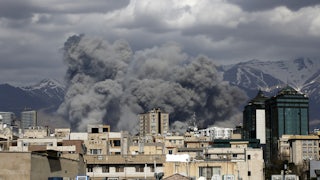
Two trillion dollars. That’s what it can cost to overthrow a regime and secure an oil route in the Middle East.
We know this from experience. That’s what we paid for our 2003–2011 engagement in Iraq. And surely this could be the total when all is dropped and exploded in Iran.
Proponents of the present conflict might pooh-pooh this, saying that the $12 billion we’ve spent so far in Iran is a mere ahem in the long muttering of government outlay. We cough up $3 billion a day just servicing the interest on the national debt. And the Iran tab, to date, is about what we dole out in a year to cover the U.S. Postal Service’s annual losses.
It’s true that, at a current burn rate of around $890 million a day, reaching $1 trillion would take three years. But with the Strait of Hormuz effectively closed and little interest from our allies in military action to open it again, one can see how this total could quickly grow. Trump is also reportedly considering further escalation, including sending troops in to retrieve Iran’s nuclear fuel. And beyond the sheer destruction required, what will be needed to reconstruct and stabilize the region once the U.S. and Israel have finished bombing it? What will it take to truly unchoke the free flow of fossil fuels? Another $2 trillion is surely possible.
In this world of zettabytes and terawatts, it’s easy to lose track of all the zeros and what exactly $2 trillion represents. The annual budget of the entire U.S. government is around $7.4 trillion, so carving out a quarter of that for a useful war might not seem so bad. Especially if, as is claimed, it could be used to long-term secure the Strait of Hormuz and ensure the energy security of the U.S. for decades to come.
But let’s consider what else that money could buy. The list is long. For $2 trillion, we could build 10 to 20 million new affordable housing units, solving homelessness and the housing shortage while creating millions of construction jobs. We could make college tuition free for over a decade for all Americans. And even if we wanted to just gain military capacity, which the president and his party seem to care a great deal about, $2 trillion would allow us to double all defense spending and shore up our depleted missile and missile defense systems and be better prepared for any future conflict.
All notable things. And yet none as notable as something that would make the power of future ayatollahs trivial: $2 trillion would be enough to build enough solar and wind capacity throughout the United States to make fossil fuels and their price swings irrelevant.
This, of course, is a difficult thing to do, with many factors that could affect how and when a new American power infrastructure could become a reality. Per a 2023 federal U.S. Energy Information report, the U.S. grid relied on 1,189 gigawatts of power, 71 percent of which came from fossil fuels and nuclear power plants. To supplant that number, according to a 2019 analysis by the consulting firm Wood Mackenzie, we would need to create more than 1,600 GW of renewables (the much higher potential overall wattage because solar and wind are intermittent and run at lower capacities during nonpeak generation hours).
All this would have to be built at an unprecedented scale, requiring annual installations exceeding those of all prior decades combined. The $2 trillion would include land acquisition, manufacturing, installation, and interconnection for truly vast arrays of turbines and panels dispersed nationwide to match demand patterns. But unlike war, which destroys capacity of all kinds, this kind of massive mobilization would create an analogously massive economy of scale. Innovation begets innovation, which lowers costs.
Such a savings will ultimately be necessary because building the generation part of this initiative is just half the battle. Paired with the $2 trillion we’d need for power creation, we need to fix our grid and enhance battery storage. The same Wood Mackenzie analysis cited says we’d need another $2.5 trillion to do that backup work.
In other words, we would have had to have avoided an Iraq War and an Afghanistan War to cover decarbonization fully.
This somewhat pie-in-the-sky thought exercise is worth doing if for no other reason than it forces us to ask, What are we doing? What wanton waste of our treasure accompanies our appetite for conflicts costing hundreds of thousands of lives? What do we, the taxpayers who are actually footing this bill, truly want our tax dollars to do? Do we want to bomb and fight our way to securing the Strait of Hormuz, or do we want to open up thousands of energy straits that flow directly to us from the sun and the wind—no bombing of children required—and create tens of thousands of jobs in the process? Do we want to pinch our domestic budgets to make one narrow pinch point free from blackmail, or do we want to get rid of pinch points altogether?
If we were truly given a chance to choose rather than have a choice rammed down our throats, I think it’s fair to say that we might select another target. Come November, one would hope, a course correction might be employed when voting taxpayers get a chance to register our displeasure over what’s been done with all our cash. Unfortunately, by that time things could have easily spiraled out of control. By 2027, the momentum toward $2 trillion could be as unstoppable as a runaway train. Should that come to pass, we may all clasp our heads and wish we could have kept the trains, the planes, the ships, the trucks, and the tanks parked while we put our hard-earned money into something that would make conflicts over oil irrelevant.