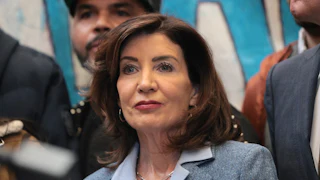
Environmental Protection Agency Administrator Lee Zeldin, reportedly being considered to replace Pam Bondi as attorney general, is not the most polarizing member of the Trump administration, not by a long shot. Yet he’s one of the most dangerous.
In contrast to the mutant plastic visage of Kristi Noem, you probably can’t call up a visual mental image of Zeldin’s eminently forgettable face. It’s also hard to call to mind any memorable utterances by Zeldin. That’s an achievement in a crowd that normally will not shut up. Consider, for example, the luridly reactionary and genocidal statements of Secretary of War Pete Hegseth, who last month called wartime rules of engagement “stupid” and “politically correct,” and recently reposted a video of the founding pastor of his church calling for the repeal of the Nineteenth Amendment. Or consider Stephen Miller, who baselessly accused ICE murder victim Alex Pretti of being a terrorist, a charge he lobs against left-leaning protesters all the time. Or take Trump himself, who gleefully bragged that he was going to destroy Iranian civilization this week and that it wouldn’t be a war crime because Iranians are “animals.”
At one point in 2022, when then-Congressman Zeldin ran for governor of New York and a violent attacker interrupted one of his campaign events, commentators noted that the unfortunate incident could help him by increasing his name recognition; a Siena poll that year found that 57 percent of New Yorkers either did not know who he was or had no opinion of him.
By last summer, as EPA chief, of course his profile had risen, but nearly a third of New Yorkers were still not sure what to think of him until the pollster explained what he was doing at EPA, at which point in the conversation his negatives tended to rise. (He’s so boring that national pollsters rarely even ask about him.) By contrast, 48 percent in a February poll had a negative view of RFK Jr, and only 5 percent of respondents said they had never heard of him.
Inasmuch as he has been perceived at all, Lee Zeldin hasn’t been perceived as an extremist, even in his blue state of origin. Although he lost his 2022 bid for governor, he came close, garnering over 47 percent of the vote. (The last Republican to win election in New York state was George Pataki, a moderate who expanded health care access for the working poor.) In fact, Zeldin was particularly well regarded on environmental issues: He has long been a tireless advocate for conservation on Long Island, fighting to protect the Long Island Sound—especially Plum Island, an area off the North Fork with extraordinary biodiversity.
But all this masks a truly extreme anti-environmental record at the EPA thus far—one that the nation’s premier pollution fans are ecstatic about.
Last Thursday, Zeldin appeared at a Heartland Institute conference of anti-environmental, pro-polluter lobbyists and activists who have been working for years to dismantle climate regulations. Before Zeldin took office, this group would have been considered quite fringe. Politico, reporting the conference last week, called them climate “contrarians.” I suppose that’s one word you might use to describe people who argue that fossil fuels are actually good for the environment and once put up a billboard comparing climate advocates to the Unabomber. The Heartland gathering had one message for Trump, Politico reported: “Please keep Environmental Protection Agency Administrator Lee Zeldin in place.”
Zeldin’s keynote address at the gathering received a standing ovation. It surely wasn’t about the speech itself: He was just as forgettable as usual. But this average-looking fortysomething lawyer was greeted like a K-pop star at the climate deniers’ conference because he has delivered for them beyond their wildest dreams. He has cut billions of dollars from climate grants the Biden administration had awarded, eviscerated pollution rules and enforcement capacity, and perhaps most significantly, wiped out the legal basis of much climate regulation: the 2009 endangerment finding, which says that greenhouse gases can be regulated because they imperil human life and health. At the Heartland gathering, a leading anti-climate activist called Zeldin “the most consequential EPA chief in the agency’s history.”
Zeldin’s significance may be the one thing the Heartland crowd is right about. No other EPA head has ever done as much damage as he has, undoing climate progress and other environmental regulations. In his first year, the EPA lost and forced out employees at more than twice the rate of other agencies, bringing staffing to a “40-year low,” with disproportionate losses of staffers with doctorate degrees and people working on public health. For 2027, Trump’s proposed budget cuts EPA spending in half.
But the toll on bodies—the sheer loss of life—will be greater still. The January announcement that the EPA will no longer consider lives saved when setting pollution rules is not only ghoulish in its logic but will make it harder to regulate numerous pollutants, including greenhouse gases, and will exacerbate deadly climate-related disasters like wildfires, which kill people both directly and indirectly, through damage to infrastructure as well as long-term health effects. A recent study estimates that smoke from U.S. wildfires already kills over 20,000 people a year. The repeal of the endangerment finding and consequent worsening of the climate crisis will also drive up food prices, increasing food insecurity for many all over the world; more people will die from hunger. That’s on top of the damage already inflicted last year: In March 2025, in a move Zeldin triumphantly called the “greatest day of deregulation that our nation has ever seen,” he announced the rolling back of air quality standards, carbon pollution limits on fossil fuel–powered plants, vehicle standards, mercury limits, and methane standards—an anti-environmental blitz that will, according to multiple analyses, cost some 200,000 lives.
Those of us who survive Lee Zeldin’s stint at EPA could still become sick or impaired because of his policies. According to the EPA’s own website, mercury exposure in the womb can cause serious developmental problems for children. In addition to its neurological effects, it also can hinder kidney functioning. Air pollution too is linked to asthma and lung cancers. These are just a few of the ills that Lee Zeldin, the least offensive man in the Trump administration, is inflicting upon Americans.
None of this can simply be reversed with a stroke of a pen by subsequent administrations: Humans and ecosystems that die will stay dead. And the damage to the government institutions that study and regulate the environment is also serious: Defunded departments can be tough to recreate; it won’t be easy to get scientists who have left government service to come back; and the deterring effect of all this on a new generation of experts, currently in school, can’t be overstated.
Not everyone has been fooled by Zeldin’s bland vibe. Those who closely follow EPA actions recognize the true disaster that his tenure has been. Even those who may have initially been optimistic about his EPA leadership have been horrified. Acknowledging his past praiseworthy record on Long Island conservation—and even climate policy—Adrienne Espostito of Citizens Campaign for the Environment wrote an op-ed last year asking, “What happened to the Lee Zeldin we knew?” His current attack on climate regulations would devastate “coastal communities across America, including his hometown,” she wrote, while undoing the endangerment finding would be “catastrophic to America’s security and future.” Some MAHA activists began a petition campaign to fire him over his deregulation of harmful chemicals.
It’s worth considering how Zeldin measures up to Scott Pruitt, Trump’s notoriously terrible, scandal-ridden EPA head in the first administration. Pruitt was far more widely vilified, even by Republicans in Congress, with Joni Ernst calling him “as swampy as you can get,” a reference to Trump’s 2016 campaign promise to “drain the swamp” of Washington corruption. But Pruitt, despite numerous moves to gut environmental regulations, also did less long-term damage than Zeldin because his corruption made him much less effective: He was under at least a half a dozen investigations by the time he resigned.
Zeldin has, by contrast, served the polluters better and with less drama. You can see why Trump would want this deceptively dull extremist in the attorney general role. After all, Pam Bondi was the opposite, attracting negative attention while disappointing Trump by not going all in on his agenda or prosecuting his enemies.
The obvious, loud, vulgar, sensationalistic evil of much of the Trump Cabinet is a liability for Trump in this attention economy, when a creepy appearance or one callous comment can become infamous on social media within minutes. But what if—think of the stereotypical serial killer—it’s the quiet ones we need to worry about? The Stephen Millers and Pam Bondis do deserve our ire, but perhaps we should fear Zeldin’s boring, methodical destruction of our natural environment, our government institutions, and our regard for human life even more. Don’t be fooled.