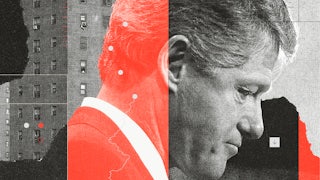
A buff, working-class white man wearing a plaid button-down shirt and large black shades pokes around a convenience store. He hears a dry, monotonous voice emanating from a television set perched on the wall.
“It’s a new morning in America—fresh, vital,” the voice declares.
The working-class shopper looks up to see a besuited, skeletal, extraterrestrial figure—a politician, it seems—delivering a speech on the TV.
“The old cynicism is gone,” the alien politician insists. “We have faith in our leaders. We’re optimistic as to what becomes of it all. It really boils down to our ability to accept. We don’t need pessimism. There are no limits.”
Director John Carpenter’s 1988 film They Live depicts a society taken over by sinister yuppie aliens. They speak of Lamaze classes and blue corn tortilla chips and retain power by keeping the human population passive and pliant.
The alien politician in this scene serves as a stand-in for Ronald Reagan. After all, Reagan’s most famous campaign ad included the memorable refrain, “It’s morning again in America.” The yuppie aliens, then, might be viewed as hard-line Reaganites.
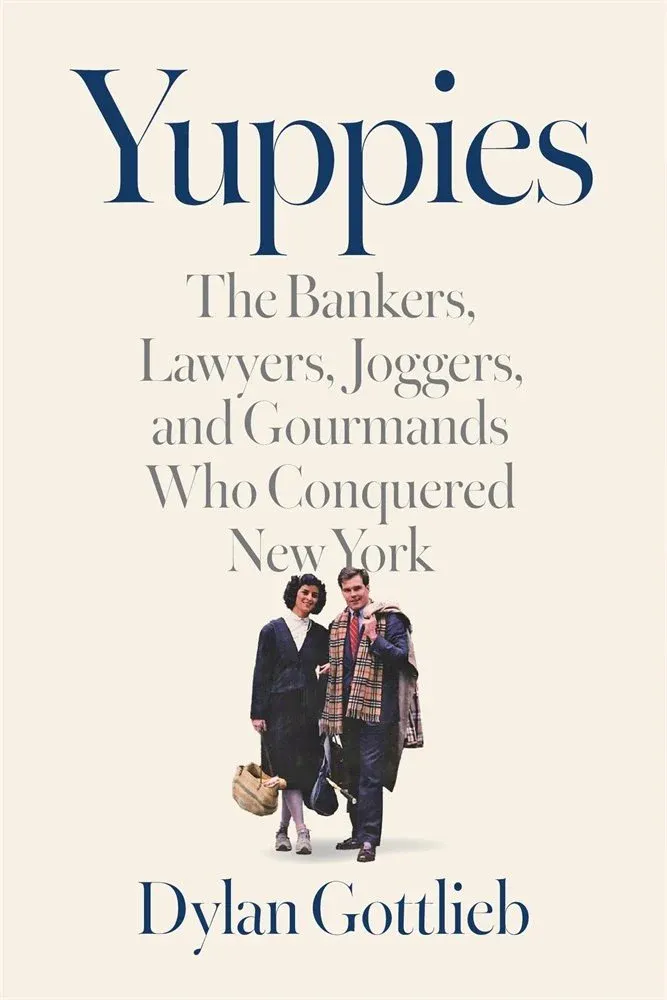
Yet the politics of the yuppie defies easy categorization. In his fascinating new book, Yuppies, historian Dylan Gottlieb provides a cultural and political biography of the young urban professional. Far from an ancillary historical actor, Gottlieb argues, the yuppie helped fundamentally remake American cities, American politics, and American society in the cutthroat 1980s and beyond.
After springboarding out of the Ivies, yuppies invaded urban spaces, often ending up in New York and working at a Wall Street investment bank, an insurance firm, a law firm specializing in corporate transactions, or as some other cog in the postindustrial, increasingly financialized economy. The prototypical young urban professional worshipped at the altar of meritocracy. They had “made it,” so why couldn’t others? With their fancy embossed diplomas, supposedly eclectic and refined tastes, gaudy salaries, and penchant for ostentatious fitness, yuppies worked diligently to demonstrate that they belonged at the top of the heap.
As their bank accounts grew—evidence of their merit, surely—yuppies raided “up and coming” (and established) neighborhoods, which subsequently turned into yuppie playgrounds. New apartment buildings, sushi restaurants, art galleries, corporate-sponsored marathons, and other yup-nip cropped up in New York and elsewhere, satisfying yuppies while alienating and displacing others.
This transformation of urban environments reflected and shaped broader political and economic shifts. Notably, yuppies helped change the face of the Democratic Party and liberalism by supporting younger, meritocratic, and technocratic candidates, such as Colorado Senator Gary Hart over the old-guard New Dealers who had run the party since the 1930s.
The yuppie-backed New Democrats anticipated and facilitated the rise of what Bill Clinton termed the “New Economy,” driven by high-paying information, technology, and finance jobs and propped up by low-wage service and retail labor. That economic arrangement, for which the yuppies served (and possibly still serve) as poster children, helped widen the gap between the rich and poor and author the dislocations that define today’s American city—namely extreme unaffordability and houselessness.
Recent decades have seen a glut of histories tracing the rise of the right. Although these studies all approached the subject in different ways, as the historian Julian Zelizer observed in 2010, they all rested on the notion that a conservative order “rose” in the late twentieth century while a liberal one “fell.” Since then, scholars such as Lily Geismer, Brent Cebul, and now Dylan Gottlieb have delivered useful correctives to “rise of the right” narratives by writing incisive books about twentieth-century American liberalism. Taken together, their studies have shown not how liberalism and the Democratic Party imploded in the final decades of the twentieth century and into the twenty-first, but how they evolved and adapted to structural developments.
As Geismer noted in 2016, organized labor functioned as the beating heart of the New Deal coalition, the electoral base on which Democrats relied from the 1930s through the 1970s or so. Amid deindustrialization and waning union membership, labor lost its luster, and the knowledge worker began to supplant the factory worker as the Democratic Party’s ideal voter. For Democratic leaders and pundits, the factory worker symbolized a bygone era—the post–World War II moment of mass production and widely shared prosperity. The knowledge worker, on the other hand, gestured toward an exciting new economic order predicated on tech, finance, service, and inequality.
Geismer examined the political lives of knowledge workers in her magisterial 2015 book Don’t Blame Us, concentrating on so-called suburban liberals along Massachusetts Route 128. Gottlieb’s Yuppies supplies a sequel of sorts, the “first social history of financialization,” in his words. If the knowledge worker represented the faceless technocratic expert behind the New Economy, the yuppie served as its highly visible and divisive mascot.
Gottlieb’s story begins with the “unshackling of Wall Street” in the Carter and Reagan years. Deregulation helped make the finance industry more lucrative and thus more appealing for recent college grads, particularly those coming from elite institutions. Banks also recruited aggressively on Ivy League and Ivy-plus campuses, while business schools worked in tandem with investment firms to develop a pipeline of young, exploitable, entry-level analysts (and future MBA students). As a result, Gottlieb documents, a “massive wave of yuppies” hit investment banks during the 1980s. Whereas only 3 percent of Wharton seniors went into investment banking in the late 1970s, 34 percent of the graduating class of 1987 did.
Once they arrived in New York City, the finance capital of the world, these yuppies often encountered harsh working conditions, especially during the chaotic mergers and acquisitions boom of the 1980s. Yuppie lawyers who joined Skadden, Arps, Meager, and Flom, the country’s most profitable law firm in the ’80s, “work[ed] longer hours, under closer managerial oversight, on smaller and less intellectually demanding piecework, with less meaningful training, all for narrower chances of promotion to partner.” Still, most yuppies toughed it out in the city, in part because of the allure of urban living.
The yuppies needed the city, and the city needed the yuppies. New York had taken a beating in the 1970s. A fiscal crisis had brought the city to the brink of bankruptcy and prompted cuts in essential services—police, fire, sanitation, and beyond. These cuts intensified many of the city’s existing problems and made New York an increasingly unlivable place. Yuppies, many believed, could save the city. But the city had to burn first.
As Gottlieb illuminates, the “urban renaissance” offered by the yuppies—the sidewalk cafés, the packs of joggers, the leafy avenues of renovated brownstones—required the “urban terror” of harassment, displacement, and even arson. On Manhattan’s Upper West Side; in Hoboken, New Jersey; in Park Slope, Brooklyn; and elsewhere, speculators at first employed less incendiary methods to remove poor, working-class, and even middle-class tenants to make room for yuppies. When they failed to evict these tenants through quasi-legal means—exploiting rent-control loopholes, for instance—they resorted to “steadily escalating harassment.” If these methods proved ineffective, they turned to the torch.
Deadly, deliberate fires engulfed many parts of New York City and its adjoining areas in the 1970s and early 1980s. Hoboken’s proximity to Manhattan—a feature that marketers emphasized with almost comedic glee—made it a prime target for arson. A January 1979 fire intentionally set at a Hoboken apartment building killed 21 people and permanently displaced 130 others. With buildings destroyed, owners collected insurance payouts and sold the land for development. And once sites in newly desirable neighborhoods were razed, new buildings sprang up within a couple of years, commanding pricier rents. Hardly anyone would face serious repercussions for the arson-for-profit wave that swept over the city in this moment.
As urban terror unleashed an urban renaissance, yuppies ran wild. Training for road races—marathons, half-marathons, and the like—emerged as a favorite yuppie pastime in New York City and beyond, no doubt because it reflected and reinforced the meritocratic myth. “Personal discipline, delayed gratification, obsessive time management, constant self-analysis, long-range planning,” writes Gottlieb, “were just as vital to marathon training as they were to the cult of individual performance demanded by law firms and investment banks.”
Taste—in more than one sense—served as another key site of yuppie exploration and expression. In the 1980s, marketers identified, and brands aggressively targeted, a growing “yuppie market”—a distinct class of consumers with large disposable incomes who privileged “premium” goods. Through their consumption—again, in more than one sense—yuppies could demonstrate their discernment, particularly in the realm of food and beverages. Here, Gottlieb explains, drawing on Pierre Bourdieu, yuppies could “turn … economic capital into social and cultural capital.”
For example, ordering and consuming sushi, the “iconic food of the 1980s,” “required one to have facility with chopsticks, comprehend dozens of foreign-language terms, and tolerate the consumption of raw fish.” By satisfying these requirements, yuppies could prove that they had earned their spot atop the social hierarchy.
Though often understood as an “apolitical demographic” or even one affiliated with the Reagan right, yuppies played a central role in cleaving the Democratic Party from its “traditional power bases of organized labor and the urban political machines that had powered the New Deal coalition.”
Though Gary Hart ultimately failed to secure the Democratic presidential nomination in 1984 (or 1988 with his ill-fated Monkey Business campaign), he encapsulated an emerging yuppie political ethos that blended “traditional liberalism and conservative austerity.” Hart also foreshadowed the Democratic Party’s reorientation toward professional-class voters and Wall Street, the echoes of which we’re still hearing today. As Gottlieb illustrates, a young congressman named Chuck Schumer, who represented the yuppie utopia of Park Slope, actively sought (and received) sizable contributions from investment banks in the early 1980s. He was ahead of the curve. The rest of the party soon followed suit.
Democrats continue to bicker over the shifts that yuppies engendered. The party’s left wing calls for severing ties with Wall Street and Silicon Valley and resuscitating some version of the Reverend Jesse Jackson’s Rainbow Coalition. More moderate and conservative Democrats—including neo-yuppies such as Pete Buttigieg—seem perfectly content to accept donations from Wall Street, to prioritize professional-class voters, and to gravitate toward the political center (whatever that means). As John Carpenter exclaimed in 2020, “I made They Live back in 1988, and nothing has changed!”
In the third decade of the twenty-first century, however, the yuppie dream is fading. Attend the correct schools, develop the correct “skills,” and work your way into the correct professional circles, the pitch went, and you too can enjoy the perquisites of yuppie living. But the inheritors of the New Economy, millennials and zoomers, got a raw deal. The promise of the New Economy foundered on the shoals of the Great Recession. Economic uncertainty, growing wealth inequality, and forever war have fueled right-wing authoritarianism at home and abroad, and yuppie liberalism has proven wholly incapable of stemming the tide. The intensifying threat of automation and the increasing casualization of labor have wiped out promising entry-level jobs. Meanwhile, soaring inflation, stagnant wages, and rising home prices have severely diminished the quality of life for many young Americans.
Amid these formidable challenges, the Democratic Party may need to pivot once again—away from yesterday’s yuppies and suburban liberals and toward the growing numbers of downwardly mobile Americans (young and old alike) whose disillusionment and desperation reveal the limits of yuppie politics as usual.