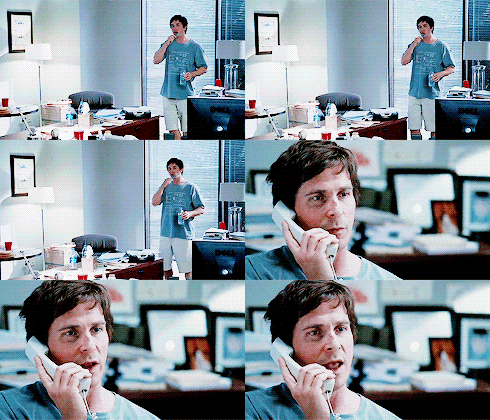
Giphy

“It ain’t what you don’t know that gets you into trouble,” which must be why The Big Short opens with a fake Mark Twain quote.

If you’ve seen The Big Short—and you should, it’s great—you’ll know that the movie opens with a quote from Twain: “It ain’t what you don’t know that gets you into trouble. It’s what you know for sure that just ain’t so.” 

It’s a perfect quote for the film, only it does not appear in any of Twain’s books, essays, letters, or speeches. Because Mark Twain never wrote it or said it or anything like it. The closest he came is “Faith is believing what you know ain’t so,” which appears in Pudd’nhead Wilson’s New Calendar and is a long way away from the quote that opens The Big Short

In fact, as far as I can tell no one said that exact quote. According to Quote Investigator, the quote should be attributed to Josh Billings, who in 1874 wrote this in what is perhaps best described as “Krazy Kat English”: 

A) I honestly beleave it iz better tew know nothing than two know what ain’t so.
B) Wisdum don’t konsist in knowing more that iz new, but in knowing less that iz false.

I haven’t been able to find any source for the exact quote used in The Big Short—Google Books, which is unreliable, only traces it to 2004. 

Interestingly, Michael Lewis’s book The Big Short opens with this similar quote, from Leo Tolstoy: 

“The most difficult subjects can be explained to the most slow-witted man if he has not formed any idea of them already; but the simplest thing cannot be made clear to the most intelligent man if he is firmly persuaded that he knows already, without a shadow of a doubt, what is laid before him.”

That quote is credited to “Leo Tolstoy, 1897.” It’s less folksy than the fake quote that the film uses, but it’s real: it appears in The Kingdom of God is Within You, a nonfiction work dedicated to Tolstoy’s theories about Christianity and Christian anarchism. (Weirdly enough, I have no idea where Lewis’s publisher, W.W. Norton, got 1897 from—the book was published in 1894—but I’m just splitting hairs at this point.) 

So The Big Short traded a perfectly legitimate Tolstoy quote for a phony Twain one, even though both quotes make the same point. Why make the switch? Was Tolstoy’s not folksy enough? Too long? Too Russian? I’ve reached out to Paramount Pictures for comment.

September 06, 2018

Hulton Archive/Getty Images

Burt Reynolds, America’s mustache, has died at 82.

From television origins (Gunsmoke), Reynolds became one of the most recognizable faces of 1970s American film. After negligible early roles in movies like Shark! (1969), he broke out (sans mustache) as archery ace Lewis Medlock in Deliverance (1972). That same year he also played “Sperm Switchboard Operator” in Woody Allen’s Everything You Always Wanted to Know About Sex* (*But Were Afraid to Ask).

Those two roles express something at the heart of the Reynolds mystique: He was macho, lusty, and funny.

Aside from Deliverance, Reynolds’s most iconic roles were in movies that eventually took on cult status. In Smokey and the Bandit (1971), The Longest Yard (1974), and 1981’s Sharky’s Machine (which he also directed), he played charming funsters with hearts of gold and biceps of steel. These roles turned Burt Reynolds into a symbol for a butch American sexuality.

The 1990s saw a Reynolds reprise, with turns in Striptease (1996) and Boogie Nights (1997). From the 2000s onward he seemed to enjoy playing up to the typecasting that arguably limited his career, cropping up in a heroic total of 37 movies this century, mostly in comic works like the Dukes of Hazzard remake. In 2019 he will appear posthumously in the Manson family dramatization, Once Upon a Time in Hollywood.

His long career included a 1973 album, featuring songs like “The First One That I Lay With” and “She’s Taken A Gentle Lover.” He winkingly embodied an American masculinity that women laughed over and men sought to emulate. With Reynolds’s death, America has lost its least subtle and most charismatic old-school Adonis. With a wink and a grin, he has disappeared into the sunset.

Chip Somodevilla/Getty Images

Clarence Thomas’s wife hires a staffer who once wrote “I hate blacks.”

Mediaite is reporting that Ginni Thomas, the wife of Supreme Court Justice Clarence Thomas, employs as a factotum Chrystal Clanton, who was fired last year from Turning Points USA for racist text messages. “I HATE BLACK PEOPLE,” Clanton texted. “Like fuck them all . . . I hate blacks. End of story.” This racist text message was first reported by The New Yorker. Mediate has also discovered that Clanton made frequent Islamophobic comments on Snapchat, including a caption of an Arab-looking man that reads, “Just thinking about ways to do another 9/11.”

On Facebook, Ginni Thomas has praised Clanton as someone “who makes every day better and more fun!” The two frequently travel together to right-wing speaking engagements. According to Mediaite, Clanton “flaunts her relationship with the Thomases to conservative friends as a way to prove that the New Yorker’s publication of her racist text messages did not ruin her career. In July, Clanton shared a photo on Instagram of herself, Thomas, and Ginni Thomas having a ‘great weekend’ together.”

Over the last decade, Ginni Thomas has been increasingly vocal as a strident advocate of right-wing politics. She recently posted a Facebook message mocking Parkland shooting survivor David Hogg as exhibiting “a special kind of stupid.”

DIBYANGSHU SARKAR/AFP/Getty Images

India still has a long way to go on LGBT rights.

The country’s Supreme Court today struck down a British-era law from 1861 that criminalized gay sex. “Consensual sex between adults in the private space, which is not harmful to women or children, cannot be denied as it is a matter of individual choice,” the court wrote in a unanimous opinion. “The law had become a weapon for harassment for the LGBT community,” said chief justice Dipak Misra. “Any discrimination on the basis of sexuality amounts to a violation of fundamental rights.” India is now one of more than 120 countries where homosexuality is decriminalized.

Politicians were divided over the ruling. The governing Bharatiya Janata Party has said it would respect the court’s decision, but BJP Member of Parliament Subramanian Swamy criticized the ruling, saying that it “could give rise to an increase in the number of HIV cases” and that homosexuality is “a genetic flaw like having six fingers on your hand.” The main opposition party, the Congress Party, tweeted that they “hope this is the beginning of a more equal and inclusive society.”

According to a poll from 2016, 40 percent of Indians agreed at least in part that private consensual same-sex relationships should not be allowed, and 71 percent said they would be somewhat or very upset if one of their children was in love with someone of the same sex. This enduring resistance to gay couples is indicative of the challenges facing Indians seeking equal rights for LGBT people, including legalized gay marriage. According to the same 2016 poll, 35 percent of Indians said same-sex marriage should not be legal, and another 30 percent were unsure.

The court explicitly said that its ruling only concerned the constitutional validity of the 1861 law and not other rights, such as those related to marriage or inheritance.

Zach Gibson/Getty Images

Leaked email hints that Brett Kavanaugh might not consider Roe v. Wade “settled law.”

Senator Susan Collins of Maine recently announced that Kavanaugh, now embroiled in a raucous Senate confirmation hearing, assured her that he believed the landmark abortion case was “settled law.” But an email written by Kavanaugh in 2003 and published by The New York Times on Thursday indicates he may have misrepresented his views. During his time as the White House counsel for President George W. Bush, he expressed skepticism about the majority opinion in Roe:

Judge Kavanaugh was considering a draft opinion piece that supporters of one of Mr. Bush’s conservative appeals court nominees hoped they could persuade anti-abortion women to submit under their names. It stated that “it is widely accepted by legal scholars across the board that Roe v. Wade and its progeny are the settled law of the land.”

Judge Kavanaugh proposed deleting that line, writing: “I am not sure that all legal scholars refer to Roe as the settled law of the land at the Supreme Court level since Court can always overrule its precedent, and three current Justices on the Court would do so.”

If Kavanaugh is confirmed to the Supreme Court, he will be in a position to overturn Roe. According to an ABC News/Washington Post poll released this week, Kavanaugh is the most unpopular Supreme Court nominee in decades. “Only two nominees have had weaker public support: Harriet Miers, who withdrew her nomination, in 2005; and Robert Bork, rejected by the Senate in 1987,” pollsters concluded.

Mario Tama/Getty

An anonymous op-ed appears to have rattled Trump.

The president is not laughing off an unsigned critique of his presidency allegedly written by a senior administration official which was published by The New York Times on Wednesday.

Trump has responded with four angry tweets:

Trump’s press secretary, Sarah Huckabee Sanders, echoed many of these points in her own statement. “Nearly 62 million people voted for President Donald J. Trump n 2016, earning him 306 electoral college votes—versus 232 for his opponent,” Sanders claimed (strangely understating Trump’s victory of nearly 63 million votes). “None of them voted for a gutless, anonymous source to the failing New York Times.”

The New York Times reports that the combined impact of the new Bob Woodward expose with the anonymous op-ed is starting to unnerve the president: “Mr. Trump’s mood vacillated from fury to calm throughout Tuesday afternoon and Wednesday. Some of his top aides worked the phones to figure out who was leaking or who might have spoken, and his daughter Ivanka Trump and other advisers tried to quell his distress.”

September 05, 2018

Eric Thayer-Pool/Getty Images

Anonymous White House official admits in Times op-ed to an administrative coup.

The New York Times has published an unsigned essay written by someone they describe as a “senior official in the Trump administration whose identity is known to us and whose job would be jeopardized by its disclosure.” The op-ed makes for very strange reading, since it combines a derisive view of Trump’s presidential skills with a partial defense of the presidency, co-opting the language of resistance to the cause of treating Trump officials with greater forbearance and civility.

According to the op-ed, “many of the senior officials in his own administration are working diligently from within to frustrate parts of his agenda and his worst inclinations.” These “senior officials” are committed, as Trump allegedly is not, to traditional Republican Party ideals.

Although he was elected as a Republican, the president shows little affinity for ideals long espoused by conservatives: free minds, free markets and free people. At best, he has invoked these ideals in scripted settings. At worst, he has attacked them outright.

The intent, perhaps, is to shield the Republican Party (and those Republicans who have worked most closely with Trump) from reputational contamination. We’re to believe that the real heroes of the Trump era are those who worked most closely with him and tried to constrain his worst impulses.

The op-ed doesn’t shirk from criticizing Trump, even suggesting that his unfitness for office reaches the levels that call for removal under the 25th Amendment. But then it retreats from asking what the failure to apply a constitutional remedy means.

Given the instability many witnessed, there were early whispers within the cabinet of invoking the 25th Amendment, which would start a complex process for removing the president. But no one wanted to precipitate a constitutional crisis. So we will do what we can to steer the administration in the right direction until—one way or another—it’s over.

What is being justified here as an act of heroism is in fact a dereliction of duty. After all, the proper constitutional course to take with an unfit president is the 25th amendment. The path chosen is far worse: an administrative coup that leaves Trump as the figurehead not only makes the United States government look foolish and untrustworthy, it also undermines democracy.

Finally, if there is a secret plot to govern competently despite Trump, surely there is nothing more self-defeating than announcing the plot in one of the world’s largest newspapers, where the president and everyone else can see it?

Rob Kim/Getty

Donald Trump is still stewing over the Access Hollywood tape.

In an interview with The Daily Caller posted Tuesday, the president continued to chew over an event that occurred two years ago: the release of the Access Hollywood tape where he was heard boasting, “When you’re a star, they let you do it. You can do anything. Grab ’em by the pussy.”

Asked about rumors that “NBC leadership” deliberately leaked the tape, Trump responded:

A lot of people say that what they did — OK, so I had a lawsuit prepared, I had a lawsuit that was prepared to be filed against NBC because they leaked that tape. First of all, that was done, that tape was, there are even questions about this tape, there’s many things going on. But it was also done in a dressing room — real questions about that whole process. And they gave it to the Washington Post because they couldn’t put it out there themselves ’cause they would’ve had tremendous liability so they gave it to the Washington Post to put out. OK. I had a lawyer hired to bring a suit right after the election ended. But one problem arose — I won the election. OK, and they were going to say, ‘what was your damages?’ The damages was I lost the election, but now I won the election. So what were the damages? I won the election. I was going to sue because what they did — that was done in the dressing room. You know those trailers are really luxury, beautiful, actually. That was done in a trailer. It ruined Billy Bush’s career. And that was done in a trailer secretly. That was illegal what they did.

There’s much to say about these comments.

The president has a long history of threatening lawsuits that are never carried out. It’s by no means clear what Trump could sue for. Following his usual pattern of kettle logic, Trump is here suggesting that the tape was both faked (“there are even questions about this tape”) and a violation of his privacy (“done in a trailer secretly”). The idea that the tape is fake is an old Trump standby, one that he raised soon after it was released.

But it’s heartening to see that Trump, in the midst of it all, still has time to comment on decor (“those trailers are really luxury, beautiful, actually”).

Joe Raedle/Getty

Marco Rubio threatens to beat up Alex Jones.

The Senate hearings to evaluate Brett Kavanaugh as a Supreme Court nominee are turning into a reunion of the more louche elements of the conspiratorial far right. Among those seen in the U.S. Capitol on Tuesday were Laura Loomer, Chuck Johnson, and Jack Posobiec. Also present was America’s foremost purveyor of paranoid fantasies, Alex Jones, who heckled Senator Marco Rubio at a press gaggle. 

While Rubio was trying to talk about the security threat posed by China interfering in the American election, Jones stood in the sidelines and mouthed off about big tech companies “shadow banning” conservatives. “The Democrats are doing what you say China does,” Jones barked. “It’s happening here but you say I don’t exist.” 

Rubio tried to laugh it off. “I just don’t know who you are, man.” Jones mimicked, floridly but recognizably, Rubio’s braying giggle and called the senator “a little frat boy.” Rubio then asked, “Who are you?” 

After Jones tapped Rubio on the shoulder, the Republican politician said, “Don’t touch me again man. I’m asking you not to touch me.” Jones accused Rubio of “trying to get me arrested.”

Rubio replied, “You’re not going to get arrested, man.  You’re not going to get arrested. I’ll take care of it myself.” Jones then bellowed, “Oh, he’ll beat me up!”

After the gaggle ended, Jones started holding court with the remaining reporters, making homophobic insinuations about Rubio and spouting off about how he was being censored. 

Thos Robinson/Getty

Hollywood, not Twitter, changed The New Yorker’s mind about Steve Bannon.

Bannon, the former Trump adviser and former Breitbart chairman, has been disinvited from The New Yorker Festival, and New York Times columnist Bret Stephens is apoplectic. While no fan of Bannon’s white nationalist politics, Stephens thinks the cause of public discourse would be best served by allowing the former presidential advisor to air his views and be confronted by New Yorker editor David Remnick. Stephens sees the rescinding of the invitation as a lamentable surrender by the venerable magazine to mob protest on Twitter.

Remnick, Stephens argues, “is no longer the editor of The New Yorker. Twitter is. Social media doesn’t just get a voice. Now it wields a veto. What used to be thought of as adult supervision yields—as it already has in Congress and at universities—to the itch of the crowd.”

Stephens is confusing the medium with the message. Twitter has allowed reader protests to be amplified, but the true reason that Bannon is not attending the event has nothing to to with trending hashtags and everything to do with celebrity power. Within hours of the announcement that Bannon was headlining the event, other famous guests made clear they would be dropping out: Jim Carrey, Bo Burnham, Judd Apatow, John Mulaney, and Patton Oswalt. Stephens briefly acknowledges this, but mainly to note that they “tweeted that they would pull out if Bannon remained on the program.” But the fact these big names tweeted their objection is far less important than the leverage they had as celebrities. If they didn’t show up, The New Yorker would hardly have a festival at all.

Stephens never confronts the actual objections to the invitation. He treats the planned on-stage discussion between Bannon and Remnick as a journalistic event. But The New Yorker Festival is not journalism. It’s a consumer event for well-to-do readers to meet writers and other celebrities. To invite Bannon to the event would, inevitably, grant Bannon a mainstream respectability he doesn’t deserve.

Stephens is well aware that inviting a controversial guest speaker can have the effect of legitimizing the speaker. In 2007, Columbia University President Lee Bollinger defended the school’s decision to host a speech by Iranian President Mahmoud Ahmadinejad by saying that it was an excellent opportunity for the autocrat to be confronted. Objecting in The Wall Street Journal, Stephens succumbed to Godwin’s law. “Hitler at Columbia would merely have been a man at a podium, offering his ‘ideas’ on this or that, and not the master of a huge terror apparatus bearing down on you,” Stephens argued. “To suggest that such an event amounts to a confrontation, or offers a perspective on reality, is a bit like suggesting that one ‘confronts’ a wild animal by staring at it through its cage at a zoo.”

Stephens position of 2007 directly contradicts what he’s arguing now. In the more recent column he even brings up Iran again, notting that “if high-profile interviews with a racist like George Wallace or a theocrat like Ayatollah Ruhollah Khomeini were worth doing by a past generation of journalists, Remnick reasoned, why not one with Bannon?” To take it to its logical conclusion, Stephens should be willing to let Khomeini—if he were still alive—to speak at either the New Yorker festival or Columbia University.

Scott Eisen/Getty

Ayanna Pressley’s primary victory shows the progressive wave is still rolling.

In an upset victory, Pressley defeated fellow Democrat Mike Capuano, who has represented Massachusetts’ 7th congressional district for 10 terms. Capuano has been a progressive legislator, one who voted against the Iraq war and the Patriot Act, but Pressley outflanked him on the left by calling for the abolition of ICE, a move Capuano rejected. Capuano also supported a “Blue Lives Matter” bill that Pressley criticized.

If Pressley wins in the November general election, as she is expected to do in this heavily Democratic district encompassing half of Boston and many surrounding communities, she’ll be the first African-American woman from Massachusetts elected to serve in Congress. Her victory is further evidence that the base of the Democratic Party, especially in safe districts, want left-wing candidates. It’s also another example of the party’s increasing openness to running female and minority candidates.