Life in a Warming World
A weekly reckoning with our heated planet—and the fight to save it

Plastics Are Poisoning Both Our Bodies and Our Politics

The petrochemical industry is obstructing a global treaty to reduce plastic pollution.

A man holding a bag stands in front of a large mound of plastic trash.
SOPA Images/Getty
Amos Mwangi, Nakuru County Waste Pickers Association secretary, at a dumping site in Kenya

If the definition of insanity is doing the same thing over and over and expecting a different result, the definition of obstruction is knowing exactly how to fix a problem and pursuing everything but the obvious solution. The U.N. Environment Program’s attempts to negotiate a global plastic treaty is suffering from both of these afflictions at once.

Negotiators are gathered in Nairobi this week for the third of five meetings to broker a treaty to reduce plastic pollution. The past two meetings didn’t go great. The first, in Uruguay, ended with parties “split on whether goals and efforts should be global and mandatory, or voluntary and country-led,” according to Al Jazeera. Given that voluntary, country-led goals are completely ineffective at actually curbing plastic pollution, this is a bit like saying the meeting ended with parties split on whether to have a meeting. The second, in Paris, ended with parties agreeing to write a draft treaty. Given that the whole point of these conferences was to draft a treaty, this is a bit like saying the meeting ended with the parties agreeing to have a meeting.

This large-scale bureaucratic performance art would be funny were it not for the deadly seriousness of the crisis. Once upon a time in the 1980s and ’90s, many people thought of plastic pollution mostly as a problem for dolphins and sea turtles, and one that could be solved by snipping the rings on six-packs of soda. Since then, a barrage of studies and reports have made clear that both oceans and land are in fact drowning in plastic trash that, even before it becomes trash, is poisoning us. It poisons the environment as it’s being made, it poisons us as we use it, it poisons the environment after we throw it out, and then it poisons us again when we eat animals and plants from that environment. Microplastics can now be found everywhere from human breast milk to the clouds above Mount Fuji. The plankton that were supposed to break down this stuff are actually pooping out more of it. Plastic production is predicted to triple by 2060, part of a well-documented petrochemical strategy by Big Oil to prop up business as the energy transition robs them of opportunities to profit off knowingly poisoning the world with their other product: fossil fuels.

Sure, plastics have some important uses—which the industry takes every available opportunity to advertise. But take a moment to try to count all the pieces of plastic you touch per day. What proportion of those are artificial heart valves? And what proportion are, by contrast, things that are convenient and cheap—because a vast industrial system has evolved to make them so—but could be replaced just as effectively by a different material, or eliminated entirely with little difference?

This week’s UNEP talks in Nairobi are fracturing along predictable lines. A “High Ambition Coalition” of countries in the global south, EU member states, Canada, and others continues to push for binding restrictions on plastics production. Countries with big petrochemical industries, including Saudi Arabia, Russia, and China, want to focus on plastics recycling. The United States, possessed of both a big petrochemical industry and a political system religiously opposed to binding agreements about anything, favors a compromise of nothing in particular. Per Reuters:

The United States, which initially wanted a treaty comprised of national plans to control plastics, has revised its stance in recent months. It now argues that, while the treaty should still be based on national plans, those plans should reflect globally agreed goals to reduce plastic pollution that are “meaningful and feasible,” a U.S. State Department spokesperson said in a statement to Reuters.

Whatever that means. Meanwhile, the U.N. still hasn’t taken action to exclude industry representatives from these talks, despite an international group of scientists last week condemning this conflict of interest. At least 143 fossil fuel and petrochemical industry lobbyists have registered to attend the latest meeting—more representatives, according to the Center for International Environmental Law, than those of the 70 smallest members combined. Six member states have even included industry representatives in their official delegations.

But let’s return to the obstruction part of the talks: the focus on plastics recycling. First off, of course the petrochemical industry wants to make this a recycling issue, since that means avoiding tackling the actual problem of excessive plastics production. But second, increased plastic recycling comes with its own set of problems. For a study released last month, researchers from Sweden, Germany, and Denmark purchased recycled plastic samples from a variety of regions and found them laced with an array of toxic chemicals, including pesticides and pharmaceuticals. This is not an isolated finding. “A recent analysis from [the International Pollutants Elimination Network],” Joseph Winters wrote for Grist in May, “found a hazardous plastic additive in every recycled plastic children’s toy and hair accessory it examined. Other research suggests that the recycling process itself can generate benzene, a human carcinogen.” And then there’s the research suggesting plastics recycling actually exacerbates microplastic pollution, with recycling facilities releasing a significant portion of the plastic material they’re trying to recycle as microplastics. That’s if it’s even correct to call such things recycling facilities, given that, according to one report, no plastic meets the reusability rate (30 percent) needed to be deemed recyclable.

Obstruction is proposing a solution you know full well doesn’t address the problem. Big oil has been pursuing this for decades, NPR and PBS Frontline reported in 2020 after reviewing internal documents: “The industry sold the public on an idea it knew wouldn’t work—that the majority of plastic could be, and would be, recycled—all while making billions of dollars selling the world new plastic.” 

This is the industry that knew about climate change in the ’70s. The industry that exploited a lethal pandemic—and understandable human fear—to try to force single-use plastic bags back into the very few jurisdictions and stores that were trying to discourage them. The industry that encouraged people to think that if they didn’t take the time to decode teeny tiny numbers on the bottom of pieces of plastic and sort them  into recyclable and nonrecyclable piles bearing little correspondence to actual recyclability, then those dead dolphins and sea turtles would be their fault. 

Why is anyone letting these obstructionists anywhere near the drafting process and expecting a productive result?

Good News, Bad News

About a year after President Jair Bolsonaro’s departure from office and the succession of the more openly environmentalist administration of Luiz Inácio Lula da Silva, deforestation in Brazil of the Amazon rainforest has reached a five-year low.

Ice in Greenland is melting increasingly fast, with troubling implications for sea level rise.

Stat of the Week

Drilling sites in Texas are apparently leaking twice as much methane as similar sites in neighboring New Mexico, which has better regulations. (This is the kind of thing that doesn’t require fancy carbon sequestration solutions. You can just fix it, now.)

Elsewhere in the Ecosystem

The 20 Farming Families Who Use More Water From the Colorado River Than Some Western States

Absolutely do not miss this wild ProPublica and Desert Sun collaboration on the worsening Western water crisis. When these reporters requested records from California’s Imperial Irrigation District to figure out where the water allocated to the area was going, the request was denied. So they used satellite data and ownership records to figure out that most of the district’s water use came down to 20 families.

Farmers in one family, the Abattis, used an estimated 260,000 acre-feet, more water than the entire Las Vegas metropolitan area uses.… The district and its farmers emphasize that they keep a steady stream of broccoli, lettuce, onions and other produce on American dinner tables, including in the dead of winter. But only a few families used a majority of the water they got to grow food that people eat. Instead, we found that most use the bulk of their water growing hay to feed livestock.

Read Nat Lash’s and Janet Wilson’s report from ProPublica and The Desert Sun.

This article first appeared in Life in a Warming World, a weekly TNR newsletter authored by deputy editor Heather Souvaine Horn. Sign up here

The Humiliation of King Charles

Despite decades of public environmentalism, the British king found himself announcing a bill to expedite oil and gas production this week.

King Charles and Queen Camilla stand in ceremonial attire, surrounded by attendants holding their robes.
WPA Pool/Getty
Britain's King Charles III and Queen Camilla at the State Opening of Parliament on November 7

What is the point of being king if you can’t edit your own speech? You have to imagine the thought crossed Charles III’s mind on Tuesday as he delivered the ceremonial address opening the new session of Parliament.

Charles has for decades presented himself as an environmentalist; while his precise views are a bit complicated, he certainly talks a lot about climate action. But the speech announcing the new legislative agenda, though delivered by the king (or queen), is written by the prime minister’s office. And Rishi Sunak’s precise views on climate action aren’t complicated; they’re nonsensical. He thinks pumping out as much oil and gas as possible from the U.K.’s reserves is actually “good for the climate because the alternative is shipping energy here from halfway around the world with three or four times the carbon emissions.”

This is how Charles found himself in the ridiculous position on Tuesday of presenting a bill to “support the future licensing of new oil and gas fields, helping the country to transition to net-zero by 2050 without adding undue burdens on households”—an explanation he surely knows is malarkey. This isn’t the first time Sunak has touted more fossil fuel extraction as part of a “pragmatic, proportionate and realistic” plan to reach net-zero. (The “pragmatic” and “realistic” part of that plan, presumably, is where the magician appears in a few years and makes all the emissions just go away.) In fact, according to Bloomberg, Sunak actually scaled back the legislative agenda ahead of the king’s speech because when his office asked officials in the U.K.’s Department for Energy Security and Net Zero to figure out ways to cut back on the environmental regulations and assessments for these drilling projects, they responded that the proposals would violate international law.

Of course, Sunak isn’t alone in insisting—contrary to all available evidence—that further fossil fuel exploration is compatible with climate goals. The Biden administration’s “all of the above” approach to energy generation also assumes, in the words of Energy Secretary Jennifer Granholm, “that oil and gas will remain part of our energy mix for years to come.”

Still, there’s something about watching an environmentalist in a velvet cape solemnly announce new oil and gas fields as a way to meet climate goals that really underlines rich nations’ suicidal dysfunction on this issue. While Peter Morgan’s hit show The Crown has helped popularize the image of the British monarchy as incapable of political statement—hog-tied by a potent blend of constitutional requirement, generational trauma, and fear of being abolished—the fact remains that Charles is physically capable of saying whatever he likes. In the past, he has called global warming “our most existential challenge of all.” If that’s the case, then perhaps now’s the time to speak up and suggest that the prime minister’s policies are, well, malarkey.

Good News, Bad News

Flood-prone Hoboken, New Jersey, is finding novel ways to help the city withstand storms—like burying tanks that can hold storm runoff beneath playgrounds.

Climate scientist James Hansen and his colleagues think climate change is happening a lot faster than expected.

Stat of the Week

$110 million

That’s the amount of money manufacturers of the toxic and extremely long-lasting chemicals known as PFAS spent during the last two election cycles alone to delay or block regulation, according to a new study recently reported by The Guardian.

Elsewhere in the Ecosystem

Millions of U.S. homes are so overheated they open their windows in the winter. Why?

If you’ve ever woken at 2 a.m. to the loud clanking and unbearable heat of a steam radiator, opened the window to let in 20-degree air just to cool the place down, and wondered about the futility of existence, this piece is for you. Wilfred Chan looks at the fascinating history of these devices, why they’ve persisted, and what it’s finally going to take to phase them out:

Steam still heats as many as 80% of New York City’s residential multifamily buildings, according to the non-profit Urban Green Council, as well as millions of homes across the north-east and midwestern United States—what the nonprofit calls the “Steam belt.” That means, in a climate emergency as energy prices spiral, tens of millions of Americans are probably opening their windows all winter to let cold air in because their homes are too well heated.…Once considered a luxury, and infamous for constantly exploding boilers, steam heating enjoyed a massive surge in popularity around the 1918 flu pandemic. In response to a “fresh air movement” to fight the virus’s spread, crowded tenement buildings installed steam systems that generated enough heat that residents could leave their windows open, even in the dead of winter. “This is why the radiators are as big as they are,” [heating expert Dan] Holohan explains. “And they’re pumping out all this heat to this day.”

Read Wilfred Chan’s piece in The Guardian.

This article first appeared in Life in a Warming World, a weekly TNR newsletter authored by deputy editor Heather Souvaine Horn. Sign up here

Endless War on a Dying Planet

The dual tragedies of war and ecological collapse in Israel and Palestine

picture alliance/Getty
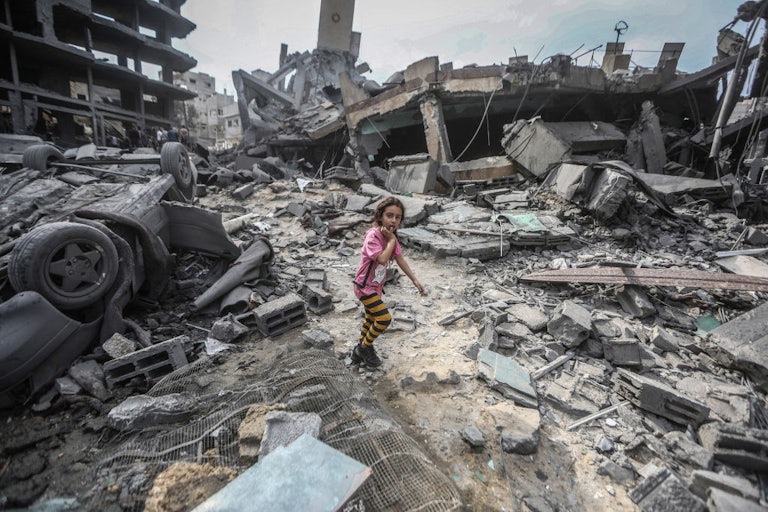
A Palestinian girl walks on rubble following Israeli airstrikes in Gaza City in October 2023.
I spent the past week glued to my phone, as I’m sure many of you did, scrolling through endless news and horrible videos of the violence in the Middle East.

Sometimes, when global disasters or conflicts happen, people will whip up an infographic pointing out the (occasionally tenuous) connections to climate change; I generally roll my eyes when someone tries to shoehorn climate into an issue that’s not particularly relevant. But in the case of Israel and Palestine, the land that’s being fought over is changing in unmistakable ways—ways that are helping perpetuate a cycle of oppression and violence. Understanding how climate and this conflict are tied together is, for me and for many others, adding another layer of tragedy onto an already heartbreaking situation.

Israel and Palestine are located in one of the most climate-vulnerable areas in the world. Temperatures in the Eastern Mediterranean and Middle East are rising almost twice as fast as the global average, an international group of scientists concluded last year; they are expected to rise 0.81 degrees each decade through the end of the century. Simultaneously, precipitation in Middle Eastern and North African countries has declined by over 8 percent each decade since the 1980s.

Both Israelis and Palestinians would be struggling to adapt to these challenges even if there were peace. But this bloody conflict has only served to exacerbate the environmental tipping points. While both Israel and Palestine are affected by sea level rise and the loss of coastal territory, the impact is especially severe on the Gaza Strip because it is one of the most densely populated places on earth, and Palestinians are not allowed to expand beyond the militarized borders. Meanwhile, in portions of the West Bank, Palestinian farmers say that settler occupation and violence have blocked them from their regular water supply, forcing them to pay high prices for water as natural sources decline. In Gaza, where much of the electricity is supplied by Israel, power outages dragged on this summer as demand for air conditioning skyrocketed, creating dangerous conditions for people who need ventilators to breathe.

Ecosystems aren’t beholden to borders; the environmental harms wrought on one population by the powerful government next door can sometimes boomerang. Israel’s control of water resources in the West Bank has helped create a huge sanitation problem that poses an immediate and dire threat to Palestinians but also a threat to Israelis, as untreated sewage flows from Gaza into the Mediterranean Sea. And while some communities living in the West Bank make a living burning electronic waste imported from Israel, the cancerous smoke is causing health problems on both sides of the border.

In recent years, international environmental groups have begun to emphasize the conditions in Palestine as not just a human rights issue but an environmental one.

“There is a clear separation between how things are being run in Israel and how they are being handled in the West Bank and the Gaza Strip,” Muna Shaheen, a member of One Climate, an Israeli-Palestinian group founded to draw attention to the ecological impacts of the crisis, told the Israeli newspaper Haaretz in 2021. “Israel’s attitude toward the West Bank is like a garbage bin. It’s completely ignoring that we all share the same sky, air and land. It’s simply stupid.”

In an age of escalating conflict, following the hottest summer on record, there seems to be no untangling these parallel tragedies of war and climate. The Israeli government, as it launched retaliatory attacks last weekend, also announced a full blockade of Gaza, including blocking water supplies to residents. On Wednesday, the Gaza Strip’s sole power station ran out of fuel after Israel refused to let more supplies in; hospitals across the region now face imminent blackouts as they attempt to care for victims. The U.S. military—which is estimated to emit more carbon dioxide than many countries—is mobilizing to provide even more support to Israel. Iran, a supporter of Hamas, is the world’s biggest fossil fuel producer that has not signed the Paris Agreement; inside its borders, its citizens are facing catastrophic levels of air pollution and are being forced to migrate as droughts, storms, and floods destroy the land. We keep ruining our planet as we kill each other, and one murderous cycle feeds into another.

“Everyone here is busy with fighting over the land,” Shaheen told Haaretz. “But in another minute, we won’t have land to fight over. It’s insane, in my opinion. The house is burning and people are fighting over who will enter it first. Wake up, God damn it!”

Good News, Bad News

Over the weekend, Governor Gavin Newsom signed into law a bill that will require large companies doing business in California to disclose emissions from all points in their supply chains.

Floods and landslides in Cameroon’s capital city of Yaoundé killed at least 30 people on Sunday.

Stat of the Week

224 hours

That’s the amount of time each year that Dammam, Saudi Arabia, could experience conditions that are too humid for the human body to handle by the end of this century, even if the world meets the goals of the Paris Agreement, a new study finds.

Elsewhere in the Ecosystem

Al Jazeera profiles the divers still looking for the bodies of the thousands of people thought to have perished in last month’s devastating dam break in Libya:

The eerily quiet divers pile onto boats to jump into the sea whenever the weather and waves permit, trying to salvage the bodies still in the waters.

The storm burst two dams above Derna, causing floods that washed through the city, wiping out the landscape, sweeping away buildings and obliterating whole neighbourhoods. The death toll is estimated at thousands, with thousands more reported missing.

“It’s a city down there. More so in the earlier days, as it was populated with bodies. But there’s still a city down there,” said one of the divers.

Read Ahmed Zidane’s full piece at Al Jazeera.

This article first appeared in Life in a Warming World, a weekly TNR newsletter authored by contributing deputy editor Molly Taft. Sign up here.

A Glimpse of Our Grief-Addled Future

A college reunion becomes a climate bereavement group.

MARK FELIX/AFP/Getty Images
A firefighter in Bourg, Louisiana, during Hurricane Ida in 2021

I took a trip last week to meet up with some old college friends. We live all around the country, so we’d chosen New Orleans as our meeting place. One of my friends went to medical school there, and he and his partner could drive there from their home in Houston—with a 6-month-old baby I was aching to meet.

Spending time with old friends at this stage of life always feels like an exercise in accepting differences, from new babies to new marriages to new houses to new cities. But what I thought might be a relaxing weekend with people I love best turned into a shared revelation about the one thing we have in common: how climate change is inextricably altering the landscapes around us, regardless of where we live.

On Friday morning, while we were walking through New Orleans to get breakfast, I began getting frantic texts from my girlfriend back in New York, who had tried to walk the dog and was immediately caught in an intense downpour. I scrolled social media, trying to learn what I could about the storm, and saw footage of people wading through streets in my neighborhood and water streaming through cracks in the walls at my subway stop. All told, more than seven inches of rain fell in Brooklyn, my borough, over a single day, and six people had to be rescued from their basement homes.

As I frantically kept up with the storm from hundreds of miles away, I learned that my friends, despite living in the path of hurricanes themselves, didn’t know that Hurricane Ida, which tore through New Orleans in 2021, also swept through New York a week later. That storm killed almost a dozen people, who were trapped in their basement apartments and drowned. It flooded in New York during Ida too? they asked, incredulous. That many people died?

That night, after the rains at home had stopped, we met up with some friends who still live in New Orleans. We were sitting at a bar in the Mid-City district, a little over a mile away from Bayou St. John, a waterway that snakes through the center of the city. A couple blocks away, a handmade commemorative marker showed the chest-high levels the water had reached in that neighborhood during Hurricane Katrina.

This couple, who have two babies around the same age as my friends’ daughter, told us about their latest environmental worry living in New Orleans. Because the Mississippi River’s water levels have been so low this summer, thanks to widespread drought, and sea level rise on the Louisiana coast so pronounced, salt water is slowly creeping up the river toward the city. The salt water is going to ruin drinking water and corrode people’s appliances and pipes. They’ve only got another couple of weeks until it hits.

What are people living here supposed to do about it? I asked. They weren’t sure. The government is working on stopgap solutions—the president declared a state of emergency last week, and the Army Corps of Engineers is installing a levee and expensive desalination machines. But those temporary fixes aren’t going to address the whole problem. Maybe they’d find a way to get out of town until a big rain upriver can flush the salt water back out to sea.

Another friend chimed in with similar news about Colorado: In a region at the southeastern edge of the state, the aquifers have been so overpumped that arsenic is leaking into the drinking water. This friend had moved to Colorado just before the pandemic, and she was one of my first texts when the wildfire smoke hit New York City in June and made our air unbreathable. You don’t realize how oppressive and scary wildfire season is, she told me, until you get to a place where it happens all the time.

What do we do about this? my friends asked me, the climate reporter. The answer isn’t particularly satisfactory. If you don’t control a massive amount of wealth invested in fossil fuels, or a huge oil company that you can suddenly shut down, your personal carbon footprint doesn’t mean much; the best course of action is to get involved in local politics, to formulate plans to keep each other safe, and to draw down carbon emissions as much as possible. But the simple, harsh truth is that even the most aggressive policies in your city won’t substantially change the way the earth seems to be revolting under our feet (and over our heads).

There at the bar, looking at the babies in front of me, I felt the ecological despair that was ever-present during the hottest summer on record. But I also felt a weird solidarity too—a small, neurotic comfort that I wasn’t alone in watching my environs change in terrifying ways. We’re experiencing this horror together, and trying to figure out a way through it.

When we said goodbye, I asked the folks in New Orleans to keep me posted on whatever they decide to do about the salt water. And I made plans to visit my friends in Houston in the winter, when we could go outside with the baby. We’d realized during the trip that because temperatures in the city were dangerously hot this summer, our weekend walking around New Orleans—in gorgeous fall weather, with light breezes and surprisingly low humidity—was the longest stretch of time their daughter had spent outside. This little baby, whom I’d immediately fallen in love with, has had to live most of her life thus far indoors.

Good News, Bad News

The World Bank said last week that it would increase its lending to developing countries to fight climate change by $100 billion over the next 10 years.

More than 100 Amazonian river dolphins were found dead in the past week, after water temperatures in the Brazilian Amazon topped 102 degrees in some places.

Stat of the Week

6.7–13.9 pieces per liter

That’s the concentration of microplastic found in cloud water gathered from mist at the peaks of Mount Fuji and Mount Oyama, according to a recently published study—the first piece of research on the presence of microplastics in clouds.

Elsewhere in the Ecosystem

The Texas Tribune skillfully covers how flooding and rains—coupled with inadequate government response for residents harmed by storms—has all but decimated a small town in Texas.

Decades ago, there were as many as 100 occupied homes in Sam Houston Lake Estates, a densely-wooded neighborhood about 60 miles northeast of Houston. Today there are fewer than a dozen, according to interviews with locals.

Water hasn’t flowed to the homes in this neighborhood in more than three years—the water company says it can’t get vehicles in to maintain its well—and first responders won’t attempt to navigate the neighborhood’s narrow bridge and eroded dirt roads.

When someone is sick or injured, residents have to drive, or carry, their neighbors out of the woods to reach medical help.

This river bottom flooded often in the past, former residents said, but not like it has in the last decade. Climate change has likely intensified flooding and accelerated erosion, experts said.

Read Erin Douglas’s full piece at the Texas Tribune.

This article first appeared in Life in a Warming World, a weekly TNR newsletter authored by contributing deputy editor Molly Taft. Sign up here.

Will Mainers Take Their Power Into Their Own Hands?

Maine voters could set a model for other areas of the country to follow with a rare hostile takeover of the electric powers that be.

Portland Press Herald/Getty Images
Workers removing a tree from power lines in South Berwick, Maine, in March 2018

While we may grumble about our electric bill, most of us take the idea of paying the costs of electricity to a specific power company each month as a given. But what if you could fire the utilities that are responsible for keeping your lights on if they do a bad job—or if they aren’t prioritizing climate change?

In November, Mainers will vote on a ballot initiative that could substantially change who controls their power—literally. If a majority of Mainers vote “yes” on Question 3, they would be able to replace Central Maine Power, or CMP, and Versant, two companies that supply more than 96 percent of Maine’s electric customers, with a new publicly owned power company. It would be a rare hostile takeover of the electric powers that be, which could set a model for other areas of the country to follow.

The campaign to replace CMP and Versant is being run by a grassroots group called Our Power. For years, Mainers have complained about outage and customer service issues from both of their big utilities. The new company, which would be named Pine Tree Power, would “bring back local control, save money, and reduce outages,” all while speeding the transition to cleaner energy.

Versant and CMP are what’s known as investor-owned utilities: for-profit companies that are given monopolies by the state to provide power to certain areas. More than 70 percent of the country gets its power from investor-owned utilities. But this model, said Joshua Macey, an assistant professor at the University of Chicago Law School who focuses on energy policy, is a relatively recent invention from the late 1800s that took off as the use of electricity was becoming more widespread and the companies profiting off it wanted to maintain control.

According to the rules of their state-given franchises, investor-owned utilities can’t earn money on the energy they provide to consumers. They’re only allowed to make a profit on building new infrastructure—which creates an incentive for utilities to go buck wild in building lots of new pipelines or a truckload of new peaker plants. By comparison, a switch to lower-emissions forms of power or incorporating efficiency upgrades to existing infrastructure only benefits the consumers served by the utilities, not the shareholders; the financial impetus to do those things, therefore, is nonexistent.

“It doesn’t really make sense for utilities to operate as for-profit companies,” Macey said.

Utilities are powerful industries in the United States—and, understandably, the owners of Maine’s utilities are stressed out about the potential changes Question 3 poses. The ballot has kicked off an enormous flood of cash in the state. In June, Floodlight and the Portland Press Herald reported that organizations funded by Avangrid and CMP’s parent companies had already spent $16.5 million on fighting Question 3—about 17 times what the ballot’s proponents have spent.

Macey said that even if the ballot initiative succeeds, the utilities will almost certainly sue, kicking off a lengthy legal process that will drag on for at least a few years. And even if courts and regulators allow the initiative to move forward, there are still aspects that are up in the air.

“It’s very exciting, but it’s a little scary to be in Maine, because they have to work out the details,” Macey said.

While Our Power’s website paints a rosy picture of what will happen if Maine ditches its for-profit power, non–investor owned utilities aren’t a total panacea to everyone’s problems. Utilities have an enormous role to play in balancing the energy transition with consumer bills—a massively complex job that doesn’t necessarily get easier when those utilities aren’t controlled by for-profit companies. The nation’s biggest public power company, the Tennessee Valley Authority, has stubbornly held onto coal-fired power for years and has largely dismissed renewable energy options for replacing some of that dirty energy.

Still, what’s going on in Maine presents an exciting new possibility for the rest of the country. The utility industry has spent massive amounts of money to ensure that it keeps control of its monopolies and the resulting profits from the American electric system—including fighting against climate action that it sees as costly to its business model. Even if Question 3 fails, it’s a powerful reminder that municipal takeover was once a common concept for how governments would rein in utilities that weren’t adequately serving their customers.

“Investor-owned utilities are given an enormously valuable gift by the government,” Macey said. “Dealing with the specific cost of transitioning away from an investor-owned model may be enormously hard. But I think, despite that, it is really important to note that utilities don’t have a license to keep having ballooning costs, failing on their environmental mandates, and failing to meet their reliability obligations.”

Good News, Bad News

The path to keep warming below 1.5 degrees Celsius (2.7 degrees Fahrenheit) is getting narrower—but there’s still a chance we could get there with aggressive action by 2030, a new report from the International Energy Agency finds.

Domestic oil production in the U.S. will reach a record new high over the next few months.

Stat of the Week

34,000

That’s the number of homes, businesses, and other structures projected to be destroyed each year by wildfires supercharged by climate change by the mid-2050s, a new report finds—double the current number.

Elsewhere in the Ecosystem

Hydropower is a major source of fossil fuel–free energy in the Western U.S. But the dams that make hydropower possible have also destroyed valuable rivers and ecosystems, sparking a complex debate in the region about the future of these dams, the Los Angeles Times reports:

Almost everybody wants to protect salmon. Here’s the challenge.

Even if every Western dam stays in place, we’ll need to build a mind-boggling number of solar fields, wind turbines, lithium-ion batteries and long-distance electric lines to break our fossil fuel addiction—and fast. That’s going to be tough, even after the landmark climate bill signed by President Biden last year. Already, opposition to renewable power infrastructure is bubbling up from rural communities, conservationists and tribes as ever-larger stretches of land are eyed by energy developers.

Start tearing down dams, and the energy transformation gets even harder. In a typical year, hydropower plants generate around 6 percent or 7 percent of U.S. electricity. The lower that number gets, the more sprawling solar and wind farms we’ll need to build.

Read Sammy Roth’s full piece at the Los Angeles Times.

This article first appeared in Life in a Warming World, a weekly TNR newsletter authored by contributing deputy editor Molly Taft. Sign up here.

This article has been updated to correct the forms the new utility may take. The previous version of this piece stated that the new utility could be an agency or a cooperative, but neither of those forms are possibilities according to the language of the ballot initiative.