Newsletter
Fighting Words
What got me steamed up this week

If Obama Had Done What Trump Just Did on Iran, He’d Be Crucified

The United States just unambiguously lost a war that it started for no good reason. A sane country would remove the imbecile who did this immediately.

Donald Trump arrives for a Medal of Honor ceremony in the East Room of the White House.
Aaron Schwartz/Getty Images

When I read history, I often wonder what it must have felt like to live those events in real time, as I’m sure you do. Did it seem an ominous moment in June 1914 when Gavrilo Princip shot Archduke Franz-Ferdinand? If I were a Briton in September 1938, would I have had an uneasy sense of foreboding watching the newsreel of Neville Chamberlain stepping off that plane from Munich?

I think such thoughts this week because I have no doubt that future historians and readers of history will surely wonder what the ever-living fuck we were all thinking when Donald Trump both started and then lost his immoral and pointless war with Iran. What we have just witnessed is almost beyond belief, and would be beyond belief if we didn’t all know going in that Trump is such an aggressively and willfully stupid human being, utterly impervious to knowledge and facts, serenely cocooned in his carapace of ignorance, surrounded by flatterers who patronize him as one does a child and who scream at Americans about his nonexistent genius, courage, and virility. They exist in a fantasyland.

But we live in the real world, and in the real world, this war was a disaster in every imaginable sense. Let’s tally up the damage:

  • First of all, there was already a diplomatic agreement with Iran that was working; the International Atomic Energy Agency reported repeatedly that Iran was abiding by the Obama-era JCPOA deal. There was no need for Donald Trump to do anything.
  • But of course, the deal was the handiwork of Barack Obama—the Kenyan Marxist who made a few jokes at Trump’s expense at a dinner one time; so Trump tore it to pieces.
  • Almost instantly, Iran started enriching uranium at levels well above the 3.67 percent limit set by the JCPOA. And why not? Trump broke the agreement. Of course they started enriching uranium at high levels again.
  • In other words: The fact that Iran once again became a nuclear threat is entirely Donald Trump’s fault.
  • With respect to its capability to build a nuclear weapon, Iran’s “breakout time,” in the preferred parlance of diplomacy, went from 12 months to seven days. That is not a typo.
  • So Trump discovers this one day. Maybe Benjamin Netanyahu explained it to him. We’ll learn that whole story at some future point. In any case, out of nowhere on the last day of February, with no warning, no prep, no nothing, Trump starts a war. Within hours, we bomb a school, killing around 120 children.
  • From a purely military standpoint, the war goes fine. We suffer few casualties, although we do kill 3,500 or more people. But Iran counters by doing the thing that every expert in the world knew Iran would do if it was ever attacked: It asserts its control over the Strait of Hormuz. If you want to come through, you have to pay to play. Up go the gas prices.
  • Now Trump is trapped. And he’s starting to get bored because the regime didn’t collapse in two weeks like he thought it would. He wants out. So he sends his corrupt son-in-law, in bed with the Saudis and in the middle of trying to humiliate Albania for no good reason, to sort things out.
  • That brings us to this week: the outlines of a deal that looks for all the world like a complete surrender. The United States of America, for only the second time in its 237 years on this earth, has unambiguously lost a war.

People can debate the above. I’m counting Vietnam, obviously; there’s no doubt about that one. I reckon the War of 1812 and the Korean War as stalemates. Under the Treaty of Ghent, the United States and Britain just agreed to go back to the way things were before the war, and with respect to Korea, the line was the 38th parallel pre-bellum and postbellum.

Some will say Iraq was a loss, but I rate it, too, as kind of a draw. It sure wasn’t a win of the sort Dick Cheney and Paul Wolfowitz told us to expect. It cost many trillions of dollars and killed hundreds of thousands. To a mixed result: Today, Iraq is a democracy, of a sort, but it’s a long way from being free. But I perhaps charitably call it a draw because the U.S. did achieve the core stated aim: It deposed Saddam Hussein.

Here, though, we have not achieved any of Trump’s shifting stated claims. There’s no regime change—or, to the extent that Trump has managed to change the regime, it’s even more hard-line and more powerful in the region than it was before the war!

And that’s before we and other nations fork over the infamous $300 billion, just a mind-boggling figure. Conservatives wanted Barack Obama impeached over the money he agreed to pay Iran (which was Iran’s money, frozen in U.S. banks), which was $1.7 billion. Trump is going to hand Iran 176 times that amount. And it’s going to end up being more, because the $300 billion is separate from whatever frozen assets Trump decides to unfreeze. Word around the campfire is that we are talking about another $25 billion or so.  

Some perspective on how much $325 billion is. The total U.S. foreign aid budget for 2025 was about $60 billion. More pointedly: Estimates vary, but it seems that Iran spends around $1 billion a year propping up Hezbollah. Imagine how much they’ll be able to spend when their Trumpy ship comes in!

The one slender thread on which the Trump administration is now hanging its hopes is that in the coming negotiations, it’ll get Iran to surrender its current stockpile of enriched uranium. That, admittedly, would be something that the JCPOA didn’t do. If they pull that off, even I will say good for them.

But for Iran, of course, this is a nearly inconceivable concession. What seems more likely to happen is that the two sides will agree to terms calling for Iran to dilute its highly enriched uranium under international supervision. Trump will sell this as a great victory. But this “down-blending,” as it’s called, was also in the JCPOA!

Above, I called this war immoral and pointless. The pointless part speaks for itself. It has accomplished nothing except making Iran stronger and the United States weaker. If Barack Obama or Joe Biden had done this, not only would they have been instantly impeached if the Republicans controlled the House, but the entire Democratic Party would have been discredited on foreign policy matters for a generation at least.

But the immoral part is worse. Trump started a war, killed a few thousand people, got tired of it, and surrendered to one of the most reactionary regimes on earth, which went on a gleeful killing spree of its own citizens earlier this year. Since the commencement of these hostilities in February, Iran has executed 44 more people and detained another 6,000. That’s the regime Donald Trump just strengthened and is about to hand many billions of dollars to. “Immoral” barely scratches the surface.

This is an epic failure. It’s not quite September 1938. But that’s only because Iran’s mullahs don’t have Hitler’s global ambitions. Morally, it’s a Neville Chamberlain moment of a sort the United States has never experienced. The icing on the cake would be Trump taking to Truth Social and boasting about “peace in our time.” A man who signed a treaty at Versailles is ignorant enough of history to not even know why that phrase resonates.
The Not-So-Secret Impulse Behind Trump’s Vulgar, Garish Birthday Party

In the real world, a weak and insecure Donald Trump is being humiliated by Iran. Ah, but Sunday night, he’ll be a manly man among manly men.

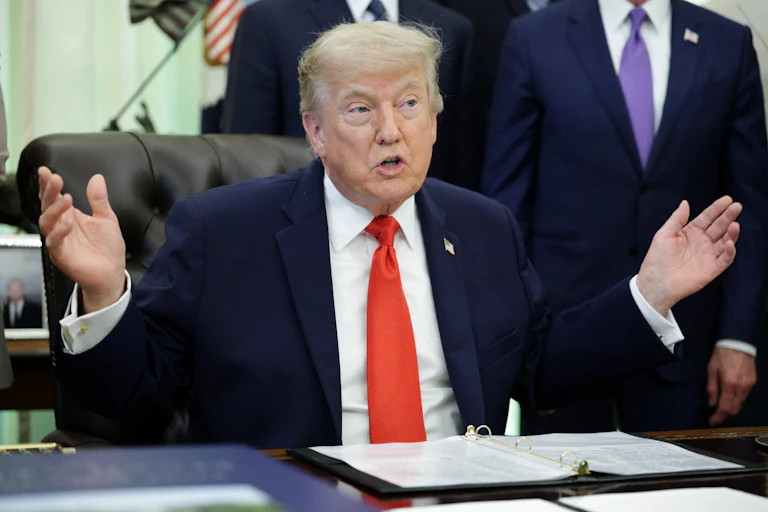
Donald Trump speaks during a proclamation signing ceremony in the Oval Office of the White House.
Alex Wong/Getty Images

The president turns 80 on Sunday, and, as with everything pertaining to Donald Trump, his need to place himself at the center of our attention is pathological. He could not just have a dinner at the White House, or a party at Mar-a-Lago. No; he had to build a massive arena on real estate that belongs to the people of the United States to host a vulgar, garish event that is one of the most violent forms of spectacle available to the human race today. Trump will be sitting there like some Roman emperor at the Colosseum watching enslaved men try to stave off lions. The man who wanted law enforcement to shoot protesters “in the knees” is probably bummed he couldn’t just replicate that.

But if you can’t have lions, six UFC fights are the next best thing. Granted, UFC fighting is very popular in the United States and across the world. I’ve read various accounts this week contending that UFC fighting has supplanted hockey as the fourth-most-popular sport on television, behind the big three of football, baseball, and basketball. I’ve also read that its popularity may have peaked; here’s a 2025 piece by a sportswriter who has followed “combat sports” for 15 years, showing that the number of matches is in steep decline. “The United States, long the backbone of [mixed martial arts], has seen a sharp decline in activity,” wrote John S. Nash. “In 2009, more than 6,266 professional fights took place across the country. This would be the pinnacle for American MMA contests. By 2024, that number had dropped to just over 3,027—a 52 percent decrease.”

Still—it’s popular. Fine. But guess what’s strikingly, overwhelmingly not popular? The idea of hosting such fights at the White House, on grounds we tend to associate with understated, democratic solemnity. A poll released Thursday found that just … wait for it … 16 percent of Americans considered it appropriate to hold MMA cage matches on the White House grounds. Meanwhile, 46 percent opposed. Even among Republicans, only 31 percent considered it appropriate. Yet a narrow plurality of Republicans in the survey backed the event, by said 31 percent to 22 percent.

Democrats opposed it by huge margins, 75 to 5 percent. Independents were strongly against it too, by 45 to 11 percent. So once again, it’s Republicans—no; specifically, it’s MAGA Republicans, because they’re undoubtedly that 31 percent—who are way out of step with what real Americans think. Yet they—Trump, his lackeys, and all those Soviet-style propagandists on Fox and Newsmax and One America and elsewhere—will of course spend the entire weekend equating men beating each other to a pulpy mass on hallowed civic ground with “real” patriotism.

It’s sickening. Oh—and it’s also, as we’ve come to expect with Trump, deeply corrupt. First of all, the cost of constructing the arena is around $60 million. Supposedly UFC is picking up that check, but with Trump, who really knows? We taxpayers will undoubtedly be on the hook for something. Meanwhile, the chief sponsor—surprise, surprise!—is Crypto.com. There are in addition figurines of some of the featured fighters. There’s apparel—garish T-shirts running $40. Over at TrumpStore.com, somewhat to my surprise, I didn’t see any merch specifically tied to the event, but you have to believe that Trump’s short-fingered hand is dipping into some till or another here. A lawsuit filed by the group the Public Integrity Project to block the event from taking place (it’s pending as I write) states that UFC set up a for-profit entity to manage this event, which is selling seating packages that cost up to $1.5 million—and that Trump previously bought $50,000 worth of stock in TKO, UFC’s owner.

Out in the real world, Trump is being reduced to impotence by a bunch of dictators who are even more reactionary than he is. He’s about to cut a “deal” with Iran that sounds like it will be little more than an extended ceasefire. It will, many experts fear, compare unfavorably to Barack Obama’s 2015 accord, which Trump tore up in 2018. Trump may achieve what Obama achieved, in terms of getting Iran to agree not to enrich uranium at anywhere close to weapons-grade levels. But as I’ve noted several times, the thing to watch is how much money Trump agrees to transfer to Iran. Which in a sense is fine; it’s Iran’s frozen money. But when Obama agreed to give Iran $1.7 billion, right-wingers screamed that it was capitulation and even treasonous. Iran now wants up to $24 billion. We’ll see how Mr. Art of the Deal fares.

But even if he does strike a decent deal, he’s already done enormous damage to the U.S. economy, the global economy, and American prestige and power projection. To sane observers in the United States and across the world, he looks like exactly what he is: a weak and hollow and insecure man who started a needless and counterproductive war out of nowhere because it looked “tough.”

But inside his little MAGA cocoon on Sunday night, he’ll be a manly man, presiding over watching other manly men spill each other’s blood for the leader’s greater glory. It’s the most undemocratic pageant one could imagine, a fact that—given that scant 16 percent support—the people know in their bones. In fact, this is exactly what fascism is: grotesque, violent spectacle that repulses most of the population but drives the fervent worshippers to a frenzied state and tries to bully its way into being synonymous with what it means to be a real American.

It’s all made worse by the fact that Dear Leader will be embarking upon his ninth decade of life that night, and that six in 10 Americans believe he lacks the mental sharpness to serve as president. So that’s the not-so-secret meaning of this event. I just wonder if Vegas will establish odds on whether he’ll fall asleep.

MY NOVEL IS OUT!: Buy my new novel, Killing Baby Hitler, out this week from O/R Books. “Fabulous in every sense,” says Kurt Andersen. “Savagely funny,” says Molly Jong-Fast. They’re right!

Why The New York Times Is Wholly Responsible for Bari Weiss’s Rise

She was at The Wall Street Journal and should have spent her career there. But the Times decided she was … interesting. Why do liberals do this?

Bari Weiss speaks to someone (not pictured)
Leigh Vogel/Getty Images
Bari Weiss interviews Senator Ted Cruz.

Everyone is up in arms, and rightly so, about what Bari Weiss is doing to CBS News in general and 60 Minutes in particular. The firing of Scott Pelley will reverberate in American journalism history as a symbolic execution of the single most groundbreaking and successful news program in the annals of U.S. broadcast television. Two of the program’s other prominent on-air correspondents were fired, as well, and we’ve seen countless news stories this week about the chaos and turmoil that have resulted. Three of the show’s remaining correspondents—Bill Whitaker, Lesley Stahl, and Jon Wertheim—reportedly huddled this week to discuss their next move; Stahl is currently out of contract.

This is a tempestuous time at one of the nation’s most staid journalistic institutions. But let’s back up a minute to appreciate how we got here. How did someone like Weiss, with no broadcast news experience, get put in charge of the network with the longest and proudest news tradition in the country? Well, we know the answer to that question. David Ellison, head of Paramount (which owned CBS), hired her last October, three months after the Trump administration approved the takeover of Paramount by Ellison’s company, Skydance. Before that, of course, Weiss had started up the very successful Free Press newsletter, devoted mainly to attacking left-wing wokery and cancel culture for dedicated subscribers.

But the pivotal moment, or actually moments, in her career came before that. The first was her hiring, in April 2017, by The New York Times. The second was her famous departure from that same paper, which she cynically and shamelessly used to get a bevy of wealthy, angry, rich men to stake her to the Free Press. You know that saying about how sometimes liberals are so open-minded that their brains start falling out their ears? Weiss’s ascent provides a lesson in how liberal institutions can sometimes place such value on proving that they’re open-minded that other liberal values, like standing for actual liberal things in the world, get tossed aside.

On April 12, 2017, as the nation’s most important newspaper was settling into the first Trump era, the honchos of the Times made an announcement. They were hiring Bret Stephens away from The Wall Street Journal. Stephens was, of course, conservative in outlook. He made for the third conservative at the generally liberal op-ed page, after longtimer David Brooks and the comparatively youthful Ross Douthat.

Well … OK, then. Brooks had been at the paper since the 1990s; Douthat since 2009. One could maybe, possibly justify adding a third after Trump’s election, to “understand” the conservative mind and the sentiment apparently flowing across this great land (even though that sentiment won 2.8 million fewer votes than liberal sentiment, but never mind that). Mind you, though, that it sure isn’t as if The Wall Street Journal and The Washington Times and the New York Post started making an effort to understand the liberal mind after Barack Obama won. The Journal has one nonconservative columnist, William Galston of the Brookings Institution, who is a friend of mine and can fairly be described as liberal-centrist. The Washington Times and the New York Post, from what I can see, have zero.

But fine. Stephens. One might have thought that would have been enough. But no! A mere two days later, on April 14, came the beaming announcement that the Grey Lady was nabbing its second Journal opinionista of the week and hiring Weiss: “It is with great excitement today that we announce that we’ll be expanding the desk’s range, voice, and reach with the hiring of Bari Weiss.” The announcement explained that Weiss would be “commissioning the kinds of quick, off-the-news pieces that are such a critical part” of our yadda-yadda-yadda and would be doing so with the “signature verve and humor” so evident in her Journal oeuvre.

That’s one of those eye-of-the-beholder questions. Here is her Journal corpus, at least the written part of it. Look, we’re all predictable to some extent, your humble servant included. I wouldn’t deny it for a second. But Weiss’s Journal pieces were predictable in a specific way that allows us reasonably to question precisely what the nation’s, nay the world’s, most important liberal opinion page found so alluring in them. Just sample these headlines: “The PC Police Outlaw Make-Believe”; “Is That Libidinous Latina Taco Gay or Bi?”; “Camille Paglia: a Feminist Defense of Masculine Virtues.”

A representative piece, from June 2015, called “Love Among the Ruins,” chides those celebrating the Supreme Court’s decision that legalized gay marriage. Oh, don’t misunderstand—Weiss supported the decision, of course! But she found it troubling that the messages “blowing up” her phone were wholly focused on Obergefell v. Hodges with not one person taking time to decry the recent mass shooting in Tunisia or the terrorist attack in France.

In other words: “The left” is so obsessed with its narrow, woke agenda that it doesn’t care about mass shootings or terrorism. It’s gibberish. Obviously, people can celebrate something they support without feeling some overwhelming, Dostoyevskian guilt about suffering on the other side of the world. Besides, I am 100 percent certain that if she’d bothered to look, she could have found quotes from Democratic politicians and human rights groups and other wokesters denouncing those tragic events. But the key to writing a column like that is not bothering to look. Smart liberals know that conservative trick and know not to indulge it.

But anyway. They hired Weiss. You would have thought that would have been enough. But no! Two years later, the Times hired a young conservative firebrand named Adam Rubenstein, who also had The Wall Street Journal on his résumé.

Nothing unusual happened for a while. Then, in the wake of George Floyd’s murder in the summer of 2020, the Times ran the instantly infamous op-ed by GOP Senator Tom Cotton arguing that it was time for the military to restore order. That contention, when put that way, is controversial but not necessarily objectionable. But many of Cotton’s particular assertions were extreme. To take one example, addressed by the Times in a later editor’s note: “For example, the published piece presents as facts assertions about the role of ‘cadres of left-wing radicals like antifa’; in fact, those allegations have not been substantiated and have been widely questioned. Editors should have sought further corroboration of those assertions, or removed them from the piece.”

Editors also should have done more to square the case he made in his op-ed with the rhetoric he’d previously deployed to make the same case, in which he called for the invocation of the Insurrection Act (which the piece cited) and further recommended that “no quarter” be given to targeted demonstrators. As David French pointed out, “no quarter”—which mean enemies should be killed on the battlefield rather than be taken prisoner—“has been a war crime since Abraham Lincoln signed the Lieber Code in 1863.” By not forcing Cotton to reconcile the position in his op-ed with the more incendiary ideas that inspired it, the Times editors laundered his original demand for violent extremism into erasure.

Rubenstein edited the piece, encouraging the inclusion of photos of federal troops protecting Black students in the 1960s South, as if people protesting the violent, nine-minute murder of a citizen were analogous to racist hordes denying rights to other citizens. A huge controversy ensued.

Weiss apparently had nothing to do with the piece, but she cynically seized on the opportunity the fracas presented to resign, citing a deeply inhospitable workplace. She announced her decision on her website, in a roughly 1,500-word letter to the Times’ publisher, rebuking him for allowing other Times employees to say rude (and admittedly sometimes quite vicious, if her account was accurate) things about her.

The letter went into several details that in most workplaces, probably including The New York Times, are typically thought and assumed to be private and confidential. But naturally, to some, revealing these behind-the-curtain anecdotes marked Weiss as a truth-teller and a martyr. And this, along with her general profile of alerting the elites to the latest lunacy at the Dalton School (and her rabidly pro-Israel stance), is what made her a hero to men like David Ellison. She started a Substack originally called “Common Sense,” which morphed into the Free Press after she raised capital from people like Marc Andreessen, David Sacks, Bobby Kotick, and Howard Schultz. The first three are all Republicans (Andreessen was once a Democrat), and Schultz is an independent.

For her own part, Weiss always used to call herself a centrist-liberal or a sane liberal or some such thing. That may have been true at some point, to some extent. But now, it’s quite clear that she is not just conservative, she’s MAGA. Maybe not in her heart, but overwhelmingly in her actions, and it’s actions that matter. She was placed at CBS by Ellison to crush the left and advance Donald Trump’s agenda, so it’s no surprise that that is precisely what she’s doing. And no matter her level of incompetence, she’ll stay there as long as she’s doing that—and as long as she’s not killing the stock price.

And it all can be traced back to that week in April 2017, when The New York Times decided it had to be broad-minded in the wake of the election of the most narrow-minded man to occupy the White House since Andrew Johnson—or maybe ever. And now the chief beneficiary of the paper’s broad-mindedness is advancing that narrow-minded man’s agenda while destroying the country’s most venerated television news operation.

Oh, and Adam Rubenstein? Whatever became of him? He shared Weiss’s sharp instinct for self-promotion. He quit the Times six months later and took to the website of The Atlantic to write a self-pitying piece about the brouhaha that his own sloppy editing caused.

And today? Well, the day after Ellison named Weiss head of CBS, CBS announced the hiring of Rubenstein as deputy editor, where he is reportedly part of Weiss’s “inner circle.” Take that, Walter Cronkite.

The Real—and Deeply Corrupt—Reason Trump Is After E. Jean Carroll

Actually, it’s not reason, singular. It’s reasons, plural. And there are 88.3 million of them.

Trump
Kent NISHIMURA / AFP via Getty Images

Holy Damage Control, Batman: CNN originally reported late in the day Wednesday that the Justice Department was opening a probe into whether E. Jean Carroll, the New York woman who successfully sued Donald Trump and won $88.3 million in damages for sexual abuse and defamation, lied during the legal proceedings against Trump, and that Andrew Boutros, the U.S. attorney for the Northern District of Illinois, would be leading the investigation. Then, on Thursday, Boutros said, Hey, not me!, categorically denying that he was investigating Carroll.

This is extraordinary on so many levels. First and foremost, it’s shocking and disgusting that the Trump administration would even contemplate doing this.

It’s important to dip briefly into the facts here. Yes, in a 2022 deposition, Carroll misrepresented the fact that Democratic billionaire Reid Hoffman donated to her defense fund. Her lawyer, Roberta Kaplan, has said that Carroll recalled later, sometime in 2023—it seems worth bearing in mind that she was in her late seventies at the time—that she had received some outside donations and that she told Kaplan, and Kaplan immediately told Trump’s lawyers. Those lawyers tried to pounce on this new information to cast doubt on Carroll’s credibility, but the judge barred Trump’s lawyers from using it at trial. Two juries subsequently found Trump liable for both sexual assault and defamation.

That’s the background. Here’s the important part, as detailed by Lisa Rubin in a recent MS NOW column: Trump appealed, twice, trying to get appellate courts to agree that Carroll was lying, and he lost both times. First, a three-judge appellate panel upheld Trump’s conviction and believed that Carroll just forgot: “Ms. Carroll plausibly represented that she had forgotten about the limited outside funding,” the panel wrote. Second, eight of 10 active judges on an appellate panel in June 2025 denied a request for rehearing by Trump’s lawyers. (And even just last month, a third appellate panel denied a rehearing of the defamation case.)

If you look at that June 2025 ruling I linked to above, you’ll see an interesting name listed as counsel for “defendant-appellant”: Todd Blanche.

This, of course, is the same Todd Blanche who is running the Department of Justice today. When Trump fired Pam Bondi as attorney general and stories came out that Trump had been displeased with her lack of zeal about going after his enemies, you, like me, probably wondered how anybody could possibly be more of an unethical, corrupt, cowardly lickspittle than Bondi was. She brought—or tried to bring—prosecutions against Trump antagonists Letitia James, James Comey, John Brennan, Fani Willis, and more. When career prosecutors declined to bring those cases, she fired them and brought in incompetent hacks to do Trump’s bidding. In some cases, federal judges found these hacks to have been installed illegally.

Bondi was venally corrupt, on an absolutely Wagnerian level. Just this week, in fact, a retired chief justice of the Florida Supreme Court, backed by 120 judges, attorneys, and law professors, brought a blistering ethics complaint against Bondi demanding that she be investigated and disbarred. That complaint is mostly about her handling of the Epstein files because, remember, she behaved indefensibly there too.

So how could anyone be more corrupt than that? I’ll tell you exactly how, through Trump’s eyes: They could succeed where Bondi failed. That was her crime. Not obviously and serially violating departmental ethical canons. Her crime was not doing it well.

Hence, Blanche. The fact that his name was on that appellate denial—that he was one of Trump’s lawyers in the Carroll proceedings—means he has personal skin in this game, which in turn means that there’s no way on earth this should be happening on his watch. And indeed, he is said to have “recused” himself on the matter of the Carroll investigation. So it was tossed to Boutros, in Chicago.

But Boutros, as I noted above, says he’s not investigating Carroll. He maintains that he’s only investigating Hoffman’s nonprofit, American Future Republic. It’s based in Chicago, you see, so there’s the veneer of justification. But this just raises the question: What has American Future Republic done wrong? It’s allowed to donate money to a legal defense fund. It’s a 501(c)4, not a (c)3, the basic difference being that a (c)4 is allowed to be more directly political (also that donations to a (c)4 are generally not deductible as charitable contributions).

GuideStar records show that the group did donate $7 million to Kaplan’s former law firm in 2020. That is by far its largest single donation. But even so, so what? The material question here isn’t whether Hoffman partly or even wholly paid for Carroll’s defense. The question is whether she lied about it. Three different panels of judges believe she did not.

What’s really going on with this investigation, one sniffs, is this. Trump is running out of appeals here. As Lisa Rubin wrote in the column I cited above: “In other words, Trump is facing down the increasingly real possibility of paying Carroll more than $88 million, before interest, with only the Supreme Court to potentially rescue him.” So he and his current lawyers are trying to resuscitate the issue that a judge prevented them from using at the original 2023 trial.

That’s not necessarily a crazy, last-ditch legal strategy for a person faced with writing that kind of check. The problem, though, is that the person is the sitting president of the United States, and “his current lawyers” are the U.S. Department of Justice, which he has corrupted. And by the way, if you want to know more about this Boutros fellow, just read Michelle Goldberg’s column today about his ghastly attempt to prosecute six people, including onetime Democratic congressional candidate Kat Abughazaleh, on felony conspiracy charges. The case fell apart last week after prosecutors admitted to misconduct before the grand jury. As Goldberg put it, “If Trump didn’t manufacture scandals on such an industrial scale, the case that collapsed last week in Chicago would have been a huge story.”

So many things would have been huge stories under any other presidency. Trump’s purchase of Dell stock and the awarding of a large Pentagon contract to the company. White House intervention to get a $620 million contract funneled to a company affiliated with Don Jr. The ongoing ICE scandals, with Democratic pols being prevented from being able to inspect horrid conditions at ICE’s detention camps. The new homeland security secretary vowing to cancel international flights to certain liberal cities. The plainly illegal effort to put Trump’s face on a new $250 bill. Any one of those, in normal times, would be a major scandal. And those were just this week.

I pondered writing about each of those. I chose the Carroll matter because it’s not only obviously corrupt but another cannon blast at the rule of law and the independence and integrity of the Justice Department. And because it’s something new: Are investigations into liberal nonprofits to become a regular thing now? So far, Trump has used the DOJ completely unethically, but he’s used it just to go after a handful of personal enemies. If he and Blanche open up the gates to start harassing liberal groups on a much wider basis, then we’re truly in tinpot dictator territory. It can, and will, get worse.

This article first appeared in Fighting Words, a weekly TNR newsletter authored by editor Michael Tomasky. Sign up here.

There’s One Thing All Democrats Must Agree On, or They’re Dead in 2028

The DNC’s 2024 autopsy is a waste of your time. The answer to the party’s woes lies deep in a New York Times poll released the same day.

House Minority Leader Hakeem Jeffries and fellow House Democrats at the U.S. Capitol
Kevin Dietsch/Getty Images
House Minority Leader Hakeem Jeffries and fellow House Democrats at the U.S. Capitol on September 30, 2025

I started reading the Democratic autopsy of their 2024 loss that was belatedly released Thursday, but I stopped on page eight, when I got to this sentence: “In 1989, after losing three straight presidential campaigns, our party refocused the conversation around policy and purpose to reclaim the vital center of American discourse.” The second I saw that indefensible sentence, I clicked away.

Why? I’ve written this a few times, but I’ll write it again: There is no comparison whatsoever to be made between the Democrats’ situation after the 1988 election and their situation now, post-2024. In 1989, the Democrats had been absolutely pasted in three elections in a row. In 1980, Jimmy Carter lost to Ronald Reagan by nearly 10 points and 440 electoral votes; in 1984, Walter Mondale lost to Reagan by 18 points and 512 electoral votes; in 1988, Michael Dukakis lost to George H.W. Bush by 8 points and 315 electoral votes.

Meanwhile, the last three presidential elections have been decided by razor-thin margins. Hillary Clinton lost narrowly, though she won the popular vote by a fairly substantial margin (2.8 million); Joe Biden won; and Kamala Harris lost by a combined 230,000 votes in three states. There is no parallel to 1989.

So why would someone write this? I can think of only two reasons. The first is a combination of historical ignorance and allowing emotion to push aside facts. Democrats were so crushed by 2024 that it kinda felt like 1988. But feeling that without looking at the actual numbers is either dumb or lazy.

The second reason someone might write that sentence is ideological. That is, they are firmly committed to the view that the Democratic Party needs to “move to the center” or even “to the right,” and so they invoke the anemic ghost of 1988 to help them make their case. And if they did happen to stop and look at the numbers from the 1980s and wrote the sentence anyway, well, that would make the writing of it a deeply cynical exercise as well, because the writer would know there’s no truth to the analogy.

That “someone,” by the way, was Democratic consultant Paul Rivera. The Democratic National Committee hired him on a pro bono, part-time basis to conduct the autopsy even though he hadn’t worked on a presidential campaign in more than two decades. Apparently, he never finished the job, as the document released on Thursday was shockingly incomplete. “For full transparency, I am releasing the report as we received it, in its entirety, unedited and unabridged,” DNC chair Ken Martin said. “It does not meet my standards, and it won’t meet your standards, but I am doing this because people need to be able to trust the Democratic Party and trust our word.”

No wonder I couldn’t read it any further. Lazy and inapt historical analogies, and indeed carrying on a detailed argument about why Harris lost, is irrelevant to what’s needed most in this moment: a discussion of how the Democrats can win in 2028. But before doing that, let me quickly offer three broad reasons why Harris lost:

1. Joe Biden didn’t exit the race in time.

2. Harris didn’t do an adequate job of reminding voters of Trump’s incompetence on a range of fronts in his first term (this is a point the autopsy apparently does make, in fairness).

3. Harris didn’t make a compelling or aggressive enough economic case.

Always in presidential campaigns, there are dozens of factors, but I would hope about 97 percent of us can agree that if Biden had exited in the spring and the Harris campaign had done a better job of 2 and 3, she’d likely have won those 230,000 votes in Michigan, Pennsylvania, and Wisconsin, and more. OK? And that’s all the autopsy that’s really needed. (There are separate questions of the ground game and spending and things like that, but those topics are for insiders only.)

The same day the autopsy was released, The New York Times published a poll looking at Democrats’ beliefs and attitudes right now. The poll does say that in some ways, Democrats and “potential Democratic supporters” want the party to move to the center; 52 percent said the party should nominate a centrist in 2028, and 25 percent said it should nominate a more progressive candidate. Respondents thought Democrats should moderate their positions on immigration (specifically the border) and crime. And I think it’s clear to most people, for example, that the 2028 Democratic standard bearer does have to take a pretty stern line on border security. It’s the one promise Donald Trump made that he’s actually delivered on, and the only issue on which he’s above water in polls (this does not include, mind you, wanton deportations by ICE thugs—just the actual border).

So there were things, surprise surprise, that Democrats disagree on. But there was one thing they seemed to agree on: “Still, the economic populism pushed by a growing number of Democratic midterm candidates has found a receptive audience. More than 80 percent of the party’s backers thought the political and economic system should be torn down entirely or needed major changes, and nearly 90 percent called the economic system unfair.”

That’s the secret sauce, right there. That’s the answer. There was one question in the poll that to me was more important than all the others. It was wordy, so bear with me: “Now I’m going to describe two hypothetical Democrats. Tell me which of the two you would be more likely to support in the next Democratic primary for president. A candidate who promises to lower prices by going after corporate monopolies and price gouging. [Or] a candidate who promises to lower prices by making it easier to build housing and expand energy production.”

I’m not quite sure why housing and energy were considered the opposite of monopoly power and price gouging, but hey, I didn’t write it. Anyway: Going after monopolies and price gougers won 67 to 30 percent. It won massive majorities from every category in the cross-tabs. Young people, 75 percent; old people, 68 percent. Men, 65 percent; women, 69 percent. Whites, 70 percent; nonwhites, 65 percent.

Oh. And among which subcategory was the result most lopsided? White noncollege, by 76 to 22 percent. In other words, those magic white working-class voters the Democrats have hemorrhaged, and the media can never stop talking and writing about. The result among nonwhite noncollege respondents was not as extreme as that, but was still a whopping 64 to 34 percent.

The lesson here is obvious. Democrats have to make it crystal clear, unmissably clear, that they are on the side of working people struggling to get by and getting nickel-and-dimed by shifty corporations every day of their lives. That means taking certain policy positions, but it means much more.

“Positions” are close to worthless in campaigns today. What’s needed today is to create emotionally gripping narratives and make them go viral. On this issue, that means calling out the bad actors by name. It means naming villains. It means educating the American public about why they’re paying higher prices for prescription drugs and other forms of medical care, and who’s responsible. Watch this five-minute clip of Alexandria Ocasio-Cortez just ever so deftly ripping the eyeballs out of David Joyner, the CEO of CVS Health, earlier this year. Much more of that, please, Democrats.

In the superficial lexicon the political media uses, I suppose this means “moving to the left” on economics. Fine. So be it. But I’d argue it isn’t even “to the left.” It’s moving to where the people are. The people are furious about getting ripped off by corporate actors whom a rigged system will never hold to account. If virtually every demographic in that poll prefers a nominee who goes after monopolists and price gougers by 30-plus points, well, polling doesn’t ever get any clearer than that.

There’s this endless and often boring debate about whether to energize the base or reach out to moderates. As the above poll numbers show, a populist economics that targets bad actors can energize both. It’s only elite moderates who are against this, because they accept money from those sources for their campaigns or their organizations. They don’t actually represent anybody, or they represent a share of the electorate that is shrinking at a lightning pace. They, too, need to get with the program. This is where the people are.

So autopsy, schmautopsy. Stop arguing about 2024, Democrats. Talk about the future. And talk about the bad guys who are making working people’s lives harder. That’s where today’s “vital center” is—they’re sick and tired of getting screwed—and that way lies victory.

This article first appeared in Fighting Words, a weekly TNR newsletter authored by editor Michael Tomasky. Sign up here.