Breaking News
Breaking News
from Washington and beyond

Trump Abruptly Ditches Trade Deal He Helped Negotiate

Donald Trump is trampling over agreements with the U.S.’s closest neighbors and allies.

Donald Trump disembarks from Air Force One
Andrew Harnik/Getty Images

The White House will not renew the U.S.-Mexico-Canada trade agreement, effectively ending the country’s trilateral economic pact with its closest neighbors and allies.

“The United States did not agree to renew the USMCA in its current form,” U.S. Trade Representative Jamieson Greer said in a statement Wednesday, the deadline to renew the 16-year arrangement. Greer added that, despite the lapse, the USMCA would remain “in force pending resolution of these issues or until the Agreement’s termination.”

“The United States will continue to engage with Mexico and Canada to address the Agreement’s shortcomings and our trade deficits with these countries,” he said.

The USMCA will automatically expire July 1, 2036, unless all three member countries come to a new agreement.

Donald Trump initially lauded the deal when it was negotiated under his first administration in 2018 as a replacement for the North American Free Trade Agreement. It went into full effect on July 1, 2020, and was designed to assist North American workers, farmers, ranchers, and businesses by creating a “more balanced, reciprocal trade” that would support job growth across the continent, according to the Office of the U.S. Trade Representative.

Since then, the U.S. has exported trillions of dollars worth of goods and services through the arrangement, though that was apparently not enough to prevent Trump from souring on the trinational accord.

Trump opted instead to impose unprecedented duties and tariffs on Mexican and Canadian goods after he returned to office in 2025, tearing the deal to shreds in the process. On June 10, the president insisted that the U.S. should have a more level playing field with its trade partners, claiming that America doesn’t need its neighbors’ goods and services.

“We don’t need anything that Canada has. We don’t need anything that Mexico has, but they need everything that we have,” Trump told reporters at the time. “And they have to treat us better.”

Canada and Mexico are two of America’s top trading partners, cumulatively accounting for about a third of all U.S. exports, per the U.S. Census Bureau’s Foreign Trade statistics. Annually, the deal has provided the infrastructure for roughly $2 trillion in annual trade, according to data obtained by The Wall Street Journal.

But the lapsed trade agreement sets the stage for a larger debate over American economic relations that some economists estimate could take a long time to pin down. In the meantime, regional economies are expected to suffer from the lingering uncertainty.

Kelly Ann Shaw, who served as deputy director of the National Economic Council during Trump’s first term, told the Journal that the U.S. will likely morph the deal into something that could look much different from the USMCA.

“That process will carry on throughout the rest of the summer, if not into the end of this year,” she said.


Small Towns Struggling to Celebrate July 4 After DOGE Axed Their Funds

DOGE cut local funds that would have been used for America’s 250th anniversary.

A window with a U.S. flag in the reflection
Jeffrey Phelps/Getty Images

Small towns hoping to put on celebrations for America’s 250th anniversary have had to cancel or scale back their plans after the Trump administration cut their funding.

NOTUS reports that Elon Musk’s Department of Government Efficiency slashed funding for humanities nonprofit councils in states and territories across the country, many of which planned to use those federal funds on history projects for the upcoming semiquincentennial. These official nonprofits were created by Congress to help make history and literature accessible to the American public.

Humanities councils in Ohio, West Virginia, Alabama, and Washington state all had to axe or scale back their anniversary plans, their leaders told NOTUS, and it had a ripple effect down to local historical organizations.

Musk’s DOGE initiative left these state organizations with just enough money to stay afloat last year. President Trump shifted millions from DOGE cuts toward his “triumphal arch” and “Garden of American Heroes,” preventing further funds from going toward local 250th anniversary projects.

Congress tried to remedy the shortfall by restoring funding for the state humanities councils to their normal levels for the 2026 fiscal year. But the Trump administration has refused to disburse that money, giving the councils less than half of what was appropriated, and told them not to expect any more.

That’s having a real impact in towns across America.

“It means that we are not able to do things that are extra, things that are bigger projects. A lot of humanities organizations would have had some incredible projects that none of us have been able to complete,” said Jessica Cyders, the executive director of the Southeast Ohio History Center. Her organization could have been a candidate for a 250th anniversary grant from Ohio Humanities, which distributes federal grants to the state’s local historical societies and community groups.

“There’s not really a lot of cultural infrastructure in West Virginia. Where most of the cultural work is done is in regional centers, community centers, small museums, county historical associations. So the people who really got hurt were those small organizations across the state,” Eric Waggoner, the head of the West Virginia Humanities Council, told NOTUS. They had planned to send their 250th anniversary funding to West Virginia University, local libraries, and small museums.

“I’m sad to say we had to scrap it,” Waggoner said. “Since we’re the only organization that does this kind of grant-making in West Virginia, without us, there’s really not much.”

“This is a pretty significant national event,” Cyders said. “Look, I’m probably not going to be alive for the 300th anniversary.”

Trump also took funding from America 250, the federal bipartisan organization that was supposed to be planning the semiquincentennial celebrations, and redirected it toward his own pet Freedom 250 projects. The president seems to have ruined what could have been amazing celebrations for the entire country with his ego, and who knows what could have been going on at the National Mall instead of a tacky “Great American State Fair.”

Trump Tells Loyalist Intel Chief to “Declassify Whatever You Want”

Donald Trump gave Bill Pulte permission to go on a declassification rampage.

Acting DNI Bill Pulte speaks
Chip Somodevilla/Getty Images

Bill Pulte became the acting director of national intelligence less than two weeks ago, but he has already become the president’s battering ram.

Speaking with reporters Wednesday, Donald Trump said he saddled Pulte with the responsibility of declassifying “almost everything.”

“Bill [Pulte] is there just for a fairly short period of time. But while he’s there, I said, ‘You can declassify whatever you want,’” Trump recalled. “I think that Bill will declassify. I told him, ‘You can declassify whatever you want.’”

The comments followed an NBC News report that the White House task force planned to declassify thousands of documents from U.S. intelligence agencies in order to bolster Trump’s election fraud conspiracy claims from the 2020 presidential election.

Sources that spoke with CNN last month said that Trump views the Office of Director of National Intelligence as playing a “central role” in election security, both past and present.

Pulte, despite bringing zero national security experience to a job in which it is legally required, impressed the president during his time in previous administration roles. In his prior position as the director of U.S. federal housing, Pulte found novel ways to legally pursue Trump’s political opponents.

“That’s exactly the type of stuff Trump wants in the person leading election security efforts. Bill will go there, unabashedly,” one unnamed source told CNN.

Trump noted Wednesday that Pulte will only temporarily fill the role, while his formal nominee, Jay Clayton, undergoes his confirmation process. That day could not come soon enough for some people within the Trump administration, who lament Pulte’s efforts to push his own agenda with the president.

“A lot of people absolutely detest Pulte,” one source told CNN last month.

Read more about Trump’s intelligence demands:

Kash Patel Failed to Disclose Massive Stock Purchase

The FBI director spent hundreds of thousands of dollars on stock in a federal contractor.

FBI Director Kash Patel stands during a press conference
Alex WROBLEWSKI/AFP/Getty Images

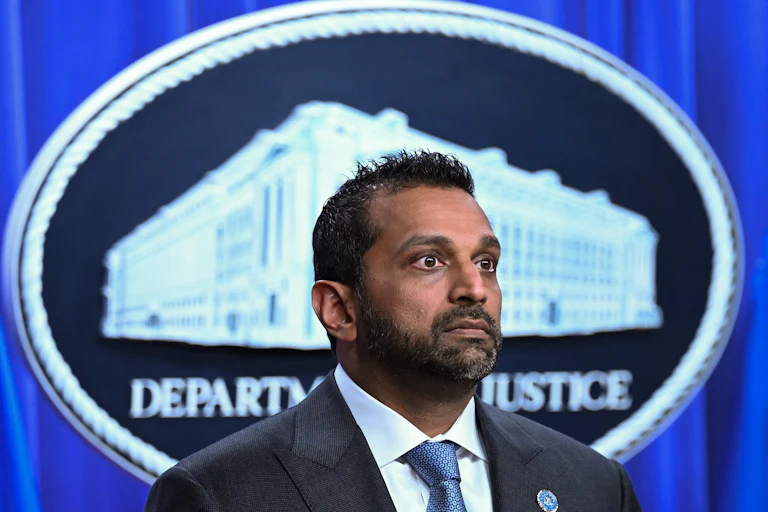
FBI Director Kash Patel failed to properly disclose a six-figure stock purchase in a company that’s been contracted by the Justice Department, NOTUS reported Wednesday.

Federal financial records first reviewed by NOTUS showed that on November 21, Patel  purchased between $100,000 and $250,000 worth of stock in MicroStrategy, a “bitcoin treasury company” that has done millions of dollars in business with the DOJ over the past decade.

Patel failed to disclose the purchase within 45 days of the trade, in violation of the Stop Trading on Congressional Knowledge Act, also known as the STOCK Act.

In a letter to the Office of Government Ethics on May 26, Patel said the purchase had been “inadvertently omitted” from his financial disclosure. Two days later, in a letter to the Office of Government Ethics, Deputy Assistant Attorney General William Taylor said the purchase had been omitted due to a miscommunication. “I continue to believe that Director Patel is in compliance with applicable laws and regulations governing conflicts of interest,” he wrote.

An FBI official told NOTUS that Patel’s late reporting was “not realized and unintentional.” However, Dylan Hedtler-Gaudette, acting vice president of the Project on Government Oversight, told the outlet that Patel’s stock purchase disclosure is “absolutely” late under the letter of the STOCK Act.

“That’s violating the law—no other way to put it,” Hedtler-Gaudette said.

Patel has yet to face the customary $200 fine for his breach of conduct—and he probably won’t.

Centrist Democrats Privately Panicking After Another Major DSA Win

Democratic incumbents realize they could be next after Melat Kiros cruised to victory in Colorado.

Democratic congressional candidate Melat Kiros speaks to supporters at an election-night watch party, her fist in the air.
Michael Ciaglo/Getty Images
Democratic congressional candidate Melat Kiros speaks to supporters at an election-night watch party after winning the Colorado primary, June 30.

Centrist House Democrats are alarmed after realizing that democratic socialists can beat them in primaries outside of New York City.

On Tuesday, 29-year-old democratic socialist, lawyer, and Ethiopian immigrant Melat Kiros defeated 15-term incumbent Colorado Representative Dianna DeGette in a high-turnout election by an impressive ten-point margin, according to early results.

DeGette is a longtime member of the Democratic establishment and was a member of the Congressional Progressive Caucus. But even with her progressive status, her support from dark money corporate super PACs and pro-Israel PACs, as well as her staunch support for Israel, made her particularly vulnerable to an attack from a candidate like Kiros—who was fired from her job over a social media post criticizing law firms’ support for Israel. Yet establishment Democrats still seem to be stunned by DeGette’s loss.

“One more case in the growing dynamic of performative politics,” an anonymous House Democrat told Axios. “Diana was an excellent representative with seniority—but the style of someone younger and more outspoken has become more attractive to that cohort of motivated urban left voters.”

Another senior House Democrat called it a “wake-up call.”

“I told everyone that would listen in 2024, that Trump winning was like manna from heaven to DSA,” another told the publication. “That DSA is … winning some safe seat primaries with these young white college-educated voters is just no shock. It’s literally their entire playbook.”

But Kiros’s supporters point to the will of the voters, not a greater playbook.

“If DeGette didn’t deserve a primary, Denverites wouldn’t have elected Melat by 10 points,” Justice Democrats spokesperson Usamah Andrabi told Axios. “All this outrage proves is the Democratic establishment’s contempt for their own voters.… It’s time for the party to catch up to its own base who are no longer interested in politicians who call themselves progressive but are bankrolled by corporate lobbies and AIPAC while voting to fund genocide and ICE.”

Kiros’s victory comes on the heels of a clean sweep of Democratic Socialists of America victories in New York City, as Darializa Avila Chevalier defeated Representative Adriano Espaillat and Assemblymember Claire Valdez became the Democratic nominee in the 7th congressional district.

“Denver voters of all ages, of all races, of all religions, sends a clear message: We will not wait,” Kiros said in her victory speech Tuesday night. “We will not wait to take the fight to Donald Trump and the oligarchy. We will not wait. We will not wait to abolish ICE and Medicare for all. We will not wait to put an end to the politics of the past, to get big money out of our politics, and to reject corporate packs at AIPAC. And no, we will not wait to end the genocide in Palestine. We believe that fundamental change can and will happen if we fight for it.”