Breaking News
Breaking News
from Washington and beyond

Platner Is Considering “Path Forward” After Sexual Assault Allegation

A woman has come forward to accuse Graham Platner, Maine’s Democratic candidate for Senate, of sexually assaulting her.

Democratic U.S. Senate candidate Graham Platner stands at a podium, his sleeves rolled up to show his tattoos.
CJ Gunther/Getty Images
Democratic U.S. Senate candidate Graham Platner speaks at his primary election event on June 9 in Blue Hill, Maine.

Maine Democratic Senate hopeful Graham Platner has responded to more allegations of sexual misconduct against women.

Jenny Racicot, a 41-year-old Maine resident who dated Platner on and off for two years, says that he sexually assaulted her in 2021—drunkenly entering her home uninvited and forcing himself on her even as she told him to stop multiple times.

“I remember him grabbing my pelvis and being really forceful of me,” Racicot told Politico in an article published on Monday. “I remember the specific moment where I thought to myself, like, ‘This is no longer my choice.’”

Racicot was one of the women who detailed Platner’s past “unsettling” behavior to The New York Times last month, but did not make her full allegation until recently due to reaction to the story being dominated by one of the women’s political connections to the GOP. She also mentioned the internal ideological conflict in her decision.

“One of the reasons I didn’t come forward sooner was, the huge moral conflict that I had between supporting his politics, but not supporting him as a person,” she said. “I just want the truth out there. I just want people to have a whole scope of who he is as a person.”

Platner has denied the allegations.

“Any accusation of non-consensual behavior is categorically false,” Platner said in a video posted on X. “Over the last 10 months, I have been deeply humbled by the faith Mainers have put in me. You have welcomed me into your homes, into your places of work, into your restaurants.... Regardless of the inaccuracy of the reporting, but mindful of the political reality it will inflict, we are taking the time to reflect on the best path forward.”

While the announcement is unclear, Platner’s political future is in more jeopardy than it already was, as calls for him to drop out begin to foment. 

This story has been updated.

“Cute”: GOP Senator Shuts Down Mike Johnson’s Plan to Pass SAVE Act

House Speaker Mike Johnson continues to struggle with Donald Trump’s signature legislation.

House Speaker Mike Johnson speaks to reporters in the Capitol
Anna Moneymaker/Getty Images

The president can bellyache all he wants about advancing the SAVE America Act, but it once again appears to be completely and utterly dead in the water.

House Republican leadership has claimed that the controversial voter ID bill—which has so far held up confirmation hearings and bipartisan bill signings at Donald Trump’s behest—could still be passed through reconciliation. But at least one GOP lawmaker whose vote is very much needed to advance the effort to the president’s desk is not so confident.

“It can’t” pass through reconciliation, North Carolina Senator Thom Tillis told MS NOW. “If it could, we’d already be talking about it. Let’s just stop playing games. Let’s stop being dishonest.”

When a reporter suggested that the House might strongarm the Senate into passing the act by blocking other legislation, Tillis responded bluntly: “That’s super cute.”

Tillis has been one of the more vocal conservative critics of Trump’s signature bill, openly questioning how the SAVE America Act could be implemented without the use of federal funds.

“Let’s assume you only allow early voting in the month of October,” Tillis told the Raleigh News & Observer last week. “Then do you honestly believe that we can have this thing up in 50 states? There’s no funding. There’s no specific implementation instructions.

“Unless they do the work to get to the 60 votes, they know it’s dead, and so all this is theater,” Tillis continued. “And honestly, here in North Carolina, or in virtually any state, the ability, if we go back to when we implemented voter ID in North Carolina, it took a year to get everything in place with adequate funding.”

The SAVE America Act sparked nationwide controversy earlier this year, particularly over a detail in the first version of the bill that would have made it more difficult for married women to vote. The backlash on Capitol Hill was so grave that it gummed up efforts to fund Homeland Security for several months, forcing Republicans to bail on the package in order to end the congressional gridlock.

The original SAVE America Act suggests numerous amendments to the National Voter Registration Act of 1993, including line items that would abolish mail-in voting, require voters to bring proof of citizenship and proof of residency to register to vote, require voter ID, and mandate voter roll purges every 30 days, an enormous bureaucratic task that would place undue burdens on local election officials. The measure also would have added federal law to prevent men from competing in women’s sports, and a ban on “transgender mutilation surgery.”

But the bill has been radically pared down since then, in large part due to the improbability of passing it in whole. House Speaker Mike Johnson has claimed that the current iteration of the act proposed by the lower chamber preserves the “backbone” of what Trump is pushing to pass in the Senate. That includes requirements to provide proof of citizenship when registering to vote, and a mandate to present photo identification when casting a ballot.

“That eliminates the problem, all the fraud and everything that everybody’s concerned about in our elections, particularly, frankly, in these blue states,” Johnson told Fox News Sunday, describing the SAVE Act as a shared top priority between the lower chamber and the White House.

The House is currently in a two-week recess, and only a handful of legislative weeks remain before midterm elections. Beyond that, lawmakers aren’t convinced the president will be satisfied with whatever solution could even get through Congress.

“He wants to go it alone, his way to the highway, and it don’t work,” Nebraska Representative Don Bacon told MS NOW. “He’s trying to pound the square peg through the circle, and it doesn’t work.”

Despite Trump’s aggressive efforts to turn the tide, Republican holdouts on the bill haven’t budged—and those that remain wish that the current administration would let this strenuous chapter come to a close.

“Republicans—those of us who can do math—would like the president and other members to recognize that there isn’t a path forward,” an unidentified lawmaker told the network.

Weather Service Scrambles in Hurricane Season After Trump Purge

Donald Trump’s mass layoffs have dramatically reduced the number of staffers at the National Weather Service—and thus the amount of data it can collect.

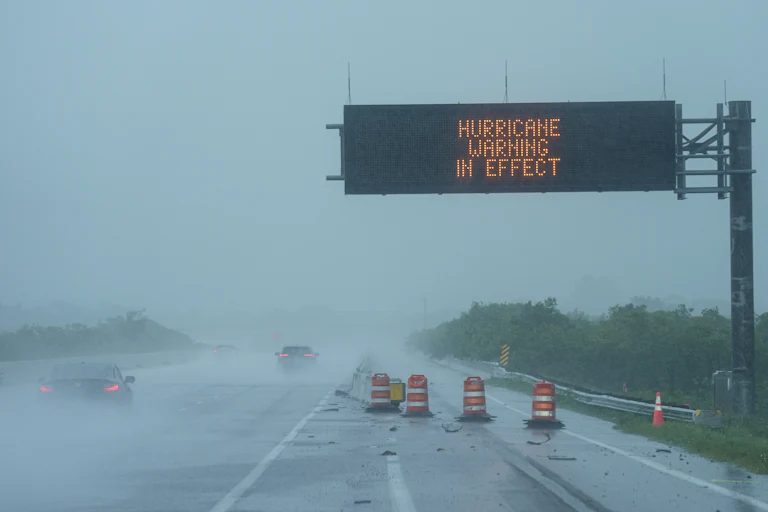
Cars drive under a road sign that says "Hurricane warning in effect" during Hurricane Milton
Lokman Vural Elibol/Anadolu/Getty Images
Hurricane Milton in Sarasota, Florida

Nearly a year after President Donald Trump’s mass government layoffs, the National Weather Service and National Oceanic and Atmospheric Association are still scrambling to replace scientists and collect missing data.

The NWS is hiring for hundreds of mostly entry-level positions, after the agency lost about 15 percent of its employees during Trump’s first year back in office, CBS News reported Monday. 

Tom Fahy, legislative director of the National Weather Service Employees Organization, said that the agency had shed roughly 600 workers in 2025. Most of those employees were seasoned workers who accepted early retirement packages, while roughly 100 were probationary employees in their first year of work. Meanwhile, NOAA employed nearly 300 fewer meteorologists and hydrologists at the end of May than it did in January 2025, according to federal data reviewed by CBS News. 

Former government scientists told CBS News that mass layoffs, which forced out experts, have undermined the research and forecasting conducted by these agencies. 

Alan Gerard, a meteorologist who worked for three decades at the weather service and NOAA before retiring last year, told CBS News that the Trump administration’s sudden reductions to the workforce disrupted the flow of institutional knowledge. 

“Obviously, people retiring and new people coming up is a natural part of any business or agency,” Gerard said. “But it’s meant to be done in an organized process, where the new people coming in have the benefit of working for a period with people who are experienced and can help train them and build up their expertise.”

Rick Thoman, a climate specialist in Alaska who worked for three decades as a weather service meteorologist, told CBS News that the sudden layoffs had been “a really bad thing.”

“Alaska is not like forecasting for Nebraska, and there are no schools of meteorology in Alaska. Everyone has to come here and learn it,” Thoman said “So, even though there’s some effort to increase staffing now, because there are no old-timers left, and folks come in here without any experience in high-latitude weather forecasting, it just makes it that much harder.”

Already, the cracks have started to show. Since Trump returned to office, employees, including Gerard and Thoman, have observed a notable decline of “upper air” data collected by weather balloons as several weather stations have stopped launching probes twice daily.  

“There’s concern about the quality of the models because of the lack of upper air data,” Gerard told CBS News. “There’s a lot of expression of just being less confident, and having less confidence in your data tends to undermine a lot of your operational decisions, right?”

Thoman pointed out that in October, weather models had incorrectly predicted a storm that displaced more than 1,000 people, after more than half of the area’s scheduled balloon launches failed to take flight in the days before the storm hit. 

Thoman said it was “inconceivable” that the lack of data had made no impact on the weather model forecast.

This shortage of both data and weather experts is especially concerning with the hurricane season about to start. Climate change has resulted in longer, more intense storms—and now, it looks like some people won’t be as well equipped to face them.

Read more about extreme weather:

U.S. Citizen Sues After ICE Hunted Him Down Over Critical Email

ICE says David Streever’s email about the murder of two American citizens in Minneapolis was actually a threat.

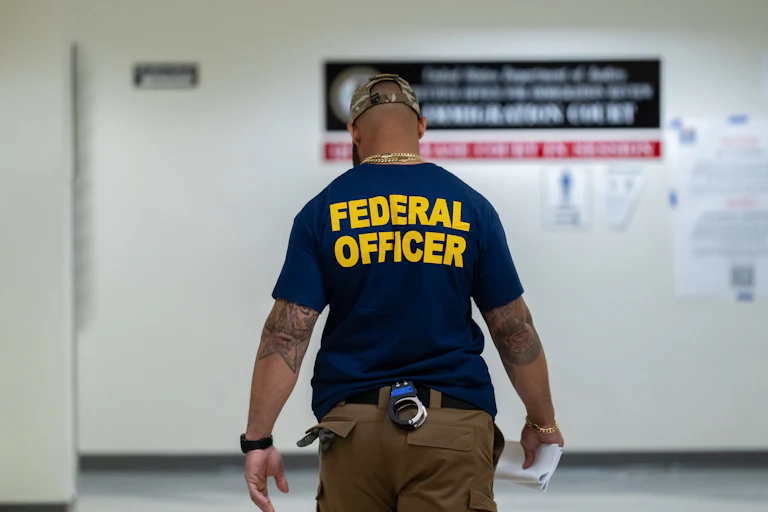
Someone with a shirt that reads "Federal Officer"
Adam Gray/Bloomberg/Getty Images

Last month, two ICE agents showed up to David Streever’s front porch in Rochester over one strongly worded email he sent to former Immigrations and Customs Enforcement Director Todd Lyons. Now he’s suing the Department of Homeland Security for First Amendment violations.

Two agents with Homeland Security Investigations, an arm of ICE, rang Streever’s doorbell on June 23 and left a “WARNING NOTICE” with his wife, which said he was possibly in violation of federal law and that Lyons was “requesting that you promptly remove and/or discontinue the aforementioned behavior.”

Streever was in Finland with his daughter at the time. When they returned, federal agents even came to the JFK Airport hotel he stayed at that night and left a note for him at the front desk.

The visit came five months after Streever initially sent the email. The lawsuit, filed Monday by the nonprofit Foundation for Individual Rights and Expression, highlights that.

“If someone is really threatening a government official, you don’t wait five months to act on it,” Adam Steinbaugh, senior attorney at FIRE, said. “The fact that authorities didn’t respond immediately shows that David presented no threat. This pursuit is designed to intimidate lawful speech, pure and simple.”

Streever’s January email to Lyons followed ICE’s killing of Americans Alex Pretti and Renee Nicole Good in Minneapolis.

The subject line was “what’s next,” and Streever warned Lyons would be haunted by the shootings.

“You will seek to lose yourself, to escape the burden of knowing the truth about yourself,” he wrote. “But wherever you go, you will find yourself. You will torment yourself until your last day on Earth.” He also equated Lyons with a Nazi.

Streever sent the email on January 26, two days after Pretti was shot and killed by federal agents in Minnesota, and 19 days after Good suffered the same fate.

The lawsuit argues that Streever’s email was speech protected under the First Amendment of the Constitution.

“Department of Homeland Security (DHS) is actively threatening that freedom, tracking down and retaliating against speakers like Plaintiff David Streever because he exercised his fundamental right to criticize one of the highest-ranking law enforcement officers in the United States,” the suit reads. “ICE’s issuance of formal ‘WARNING NOTICE’ documents to critics who engage in protected speech—and its decision to have federal agents deliver those warnings in person—can have only one purpose: to systemically chill ICE’s critics and coerce them into silence.”

Streever said his email came from frustrations with ICE’s violent tactics.

“Like many Americans, I was deeply upset after the shootings in Minnesota and I felt compelled to do something,” Streever said in a statement. “Writing an email to the head of ICE seemed like the least I could do to express my sense of outrage. I never dreamed it would lead to a knock on my door by federal officers or descending on my hotel in the dark of night.”

It certainly shouldn’t have. Yet this pattern of speech repression has become all too common under the Trump administration, as it has attacked or threatened to attack people for anything that threatens its ideology, whether writing op-ed columns in support of Palestine or criticizing Charlie Kirk.

NATO Chief Warns They Can’t Count on Trump’s U.S. Anymore

NATO Secretary General Mark Rutte issued the message hours before Donald Trump is due to arrive in Turkey for a summit.

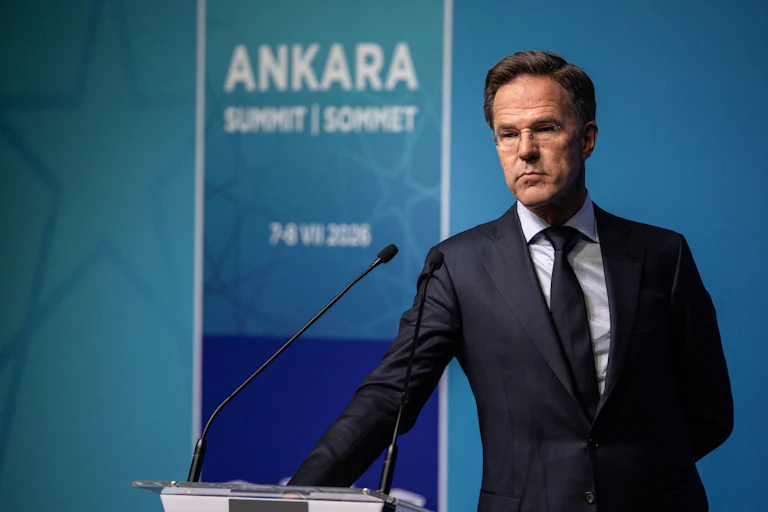
NATO Secretary General Mark Rutte stands next to a podium. He rests one hand on it.
Chris McGrath/Getty Images

Western alliances are turning away from America.

NATO Secretary General Mark Rutte told reporters at a press conference in Ankara, Turkey, on Monday that NATO’s traditional reliance on the U.S. is no longer a sustainable model for the military and economic coalition.

“What you are seeing is a NATO which indeed is changing in a transformational sense,” Rutte said. “I would argue that the NATO we had only three or four, five years ago was not sustainable.

“It is not sustainable that we ask a country with 350 million people, living eight hours flying from here, to defend against the Russians with 600 million people living in this part of NATO territory—the richest part of the world—being so overly dependent on the United States,” Rutte continued.

“So, rebalancing that—the United States still providing nuclear, the United States still providing crucial conventional support to NATO as a whole and therefore to the transatlantic security, and therefore of course also to their own security—rebalancing that is crucial.

“And therefore a stronger European role, Canada also stepping up, is important, because all of us—the alliance, to be honest—would long-term probably not have been sustainable,” Rutte said. “Stronger Europe, stronger NATO.”

Canada has made generational investments in its defense spending over the last year, and is reportedly on course to meet NATO’s next commitment: using 5 percent of its gross domestic product for defense spending by 2035, according to Canadian Prime Minister Mark Carney.

Carney has made a point to publicly criticize Donald Trump and his apparent disinterest in being the leader of the free world. Earlier this year, Carney delivered a scathing address at the World Economic Forum in Davos, Switzerland, in which he marked the finale of Pax Americana and the reorganization of global power.

“The middle powers must act together because if we’re not at the table, we’re on the menu,” Carney said at the time.

Leaders from NATO member states, including Trump, are meeting in Turkey this week in what foreign policy experts anticipate will be one of the tensest summits yet. Late last week, Trump claimed that the NATO alliance had become “one-sided,” and that the U.S. “didn’t need anything” from the Cold War–era coalition. In a Truth Social post on Thursday, Trump referred to America’s involvement in NATO as “ridiculous” and claimed that “they were not there for us!!!”

But that’s not true. Despite Trump’s rhetoric, there has only ever been one time in history in which NATO’s Article 5 has been invoked: the global mobilization to support America in its military offensive against Afghanistan after 9/11.

Nonetheless, Americans don’t seem to believe that the country’s long-standing European allies would support the U.S. if it were attacked. A Politico survey of more than 31,000 respondents, published Friday, found that just 43 percent of U.S. adults believed that the alliance would assist their home country if it were attacked. That was the lowest score out of any of NATO’s 32 member states when asked the same question.

The U.S. president has been on the offensive against NATO since the early days of his first term in office. He regularly threatens to remove America from the coalition, and has been remarkably cavalier at times about the organization’s potential dissolution. He has also baselessly insisted that other NATO members have failed to pay their dues to the entity and shortchanged the U.S. in the process, even though that’s not how the alliance operates.

It is unclear who in the Western world benefits from the dissolution of NATO. John Bolton, Trump’s first-term national security adviser and a policy hawk who also served under Ronald Reagan, has said that the consequences of exiting the alliance could be dire.