FEMA is not all right. As the United States faces another summer of extreme weather exacerbated by climate change, the Federal Emergency Management Agency—which coordinates federal disaster response, relief, and preparedness—continues to shuffle through leadership a roster of mostly unqualified Trump loyalists.
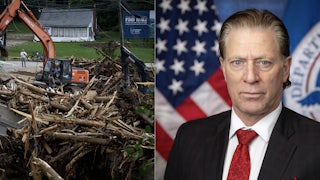
This week, Donald Trump nominated Cameron Hamilton to lead the agency, which has not had a Senate-confirmed administrator since January 2025. If Hamilton’s name sounds familiar, it’s because he was fired a year ago as the senior official performing the duties of administrator of FEMA for saying—shocker!—that the agency should continue to exist. He was replaced by David Richardson, perhaps best remembered for yelling at staff soon after beginning the job and then taking several days to show up to the scene of flash floods in Central Texas that killed more than 130 people last July. Richardson, who happens to be a novelist, resigned after just six months on the job and was replaced by the former government I.T. official Karen Evans, chosen by erstwhile Department of Homeland Security head Kristi Noem. Known internally as “The Terminator,” Evans reportedly acted as a “final gatekeeper” for FEMA funding, according to CNN, in charge of axing grants, contracts, and staff. She’ll now serve as the director of DHS’s waste, fraud, and abuse task force. Her replacement is Bob Fenton Jr., who first joined the agency in 1996 and has led FEMA’s Region 9 office since 2015.
If the White House gets its way, Fenton, a FEMA official with roughly 30 years of experience at the agency, will be replaced by a former NAVY Seal who lost a congressional primary. Meanwhile, FEMA’s associate administrator of the Office of Response and Recovery has made headlines in recent months for claiming to have teleported to a Waffle House in Rome, Georgia. CNN reported earlier this year that Gregg Phillips had repeated teleportation claims on multiple right-wing podcasts, and touted a string of far-right conspiracy theories: that Biden’s DHS conspired to assassinate Donald Trump, that Biden was elected as a result of widespread voter fraud, and that a “Chinese army” would invade the United States. The news outlet NOTUS reported last week that one of FEMA’s most experienced executives—Deputy Associate Administrator Keith Turi—will depart at the start of the Atlantic hurricane season, on June 1.
At lower levels, FEMA remains dangerously understaffed. Sabotaging Our Safety, or SOS—a group of emergency management experts and former FEMA leaders—gave the agency an “F” on preparedness in a recent report. Three out of four top leadership positions remain vacant, the group notes. The regions covering Texas and Louisiana have neither a regional administrator nor a deputy. As a result of firings at the start of the Trump administration, FEMA has its lowest-recorded levels of available field staff. “Leadership positions sit vacant. A tenth of the core disaster response workforce has been eliminated,” SOS writes. “No multi-year strategic plan exists. Training exercises that have taken place every year for half a decade have simply not happened.” These issues came to a head last July. Despite the agency’s claims that, during deadly flooding in Texas Hill Country, a “majority” of calls to the toll-free FEMA Helpline were answered, the Government Accountability Office found that 58 percent of those calls in fact weren’t answered.
The timing of FEMA’s spoliation is less than ideal. Below-average snowfall followed by early, above-average temperatures are predicted to elevate wildfire risk across the Western U.S.; dry conditions in the Southeast—now in the midst of a historic drought—threaten additional dangers there too. Two large wildfires in Georgia have already destroyed 120 homes and scorched 50,000 acres. Smaller fires in Florida have burned up 120,000 acres. As The New York Times notes, timber plantations in the region’s “wood basket” are less likely to initiate prescribed burns that can mitigate wildfire risk by burning through brush that can act as kindling. Hurricanes can also knock down trees, allowing fires to spread more rapidly.
It isn’t only rising temperatures that will rattle the country this summer. NOAA’s Climate Prediction Center now predicts a 61 percent chance of an El Niño, a natural weather pattern involving warming Pacific Ocean waters. Scientists with World Weather Attribution predict that human-induced climate change will have more of an impact on this year’s extreme weather than what may well be the strongest El Niño ever.
There have been talks of reforming FEMA to prepare for the future for years, but the reforms the White House is looking to bring about may have the opposite effect. The Trump-appointed FEMA Review Council last week issued a long-overdue final report that has been plagued by accusations of meddling by former DHS head Kristi Noem. Although the report doesn’t recommend scrapping the agency, as Trump has previously suggested, it outlines making it more difficult for states to secure emergency aid while greatly limiting programs to help disaster survivors secure long-term housing and other benefits.
As part of an effort to “return leadership for emergency response and recovery to the States, Tribes, and Territories,” the council proposes raising the threshold for states to qualify for federal disaster assistance by 50 percent, and changing the way those numbers are tallied. As the report itself states, the new standard would exclude 29 percent of the disaster declarations made between 2012 and 2025. That would have saved the federal government $1.5 billion, or less than 5 percent of the direct, likely underestimated cost of the war in Iran so far. While emergency management experts have long pushed for FEMA to be excised from DHS and made into a Cabinet-level position, the report calls for keeping the agency under DHS, as it has been since 2003. The council’s recommendations are nonbinding, and most would need to be legislated by Congress.
States seem less confident than the White House about their ability to take on more responsibility for disaster relief and recovery. Many local governments lack dedicated emergency management offices, and rely heavily on federal resources for critical staffing and training. Brett Compston—the chief of Nevada’s Office of Emergency Management—warned last week that the state faces a “9/11 equivalent” for emergency management as a result of changes happening at the federal level. As Compston noted, 81 percent of his office’s budget comes from the federal dollars, which fund salaries for 84 percent of its staff.
There have been some recent improvements. New DHS head Markwayne Mullins rescinded a Noem-era policy that gave her final say over DHS dispensations of more than $100,000, ascribed with hindering disaster response. Courts have ordered FEMA to appropriate funds through the oversubscribed, congressionally mandated Building Resilient Infrastructure and Communities program. The administration had previously sought to block much of the $1 billion pot dedicated to helping states, local governments, territories, and tribes prepare for fires, floods, and hurricanes and other hazards.
With FEMA already stretched thin, though, the White House could be poised to further politicize the process of who gets aid. A Washington Post investigation published last week found that FEMA significantly decreased hazard-mitigation grants to Democratic-led states last year, including fire-prone California and Colorado. If he’s confirmed, Cameron Hamilton doesn’t seem likely to “abolish FEMA.” But starving the agency of resources, placing more of the burden onto cash-strapped local and state governments, and withholding federal funds from Democratic governments could make it less and less relevant for millions of people seeking relief.