Poll: Swing Voters Want Progressive Populism

A new Data for Progress survey found that Medicare for All, regulating AI, and taxing the rich were the top issues that would convince these undecided voters to back Democrats this fall.

A protester holds a sign that reads, ''Texas Proud: Medicare for y'all''
Reginald Mathalone/NurPhoto/Getty Images

A new report from Data for Progress spells good news for Democrats—particularly those running on a message of economic populism. DFP surveyed 447 swing voters between May 15 and June 21 and found that they favor Democrats over Republicans on the generic congressional ballot by a 12-point margin, though the plurality of swing voters (46 percent) are unsure which party they prefer.

What were the top issues that would move swing voters to vote for a Democrat? Raising taxes on the wealthy, instituting Medicare for All, and banning artificial intelligence from using personal data to set wages or prices. Economic issues like these have been embraced by progressive candidates, such as Abdul El-Sayed in Michigan, Randy Villegas in California, and Sam Forstag in Montana. Villegas and Forstag both won their House primaries against opponents who ran to the center, and El-Sayed’s Senate primary against an establishment centrist will be held on August 4.

“I think the big takeaway from this report is that swing voters who could decide the midterms are not asking Democrats to sound more like Republicans,” said Ryan O’Donnell, DFP’s executive director.

DFP ran a similar survey in 2024. At that time, swing voters tended to be younger and more racially diverse. Today, DFP found that there aren’t significant demographic differences between swing voters and other likely voters. Despite the change in demographics, economic issues have consistently remained a top priority for swing voters. “Even though the electorate’s changed, the fact that their focus on economic populism has stayed so consistent is something to consider,” O’Donnell said.

Other findings in the report support that notion. DFP asked respondents what issues they consider most when deciding which candidates to vote for. The top three issues were “economy, jobs, and the cost of living,” which 38 percent of respondents selected; “programs like Social Security and Medicare,” which 17 percent selected; and “health care,” which came in at 6 percent. So-called culture-war issues ranked far lower: Only around 3 percent of respondents selected “LGBTQ+ issues” as their top priority, and around 1 percent selected “race relations and racism.” Notably, “immigration” was the third-highest issue in 2024 but has fallen to twelfth in this year’s survey.

Swing voters also shared what they find most concerning about the Democratic Party, and the results echo what many progressive members of the party have been saying for years: 32 percent of respondents said that “leadership is too old and out of touch,” and another 32 percent said that the party is “not doing enough to lower costs.”

Some economic populists have rejected the Democratic Party brand and are running instead as independents, like Senate candidate Dan Osborn in Nebraska. “He’s doing a great job at pushing that message in Nebraska,” O’Donnell said. “Swing voters in general largely reject partisan and ideological labels, so it reflects that, as well.”

Overall, the poll helps dispel the popular wisdom that running a conservative, centrist campaign is the best way to get the support of those in the middle. “If I were a Democratic leader reading this, I would say that these results indicate that taking a more conservative stance is not the way to win over the voters you need to win,” he said.
Who Benefits From Mallory McMorrow’s Exit in the Michigan Senate Race?

It’s now a two-way contest between progressive Abdul El-Sayed and centrist Haley Stevens.

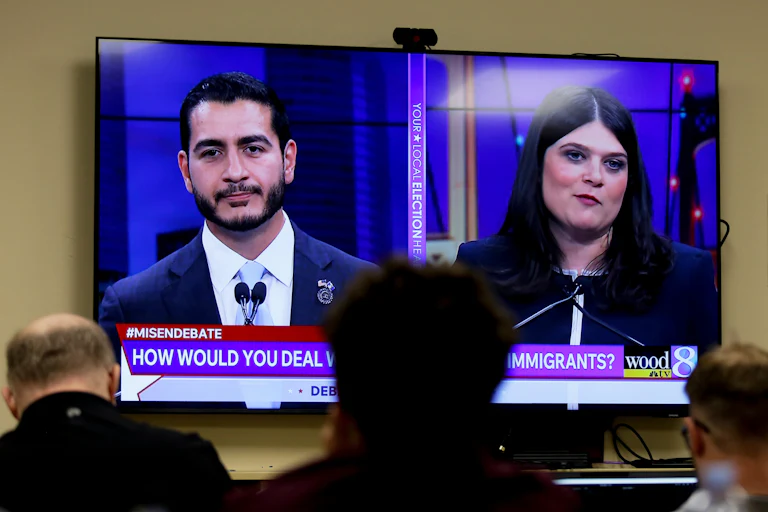
Michigan U.S. Senate candidates Abdul El-Sayed and Rep. Haley Stevens during a debate on Tuesday night
AP Photo/Kristen Norman
Michigan U.S. Senate candidates Abdul El-Sayed and Representative Haley Stevens during a debate on Tuesday night

In Michigan’s Democratic race for U.S. Senate, state Senator Mallory McMorrow was caught in the middle of—and ultimately squeezed out by—centrist Haley Stevens and progressive populist Abdul El-Sayed. Now, with McMorrow having suspended her campaign on Sunday, Stevens and El-Sayed are both vying for her supporters ahead of the August 4 primary—a head-to-head contest that reflects the growing division between the party establishment and the left. “The battle for the Democratic Party that we see nationally has come to Michigan,” said David Dulio, a professor of political science at Oakland University.

So far, McMorrow has not endorsed either candidate for the seat. One Michigan political organizer shared a text conversation with The New Republic in which McMorrow confirmed she had no plans to endorse. Kelly Neumann, the former financial co-chair of McMorrow’s campaign, has the same impression. “I think she wants the people to make their own decision,” she said about McMorrow’s plans. “I think everybody knows in their heart where, where she would vote,” Neumann added. McMorrow didn’t respond to an inquiry.

“Whoever wins this primary on August 4th will have my full support,” McMorrow wrote in a statement on X announcing her withdrawal from the race.

El-Sayed, a former state public health official and TNR contributor in 2021–22, is running on a platform that includes Medicare for All and getting corporate PAC money out of politics. He’s picked up a number of progressive endorsements, including the likes of Senator Bernie Sanders, Representative Alexandria Ocasio-Cortez, and the United Auto Workers.

Stevens is backed by Senate Minority Leader Chuck Schumer, Speaker Emerita Nancy Pelosi, and the EMILY’s List PAC, which endorses pro-choice women running for office. She’s focused on her legislative experience, having been a member of the U.S. House of Representatives since 2018.

In a debate between the two on Tuesday night, they pushed each other on the role of money in politics. El-Sayed asked Stevens about the money her campaign has received from AIPAC, while Stevens pushed El-Sayed to release his tax returns. The two also sparred over energy costs. Both bemoaned that Michiganders have experienced power outages and high utility bills, but El-Sayed pointed out that Stevens has received tens of thousands of dollars in campaign contributions from Detroit Edison, the major utility company in southeastern Michigan; its PAC contributed $35,000 to Stevens’s campaigns for House, as well as $10,000 to a PAC associated with her.

In their closing statements, they made their priorities clear. El-Sayed hammered on his economic populist message. “We need to take on oligopolies and billionaires,” he said. “We need to guarantee health care through Medicare for All.” He invited people to join his campaign, saying, “It’s the many versus the money.” Stevens made the pitch that she’s the right candidate to take down Republican Senator Mike Rogers in the general election: “I am fed up and fired up. Let’s go beat Mike Rogers, send him back to Florida a second time, and make sure that Michigan shines at the lawmaking table.”

El-Sayed is hoping for a windfall of McMorrow supporters, writing on Sunday: “I welcome her supporters to our movement to stand up against money in politics, to put money back in pockets, and pass Medicare for All.”

In a statement, Stevens praised McMorrow but didn’t explicitly ask McMorrow’s supporters to join her campaign. “Anyone who raises their hand to serve the people of Michigan and puts forward thoughtful ideas for how they would lead earns my respect,” she wrote. Caitlin Legacki, a spokesperson for her campaign, told me, “Now that it’s a two-person race, we have a chance to really go out and consolidate Haley’s voters, which includes Mallory’s remaining supporters who we’re all working really hard to try and woo.”

Some Michiganders say that, anecdotally, McMorrow’s decision to drop out of the race has been a boon for El-Sayed. “We’re getting a lot of new Mallory people coming to the group,” said Wanda Hammoud, the board chair for One Fair Wage Action, about a pro-El-Sayed Facebook group she started. The group has over 21,000 members, and Hammoud said it jumped by 2,000 in just one day this week.

“I’ve been pretty much an establishment Democrat, quite honestly,” said Neumann. Despite that, she said, “right off the bat, I knew immediately when I received the news that [McMorrow] was going to suspend her campaign that I was going to go to Abdul El-Sayed. I just knew that’s where I had to go. I’m looking for change.” (Neumann and the Stevens campaign sparred earlier this year when an old, controversial social-media post of Neumann’s resurfaced. Neumann blamed the Stevens campaign for publicizing the post to hurt McMorrow’s campaign.)

El-Sayed has led in most polls since April. Most recently, a late-June Quantus Insights poll surveyed 433 likely voters and found 41 percent supporting El-Sayed, 36 percent supporting Stevens, 8 percent supporting McMorrow, and 16 percent undecided.

“If endorsements from this point pretty much break equally, the tie goes to Abdul, because he was already leading in the polls,” said Adam Green, co-founder of the Progressive Change Campaign Committee. “He just needs to keep the dynamics the way they were.”

Since McMorrow dropped out, El-Sayed has received endorsements from Representative Analilia Mejia, Michigan state Senator Stephanie Chang, and Representative Maxwell Frost. On the day McMorrow left the race, Stevens received an endorsement from Attorney General Dana Nessel. Green expects more endorsements to come this week. He specifically has his eyes on Senator Elizabeth Warren, who endorsed McMorrow, and Jewish politicians like Andy Levin, who Green says could help draw Jewish voters to El-Sayed. Stevens, backed by the American Israel Public Affairs Committee, has called herself a “proud pro-Israel Democrat.” Meanwhile, El-Sayed is critical of Israel’s government and outspoken about the genocide in Gaza.

If Warren endorses El-Sayed, Green said, “that would be a very high-profile, newsworthy signifier that McMorrow world is going Abdul’s direction.”

The Ex-Vegan Looking to Unseat a Republican Cattle Rancher in Congress

Colorado Democrat Manny Rutinel took down a more moderate candidate in this week’s primary, and will face off against House Representative Gabe Evans this fall.

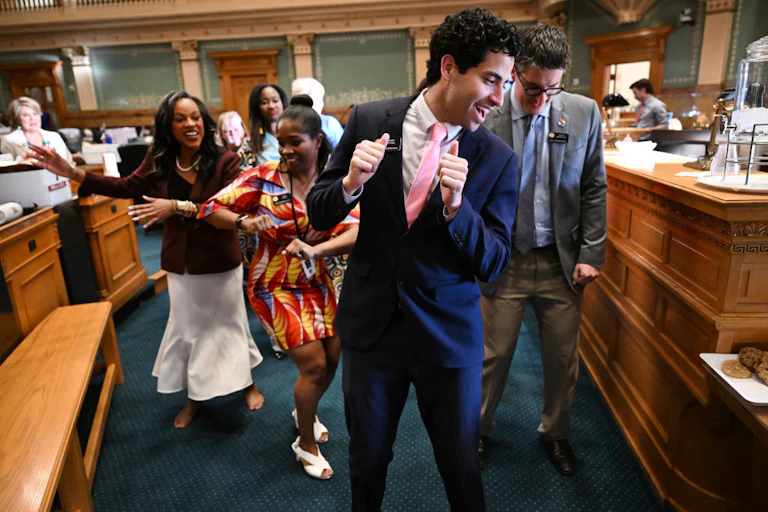
Manny Rutinel, center, and other Colorado representatives dance on the state House floor in 2024
Helen H. Richardson/MediaNews Group/The Denver Post/Getty Images
Manny Rutinel, center, and other Colorado representatives dance on the state House floor in 2024.

Manny Rutinel’s victory this week in Colorado’s primaries has set up a once-unthinkable scenario: This November, in one of the most crucial swing races in the country, a former vegan activist will face off against a cattle rancher in a district dominated by meat-processing giant JBS.

Rutinel, a 31-year-old member of the Colorado House of Representatives, beat his more moderate opponent, Shannon Bird, earlier this week in yet another victory for insurgent progressives. But as he now pivots to the general election, he’ll be facing Republican Gabe Evans and an onslaught of attacks over his past statements on animal rights and meat consumption.

The 8th district, created in 2021 by the state’s independent redistricting commission, is Colorado’s only swing district, and swingy it is—voters in the district elected a Democrat in 2022 by fewer than 1,600 votes and Evans in 2024 by fewer than 2,500 votes.

“It’s reasonable to think that [the district] will just switch back and forth with whatever party is having a good year that year,” said Seth Masket, professor of political science at the University of Denver. “Given what we’ve seen in other elections this year, I think there’s a very good chance it swings to the Democrats.”

The district, which includes the northern suburbs of Denver and stretches north into more rural communities, is a major agricultural region. JBS, the world’s largest meat-processing company, is one of the district’s biggest employers. Evans himself owns a small cattle herd and is a self-described beef producer.

As a student at Yale Law School, Rutinel gave an interview to a campus publication calling animal agriculture “a horrific, exploitive industry.” That same year, he told a legislative committee in Connecticut that “the globe must dramatically shift away from animal products and toward fruits, vegetables, legumes, whole grains, and nuts.”

Since running for Congress, Rutinel has backtracked, saying that he is no longer a vegan and that “it’s important for me to be able to enjoy the delicious products that Colorado ranchers make.” He’s also stopped calling for Medicare for All and a ban on fracking.

Republicans are already jumping onto Rutinel’s vegan past. After Rutinel won his primary, the regional press secretary for the National Republican Campaign Committee posted a photo on X of Rutinel as a college student, shirtless and carrying a People for the Ethical Treatment of Animals sign. “He is a far-left vegan activist who wants to end animal agriculture,” the post reads.

Meat occupies an almost sacred space in American politics—and a particular obsession with it on the right is nothing new. Already this cycle, Republicans have attacked Texas Senate candidate James Talarico over his past comments about reducing meat consumption: “This freak wants to BAN BBQ,” Senator Ted Cruz wrote in an X post. In response, Talarico leaned into meat eating, posing for a photo in a Texas flag shirt while eating barbecue. At an event, he said, “I deny all accusations of veganism.”

“Republicans will just be working to portray him as out of step, as too far left for Colorado. That is to some extent what they’re trying to do now with going after vegetarianism,” Masket said about Rutinel. But he’s not terribly worried that Rutinel’s vegan past will hurt his campaign. Unlike in Texas, Masket said, vegetarianism and veganism are well established and understood in Colorado, and the more important dynamic in this election will be voters’ dissatisfaction with Trump, he said.

“November is going to be, particularly at the congressional district level, a referendum on the Trump administration,” agreed Robert Preuhs, the chair of the political science department at Metropolitan State University of Denver. The outcome in the 8th district in particular, he added, will “depend to some extent on what the Trump administration does between here and November and the extent to which Dave Evans feels comfortable endorsing those actions.”

Rutinel has established himself as a forceful critic of the Trump administration, campaigning adamantly against Immigrations and Customs Enforcement and criticizing Bird for her committee vote against a bill that would prohibit local law enforcement from collaborating with ICE.

Rutinel also took a strong stance on artificial intelligence. In 2025, he was a sponsor of a bill that would protect whistleblowers who sought to disclose AI safety issues. Public First Action, an AI-safety PAC, covertly supported Rutinel by giving $2 million to the Latino Victory Fund, Transformer reported on Wednesday. A PAC funded by Chris Larsen, a billionaire cryptocurrency firm founder, also spent $980,000 on the race in favor of Rutinel.

Analysts say Rutinel now faces a difficult balancing act: moderating his positions enough to appeal to swing voters, while also keeping his base energized. He’ll have help: The Democratic Party is expected to spend heavily to try to flip this district. The race may wind up being a test of whether culture-war issues—like Rutinel’s past veganism—will matter more to swing voters than ICE and Trump’s record.

What SCOTUS’s Campaign Finance Ruling Means for Democrats

One possible, overlooked implication of the Supreme Court’s finance ruling would be giving political parties an advantage over PACs when it comes to political spending.

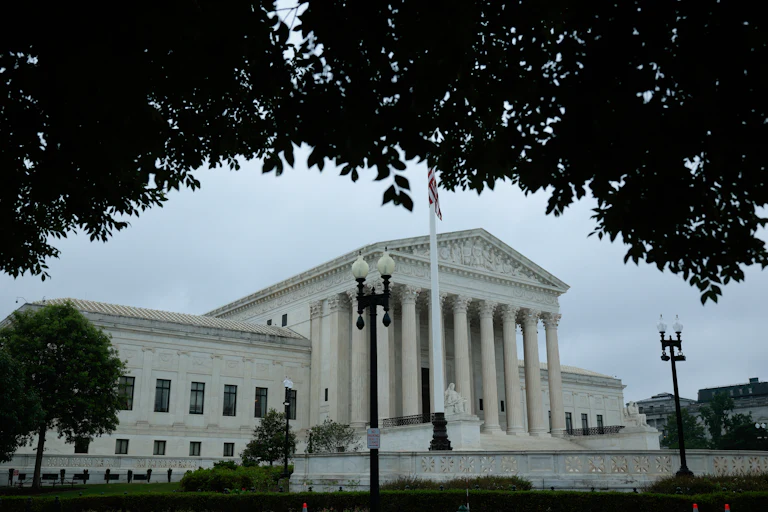
The Supreme Court building is seen from an angle.
Chip Somodevilla/Getty Images

“This is Citizens United 2.0,” Representative Greg Casar said Tuesday about the Supreme Court’s ruling allowing political party campaign committees to coordinate directly with campaigns without a cap on spending. Republicans praised the decision, while Democrats issued dire warnings about the fate of democracy.

But behind the partisan divide, there’s an interesting disagreement about what, exactly, the ruling will do: Some analysts say this decision could weaken the power PACs have over elections, making political parties the dominant spending force. Unfortunately for Democrats, though, the decision will probably heighten a fundraising advantage Republicans already have this year.

Then-Senator JD Vance, then-Representative Steve Chabot, the National Republican Senatorial Committee, or NRSC, and the National Republican Congressional Committee, or NRCC, first brought National Republican Senatorial Committee v. Federal Election Commission to federal court in 2022. They argued that the court should overrule its 2001 decision restricting the amount of money political parties can spend in coordination with candidates—particularly via committees like the Democratic National Committee, Republican National Committee, or House and Senate campaign committees. The petitioners argued that these limits violated the First Amendment.

Due to Tuesday’s ruling in favor of Vance and his associates, political parties can now both coordinate with candidates and raise unlimited funds—giving them an advantage over PACs, which can raise unlimited funds but cannot coordinate directly with candidates.

Super PACs have become a dominant force in campaign spending since 2010, when the Supreme Court struck down caps on independent spending by corporations in Citizens United. That decision gave corporations immense power to influence elections, but with the important caveat that super PACs aren’t able to coordinate with campaigns. (Campaigns have found creative ways to get around this, namely by putting “red boxes” on their websites that instruct PACs how to spend their money without directly communicating with them.) Super PACs will remain important forces in elections. But after Tuesday’s decision, political parties may once again have an advantage over super PACs.

Democrats are concerned about both the short- and long-term impacts of the decision. In the short term, they say, this could deal a blow to vulnerable House and Senate candidates, since the RNC has a major fundraising advantage over the DNC. At the end of May, the RNC reported its highest-ever cash-on-hand total, $125 million. In comparison, the DNC had just $14.4 million on hand and was $18 million in debt.

On the Senate side, candidates in competitive races like Mary Peltola in Alaska and Sherrod Brown in Ohio may face better-funded opponents this fall. The Democratic Congressional Campaign Committee’s “frontline” candidates, incumbents running in swing districts, could face a similar challenge from their Republican opponents. The ruling could throw a wrench into the Democratic Party’s confidence that they will be able to retake the House, and perhaps the Senate, this fall.

In a statement, Democratic Senatorial Campaign Committee, or DSCC, Chair Kirsten Gillibrand, Democratic Congressional Campaign Committee, or DCCC, Chair Suzan DelBene, and DNC Chair Ken Martin downplayed the threat to Democratic candidates. “In November, voters will reject Republicans’ toxic agenda and efforts to rig the system and weaken our democracy by electing a Democratic House and Senate majority,” they wrote.

In the long term, Democrats say the ruling will make elections more corrupt and flooded with dark money. Casar called the decision an example of the “hyperpartisan donor-purchased Supreme Court” reversing one of the landmark campaign finance wins of the post-Watergate era. “It’s essentially legalizing corruption in our political system,” he said.

Senator Sheldon Whitehouse, the ranking member of the Senate Judiciary Subcommittee on Federal Courts, had a similar view. “Republicans would get laughed out of Congress if they tried to repeal the few remaining guardrails against dark money and special interest influence,” he wrote in a statement. “So instead, Republicans run to their captured Supreme Court to do the democracy-damaging work for them.”

The Bill That Pits House Against Senate Against Big Tech

The KIDS Act passed the House. But some worry differences between the House and Senate version could be exploited by tech companies.

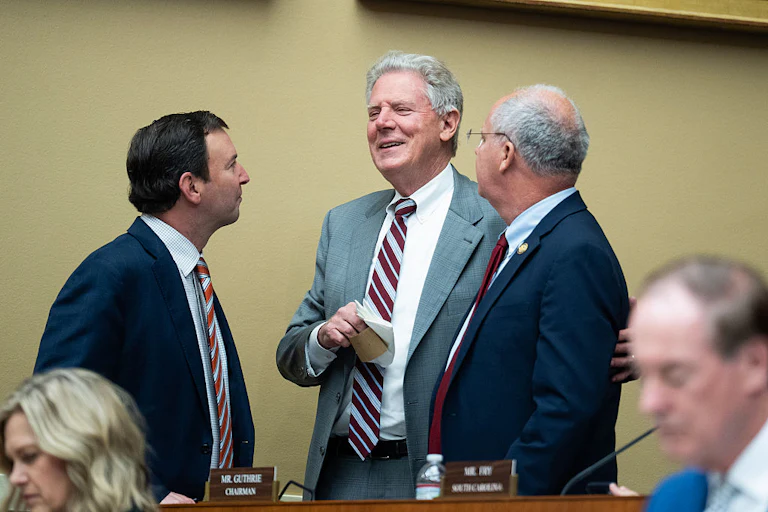
Frank Pallone Jr., Craig Goldman, and Brett Guthrie talk in a huddle while standing, with others' heads visible in the foreground.
Tom Williams/CQ-Roll Call Inc./Getty Images
Representatives Craig Goldman, Frank Pallone Jr., and Brett Guthrie

On Monday night, the House passed a weaker version of the Senate’s Kids Online Safety Act, or KOSA, aimed at regulating the tech industry and protecting children online. Whether this is a good thing or not depends on whom you ask.

House leaders have taken four years to reach a compromise on their own version of KOSA, which the Senate passed in 2022. The House version, called the Kids Internet and Digital Safety, or KIDS, Act, passed by 267–117 on Monday night.

Representative Frank Pallone Jr., the Democratic co-sponsor of the KIDS Act, lauded it as an example of bipartisan cooperation last week. “This agreement proves Congress can come together to deliver real online protections for our nation’s young people,” he said in a statement.

But Senate Democrats have suggested that they won’t advance the House version. “We’re not going to go with some weak standard,” said Senator Maria Cantwell on Friday. “We are going to go with a law that can be enforced and accountability, and we’re not going with a study, we’re going on with something that holds them accountable.”

Senator Richard Blumenthal, a co-sponsor of KOSA, even suggested that passing the weaker House version could give tech lobbyists ammunition to “exploit the kind of misunderstandings that can occur” between the two chambers and kill provisions they don’t like. “We need to stop this bill in the House and we need to prevent the White House from forming an alliance with Big Tech,” Blumenthal said.

Cantwell, Blumenthal, and their allies say the KIDS Act doesn’t include the strongest parts of KOSA, like the “duty of care” provision, which makes tech companies legally responsible for the well-being of children on their platforms, or the stipulation that KOSA doesn’t preempt states, allowing them to pass stricter measures in the future. The KIDS Act, on the other hand, includes federal preemption language that opponents say could harm states’ ability to enforce tech regulations themselves. In late May, 44 state attorneys general sent a letter to Congress opposing the KIDS Act on the grounds that it would preempt their legislative and legal efforts.

“This bill has no real duty of care. In other words, it has no standard to hold accountable the Big Tech companies that can drive addictive, toxic content through their algorithms and other technologies at children,” Blumenthal said in a press conference on Friday.

On Friday, nearly 100 digital- and kids-safety groups sent a letter to House leadership and the sponsors of the KIDS Act urging them to reject the bill on the grounds that it doesn’t go far enough to protect children from Big Tech. In addition to the “duty of care” issue, the authors noted that the KIDS Act drops the requirement that tech platforms offer a chronological feed rather than an algorithmic, engagement-maximizing one. The authors are also concerned that the KIDS Act defines social media platforms too narrowly, leaving out apps and websites like Roblox, which has exposed some children to sexual and financial exploitation.

But others think both acts are a bad idea—that the provisions in KOSA and KIDS, instead of protecting kids, could harm their ability to engage in free speech and access resources for mental health, addiction, and other social issues. Groups like the American Civil Liberties Union and GLAAD say that measures meant to protect kids could push tech platforms to set age limits and push younger children off of their websites, harming LGBTQ+ kids or others who are looking for community and resources online.

“Maybe by different routes, [the bills] accomplish the same objective,” said Aaron Mackey, the deputy legal director of the Electronic Frontier Foundation. “They’ve pushed online services to have legal obligations to police their content and exclude kids from vital places and space.”

Tech companies have pushed against both the House and Senate versions, but have spoken more favorably about the House bill. Zach Lilly, the director of government affairs for NetChoice, a tech industry group, said that the House bill “is a real effort to improve upon the disastrous censorship regime being championed in the Senate.”

After Monday’s House vote, it remains to be seen which bill will ultimately come out on top and head to the president’s desk—and whether the tech lobby will be able to exploit the rift between House and Senate.