Newsletter
Fighting Words
What got me steamed up this week

We Now Have the Leading Charge in Trump’s Next Impeachment

Why is the president willing to withdraw Todd Blanche’s nomination? The answer constitutes a blatant high crime and misdemeanor.

Trump
Aaron Schwartz/CNP/Bloomberg/Getty Images

The Todd Blanche nomination mess in the Senate is truly one of those pass-the-popcorn moments for Democrats and liberals. One can sense that John Cornyn and Thom Tillis, the two outgoing Republican senators who have suddenly developed the backbone to maybe vote against the attorney general nominee now that they’re not facing their voters again, represent a far more broadly (if privately) held view in the Senate GOP that the man is manifestly unqualified.

But this fracas is more than mere entertainment. It’s a full-blown scandal, as President Trump’s real interests here have become clearer, notably via a Truth Social message he posted late Thursday morning. It’s raw sewage even by his standards, and if the Democrats retake the House, this matter has now jumped to the top of my list of grounds for impeachment. It should provide the basis for the first article Democratic Representative Jamie Raskin and his Judiciary Committee draw up.

It all has to do with the slush fund. The fund, you’ll recall, was the result of a settlement in a mind-bending legal proceeding in which Trump sued himself: That is, the president of the United States sued the Internal Revenue Service, seeking $10 billion for the (admittedly illegal) leak of some of his tax returns back in 2019. In May, Trump’s Justice Department, led at the time by Blanche as the acting attorney general, settled the suit between Trump the president and Trump’s IRS by establishing a $1.776 billion “anti-weaponization” fund, whose moneys were to go to parties Trump deemed to have been wronged by the deep state—starting of course with Trump himself. It also included a shocking clause granting Trump, his family members, and his companies immunity from prosecution for any tax-related crimes they may have committed before the date of deal.

In other words: Blanche created a nearly $2 billion slush fund for Trump to steer money to anyone he wants—and granted him and his kids broad immunity from potential federal prosecution. One observer called it “a breathtaking abuse of the tax and legal system.” Raskin put out a 10-point memo on why the deal is “unconstitutional, illegal, and a fraud on the court.” In June, a federal judge blocked the fund’s creation, so it’s on hold for now and probably headed, one supposes, to the Supreme Court.

Around that time, amid the public outcry, Blanche said that the fund would not go forward. He told Congress that the department would put that in writing. But it never has. That’s the holdup with Cornyn and Tillis. If they get it in writing, presumably they would still vote for Blanche.

So that’s when Trump stepped in Thursday morning, when it looked like Blanche’s nomination might be dead, and “truthed” (and boy, it was the truth for once, all right): “Todd Blanche is a STAR, and everyone knows it! He has the potential to go down as one of the Greatest Attorney Generals of All Time. However, John Cornyn, of Texas, and Thom Tillis, of North Carolina, both of whom I refused to Endorse, and whose political careers have been ended by my action, are refusing to vote for this Great Nominee, who will remain, in any event, as Acting. Remember, both Cornyn and Tillis voted for Merrick Garland, and others, too numerous to mention. I have no objection to temporarily withdrawing Todd’s name, if they do not do the right thing, and putting him back after Cornyn and Tillis are out of office.”

What Trump is saying here is obvious. The slush fund and probably especially the immunity are far more important to him than Blanche is. And anyway, Blanche, whose servile lickspittleism makes predecessor Pam Bondi look like a paragon of independence, can stay in the job more or less indefinitely as acting A.G.

This morning, around 7 a.m., Trump “truthed” again. The fund isn’t for me, he insisted. Rather, it’s for the people who raided the Capitol and banged cops’ heads in; it’s for “the great American Patriots who were hunted down like dogs and whose lives were unfairly and illegally destroyed by the Crooked Joe Biden Administration.… Perhaps there has never been a group of people treated so badly in our Nation’s history.” He’s almost surely lying about himself. But even if he’s not, sending $1.8 billion in taxpayer dollars, received in the corrupt manner this money was received, to convicted January 6 insurrectionists is without question a high crime in and of itself.

Once again, as with so many other things Trump has done, it’s inconceivable to imagine any other modern American president even thinking this up, let alone doing it. Suing himself; then installing a spineless yes-man—his former personal lawyer, no less—as acting attorney general, who then agrees to a settlement including nearly $2 billion in taxpayer money plus an immunity grant; then being willing to sacrifice said A.G.’s confirmation in order to preserve the fund and the immunity claim. It defies belief.

It’s hard to say how many articles of impeachment the Democratic House might come up with. Indeed, Raskin and his committee’s biggest challenge will be deciding which high crimes and misdemeanors not to pursue. There’ve been dozens, hundreds, and they just can’t plausibly bring an indictment of 100-plus counts. They’re going to have to keep it to some number that the public can digest and buy into.

But the slush fund and immunity grant sure look like count number one to me. Unless of course five members of the you-know-what decide it’s all legal. If that happens, the House Judiciary Committee might look at impeaching them, too.
This article first appeared in Fighting Words, a weekly TNR newsletter authored by editor Michael Tomasky. Sign up here.

Trump Just Gave Us a Horrible New Reason to Worry About the Iran War

The president is getting frustrated that U.S. military strikes are accomplishing nothing—and he’s starting to lash out.

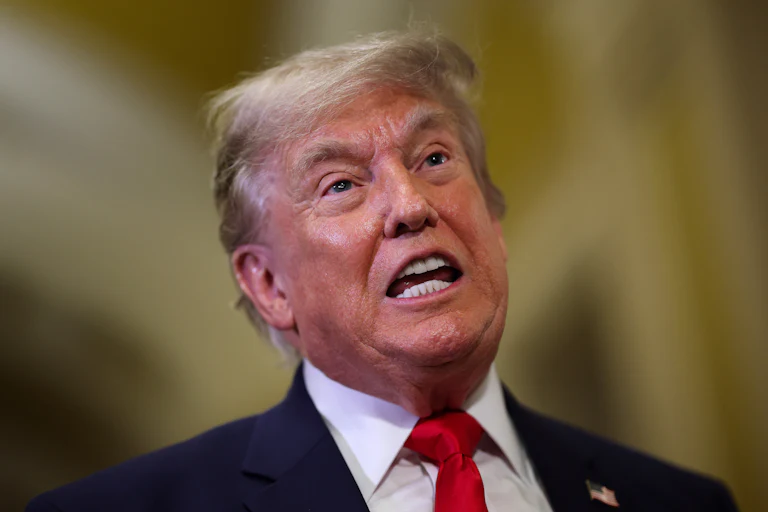
Donald Trump grimaces in angry expression
Kevin Dietsch/Getty Images

Donny is frustrated. The Wall Street Journal reports that at a recent White House meeting, President Trump “launched into a tirade against Iranian leaders, calling them scumbags and lunatics, and unleashing a series of expletives.” He is worried that the war is “consuming his presidency.” He doesn’t understand why those silly mullahs don’t understand that he’s Mr. Art of the Deal.

One administration official told the paper that Trump sees few good options besides continuing these daily strikes. But these strikes apparently aren’t having much impact, either militarily or psychologically. The Journal also reported this week that satellite images show that Iran is rebuilding the damage done by U.S. strikes and is doing so fast. And after all, if Iran were afraid of the U.S., it wouldn’t have broken the ceasefire earlier this month by striking commercial vessels passing through the Strait of Hormuz.

Some wars start big. World War I is the paradigmatic example. Europe was more or less at peace, the Balkans excepted, all those inbred cousins lolling in their palaces as various ethnic and proletarian resentments built among their people. Then, boom, one event—the assassination of a Hapsburg potentate—exploded the powder keg, and within weeks, millions were mobilized into a war that said cousins blithely thought would last a few weeks but ended up leaving an entire generation of young European men physically and psychologically strafed.

But most wars start small. They’re incremental. Even the most destructive war in human history started this way. Of course, Adolf Hitler was lying to the world about his ultimate aims, when he kept saying—after the Alsace, after Austria, after the Sudetenland—that he had no further territorial claims on Europe. But chronologically, the war proceeded in small, incremental steps, and even if Neville Chamberlain has gone down in historical shame, it’s also true that the broader public could have been forgiven for thinking, even after Munich, that world war was hardly inevitable.

In the current case, I’m sure Donald Trump no more anticipated that this war would prove problematic than Lyndon Johnson did with respect to Vietnam or George W. Bush did vis à vis Iraq. These things are always supposed to be easy for the mighty United States.

But somehow they rarely are. Only George H.W. Bush successfully prosecuted a short war. Why? Because the Persian Gulf War had one very specific and contained goal: force Saddam Hussein out of Kuwait. One can agree or disagree with his decision to launch the war, but at least it was aimed at doing one and only one small and specific thing. The neocons were imploring him to march on to Baghdad. He said no, you people are crazy. Then his dumb son got to the White House, and he put the crazies (led by Dick Cheney) in charge, and they launched a war based not on one specific goal but on a theory—that regime change in Iraq would help spread democracy throughout the Middle East.

Do we think Trump gave these matters two minutes’ worth of thought before he decided to start this war? We know the answer to that question. Of course he didn’t. Because to Trump, the laws of history don’t apply to him. He’s different. And Benjamin Netanyahu, who according to Maggie Haberman and Jonathan Swan did the lion’s share of the work of convincing Trump to do this, knew perfectly how to feed Trump’s vanity and take advantage of his total historical ignorance.

So now, Trump is frustrated, like a little boy whose Christmas toy won’t work. That frustration is key here, and much, sadly (I hope not tragically), hangs on it. Will he be content to keep launching strikes that aren’t accomplishing much? Eventually, it seems, the odds are that he’ll get tired of that, and he’ll need to teach those “scumbags and lunatics” a real lesson.

And that’s how little wars grow. There’s a chance that he has enough sense to know that if he doesn’t get out of this soon, it could crescendo into a disaster that will spin out of his control. That’s what happened to LBJ—he knew every step of the way as he asked Congress for more money and troops that he was marching the country to defeat and destroying his own legacy, but he did it anyway. And he was much smarter than Trump will ever be.

I remember well when Syria’s Bashar Al Assad was massacring his own people by the thousands, dropping those cluster bombs on his own people. Some were screaming at Barack Obama: Do something! We’re the United States, how can we allow this to happen?

I think it would have been good if we’d been able to do something. On the other hand, I’m sure Obama thought that the last thing in the world he wanted was to go into a country we don’t really know with a sanguinary tyrant and ancient enmities and think we can smooth it all out before Americans lose their patience; Syria was not going to be his legacy. All those deaths were horribly tragic. But at least, against the charge of typical American hubris, Obama can plead not guilty.

Whatever happens in Iran, Trump is already guilty on that count. The launching of this completely unnecessary and unjustified war was an act of supreme hubris. Now it’s starting to really hit home with him that he may have been wrong. But he’s never wrong; incapable of shouldering blame, he will transfer it onto someone else. If that doesn’t worry you, you aren’t paying attention.

THE NEW TNR BLUE BOOK! I hope maybe you’ve noticed that we launched a new newsletter this week, The TNR Blue Book. It’s a morning inside-dope newsletter, sort of like some of those that already exist, except with this difference: We will focus exclusively on what Democrats are doing on Capitol Hill and around the country; we’ll leave the Mikey Johnson dramas to others. In addition, we’ll provide news about what the progressive advocacy groups and think tanks are up to. The idea, in other words, is to cover (and in some sense help build) a community of people working to fight authoritarianism and defend the republic. All that, plus a little humor and political trivia.

We send it out four days a week, Tuesday through Friday, around 8:30 in the morning. I really think you’ll like it. BUT: You DO need to sign up for it. That’s how we sell advertising for it (and no, not the Petroleum Institute; our first advertiser is the American Federation of Teachers). So please follow this link and opt in. It takes about seven seconds and is free. Thank you.

This article first appeared in Fighting Words, a weekly TNR newsletter authored by editor Michael Tomasky. Sign up here.

No President Has Embarrassed This Country the Way Trump Did Last Night

His big speech was a dud. But that doesn’t mean it can’t still reverberate in chilling, Constitution-torching ways.

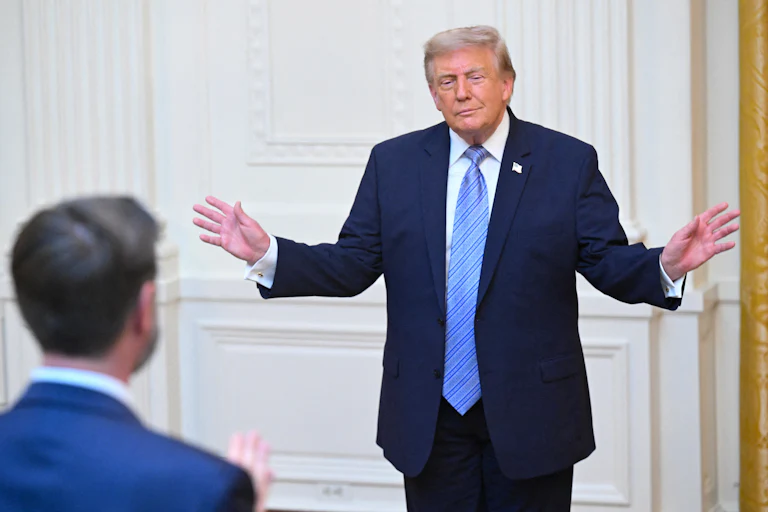
Trump in the East Room of the White House
SAUL LOEB/POOL/AFP/Getty Images
Trump in the East Room of the White House on Thursday night

First of all, I could barely stay awake. It was only a 25-minute speech, and it’s not like 9:25 p.m. is my bedtime, but President Donald Trump’s affect was so strained, his rhetoric so ploddingly predictable, and his “evidence” so vaporous that my mind started wandering at around 9:13. I wondered if it was only me, because I’m obviously not the most objective observer in the world when it comes to Trump, so afterward I flipped on Fox News for a few minutes, long enough to see that even Sean Hannity couldn’t rouse himself into a state of excitation.

So Trump’s much-ballyhooed (chiefly by him) speech Thursday night was a dud. So say I; so, in not so many words, said Hannity (perhaps lurking in the corners of his mind last night was the nearly $800 million his network paid out in a legal settlement after it was caught promoting Trump’s lies); so said Playbook this morning (“Trump’s anticlimax”); so said the gang on Morning Joe. That’s good. It tells us that that power he had over people and institutions a year or 15 months ago has evanesced.

More than that, it was just an embarrassing moment for the United States of America. When has a president ever done anything like that—commandeered the bully pulpit to spread poisonous half-truths and lies? Presidents often lie about this or that particular thing. But no one has ever pressed an obviously bogus case like that. Even the throwaway lines were poisonous lies (“We had transgender for everybody” before he returned to the White House). So it’s unlikely that most Americans are taking it very seriously.

Still: He’s the president, he’s backed by a couple hundred lapdogs on Capitol Hill who will repeat and endorse whatever he says, and of course he is reinforced by a propaganda network that reaches millions of Americans every day that will do the same. So the speech still matters, and it may set in train naked attempts to rig the election and prevent some Americans from voting.

But having seen the speech, and despite what everyone is saying, and indeed despite what I myself assumed going in, I’m not so sure that the main point here was to lay some kind of groundwork for November. Trump may be the most corrupt and furtive man ever to occupy the presidency, but in this one way he is achingly transparent: His motivations are always right out there. And his motivation last night wasn’t really November. It was just what he said. It was 2020.

This man-child with the emotional life of an 11-year-old and an ego that bruises more easily than a three-day-old banana will never stop being obsessed about 2020. In Trump’s mind, Trump can’t lose. It simply can’t happen. (Privately, he has admitted to more than one former aide that he lost, but let’s set that aside for now.) And nothing is ever his fault. Ergo, the election had to be stolen. And he has to “prove” it.

A normal person would let this go after a while and start focusing on the future. The broad interpretation that last night’s speech was really about 2026 and 2028 is a function of people making that assumption. But it’s a fatal assumption in this case. Trump is not normal. Trump is possessed.

His loss must be vindicated, whatever it takes. It might be vindicated by lies. He will know deep down that they are lies, but he won’t care. For Trump, the world is a jungle—eat or be eaten. It’s an authoritarian worldview, because if that’s what you believe, then any action is justified to avoid being the eaten. But he can’t drop it until the vindication is received.

Plenty of dangers lurk for the republic, despite his motivation being mainly retroactive, by the way. The sycophant he wants to install as attorney general, who referred to himself as Trump’s lawyer at his nomination hearing this week, has proven himself more than capable of filing charges against anyone Trump wants him to indict. And the sycophant he wants to install as director of national intelligence, who at his hearing this week couldn’t bring himself to say that Joe Biden won the 2020 election, will presumably gather intel on anyone Trump tells him to look into. So we have every reason on earth to fear that if Todd Blanche and Jay Clayton are confirmed in their respective positions, they’ll take a torch to the Constitution in an attempt to give Trump his vindication.

So picture it. Two and a half more years of sham indictments, destroyed reputations, phony charges repeated by state propagandists who call themselves journalists. And since none of it will work, because the 2020 election was not in fact stolen, it will continue until the day Trump leaves office. Beyond, actually. He’ll be on this jihad until the day that last well-done steak with ketchup arrests whatever’s left of his heart.

That’s bad enough. But yes, inevitably, the speech will have ramifications for this November. It’s hard to know right now what they will be. On the one hand, it seems that his cherished SAVE America Act will never become law. So he probably can’t do that.

Otherwise, though, saying what he said last night about 2020 tees it up for him to repeat as needed between now and November 3 that he—and Attorney General Blanche and DNI Clayton—have unearthed new evidence that the deep staters are up to their old 2020 tricks. Therefore, they have no choice but to deploy ICE agents to certain polling places. This is clearly against federal law. Blanche had said at the Conservative Political Action Conference in March that such a move might be necessary; at his hearing, under questioning from Senator Amy Klobuchar, he said he’d “follow the law,” but his language was slippery.

In sum: Trump’s motivation may be retroactive, but for the Republican Party and the right-wing media machine, the speech’s greatest utility is proactive. Either way, we’re left with the grim reality that a steaming pile of lies that nearly everyone knows to be lies could end up exerting a chilling influence over the administration of justice in this country and our electoral process.

At the same time, let’s conclude on a more positive note. The reaction to the speech is for the most part encouragingly negative and dismissive. The New York Times, well known for the cowardly equivocation of its homepage headlines regarding such matters, actually used the phrase “outlandish claims” in an early headline. For the Times, that’s a shot of Tabasco sauce.

Maybe this speech, combined with those Justice Department goons serving subpoenas to four Times reporters at their homes, will finally convince executive editor Joe Kahn that a newspaper’s job actually is to fight for democracy. The water’s fine, Joe; as Victor Laszlo said to Rick Blaine, it’s never too late to join the fight.   

This article first appeared in Fighting Words, a weekly TNR newsletter authored by editor Michael Tomasky. Sign up here.


Susan Collins May Be Chuckling, but She’s in Far Worse Trouble Now

She was pretty clearly going to beat a man credibly accused of rape. But now? There’ll be a normal Democratic candidate in a heavily Democratic state.

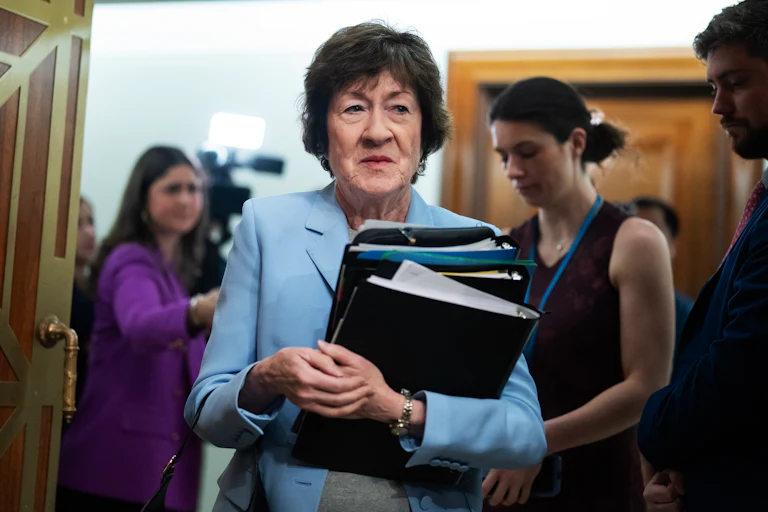
Susan Collins arrives for a committee hearing.
Tom Williams/Getty Images

The conventional media wisdom is that Maine GOP Senator Susan Collins is sitting back and laughing this week, and well she might be. The collapse of Graham Platner’s campaign is an implosion for the ages, and it puts the state’s Democrats in a tricky situation they need to navigate skillfully in these next two weeks.

But November is a long way away. If—and it’s a big but by no means insurmountable if—the Democrats make it through these next two weeks without too many bruises and unite behind a nominee, Collins is still going to be fighting for her life in a Democratic state where Donald Trump’s approval rating is 36 percent, where 85 percent say the state’s economy is fair or poor, and where the generic Democratic congressional edge in one recent poll is a hefty 11 percent. Those are all terrifying numbers for Collins, and she knows it.

Before we get into all that, a few closing thoughts on Platner. I wrote about him a month ago, after The New York Times published some unsavory revelations about his treatment of some former girlfriends (while others said he was fine toward them), and right before the primary. I wrote that since he was almost certain to be the nominee, national Democrats needed to back him.

I did, however, add three caveats, as experience has taught me to do in such situations: “Short of revelations involving murder, rape, or a taste for child pornography, Platner needs to be backed by Democrats to the hilt.” Well, he managed one out of three, but one is enough. It’s utterly and obviously disqualifying.

Some Platner defenders have tried to say, What about innocent until proven guilty? That’s ridiculous in the context of running for office. Yes, it means everything in a court of law, where a defendant is on trial for his very freedom; there, he is absolutely entitled to a presumption of innocence, and he must be given his day in court so that we all hear his side. But a political campaign isn’t a criminal trial. In a political campaign, political judgments must be made, and the clear political judgment here is that no party can back someone facing a credible allegation of rape, for God’s sake.

As for the intentionally weak vetting of Platner by the young leftist strategists who “discovered” him: I hope people have learned some obvious lessons. Daniel Moraff, the person who’s apparently largely responsible for this debacle, told The Wall Street Journal last month that he sensed a public thirsting for non-cookie-cutter candidates who challenge the status quo. That’s surely true, in a lot of places, but it hardly means you don’t need to put your candidates through the usual paces. It’s grotesquely arrogant and irresponsible, and if Collins ends up winning, Moraff will bear a huge share of the blame.

However: I still say, Moraff and Platner aside, Collins could well be in far more trouble with a new Democratic nominee. Kamala Harris beat Trump by seven points in the state. And as I noted above, in a recent poll, respondents said that for Congress, they’d choose a Democrat over a Republican by 53 percent to 42 percent. On top of that, Democratic gubernatorial nominee Hannah Pingree, who will be at the top of the ticket, looks like she’s going to beat her Republican foe by around 15 points. That means Collins is going to have to convince a lot of independents to switch from the D column to the R one as they move down the ballot from governor to senator.

Collins has won such voters before, but I would remind people, as they look over past elections for parallels, to take note not only of what’s similar but of what’s different.

The main (as it were) case in point here is 2014. Shenna Bellows, the current secretary of state and a leading contender to replace Platner, was the Democratic nominee against Collins that year. Collins blew her out by 30 points, which some say should raise a lot of red flags.

Well, there are a host of differences between 2014 and today. One, Bellows was a 39-year-old novice then, who had never held office and whose claim to fame was that she had been the head of the state’s ACLU. Two, it was the sixth year of a Democratic incumbent presidency, a notoriously hard year for candidates of said party. Three, the Maine of 2014 was in such a cantankerous state that it reelected embarrassing extremist loudmouth Paul LePage as its governor. Four, it was pre-Trump, which changes everything. Five, it was before Collins’s vote to confirm Brett Kavanaugh as a Supreme Court justice because she took him at his word that Roe v. Wade was “settled law.”

I’m not saying Bellows should be the choice. I don’t know enough about the available candidates or the ins and outs of Maine politics. That’s up to those 600 Democratic delegates to sort out and decide. I’m just saying that what’s past isn’t always prologue. The point is what’s going on now. And what’s going on now, nationally and in Maine, is a strong anti-Trump sentiment—and a GOP incumbent senator who voted to confirm 22 of Trump’s 23 Cabinet nominees.

What the Maine Democratic Party, and to some extent the national Democratic Party, has to do here is run a process that is widely accepted as having two qualities: It must be transparent, and it has to feel fair. The party needs to give voters and citizens regular updates on the process—this is happening today; this is happening next Tuesday—so that everyone feels they’re in the loop and no one feels sandbagged. And it needs to feel fair so that in the end, everyone at least feels that they need to accept the outcome.

As for the national party, I hope Chuck Schumer has the sense to stay completely out of this. His fear of Platner turns out to have been justified, but the way he pushed Governor Janet Mills—who ran as if she didn’t really want to be there—into the race only helped Platner score the nomination. If Schumer and national Democrats are perceived as putting their finger on the scale for a candidate—for instance, in order to stop former state Senate Majority Leader Troy Jackson, who is widely seen as most Platner-like in his populist politics—they’ll only sow rancor and help Collins in the long run.

In the short term, this was a good week for Susan Collins. But to paraphrase Harry Hopkins, people don’t vote in the short term. They vote in November. By then, she could very well be regretting this week’s events.

This article first appeared in Fighting Words, a weekly TNR newsletter authored by editor Michael Tomasky. Sign up here.

Donald Trump Is a Treacherous, Idolatrous, Know-Nothing Anti-Patriot

As we celebrate America’s 250th birthday—and not the sitting president—let’s remember what true patriotism looks like.

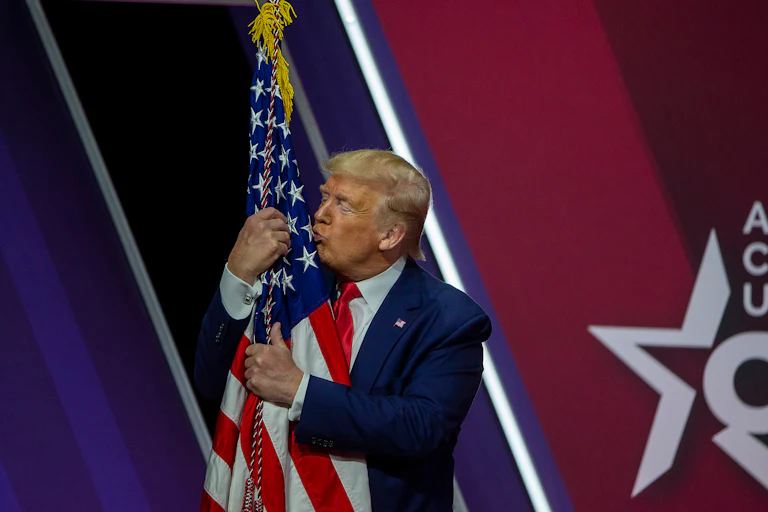
Trump at the 2020 Conservative Political Action Conference
Tasos Katopodis/Getty Images
Trump at the 2020 Conservative Political Action Conference

History—in this case, through the pen of James Boswell—does not record for us the context in which Samuel Johnson offered up the famous quote that “patriotism is the last refuge of a scoundrel.” According to samueljohnson.com, the English intellectual and polymath just blurted it out on the evening of April 7, 1775, providing no context or explanation of what was on his mind. Some biographers apparently believe he was thinking of William Pitt the Elder, and the former prime minister’s frequent invocation of the term.

We do, however, have more thoughts on the matter from Johnson that have survived. The year before, Johnson—something of a mixed bag, politically, but an ardent foe of slavery long before abolitionism became a movement in Great Britain—wrote and delivered to Parliament a speech he called “The Patriot.” It was election time, and Johnson was laying out for the assembled some of his ideas about the duties of public service, and what patriotism does, and does not, mean.

Herewith, just a few choice quotes:

“To instigate the populace with rage beyond the provocation, is to suspend publick happiness, if not to destroy it. He is no lover of his country, that unnecessarily disturbs its peace.”

“Still less does the true patriot circulate opinions which he knows to be false. No man, who loves his country, fills the nation with clamorous complaints, that the protestant religion is in danger, because ‘popery is established in the extensive province of Quebec,’ a falsehood so open and shameless, that it can need no confutation among those who know that of which it is almost impossible for the most unenlightened zealot to be ignorant.”

Finally, in his closing peroration, Johnson urged the next House of Commons to “unite in a general abhorrence of those, who, by deceiving the credulous with fictitious mischiefs, overbearing the weak by audacity of falsehood, by appealing to the judgment of ignorance, and flattering the vanity of meanness … arrogate to themselves the name of patriots.”

As we watch (or avoid watching) Donald Trump trying to turn the celebration of the United States’ 250th birthday into a celebration of Donald Trump, we would do well to remember Dr. Johnson’s thoughts. In wondering what he might think of the president’s ideas and actions this week, there is very little mystery. Let’s review a couple of those actions, as reported by Politico Playbook Friday morning:

  • You saw that ridiculous video of Trump “talking” with the AI Teddy Roosevelt? Well, this was meant to be part of a “living museum recreating Theodore Roosevelt’s frontier experience,” as envisioned in a “planning document” from America250, a bipartisan, congressionally chartered, decade-old plan to launch various commemorations. From Playbook: “It hoped to draw 250,000 visitors for a nationally televised celebration on July 1 featuring A-list performers, immersive historical programming, a drone spectacular and, ultimately, the Theodore Roosevelt Presidential Library’s grand opening.” Instead, it launched with a visit from Trump.
  • The Smithsonian Folklife Festival, a decades-old Washington summer fixture that always takes place on the National Mall, was given the boot this year and forced inside the Smithsonian Castle to make way for Trump’s Great American State Fair, which has been drawing fewer attendees than a lot of Little League games.
  • Finally, it almost goes without saying that the Trump administration stiffed America250, according to Politico. Congress appropriated $150 million to the project, but organizers have received just $25 million to date. Democrats also alleged this week that some America250 donors were tricked into donating to Trump’s personal semiquincentennial organization, Freedom 250, which is responsible for the UFC fight at the White House and the ongoing fair. (Naturally, Freedom 250 is not subject to congressional oversight, and it can keep its donors private.)

But these, of course, are minor matters that will pass. The real hallmarks of Trump’s false patriotism are the things that make his tenure such a horrific embarrassment and civic tragedy to so many millions of Americans. The constant lies meant to glorify him and his reign. The toxic hatred of so many of the people he was elected to serve. The petty and immoral pursuit of his political enemies. The operatic and open corruption.

These are venal acts. But as July 4 approaches, it behooves us to remember specifically that they are also unpatriotic. Or worse: They are aggressively anti-patriotic. Real patriotism is truthful and humble; it tolerates and even welcomes dissent, and, understanding that the people rule in a democracy, it serves supporters and detractors equally; it seeks justice rather than revenge; and it understands that to pursue profit from office is abhorrent.

Trump knows none of that. He is a treacherous, know-nothing anti-patriot. The image that sticks with me, the photo that made me both roll my eyes and gasp in horror when I first saw it, was the one of Trump kissing an American flag. What a grotesque act of civic idolatry; in fact, let’s throw “idolatrous” in there too. And if you don’t understand why kissing a flag is an act of grotesque civic idolatry, then you, my friend, are part of the problem.

Let’s close with a few more thoughts on patriotism from some people who actually knew what it means:

George Washington: “Guard against the impostures of pretended patriotism.”

G.K. Chesterton: “‘My country, right or wrong’ is a thing no patriot would ever think of saying except in a desperate case. It is like saying ‘My mother, drunk or sober.’”

Albert Einstein: “Heroism on command, senseless violence, and all the loathsome nonsense that goes by the name of patriotism—how passionately I hate them!”

And maybe my favorite, from Clarence Darrow: “True patriotism hates injustice in its own land more than anywhere else.”

There is still much to celebrate about the United States of America—its art and literature and music, its scientific achievements, its physical beauty, and of course the principles of liberty it introduced to the world 250 years ago and toward which we daily and yearly strive. The anti-patriots do have the upper hand right now, but more and more people are seeing through them. In addition, they are also making real, Johnson- and Darrow-esque patriots of millions who were once disengaged. That is something to be hopeful about, and to celebrate, this weekend.

This article first appeared in Fighting Words, a weekly TNR newsletter authored by editor Michael Tomasky. Sign up here.