Breaking News
Breaking News
from Washington and beyond

Trump-Aligned Board Threatens to Demolish the Kennedy Center

If the president can’t have it, no one can.

A security guard walks through the John F. Kennedy Center for the Performing Arts.
The John F. Kennedy Center for the Performing Arts.
Brendan Smialowski/Getty Images
The John F. Kennedy Center for the Performing Arts.

The Trump administration, in its ongoing effort to shatter previous world records for spitefulness, is threatening to demolish the John F. Kennedy Center for the Performing Arts if it is not allowed to put Donald Trump’s name on it.

In a court filing Monday, prosecutors suggested that the proposed $250 million renovation project—which includes tacking the president’s name to the facade of the building—was necessary for the institution’s survival, The New York Times reported.

“Without those efforts, the center will deteriorate further into an unsafe, decrepit structure that will be required to be taken down,” the filing said, “with a determination to follow on what to build on the site, such as a large outdoor amphitheater overlooking the Potomac River that has been proposed, by some, for many years.”

In reality, Trump’s overhaul of the prestigious national theater has only hastened its demise. The Kennedy Center is on track to fall $100 million short of its profit goal, and the shortfall can be directly tied to Trump changing the institution’s name. It expects to miss its budget target by 70 percent and contributed revenue by 25 percent, a projected $23 million deficit.

The Kennedy Center has become an outlet for the Trump administration’s shocking pettiness. The President Trump-appointed Kennedy Center board first tried to close the center in May, after multiple artists cancelled their performances in response to the proposed name change. Democratic Ohio Representative Joyce Beatty successfully challenged the decision in court.

The renovations were blocked by U.S. District Judge Christopher Cooper, who argued that the board’s decision was “ill-informed and seemingly preordained.” Trump’s name was then scraped off the wall, and the building’s facade has remained concealed by a massive tarp.

Earlier this month, the board voted again, this time deciding to close the center for two years so that it can renovate the building in Trump’s image. Now Beatty has asked a federal judge to once again keep Trump’s name off of another man’s memorial.
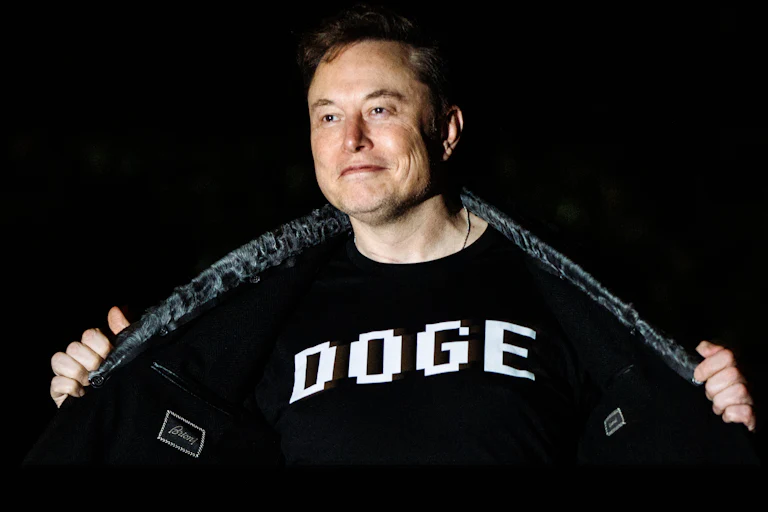
We’re About to Learn How DOGE Helped ICE Get Taxpayer Data

A federal court has ruled that DOGE must release its internal communications related to a controversial deal between the IRS and the Department of Homeland Security.

Elon Musk wearing a DOGE shirt
Elon Musk
Samuel Corum/Getty Images
Elon Musk

A court has ordered the Department of Government Efficiency, or DOGE, to disclose to immigrants’ rights groups how involved it was in getting tax and Social Security information shared with the Department of Homeland Security. 

U.S. District Judge Indira Talwani ruled Monday that the government has to turn over the records after refusing requests to do so as part of a lawsuit against Trump administration officials, Bloomberg reports. The government has until September 14 to comply with the ruling, Talwani said, adding that its refusal constituted “another significant gap precluding the court from evaluating Plaintiffs’ claims.”

As part of President Trump’s mass deportation agenda, DHS and the IRS reached an agreement to share taxpayer information to find undocumented immigrants. Immigration advocacy groups sued to stop the data sharing, and a federal court granted them a preliminary injunction in February limited to the IRS. 

Talwani rejected the government’s claims that it handed over all of the legally required materials to the groups suing it, saying that federal agencies also had to turn over DOGE’s communications, as well as those from inside the Social Security Administration. However, the judge granted the government one reprieve, saying that it does not need to turn over the actual data the SSA shared with DHS or the names and contact information of SSA employees involved in the data sharing. 

DOGE, spearheaded by tech oligarch Elon Musk, was given unprecedented access to internal government data from the start of Trump’s second term. Almost every agency was mined, including the SSA, the Treasury Department including the IRS, and Medicare and Medicaid records. All of this was ostensibly to root out waste, fraud, and abuse while increasing efficiency, although that never happened

Musk’s businesses, including his artificial intelligence company xAi, could have benefited from this information, but that is still under investigation. What is known is that the data definitely helped and continues to help Trump’s efforts to deport millions of immigrants. Now the public will get at least a small look into how DOGE helped Immigration and Customs Enforcement’s violent deportation efforts.  

This Kentucky Republican Is Erasing Trump From His Campaign

Ralph Alvarado’s campaign website used to tout connections to the president. Not anymore.

Senator Ralph Alvarado Jr. speaks during the 2016 Republican National Convention in Cleveland, Ohio.
Daniel Acker/Getty Images
Senator Ralph Alvarado Jr. speaks during the 2016 Republican National Convention in Cleveland, Ohio.

Is the Republican Party going to spend the election season running away from Donald Trump? If Ralph Alvarado, a Republican candidate running for Kentucky’s 6th congressional district, is any sign of things to come, then maybe so.

This week, Alvarado stripped mentions of the president’s agenda from his campaign materials, apparently deciding that being too tied to Trump would hinder rather than help his odds come November.

Before-and-after screenshots of Alvarado’s campaign website, captured by NBC News’s Sahil Kapur, reveal that Alvarado’s messaging has switched from marking him as an “America First Fighter” to “Independent Leadership.”

On June 9, Alvarado’s website proudly displayed his loyalty to the president, claiming in a subheading that “President Trump needs more allies in Congress to deliver on his bold vision to Make America Great Again. With your help, I will be that fighter.”

By August 24, the physician’s tune had changed. The new text in that space reads: “Healthcare isn’t a talking point to me—it’s been my life’s work. In Congress, I’ll work with both parties to fight for affordable healthcare, lower costs, and practical solutions that help Kentucky families.”

A photo of Alvarado standing beside Trump was also removed from campaign materials. In place of a paragraph that once described Alvarado as “one of President Trump’s earliest supporters” and detailed his determination to “stop the woke agenda,” new language now frames him as an ardent supporter of bipartisanship, singularly focused on bringing down healthcare and affordability costs.

He’s not the only one to make a change. Andy Biggs, the MAGA Republican running in Arizona’s gubernatorial race, originally pushed campaign signs that championed the fact that he was “Trump endorsed” in bold, black lettering above his own name. That no longer seems to be the case. Biggs’s campaign has since erected modified signs that added the name of Biggs’s running mate, Sine Kerr, and stripped any mention of the president from his roadside advertising. (Unlike Alvarado, Biggs’s website still mentions that he was endorsed by Trump.)

Recent polling offers some insight behind these curious changes. A Reuters/Ipsos poll published Tuesday suggests that the president’s influence is waning: Just 13 percent of Americans strongly approve of the president—down from 23 percent who felt the same way this time last year, according to data from a 2025 YouGov Poll.

Republican attitudes towards Trump have also changed, according to the Reuters/Ipsos poll. Just 35 percent of conservatives surveyed said they “strongly approved” of Trump’s job during his second term. In the same poll, 41 percent of registered voters said that they would vote for a Democratic candidate if the presidential election were conducted today.

Midterm-bound Republicans were explicitly encouraged by the White House as well as party leadership last month to break from Trump in an effort to save their election chances.

“The understanding is pretty damn implicit: The president is going to say what the president is going to say,” a Republican operative working on the party’s midterm races told MS NOW in July. “You’re not going to have candidates or lawmakers running out to defend the president’s handling of the economy or the war—polling shows that most people don’t agree with his handling.”

The “Woke” Painting That’s Driving the Trump Administration Crazy

State Department officials have declared a weird war on a piece of art that once hung in the U.S. Embassy in the Dominican Republic.

Artist Kehinde Wiley
Roy Rochlin/Getty Images
Artist Kehinde Wiley

President Donald Trump’s administration was so triggered by a “woke” painting that it had it removed.

For years, a Kehinde Wiley painting titled Young Artists After Siamesas 1960 hung in the U.S. Embassy in the Dominican Republic. The piece, commissioned by the federal government in 2013, shows four Dominican models against a bright floral backdrop. Wiley is perhaps best known for his portrait of former President Barack Obama, which currently hangs in the National Portrait Gallery in Washington, D.C. It could be that fact that has made the Trump administration so upset.

Either way, the Trump administration just can’t handle the prospect of displaying another one of Wiley’s works. After covering the painting with a large tarp, State Department officials removed the piece last week. Now they’re considering whether they’re allowed to sell it, The New York Times reported Monday.

Speaking on Sean Spicer’s podcast last week, Erin Scavino, the director of art in embassies, described the painting as “very woke” and “aesthetically terrifying”—whatever that means. According to her State Department bio, Scavino is a lawyer whose vague artistic background includes “cultural expression through fluid installation art” and “innovative design residency programs that integrate art with recycled materials, turning waste into creative wonders” (which sounds pretty “woke”). Her presence in the Trump administration probably has less to do with her fluid installations and more to do with the fact that she did a brief stint on The Apprentice and is married to eternal Trump flunkie Dan Scavino, who currently serves as the director of the White House Presidential Personnel Office.

Virginia Shore, who served as director of art in embassies from 2000 to 2017, said there was no precedent for selling the piece. “Calling this ‘woke’ is difficult for me to understand,” she told the Times. “This is a program validated and financially backed under Bush. There is a science of building trust and empathy across borders.”

The Trump administration wasn’t even willing to acknowledge what it is about the painting that offends its sensibilities. In a statement Monday, a State Department spokesperson didn’t address the actual work. Instead, the statement referred to allegations of sexual assault against Wiley, which he has denied, and criticized Wiley for once describing a different artwork as a “play on the ‘kill whitey’ thing.”

“The work of an individual with such violent and racist words and depictions has no place in the America First State Department,” the spokesperson said.

If the Trump administration wanted to get rid of racist art, why reinstall a Confederate statue? Well, because it’s not about that at all. The effort comes amid a wider trend of Trump administration efforts to expunge Black history from American monuments and museums.

Leah Campos, the U.S. ambassador to the Dominican Republic, celebrated the painting’s removal on Instagram.

“In the Trump Administration and under my leadership we are turning away from globalist and woke ideologies and instead embracing American patriotism and the beauty of our great country!” she wrote, including a video of the painting’s removal edited with the Twisted Sister song, “We’re Not Gonna Take It.” Leave it to the Trump administration to put an antiestablishment song over a video of government censorship.

Canada Retaliates With Plan to Tariff Hundreds of American Goods

Canada has announced retaliatory tariffs as Trump’s trade war escalates.

President Donald Trump and Canadian Prime Minister Mark Carney
Evelyn Hockstein/POOL/AFP/Getty Images
President Donald Trump and Canadian Prime Minister Mark Carney

Canada has hit back at the United States, announcing retaliatory tariffs of up to 50 percent on $20 billion worth of American goods, most notably aluminum, steel, and fish. Trump announced 50 percent tariffs on Canada last month, and threatened to levy even more this week.

Canada’s tariffs will affect a wide variety of U.S. goods beginning September 8, including steel, dairy, appliances, agricultural equipment, pulp and paper, and electronics.

Canadian Prime Minister Mark Carney suspended trade talks with Trump last Friday after the U.S. demanded last-minute concessions regarding Quebec law requiring the U.S. to print manuals and packaging in French—a seemingly minute detail to make a dealbreaker. This of course led Canada to exit talks, as they took it as an attack on their culture and sovereignty.  

Now U.S. consumers will pay for the perceived slight. 

“Canada must respond, and today we are—in a proportionate, targeted, and strategic way. Today, I am announcing that Canada will match the United States tariffs dollar for dollar, rate for rate. Effective September 8, Canada will impose counter tariffs of up to 15, 25, or 50 percent on $27.6 billion in imports from the United States of America,” Canadian Finance Minister François-Philippe Champagne said on Tuesday. “For each product, our tariff would match the American tariff on the same type of Canadian goods. Those tariffs will have real consequences for Canadian workers, businesses, and communities across our nation. Canada must respond, and today we are in a proportionate, targeted, and strategic way.”

These tariffs from Canada will inevitably make it more difficult for U.S. companies that do business with Canada to compete in the near future—and cause prices on those aforementioned key goods to rise. And more than anything, Trump’s chaotic, greedy vindictiveness has cost us a good relationship with perhaps our closest ally in the world.