Breaking News
Breaking News
from Washington and beyond

Here’s How Trump’s Culture War Killed Trade Talks With Canada

Prime Minister Mark Carney says that U.S. demands to curtail his nation’s French-language identity were a nonstarter.

Canadian Prime Minister Mark Carney speaks at a press conference in Ottawa, Ontario
Canadian Prime Minister Mark Carney at a press conference in Ottawa, Ontario
Dave Chan/Getty Images
Canadian Prime Minister Mark Carney at a press conference in Ottawa, Ontario

Trade talks with Canada collapsed over the weekend after the Trump administration demanded the country curtail its culture. But one interesting wrinkle is that the Trump administration’s intransigence has potentially, if only temporarily, healed a rift between the French-speaking Quebecois and their English-speaking neighbors.

Canadian Prime Minister Mark Carney suspended the talks on Friday, triggering President Trump’s 50 percent tariff rate on roughly $28 billion in Canadian exports. Carney has promised to match the tariffs “dollar for dollar.”

In a powerful speech delivered the following day, Carney referred to the United States as untrustworthy and unreliable, informing the Canadian public that the country would need to forge a more independent future without the U.S.

“We cannot control the storm blowing in from Washington,” Carney said. “We can chart a new course by building Canada strong at home and diversifying our trading relationships abroad.”

The “new U.S. tariffs are designed to hurt us and divide us,” Carney continued. “They’re a miscalculation.”

Canada’s reciprocal tariffs against goods and services from the U.S. are expected to begin September 8.

The two nations had spent months drafting a suitable trade agreement—talks that, according to Trump, were fruitful. Last Tuesday, Trump told reporters that the countries had reached a deal and were fine-tuning some details. On Friday, hours before the midnight deadline, Trump still insisted that he believed a deal could be reached.

Canadian officials did not paint the same picture. Premier Christine Fréchette told reporters Saturday that the U.S. had demanded last-minute concessions relating to Quebec’s French-language protections. “A red line,” she noted.

“Our culture, our language, is central to our identity, and it is important to exclude that from the negotiating table,” Fréchette said, according to The Montreal Gazette. “Even though we are threatened with different tariffs, it won’t change. We will stay the way we are.”

Carney similarly said that the U.S. had “asked too much.”

The Trump administration has singled out two Canadian laws as pressure points in the negotiations: Bill 96, an act that identifies French as the official language of Quebec, as well as Bill 109, which affirms the cultural sovereignty of the region and grants it the ability to set French-language quotas for French-language content (which it has not yet done). The two laws were passed in 2022 and 2025, respectively.

American officials have claimed that the laws have placed an undue burden on U.S. manufacturers, requiring them to produce packaging, controls, and instruction manuals in French in order to sell products in Quebec. Some of America’s biggest streaming companies—including Netflix, YouTube, Apple, and Spotify—have also argued against the laws, contending that there are practical issues relating to the theoretical implementation of language quotas in their databases.

U.S. Trade Representative Jamieson Greer said in a statement that “this is a missed opportunity for Canada to partner with the United States,” adding that the offer would have given Canada “the best treatment of any major exporter to our market.”

In response to this weekend’s trade talks, Paul St-Pierre Plamondon, the leader of the currently out-of-power Parti Québécois, said that any future referendum on Quebec’s independence would be delayed until Trump leaves the White House. “This unpredictability of the American administration will harm our process as well as the quality of the debate on our future as a nation,” he said.

There are currently no scheduled meetings to continue talks between the two countries, according to a senior Trump official.

Navy Sailor Aboard USS Lincoln Learns ICE Took His Dad

U.S. Navy sailor Joshua Aviles hadn’t seen his dad in nine months when he learned his father was arrested.

USS Abraham Lincoln in the sea
USS Abraham Lincoln
U.S. Navy/Getty Images
USS Abraham Lincoln

A Florida father was arrested by U.S. Border Patrol while his son serves on the now infamous USS Lincoln in the Persian Gulf.

Luis Manuel Aviles, a 19-year U.S. resident with a work permit, was detained by Border Patrol agents outside of his Key West home on Saturday. Originally from Nicaragua, Aviles was working as a handyman when he was detained.

“Having a family member in the military is not a free pass to violate our nation’s laws,” the Department of Homeland Security said in a statement, claiming that it “does not pick and choose which laws to enforce.”

Aviles’s son Joshua expressed devastation and “heartbreak” as he heard the news aboard the Lincoln.

“I’ve been deployed for over nine months, out at sea in the Middle East aboard the USS Abraham Lincoln, fighting for a country that has given me everything. I just got a call that my dad was taken by ICE,” he wrote in a Facebook post on Saturday. “My dad has his driver’s license, Social Security card, and work permit. We have done everything through immigration to get his green card approved, and we are just waiting.

“This is heartbreaking for me. I don’t know how I can mentally continue working 12+ hour days knowing that my dad is somewhere, possibly being treated like a criminal,” he continued. “My dad’s only ‘crime’ was coming to this country to give my siblings and me a better life.”

The USS Lincoln—which has been out at sea for over 270 days, a record—has reportedly suffered from food shortages and sanitation issues. There have also been multiple instances in which sailors tried to jump overboard. On top of all of that, Aviles is now forced to spend the remainder of his time on the ship tortured by the thought of his father’s detainment and potential deportation—as he may not even get to see him after hundreds of days in the Persian Gulf.

Alaska Just Has Too Many Dan Sullivans

The big news out of the Last Frontier’s Senate race is that Dan Sullivan has endorsed Dan Sullivan over Dan Sullivan. Got it?

One of Alaska’s many Dan Sullivans
Andrew Harnik/Getty Images
One of Alaska’s many Dan Sullivans

Yet another Dan Sullivan has entered the chat.

In the Alaska Senate race, which has managed to give everyone a headache, former Anchorage Mayor Dan A. Sullivan has endorsed Republican Senator Dan S. Sullivan for reelection over retired teacher Dan J. Sullivan, NBC News reported Sunday.

“As the OG Dan Sullivan, I urge Alaskans to vote for Sen. Dan S. Sullivan. He’s been great for Alaska,” the former mayor wrote in a post on Facebook last week.

For those keeping score at home, in last week’s all-party primary elections, Dan S. Sullivan advanced to the general election, against a tough Democratic challenge from former Representative Mary Peltola. Despite Alaska’s typical GOP lean, Sullivan secured roughly 43 percent of the vote, while Peltola won 48 percent.

Dan J. Sullivan, who is also running as a Republican, secured only 2.4 percent of the vote but was still more successful than the other 13 challengers not named “Dan Sullivan.” The primary is decided by ranked-choice voting, and the top four finishers advance—meaning that this Senate race could still be a state-wide Sullivan-off.

After initially blocking Danny J from running, the Alaska Supreme Court ruled in June that the Alaska Division of Elections did not have the authority to create new requirements for candidates—like, that they have different names.

Trump’s White House Ballroom Defense Unravels as Secret Bunker Exposed

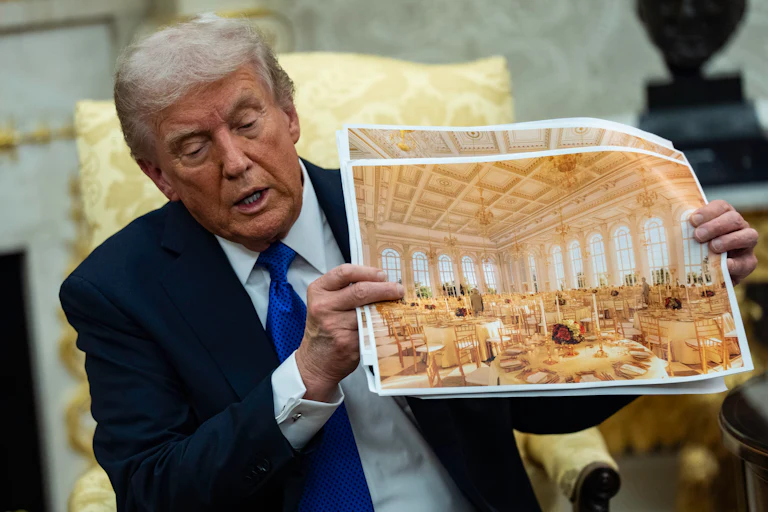
Trump claims he needs the White House ballroom for national security. But the White House already has a secret bunker.

Donald Trump holds up a photo of a mock design of his ballroom while sitting in the Oval Office of the White House.
Salwan Georges/The Washington Post/Getty Images

President Trump may have undermined his own legal argument to build a new White House ballroom.

Trump is claiming that ballroom is necessary because it will also provide a secure underground facility in case of a national emergency, an argument his lawyers have used in court. But former White House officials told The Washington Post that the building already has a fortified bunker deep underground that was built more than a decade ago to shelter the president and White House staffers.

The facility, located over 60 feet underneath the White House, was secretly built during the Obama administration and can house dozens of people for multiple weeks, the officials told the Post. It can withstand a nuclear bomb and was designed to give the president a secure command center if such a disastrous scenario takes place.

Trump and his lawyers have argued in court that the White House ballroom is necessary for national security because secure underground facilities are part of the plans. White House spokesperson Davis Ingle repeated those arguments when contacted by the Post.

“The East Wing Modernization Project is inextricably tied to the security of the President, the White House grounds and the certain security infrastructure assets,” Ingle said in a statement. “Recent events such as the foiled attack on the historic UFC Freedom 250 event at the White House proves exactly why the East Wing Modernization Project is severely needed for large scale events, which include drone proof structures and drone ports among other critical security enhancements.”

Last week, Supreme Court Chief Justice John Roberts stayed a lower court ruling and allowed the Trump administration to continue construction on the ballroom while the high court considers the White House’s arguments. The U.S. Court of Appeals for the District of Columbia had ruled that the ballroom was illegal because Trump didn’t have congressional approval.

Administration officials such as White House deputy chief of staff Stephen Miller have used national security arguments to defend the ballroom. Miller wrote in a court filing that the construction “serves continuity-of-government interests by ensuring that the President and senior national security staff are able to operate from a protected facility during any attack on the nation’s capital.”

In an August 13 filing to the Supreme Court, Army Secretary Dan Driscoll wrote, “Securing this reinforced subterranean node guarantees uninterrupted command and control in place.”

The White House ballroom and underground facilities are “a nondiscretionary prerequisite to ensure the President can maintain continuity of government, uninterrupted operations, and effectively exercise National Command Authority during an attack or global crisis,” Driscoll wrote.

But the Post’s report shows that all of those arguments don’t hold up when there’s already a secure, underground bunker at the White House that is just over a decade old. Trump is expending government resources to defend a vanity project that has no real justification besides his own love of luxury buildings.

Washington Post Ordered to Rehire Columnist Fired Over Charlie Kirk

The Washington Post must reinstate Karen Attiah, a private arbitrator ordered.

Karen Attiah with a mic in front of her
Karen Attiah
ISABEL INFANTES/AFP/Getty Images
Karen Attiah

A private arbitrator has ordered The Washington Post to rehire opinion columnist Karen Attiah—who was fired from the paper last September after she criticized gun violence and posted a racist quote from right-wing activist Charlie Kirk after his death.  

“After the Washington Post fired me last year for speaking the truth in the wake of the Charlie Kirk killing, I fought back. And I’m happy to announce: I won my case against the Washington Post,” Attiah—the Post’s only Black opinion columnist at the time of her firing—wrote Monday on Bluesky. “They have been ordered to reinstate me immediately.”

“This decision confirms what we’ve said from the start: I was doing my job as an opinion writer, and this was wrongful termination,” she said in another statement. 

An independent arbitrator found the Post “violated” its labor agreement and “did not have good and sufficient cause” to fire Attiah, according to a copy of the order reviewed by The New York Times.

Attiah made a string of posts on Bluesky in the aftermath of Kirk’s shooting in Utah, which followed a school shooting in Colorado, with only one of her posts actually mentioning Kirk by name. 

“I wish I had hope for gun control and that I could believe ‘political violence has no place in this country.’ But we live in a country that accepts white children being massacred by gun violence,” she wrote first. “Not just accepts, but worships violence.”

“Part of what keeps America so violent is the insistence that people perform care, empty goodness and absolution for white men who espouse hatred and violence,” she then wrote, referring to Kirk, who spent much of his career trying to justify racism and bigotry. “Refusing to tear my clothes and smear ashes on my face in performative mourning for a white man that espoused violence is … not the same as violence,” she said later.

The one post Attiah made that actually had Kirk’s name in it was a slightly paraphrased quote. 

“‘Black women do not have the brain processing power to be taken seriously. You have to go steal a white person’s slot’—Charlie Kirk,” she wrote. (Kirk’s original quote was “You do not have the brain processing power to otherwise be taken seriously,” in reference to former first lady Michelle Obama, news host Joy Reid, Supreme Court Justice Ketanji Brown Jackson, and former Representative Sheila Jackson Lee, although his ire was certainly directed at any successful Black woman.) 

Attiah said the Post found her Bluesky posts to be “unacceptable,” “gross misconduct,” and “endangering the physical safety” of her co-workers. She added that she was fired “without conversation,” and called it a “violation of the very standards of journalistic fairness and rigor the Post claims to uphold.” The arbitrator felt similarly, and the decision to reinstate Attiah was widely celebrated. 

“Journalists can’t work at an organization where they must live in fear of being arbitrarily fired for doing their jobs—which, in Karen’s case, was writing her opinion,” Washington Post Guild Chair Natalie Vineberg wrote in a statement. “This decision is a victory for all Guild members who benefit from and fought for the just cause protections in our contract, and a tribute to every Guild member who took action in solidarity with Karen.”

Editor’s Pick: