
It is modernity’s hardest brag: In a single century, the average human lifespan more than doubled. A generation terrorized by tuberculosis, scarlet fever, and cholesterol now lives in the memory of one that reasonably expects—with a little discipline and a common prescription or two—to surpass the ripe Old Testament mark of 70 years, perhaps by decades. In just a few years, Americans older than 65 will constitute one-fifth of the population, the same proportion as those under 18. For the first time, past and future will view each other across a demographic seesaw that is perfectly level.
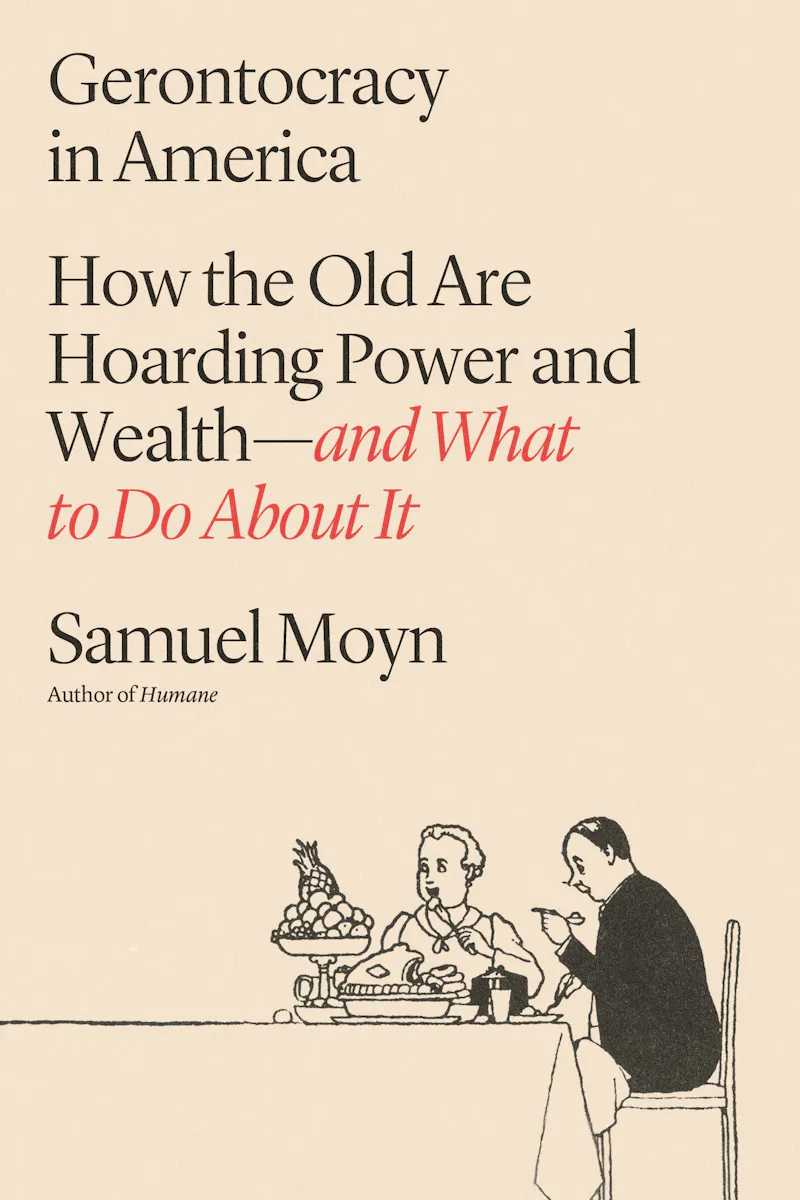
In Gerontocracy in America, law professor Samuel Moyn argues that nothing about this novel arrangement is level, perfect, or even good. Rather, it represents a radical, historic skew. The boomer beneficiaries of “the great aging” have blocked the natural order and flow of time with fantasies of an eternal prime and the hoarding of resources away from the more deserving, increasingly restless young. Where the old once had the decency to plop expeditiously off the generational conveyor belt, they now selfishly just keep going, like some fast-breeding army of geriatric Energizer Bunnies. The result, argues Moyn, is systemwide social arteriosclerosis. A nation once “oriented to innovation and problem-solving” has devolved into one “increasingly built around caretaking and compassion,” where
a future focused on what to become next—collectively, not just personally—is being foreclosed, life reduced to a mass project of eking out a little extra in the face of the inevitable death of has-beens as they exert continuing control.
It is a safe bet that the AARP will not be promoting Gerontocracy in America to its 38 million members. Its depiction of the great aging as an orgy of elder egotism is so dark that it casts a shadow on the very medical advances that enabled it (and which happen to be among the heaviest fruits of the lost “innovation society” the book pines for). Moyn assigns blame not just to the high-profile octogenarians who are its public face, but also millions of middle- and working-class retirees who remain in the labor market (usually against their wishes) and donate to candidates who promise to protect their embattled interests.
For Moyn, returning the country to a state of vigor and dynamism requires questioning every widely held assumption about aging, life extension, and death. Only then can we overthrow the gerontocracy and “realize our collective aspiration to innovation,” while also achieving “intergenerational equity.” It is time, apparently, to refresh the tree of liberty with the blood of geezers—even if the majority are themselves only scraping by in an increasingly unequal society whose punishments can be most brutal on the old.
The size and relative health of today’s senior cohort may be new, but gerontocracy—a power structure systematically weighted by age—is very old. Max Weber assessed the link between age and leadership to be one of the “foundations of human politics across space and time,” Moyn observes, and not just in the elder-venerating cultures of Asia. The Oracle of Delphi instructed the Spartan lawgiver Lycurgus to vest power in a council of men 60 and older. This drew praise from Plato—but not Aristotle, an early critic of gerontocracy—and inspired councils throughout history, including the U.S. Senate. Moyn censures Cicero for hyping the inherent wisdom and virtues of being old, and bemoans the influence of Old Testament authors who described gray hair as “a crown of glory.” The early Christians made matters worse by naming their church leaders presbyteroi—Greek for “old men”—as did the early Americans, who used the English translation—alderman—for the New World’s representative democratic figure.
Jean-Jacques Fazy put forward the idea that elder veneration was a cover for corrupt rule in his 1828 pamphlet Gerontocracy: The Abuse of the Wisdom of Elders in the French Government. For Fazy, as for Moyn, the problem with gerontocrats was not just their age or wealth, but the proclivity to reactionary politics that age and wealth cultivate together. “Skittish of progress, with a bias that old men have for rest, the agitation that arises around them tires them out, and their priority is to guard against it,” Fazy wrote of the doddering blue bloods who dominated the French Parliament after the Bourbon restoration.
The nineteenth was Moyn’s kind of century, bursting with youthful impatience and responsive to Fazy’s call to generational arms. Rapid industrial change and surging democratic energy combined to drain the old of their prestige; in 1893, Émile Durkheim observed that the old had become “pitied more than feared.” Nowhere was this truer than in the brattiest of the adolescent republics, where the youth charge was led by Progressives like Herbert Croly, Walter Weyl, and Walter Lippmann, who named this magazine The New Republic because, Moyn quips, they “didn’t want an old republic anymore.”
In Moyn’s telling, the old were already regrouping for a counterattack by World War II, more than half a century before “the longevity revolution” had a name. As their numbers grew with the gallop of modern medicine, the old began voting en masse in primaries, steadily amassed wealth and social power, and invented a new social class bolstered by what Moyn describes as the best-funded lobby in history, the AARP. The result is a gerontocracy whose “ravaged and wrinkled face” can be seen across our politics, from statehouses to the Oval Office.
The fact that our officials have been getting steadily older since 1990 merely reflects a bigger problem, Moyn argues—“the elder power behind the thrones.” The numbers are indeed striking. Ninety percent of House seats are decided by primaries in which seniors vote at six times the rate of those under 34. In 1968, only 15 percent of votes were cast by voters 65 and older; in 2024, the median age of the American voter was 65. (In New Mexico, it was 71.) Special elections and primaries are dominated by voters who have “aged more than their fair share,” Moyn writes, who typically favor lower taxes and oppose development projects that might threaten real estate values. The enthusiasm and discipline they demonstrate at the polls are no autumnal flowering of democracy, but a wintry “parody” and “subversion” of it that has “modeled civic participation” at the cost of “closing off the collective future even as their own deaths inexorably approach.”
Such passages invite one to imagine a white-haired mob gathered in fury outside Moyn’s Yale Law School office, re-creating the “Eldsters” riot that opens Make Room! Make Room!, Harry Harrison’s 1966 dystopian science-fiction novel of generational warfare, resource scarcity, and climate change (better known to most people by its 1973 film adaptation, Soylent Green). Moyn proposes a staggered program of political disenfranchisement and mandatory retirement similar to the policies that inspired Harrison’s Eldsters to mobilize. At its center is a kind of democratic death panel, empowered to restore electoral balance through weighting ballots by birth year. This is not a new idea, and 37-year-old Brandeis professor Douglas Stewart floated an extreme version of it in a 1970 New Republic article advocating ending eligibility to vote at age 70. Echoing Fazy, Stewart argued this was justified by the inclination of the old toward “greed, cowardice, resentment over the cheats of life … and the consequent desire to punish somebody for it.” Moyn regretfully concedes that cutting voters off at 70 is probably too “radioactive” in the United States—a country that tends to “romanticize” one-person, one-vote—and instead floats a compromise in which ballots decline in value as voters age. The average age of officeholders, meanwhile, could be pushed downward with age limits, term limits, and mandatory capacity testing. If the DMV can do it, why not Congress?
It’s a fair question, as are Moyn’s exasperated rhetorical questions about why we still have a Senate—the “most glaring holdover of elder councils as the first human form of rule”—at a time when many other democracies have moved away from the bicameral model, either rendering their upper chamber largely toothless, as in Britain, or doing away with it altogether, as in Sweden, New Zealand, and Denmark. But age is hardly the main problem with the U.S. Senate. Would the body be less worthy of destruction were it dominated by replicas of 44-year-old Katie Britt, and purged of the 84-year-old Bernie Sanders? The urgent problem with the Senate as an institution is not the age of its members but the absurd structural overrepresentation of rural states at the expense of states where most Americans actually live.
Nor is age really the issue with another of Moyn’s targets, the Supreme Court. Moyn presents his ideas for reform with a reminder that Franklin D. Roosevelt’s abandoned court-packing plan called for one new member for every justice over 70. But the oldest member on the court at the time of FDR’s plan was an 80-year-old Louis Brandeis, widely regarded as one of the most important liberal justices in the country’s history. The problem with the court is the ability of corrupt and ideological supermajorities to hold the country hostage. Again and again, listing off ages turns out to hold little explanatory power: Donald Trump is 80, but Stephen Miller is 40, JD Vance only 41, and Pete Hegseth 46. Youth is hardly a guarantee of public virtue or progressive politics. And while there is truth in Moyn’s charge that older voters skew (small “c”) conservative, he is too dismissive of the potential to balance their power by mobilizing more young voters. There is ample recent evidence that strong left candidates and politics can drive youth turnout to match and even overwhelm the old at the polls. Attacking universal franchise is the other side’s game.
Is the longevity revolution really the determining factor of our democratic dysfunction, or is it a secondary phenomenon that tracks, with so many others, onto deeper and more fundamental structures of power?
Moyn dutifully nods at these questions, as he nonetheless races along to make his case for the salience, if not primacy, of age as a new social class. In the modern gerontocracy, he believes, the old are more than just a subset of the ruling class; they have subsumed the ruling class itself. In this analysis, Moyn largely waves aside distinctions between the working class, middle class, and the rich, in favor of counting the number of candles on the birthday cake. “Class is real; age is also real, helping make class what it is. If capitalism is gendered and racialized, it is also gerontocratic,” he writes. “Old Americans are disproportionately rich.”
It would be more true to say that some old Americans are very rich, while the rest are living modestly or struggling. Moyn frequently zooms past such nuance. Consider his treatment of the widening generational wealth gap: The median wealth of 65-plus Americans is 47 times that of the 18–34 cohort. It’s a striking number—average wealth in the United States peaks between the ages of 65 and 74 at over $400,000—but it’s much less striking when you remove the top 20 percent of senior households, which together control nearly 90 percent of senior-held wealth. When the country clubbers and stockholders are sliced from the equation, what gap remains is almost entirely attributable to home equity accrued on modest homes purchased in the middle and late decades of the last century. These purchases were possible because of the young family–oriented welfare state politics that Moyn is nostalgic for, putting him in the awkward position of blaming middle- and working-class people for the perfidy of aging in place with a single asset.
That asset increasingly does not even guarantee basic security. A report by the National Council on Aging found 80 percent of senior-led households “are unable to weather a major shock, such as widowhood, serious illness or the need for long-term care,” and nearly half “lack the income needed to cover basic living costs.” More than 40 percent of seniors with home equity still pay a mortgage, putting them “in a similar, and sometimes more precarious, financial position than a typical 45-year-old worker with a steady income,” the report concludes. Moyn’s assertion that “the golden years are gilded” in our gerontocracy will be news to 12 million seniors who spend a third or more of their limited income on housing, same as any Gen Z barista.
Himself a comfortably middle-class Gen Xer, Moyn acknowledges but mostly avoids the reality of deepening elder poverty. “For sure, poor old people exist; rich young people do, too,” is a typical evasion. A failure to appreciate the prevalence of senior precarity haunts Moyn’s complaint against the older workers he accuses of clogging the labor force. His contention that old people are refusing to make way for future leaders—“a gerontocratic crisis of succession on the scale of American society itself”—for example, focuses on the retirement age of men and women atop the Fortune 500. “The average hiring age of corporate leadership at the top American companies … has risen dramatically from forty-six to fifty-five in the past two decades,” he writes, punctuating these numbers with reference to the HBO Max drama Succession, which also provides the book’s epigraph (a character’s lamentation: “I’m bored, working for this dictatorship of dying men”). The elite focus carries over into the book’s discussion of America’s aging professoriat. Balzac’s archetypal old miser Félix Grandet is “alive and well in America today,” writes Moyn, with “a side hustle at Yale.”
The issue of Ivy League professors holding on to tenured positions well into their seventies may strike Moyn as a serious problem—the academy is his habitat—but it’s hard to see anyone thinking it cracks the top-thousand crises facing the country. More urgent is the phenomenon of exploding executive compensation amid falling wages, declining labor power, and deepening inequality. But Moyn approaches these worthy targets only to drop more bombs over the age of society’s worst actors. Obscene corporate salaries and self-serving stock buybacks are concerning mainly for their “direct implications for the fusion of age and class inequality in America today.” If inequality has spiraled along with the rise of aging executives, Gerontocracy in America suggests the latter is somehow driving the former. But does anyone really believe that younger CEOs, or the hedge fund founders they increasingly serve, are any less greedy than their older selves? Is Bill Ackman, 60, more public-spirited or less ideologically driven to generate profits than Warren Buffett, 95?
Even if the exercise of tracking CEO ages were not absurd, a CEO’s reasons for reigning longer have little to do with the reasons most older people are remaining in the workforce past retirement age. While CEOs may choose to “hoard” jobs and status—driven by vanity, ego, and addiction to power—they are a tiny portion of older Americans. More typical is the senior citizen who is forced to take on a new job just to survive and pay or prepare for emergency medical debt. All of these workers must be shaken from employment rolls argues Moyn, beginning with the repeal of the Age Discrimination in Employment Act, the 1967 law that ended mandatory retirement ages and that Moyn considers “one of the AARP’s most consequential and toxic achievements.”
Once forced into retirement, clearing the lanes of advancement for the worthy young, Moyn argues, the old must be stopped from “spending their way to a compliant political order.” As with a weighted system that reduces the power of elders’ votes, he proposes campaign finance reforms that stop them from using their savings and pensions to reinforce a gerontocratic government “bought and paid for by those who are up in years.”
It is true that old people dominate contributions to campaigns. (They are also systematically preyed upon and scammed into recurring donations by the biggest Democratic and Republican fundraisers, which Moyn does not mention.) Yet again, however, the numbers fail to convince. The country’s 61 million seniors account for around half of federal campaign contributions, most of them small online donations. Meanwhile, the country’s more than 900 billionaires alone account for nearly 20 percent of all money in federal politics. Even factoring in the collective lobbying might of the AARP, the old do not compare as a force to the dark money spigot opened by Citizens United, the democracy-destroying ruling issued by a conservative majority in 2010, when Chief Justice John Roberts was a sprightly 54 years old—still a decade from enjoying the senior discount at McDonald’s. Though Moyn makes sure to take a (justified) swing at the piñata of Ruth Bader Ginsburg’s decision not to retire while Barack Obama was president, the closest he gets to mentioning Citizens United is an age breakdown of the megadonors it enabled. The biggest spender of the 2024 cycle may have been 55-year-old Elon Musk, but Moyn finds more meaning in the ages of Timothy Mellon (84) and Miriam Adelson (80), both of whom provide a “stark reminder of how the gerontocracy of private means is laundered into the gerontocracy of government policy.”
Nowhere does the book’s argument feel more forced. Is Adelson’s current dotage more relevant than the billions her late husband was allowed to amass in his prime, or the Roberts court ruling that allows her to spend it on politics? Moyn’s efforts to explain every aspect of our corrupt politics through the lens of age here begins to verge on mania. When he starts bemoaning the lack of public data on the average age of AIPAC donors, the reader begins to wonder if maybe grandpa isn’t the only one who needs a nap.
As well as systematically reducing the power of the senior vote, Moyn would deploy more surgical tools to “overthrow the housing kingdom of the older set.” After raising and dismissing the possibility of age quotas for certain ZIP codes, he settles on a laudable basket of tax reforms that would reverse decades of organizing victories by (mostly well-heeled) seniors. In place of homestead exemptions and property tax limits in the mold of California’s Proposition 13, seniors would face an age-weighted but progressive regime that would fall hardest on those with “highly assessed … second or third homes.” If these failed to disincentivize elder house hoarding, Moyn proposes lowering the boom with a housing death tax, proceeds from which would be used to fund new housing.
When these proposals take aim at the wealthiest, it’s hard to argue with them. When aimed at ordinary seniors, they require heavy doses of sweetener. And here Moyn envisions a grand bargain: As a reward for “dying broke, as property and resource transfer is incentivized or forced,” seniors will be sent forward into a “new utopia” of “socialism for the old.” In the book’s final pages, Moyn recognizes that elder hoarding is, in most cases, not driven by greed, so much as “the foreboding intuition that there will not be enough to avoid the indignities of the last stage of life.” Addressing this reality with a safety net is a moral requirement, but is mostly described as a pragmatic measure, required “if only to keep the threat of gerontocracy at bay.” Elsewhere he argues for “guaranteed care until their last breath—if only to convince them to go along with an inspiring rejuvenation of society.”
On the subject of making retirement an enticing prospect, Moyn returns with open arms to Cicero, the villain of the book’s early chapters. The Roman did untold damage by romanticizing the wisdom and virtue of the old, but for Moyn there’s propaganda value in his idealized vision of a quiet retirement dedicated to gardening and reflection. With time to think and no pressure to work, the old can develop a healthier relationship with their impending demise, which will, Moyn hopes, result in fewer expensive late-life medical interventions.
This is the last and arguably most severe of the book’s many provocations. It is also one with a pedigree as ancient as gerontocracy. The ancients revered the old, but they also understood that the good life had natural limits. In Greek myth, Tithonus learned the folly of eternal life accompanied by eternal decline. Jonathan Swift updated this lesson with the Struldbruggs of Gulliver’s Travels, who showed this folly was really a kind of hell. In keeping with the book’s actuarial approach to intergenerational justice, Moyn’s hero on this point is the late bioethicist Daniel Callahan, who proposed that late-life health care be limited to home care, rehabilitation, and palliative care for people older than 80. He doesn’t explain what this would mean in practice: denying a hip replacement? Cutting off diabetes treatment? Leaving people to die, when long used and well-studied interventions are available? Instead Moyn likens Callahan to a modern version of Seneca, the Roman poet and philosopher who observed the fine line between extending life and extending death once decline sets in. For his slaughtering of sacred longevity cows, Moyn holds that Callahan’s thinking remains “indispensable” for “integrating a better understanding of mortality into the public imagination.”
Late-life and death aren’t easy conversations, and Moyn deserves credit for not flinching from them. But the ageist bravado he brings to a subject as delicate as the length of a human life is jarring. We should assault dynastic concentrations of old money—in both senses of the phrase—and rewire society’s broken relationship to mortality. But we can do so in a way that acknowledges the value of every life, at every stage. Whether he is or not, Moyn gives the impression of being incurious and even insensitive to the immense meaning that a couple of more years with one’s family and friends might hold at any age, or why people cling so tightly at the end.
We can only learn so much from a book that understands and scolds the old as fundamentally a housing and labor problem—to be managed with compassion “if only” to protect the ideal and feed the churn of the go-getting “innovation society.” Cicero may have overstated them, but there has always been truth in ancient saws about white-haired sagacity. The old know what it is to be young, while the young do not know what it is to be old. And if there’s a cautionary lesson in the distilled wisdom of contemporary deathbed regrets, it is against the lie of ceaseless hustle.


