“Religion is back in our country, bigger and stronger than it has been in many, many years,” President Donald Trump announced to the Faith and Freedom Coalition on June 26. “Religion’s really …”—he made a rocket-ship sound effect and thrust his finger skyward—“going up. If that were a stock, we’d be very, very rich, all of us.” Great nations have God and religion, and, he added, “if you don’t have that, it just doesn’t seem to work out, does it?” It sounded almost like a threat.
That same day, Trump’s Religious Liberty Commission delivered a full draft of its 224-page report, the centerpiece of which is “12 Recommendations to Strengthen Religious Liberty for All Americans.” Those recommendations include the creation of a Justice Department “religious liberty task force,” production of “Know Your Rights” posters, repealing the Johnson Amendment, and creating “religious liberty violation reporting hotlines/online portals.”
The commission, housed in the DOJ, was established via executive order last year to advise the White House Faith Office and Domestic Policy Council by offering suggestions for how to “preserve and enhance religious liberty” in U.S. law and public life. Chaired by Texas Lieutenant Governor Dan Patrick and vice-chaired by Ben Carson, it is primarily composed of right-wing activists. A few have legal experience; others are prominent religious leaders, politicians, authors—and Dr. Phil.
The report itself is, as legal scholar Micah Schwartzman has put it, “an embarrassing document” (although “shameless” might be more fitting). Still, as we have learned and relearned over the past decade, government officials do not have to be thoughtful, competent, or serious to do real damage. Slapdash and unserious as the report might be, it does its job: laying out how to use the cause of religious liberty to advance right-wing goals.
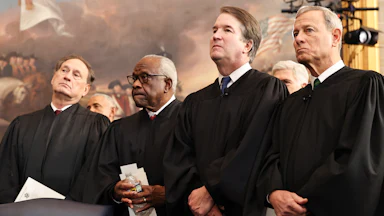
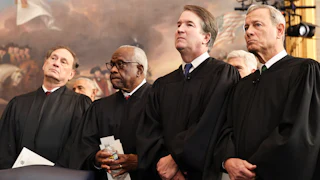
For over two decades, the Christian conservative legal movement, led by well-funded groups such as Alliance Defending Freedom and with help from the Roberts court, has transformed the idea of religious freedom. The era of “high separation” between church and state is over, and free exercise is a tool reserved primarily for conservative Christians. If the commission’s recommendations are implemented with the DOJ’s backing, they will be the next steps in this broader project. Religious liberty is a banner under which the administration and its allies will continue to undermine other civil rights, dismantle public goods, and insulate certain favored citizens from public accountability.
The commission’s report offers many legal and policy suggestions, but it also seeks a broader cultural shift. “Safeguarding religious liberty,” it claims, “requires more than defending legal rights after they have been violated. It requires cultivating a culture that understands why those rights exist in the first place.” This mission demands that Americans respect religious liberty and the rights it affords, but first they must celebrate and value religion itself.
The premise of the commission’s work is “a simple but profound truth: religious liberty is essential because religion itself is indispensable to a flourishing society.” In recent decades, high-profile cases have dramatized the conflict between individual religious freedom and the public good. The religious belief and speech of cake bakers, website designers, and licensed counselors—to refer to three Supreme Court cases in which ADF successfully sought exemption from or contested Colorado’s civil rights laws—come into conflict with the civil rights of others, particularly LGBTQ people. But, the commission argues, the “Founding Fathers recognized that religious liberty is not merely a private benefit for believers, but a public good for the nation.”
Here, they sidestep the fact that private benefits do in fact conflict with public goods—when business owners discriminate against their potential clients, when tax dollars are funneled to discriminatory private institutions and away from public schools, or when religious groups flout public health mandates during a pandemic—and instead assert that, because religion is ultimately good, religious liberty benefits everyone. If religion is “an essential aspect of what it means to be human,” as the report claims, then it follows that it would be privileged at least as much as, if not more than, other aspects of one’s humanity. Thus, those institutions that foster religion are not at odds with, or even really separate from, state institutions: Church and state should not be completely separate but, “in reality,” should “strengthen and support one another.” There is no wall between the two, the commission concludes, but a “bridge.”
The report is divided into 14 chapters, most of which are devoted to a particular issue or arena of public life. Chapter titles include “Students Don’t Check their Rights at the Schoolhouse Gate,” “The Rights and Roles of Parents and Teachers,” and “Anti-Semitism.” The content of each is drawn largely from the commission’s seven hearings held over the past year. These hearings primarily served as platforms for supposedly persecuted believers—each one a potential “religious freedom celebrity”—to offer testimonials, with occasional subject-area experts adding their analysis. Some were claimants in well-publicized disputes, including cases brought by conservative Christian legal organizations, such as ADF and First Liberty Institute, whose Kelly Shackelford and Allyson Ho are on the commission.
These anecdotes make up much of the report, the final recommendation of which is: “Honor the courage of religious liberty heroes through creating a Presidential Medal of Religious Liberty and First Freedom Hero Awards to recognize Americans who stand up for religious freedom and play an indispensable role in protecting citizens’ Constitutional rights.” Chapters conclude with pictures from the hearings of these heroes. It reads like a book of martyrs with policy recommendations.
The testimonies reveal their uses. Twelve-year-old Shea Encinas testified that in fifth grade, his “school forced [him] to teach [his] kindergarten buddy about changing his gender using a book called My Shadow Is Pink.” Shea did not refuse. However, his family “spoke up” afterward, and, according to Shea, “the school treated us badly and kids started bullying me and my brother because of our faith and the school did nothing to stop it.” The school did not offer an opt-out of certain readings. Later, the school hosted a “Pink Out the Hate” day, on which students would wear pink to show solidarity with LGBTQ students. According to Shea, he “felt like the entire school …[was] standing against me and ridiculing my beliefs.” When he arrived, he was dismayed to see that “over half the school wore pink. I felt completely alone.” Shea and his brother were ostracized, and the family “felt they had no choice” but to enroll in a private school.
Without discounting (or taking too seriously) Shea’s feelings, there is something poignant in stating so starkly that when he was not in the majority he “felt completely alone.” In the nation the commission hopes to create, Shea’s rights would not simply be protected; so too would his feelings. The commission wants Americans to be proud of religion, and of religious liberty. Perhaps even more than wanting to feel pride, they want some people not to feel shame. They want anti-sociality without consequent social stigma. As religious studies scholar Donovan Schaefer has written, for some conservatives, “it becomes easier to repudiate shame altogether than respond to the moral demands placed on them.”
Following this line of argument, religious studies scholar Finbarr Curtis explains, “Trumpism is the response to the fear that someone somewhere is threatening to take something that is rightfully yours. As a vigorous response to threats, Trump’s illiberalism makes his supporters feel safe.” The message of the commission’s report is that these threats abound, from vaccine mandates and “transgenderism” and “bad actors in the government and within institutions,” but the Department of Justice will protect you. There will be posters reminding everyone to “Know Your Rights.” Your teachers will undergo religious liberty training. If anyone does violate your rights or make you feel unsafe, there will be an online portal where you can report the threat. They will be investigated.
Even in this boom time for religious liberty, with religion’s stock going up, some claimants still lose their cases. In fact, the named claimant in Landor v. Louisiana Department of Corrections, the most recent religious freedom case at the Supreme Court, lost. And a landmark law—2000’s Religious Land Use and Institutionalized Persons Act, or RLUIPA—was significantly restricted. Naturally, it was a case that spelled out exactly who could expect to enjoy religious freedom and who should not.
Damon Landor, by all accounts a devout Rastafarian, did not cut his hair in keeping with his faith. When incarcerated, he explained and documented this practice. For a while, his religious rights were honored. When he was transferred to a new facility, he handed them his paperwork stating his religious exemption. Prison guards threw it in the trash and then held Landor down and shaved his head. He sued the prison officials in their individual capacity, which the court found was beyond the scope of RLUIPA. Justice Neil Gorsuch, writing for the majority, held that prison employees could not be sued here because they had not “voluntarily and knowingly consent[ed] to answer lawsuits” under RLUIPA. As lawyer and legal scholar Elizabeth Reiner Platt noted, this is a standard that “employees are unlikely to agree to.” Why would they?
The Religious Liberty Commission’s report—in a draft issued three days after the Landor decision—says DOJ “should issue updated guidance on how [RLUIPA] provides incarcerated individual with the right to receive reasonable religious accommodations while incarcerated.” To what end? With what effect? Justice Ketanji Brown Jackson wrote in her Landor dissent that “state-empowered prison officials will have little incentive to abide by federal law.” It is hard to imagine that DOJ will effectively cultivate a culture of respect for religion and religious liberty in a case like this. Will prisons hang “Know Your Rights” posters in common spaces? Will wardens undergo religious liberty trainings that would prevent such an incident? Will incarcerated persons call the hotline? The recommendations seem to be for Shea Encinas and his parents more than Damon Landor.
Some critics, such as Sarah Posner, a journalist and expert on the Christian right, have called the commission’s report “an homage to Christian nationalism.” As Posner notes, a multi-religious coalition legally challenged the commission, based on its nearly entirely Christian composition and clearly biased framing. Skye Perryman, president and CEO of Democracy Forward, said that the commission is “not about religious liberty, it is about pursuing a culture of Christian Nationalism that seeks to divide and isolate people across our nation.”
The Public Religion Research Institute has found that 11 percent of Americans are “adherents” to Christian nationalist ideas and 21 percent are “sympathizers.” Christian nationalism is correlated with support for religion in general and “Judeo-Christian values.” In a 2021 poll on religious liberty, PRRI found that 10 percent of Americans completely agree and 21 percent somewhat agree with the statement, “In the U.S., when there is a conflict, the rights and religious freedom of Christians have priority over the rights and religious freedom of non-Christians and non-religious Americans.” Perhaps this is the “culture of Christian Nationalism” of which Perryman warns. About a third of Americans, then, support some kinds of favorable treatment for Christians. It is reasonable to think that the hotlines are for them—or, at least, that they’ll be frequent users.
While Christian nationalist ideology might be a factor, the Religious Liberty Commission is better understood as a right-wing project. If its goal is to install Christian supremacy, it is only as a route to empower private actors to subvert the public good. It seeks to exempt certain people—Christians, yes, but more importantly conservatives—from public accountability, and from feeling bad about abridging the civil rights of disfavored groups. It advocates siphoning funds from public schools and rerouting them toward private institutions, or “creating a robust system of universal school choice” and “securing parental rights.” It encourages citizens to surveil and report, rather than tolerate, their neighbors. It recommends that DOJ “develop a dedicated Religious Liberty Task Force,” whose tasks would include issuing cease-and-desist letters to public school districts with trans-inclusive policies. It seeks to create a culture of fear and suspicion and, in so doing, alleviate the fears of anti-pluralists, their feelings of loneliness, exclusion, and shame. Throughout, the message is clear: Get religion. If you don’t, the commission suggests, it just doesn’t seem to work out, does it?