Life in a Warming World
A weekly reckoning with our heated planet—and the fight to save it

A Glimpse of Our Grief-Addled Future

A college reunion becomes a climate bereavement group.

MARK FELIX/AFP/Getty Images
A firefighter in Bourg, Louisiana, during Hurricane Ida in 2021

I took a trip last week to meet up with some old college friends. We live all around the country, so we’d chosen New Orleans as our meeting place. One of my friends went to medical school there, and he and his partner could drive there from their home in Houston—with a 6-month-old baby I was aching to meet.

Spending time with old friends at this stage of life always feels like an exercise in accepting differences, from new babies to new marriages to new houses to new cities. But what I thought might be a relaxing weekend with people I love best turned into a shared revelation about the one thing we have in common: how climate change is inextricably altering the landscapes around us, regardless of where we live.

On Friday morning, while we were walking through New Orleans to get breakfast, I began getting frantic texts from my girlfriend back in New York, who had tried to walk the dog and was immediately caught in an intense downpour. I scrolled social media, trying to learn what I could about the storm, and saw footage of people wading through streets in my neighborhood and water streaming through cracks in the walls at my subway stop. All told, more than seven inches of rain fell in Brooklyn, my borough, over a single day, and six people had to be rescued from their basement homes.

As I frantically kept up with the storm from hundreds of miles away, I learned that my friends, despite living in the path of hurricanes themselves, didn’t know that Hurricane Ida, which tore through New Orleans in 2021, also swept through New York a week later. That storm killed almost a dozen people, who were trapped in their basement apartments and drowned. It flooded in New York during Ida too? they asked, incredulous. That many people died?

That night, after the rains at home had stopped, we met up with some friends who still live in New Orleans. We were sitting at a bar in the Mid-City district, a little over a mile away from Bayou St. John, a waterway that snakes through the center of the city. A couple blocks away, a handmade commemorative marker showed the chest-high levels the water had reached in that neighborhood during Hurricane Katrina.

This couple, who have two babies around the same age as my friends’ daughter, told us about their latest environmental worry living in New Orleans. Because the Mississippi River’s water levels have been so low this summer, thanks to widespread drought, and sea level rise on the Louisiana coast so pronounced, salt water is slowly creeping up the river toward the city. The salt water is going to ruin drinking water and corrode people’s appliances and pipes. They’ve only got another couple of weeks until it hits.

What are people living here supposed to do about it? I asked. They weren’t sure. The government is working on stopgap solutions—the president declared a state of emergency last week, and the Army Corps of Engineers is installing a levee and expensive desalination machines. But those temporary fixes aren’t going to address the whole problem. Maybe they’d find a way to get out of town until a big rain upriver can flush the salt water back out to sea.

Another friend chimed in with similar news about Colorado: In a region at the southeastern edge of the state, the aquifers have been so overpumped that arsenic is leaking into the drinking water. This friend had moved to Colorado just before the pandemic, and she was one of my first texts when the wildfire smoke hit New York City in June and made our air unbreathable. You don’t realize how oppressive and scary wildfire season is, she told me, until you get to a place where it happens all the time.

What do we do about this? my friends asked me, the climate reporter. The answer isn’t particularly satisfactory. If you don’t control a massive amount of wealth invested in fossil fuels, or a huge oil company that you can suddenly shut down, your personal carbon footprint doesn’t mean much; the best course of action is to get involved in local politics, to formulate plans to keep each other safe, and to draw down carbon emissions as much as possible. But the simple, harsh truth is that even the most aggressive policies in your city won’t substantially change the way the earth seems to be revolting under our feet (and over our heads).

There at the bar, looking at the babies in front of me, I felt the ecological despair that was ever-present during the hottest summer on record. But I also felt a weird solidarity too—a small, neurotic comfort that I wasn’t alone in watching my environs change in terrifying ways. We’re experiencing this horror together, and trying to figure out a way through it.

When we said goodbye, I asked the folks in New Orleans to keep me posted on whatever they decide to do about the salt water. And I made plans to visit my friends in Houston in the winter, when we could go outside with the baby. We’d realized during the trip that because temperatures in the city were dangerously hot this summer, our weekend walking around New Orleans—in gorgeous fall weather, with light breezes and surprisingly low humidity—was the longest stretch of time their daughter had spent outside. This little baby, whom I’d immediately fallen in love with, has had to live most of her life thus far indoors.

Good News, Bad News

The World Bank said last week that it would increase its lending to developing countries to fight climate change by $100 billion over the next 10 years.

More than 100 Amazonian river dolphins were found dead in the past week, after water temperatures in the Brazilian Amazon topped 102 degrees in some places.

Stat of the Week

6.7–13.9 pieces per liter

That’s the concentration of microplastic found in cloud water gathered from mist at the peaks of Mount Fuji and Mount Oyama, according to a recently published study—the first piece of research on the presence of microplastics in clouds.

Elsewhere in the Ecosystem

The Texas Tribune skillfully covers how flooding and rains—coupled with inadequate government response for residents harmed by storms—has all but decimated a small town in Texas.

Decades ago, there were as many as 100 occupied homes in Sam Houston Lake Estates, a densely-wooded neighborhood about 60 miles northeast of Houston. Today there are fewer than a dozen, according to interviews with locals.

Water hasn’t flowed to the homes in this neighborhood in more than three years—the water company says it can’t get vehicles in to maintain its well—and first responders won’t attempt to navigate the neighborhood’s narrow bridge and eroded dirt roads.

When someone is sick or injured, residents have to drive, or carry, their neighbors out of the woods to reach medical help.

This river bottom flooded often in the past, former residents said, but not like it has in the last decade. Climate change has likely intensified flooding and accelerated erosion, experts said.

Read Erin Douglas’s full piece at the Texas Tribune.

This article first appeared in Life in a Warming World, a weekly TNR newsletter authored by contributing deputy editor Molly Taft. Sign up here.

Will Mainers Take Their Power Into Their Own Hands?

Maine voters could set a model for other areas of the country to follow with a rare hostile takeover of the electric powers that be.

Portland Press Herald/Getty Images
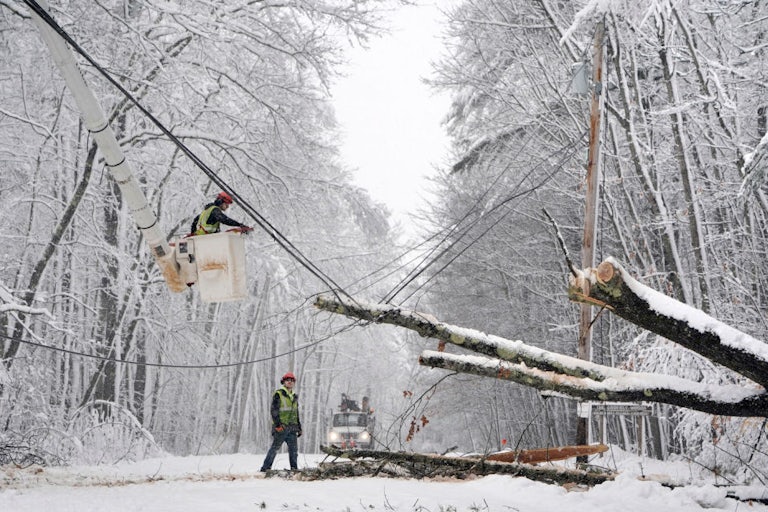
Workers removing a tree from power lines in South Berwick, Maine, in March 2018

While we may grumble about our electric bill, most of us take the idea of paying the costs of electricity to a specific power company each month as a given. But what if you could fire the utilities that are responsible for keeping your lights on if they do a bad job—or if they aren’t prioritizing climate change?

In November, Mainers will vote on a ballot initiative that could substantially change who controls their power—literally. If a majority of Mainers vote “yes” on Question 3, they would be able to replace Central Maine Power, or CMP, and Versant, two companies that supply more than 96 percent of Maine’s electric customers, with a new publicly owned power company. It would be a rare hostile takeover of the electric powers that be, which could set a model for other areas of the country to follow.

The campaign to replace CMP and Versant is being run by a grassroots group called Our Power. For years, Mainers have complained about outage and customer service issues from both of their big utilities. The new company, which would be named Pine Tree Power, would “bring back local control, save money, and reduce outages,” all while speeding the transition to cleaner energy.

Versant and CMP are what’s known as investor-owned utilities: for-profit companies that are given monopolies by the state to provide power to certain areas. More than 70 percent of the country gets its power from investor-owned utilities. But this model, said Joshua Macey, an assistant professor at the University of Chicago Law School who focuses on energy policy, is a relatively recent invention from the late 1800s that took off as the use of electricity was becoming more widespread and the companies profiting off it wanted to maintain control.

According to the rules of their state-given franchises, investor-owned utilities can’t earn money on the energy they provide to consumers. They’re only allowed to make a profit on building new infrastructure—which creates an incentive for utilities to go buck wild in building lots of new pipelines or a truckload of new peaker plants. By comparison, a switch to lower-emissions forms of power or incorporating efficiency upgrades to existing infrastructure only benefits the consumers served by the utilities, not the shareholders; the financial impetus to do those things, therefore, is nonexistent.

“It doesn’t really make sense for utilities to operate as for-profit companies,” Macey said.

Utilities are powerful industries in the United States—and, understandably, the owners of Maine’s utilities are stressed out about the potential changes Question 3 poses. The ballot has kicked off an enormous flood of cash in the state. In June, Floodlight and the Portland Press Herald reported that organizations funded by Avangrid and CMP’s parent companies had already spent $16.5 million on fighting Question 3—about 17 times what the ballot’s proponents have spent.

Macey said that even if the ballot initiative succeeds, the utilities will almost certainly sue, kicking off a lengthy legal process that will drag on for at least a few years. And even if courts and regulators allow the initiative to move forward, there are still aspects that are up in the air.

“It’s very exciting, but it’s a little scary to be in Maine, because they have to work out the details,” Macey said.

While Our Power’s website paints a rosy picture of what will happen if Maine ditches its for-profit power, non–investor owned utilities aren’t a total panacea to everyone’s problems. Utilities have an enormous role to play in balancing the energy transition with consumer bills—a massively complex job that doesn’t necessarily get easier when those utilities aren’t controlled by for-profit companies. The nation’s biggest public power company, the Tennessee Valley Authority, has stubbornly held onto coal-fired power for years and has largely dismissed renewable energy options for replacing some of that dirty energy.

Still, what’s going on in Maine presents an exciting new possibility for the rest of the country. The utility industry has spent massive amounts of money to ensure that it keeps control of its monopolies and the resulting profits from the American electric system—including fighting against climate action that it sees as costly to its business model. Even if Question 3 fails, it’s a powerful reminder that municipal takeover was once a common concept for how governments would rein in utilities that weren’t adequately serving their customers.

“Investor-owned utilities are given an enormously valuable gift by the government,” Macey said. “Dealing with the specific cost of transitioning away from an investor-owned model may be enormously hard. But I think, despite that, it is really important to note that utilities don’t have a license to keep having ballooning costs, failing on their environmental mandates, and failing to meet their reliability obligations.”

Good News, Bad News

The path to keep warming below 1.5 degrees Celsius (2.7 degrees Fahrenheit) is getting narrower—but there’s still a chance we could get there with aggressive action by 2030, a new report from the International Energy Agency finds.

Domestic oil production in the U.S. will reach a record new high over the next few months.

Stat of the Week

34,000

That’s the number of homes, businesses, and other structures projected to be destroyed each year by wildfires supercharged by climate change by the mid-2050s, a new report finds—double the current number.

Elsewhere in the Ecosystem

Hydropower is a major source of fossil fuel–free energy in the Western U.S. But the dams that make hydropower possible have also destroyed valuable rivers and ecosystems, sparking a complex debate in the region about the future of these dams, the Los Angeles Times reports:

Almost everybody wants to protect salmon. Here’s the challenge.

Even if every Western dam stays in place, we’ll need to build a mind-boggling number of solar fields, wind turbines, lithium-ion batteries and long-distance electric lines to break our fossil fuel addiction—and fast. That’s going to be tough, even after the landmark climate bill signed by President Biden last year. Already, opposition to renewable power infrastructure is bubbling up from rural communities, conservationists and tribes as ever-larger stretches of land are eyed by energy developers.

Start tearing down dams, and the energy transformation gets even harder. In a typical year, hydropower plants generate around 6 percent or 7 percent of U.S. electricity. The lower that number gets, the more sprawling solar and wind farms we’ll need to build.

Read Sammy Roth’s full piece at the Los Angeles Times.

This article first appeared in Life in a Warming World, a weekly TNR newsletter authored by contributing deputy editor Molly Taft. Sign up here.
This article has been updated to correct the forms the new utility may take. The previous version of this piece stated that the new utility could be an agency or a cooperative, but neither of those forms are possibilities according to the language of the ballot initiative.

For The Wall Street Journal, the Climate Call is Coming From Inside the House

When will the Journal’s editorial board wake up to reality?

Robert Nickelsberg/Getty Images

Last week, The Wall Street Journal published a bombshell investigation into ExxonMobil’s internal strategy to downplay the role of fossil fuels in causing climate change. The investigation offers shocking details of how Exxon executives worked behind closed doors to push narratives that would help them drill more oil; funded “science to support [their] business” as the consensus around man-made global warming grew; and adopted ludicrous tactics such as trying to influence the U.N. Intergovernmental Panel on Climate Change, the world’s leading scientific body, after the group published a report sounding the alarm.

We’ve known for several years that Exxon has spent the past few decades working to suppress climate science and mislead the public. The Journal’s investigation takes what we already knew about the oil company’s deceit one step further, using newly unveiled documents to show how Exxon continued to perpetuate climate denial well into the 2010s—even as it was making public statements acknowledging climate science and in support of the Paris Agreement. In addition, the period covered by the Journal’s reporting includes the time when the company was under the control of Rex Tillerson, later Trump’s secretary of state.

“The documents reviewed by the Journal, which haven’t been previously reported … show that Tillerson, as well as some of Exxon’s board directors and other top executives, sought to cast doubt on the severity of climate change’s impacts,” reporters Christopher Matthews and Collin Eaton wrote. “Exxon scientists supported research that questioned the findings of mainstream climate science, even after the company said it would stop funding think tanks and others that promoted climate-change denial.” Damning stuff!

For a blockbuster investigation like this, a big media outlet will often pull in reinforcements from its various sections to help promote it or add context. But while the Journal did run a companion podcast on the Exxon investigation, its editorial board and op-ed section stayed completely silent on the bombshell. The editorial board did, however, run a piece last Sunday that fearmongered about the Securities and Exchange Commission working with the “climate lobby” to give “trial lawyers ammunition to attack business” with the agency’s proposed climate disclosure law. That’s not terribly surprising: The Journal’s opinion section, after all, decided to spend the hottest summer in recorded history publishing misleading pieces on climate change and wildfires and railing against efforts to encourage people to bike more. (The editorial board published no pieces on the record-breaking heat the entire country felt this summer—I checked.)

As with the Exxon investigation, the disconnect between The Wall Street Journal’s reporting side and its opinion department isn’t exactly news. The Journal’s opinion section has long been a bastion for some of the most stubbornly immovable—and increasingly absurd—climate denial in news media. It routinely publishes notable players from the climate-denier ranks. Its editorial board has a history of denying basic climate science. It once ran an attack on the science around sea level rise that was so full of scientific errors that a professor of earth science said that if the author was one of his students, he would have failed. Rhode Island Senator Sheldon Whitehouse even gave a speech on the floor of the Senate in 2018 about just how shitty the paper is on this topic.

The Journal’s former owner, Rupert Murdoch, who stepped down from his position this week, is one of the great platformers of conservative talking points—and climate denial—through the various outlets of his media dynasty; the paper is reportedly his first read of the morning, and its editorial board is widely seen as being able to tip the scales of the mainstream Republican Party on various candidates and issues. But the Journal has also faced blowback from its own reporters over content published in its editorial pages, since the newsroom sent a letter to leadership in 2020 complaining about the lack of fact-checking in its op-ed section. As the world gets hotter and hotter, the gulf between the world of the Journal’s venerable opinion staff—where the science around climate change is hogwash, where a delirious “climate lobby” is trying to usurp capitalism, where we should all just shut up and drill more oil—and the stories its decorated newsroom is actually reporting may only grow.

Ironically, the Journal’s investigation was based on a huge trove of documents that Exxon was forced to turn over to New York’s attorney general for its investigation of the company in 2015; that suit, as well as subsequent climate lawsuits, became a favorite punching bag for the editorial board. Over the weekend, California filed a massive lawsuit against several oil companies, and NPR reported that the state is likely to use the documents uncovered by the Journal in court. The so-called “climate lobby” that’s given “trial lawyers ammunition to attack business” that the editorial board is so so up in arms about may wind up simply being the paper’s own reporters, doing good work in its own newsroom.

Good News, Bad News

Tens of thousands of activists turned out on Sunday in New York to march to demand that the Biden administration end U.S. reliance on fossil fuels.

U.K. Prime Minister Rishi Sunak will walk back or delay some of the country’s climate policies, he said in a speech Wednesday, claiming the moves will save consumers money.

Stat of the Week

50x

That’s how much more likely climate change made the devastating floods in Libya earlier this month that killed thousands of people, a new study has found.

Elsewhere in the Ecosystem

The Sierra Club has had a rocky road with its approach to racial equity in the wake of the hiring of its first Black leader, The Washington Post reports:

Today, the 131-year-old group is in turmoil over its approach to diversity, equity and environmental justice, according to interviews with 12 current and former staffers, most of whom spoke to The Washington Post on the condition of anonymity for fear of facing retaliation or otherwise harming their job prospects. The tumult illustrates the challenges top environmental groups face in trying to diversify their staffs, despite their recent efforts to reckon with the conservation movement’s legacy of racism. After coming under scrutiny for not doing enough to promote employees of color and fight pollution that disproportionately hurts minority communities, even organizations that have shifted course find themselves embroiled in fights over how to address past wrongs and ensure equity.

Read Maxine Joselow’s full piece at The Washington Post.

This article first appeared in Life in a Warming World, a weekly TNR newsletter authored by contributing deputy editor Molly Taft. Sign up here.

The Headwinds Facing Offshore Wind Farms

What’s the big holdup?

Drew Angerer/Getty
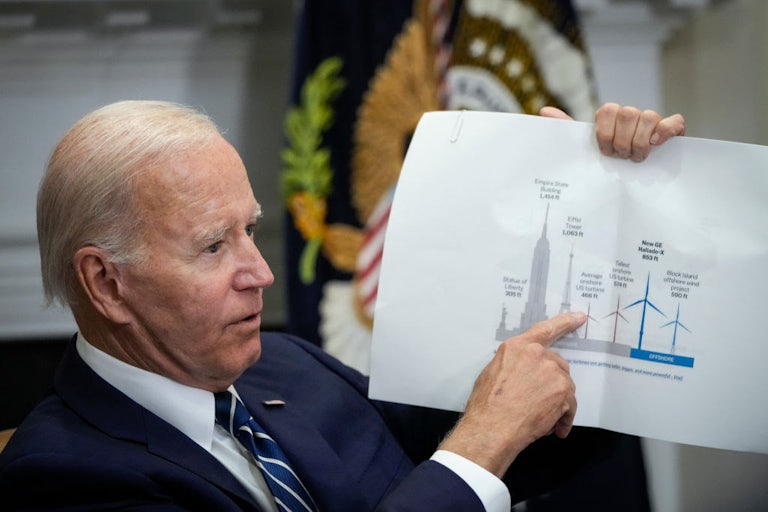
President Joe Biden with a wind-turbine size comparison chart.

Last week, the Biden administration held the nation’s first ever offshore wind auction in the Gulf of Mexico. It described the sale in a press release as part of its “once-in-a-generation investment in America’s infrastructure and our clean energy future,” with the potential to power around 1.3 million homes with clean energy. A significant sale could have signaled a shift away from fossil fuels for the oil- and gas-intensive Gulf region, but it was far from a runaway success: Only two companies bid for the leases on offer.  

The sale isn’t the only sign of trouble for the U.S. offshore wind industry—and some major players are flagging problems to come. Following a summer of canceled projects from various companies, Danish offshore wind giant Orsted said in an interview with Bloomberg on Tuesday that it needed more help from the U.S. government if it was going to move forward with its U.S. projects. “We are still upholding a real option to walk away,” CEO Mads Nipper told the outlet. 

The Biden administration has made kick-starting the U.S. offshore wind industry a core part of its climate agenda, while also hoping to make it a cornerstone of Biden’s plans to invest in manufacturing jobs. It set an ambitious goal of installing enough offshore wind energy to power 10 million homes by the end of the decade. But despite record investments and government incentives, some serious headwinds (pardon the pun) are facing the industry. From the hard financial realities of building capital-intensive infrastructure projects to serious fossil fuel–funded political opposition, there’s a rocky road ahead for offshore wind over the coming years—no matter how much support or incentives the Biden administration throws at it.

When climate people talk about the renewable energy transition, they tend to wax poetic about the continually plummeting costs of wind and solar. That holds true for wind on land but is not the case for its offshore component. Siting and construction for offshore wind turbines is, unsurprisingly, much more expensive than for onshore wind; some estimates place the price tag for a kilowatt-hour of energy produced by offshore wind almost five times as high as that same kilowatt-hour produced onshore. There’s a lot of labor and time involved in installing skyscraper-size turbines miles off the coast. While onshore wind has had a steady foothold in the United States for decades, there are only two offshore wind farms currently operating in the U.S., off the coast of Virginia and Rhode Island. Many of the proposed projects are having to start from scratch in figuring out manufacturing and labor. 

When you add the high price of materials like steel, things get even trickier. Because they don’t face many of the siting regulations that affect onshore turbines, individual offshore turbines can be designed much larger than their onshore counterparts in order to capture more power. These turbines are only projected to grow bigger over the coming decades. That’s great news for the grid but means higher installation costs up front. 

Many of these problems are not unique to the offshore wind industry; with high worldwide prices for raw materials and labor, plus sky-high interest rates in the U.S., it’s not exactly a great time for huge infrastructure projects in general. As Bloomberg’s Liam Denning wrote last monthoffshore wind has a lot more in common with the nuclear industry than it does with its onshore counterpart in terms of big, lengthy projects with a lot of upfront costs—and is similarly going to have to rely on the government to get a lot of its farms across the finish line.  

For capital- and time-intensive industries like offshore wind and nuclear, the political support of a presidential administration can make or break projects. In the U.S., the Trump administration’s antagonistic attitude toward renewable energy created several roadblocks and additional lag times for offshore wind, including, ironically, a last-minute environmental review for already-delayed projects in the Atlantic Ocean. All the Biden administration’s encouragement and tax incentives can’t make up for lost time. (Some developers are flagging that certain requirements in the Inflation Reduction Act—including, notably, that turbines be made in the U.S. and sited in specific communities—are making it more difficult to access those incentives.)

And unlike nuclear, which has seen a dramatic surge in support from the center and right wing in recent years, offshore wind is currently the target of a massive misinformation campaign. Since Biden took office and projects around the country have begun to move forward, right-wing groups—many funded by fossil fuel interests—have mobilized grassroots opposition (or created it wholesale) along the Atlantic coast, professing concern for offshore wind’s impact on wildlife. In places like New Jersey, offshore wind developers are facing lawsuits from these astroturf groups that are tangling up the process.

Even if offshore wind companies manage to weather the industry’s financial troubles and handle these lawsuits, this political opposition isn’t something to be ignored. The GOP is learning to more creatively campaign against climate action and figuring out different ways to boost fossil fuels when it’s not in power. As we saw with the Trump administration, much of the American clean energy project is a long game, requiring years of encouragement and incentives; the most enthusiastic, pro–climate action administration in the world can’t play catch-up if we go back to square one every election cycle.

Good News, Bad News

A Memphis-area plant that uses carcinogens to sterilize medical equipment will shut down following years of activism from community members living around it.

An entire town in Louisiana was forced to evacuate last week as part of Louisiana’s “unprecedented” summer of wildfires—August alone saw 441 fires. 

Stat of the Week

25%

That’s how much climate change has increased the risk of wildfires in California, a new study shows.

Elsewhere in the Ecosystem

Climate change came for Burning Man this year—but last year, its organizers helped stop a geothermal energy project in the desert where the festival is held, Grist reports

The Burning Man Project, the lead plaintiff in the lawsuit, also worked with residents of the tiny town of Gerlach, the hamlet closest to the geothermal development, to appeal the [Bureau of Land Management]’s decision. The wells, the organization said, would “threaten the viability” of Burning Man’s various projects in Nevada by potentially jeopardizing local hot springs in the area and disrupting the desert ecosystem. The plaintiffs argued that BLM had approved the project without adequate environmental review and hadn’t sufficiently consulted local communities, including the Summit Lake Paiute Tribe, in its permitting process. 

“People travel to Gerlach to experience the solitude of the vast open spaces and undeveloped vistas present in the Black Rock Desert,” the lawsuit said, “as well as to attend numerous events and to pursue a variety of recreation experiences in the undeveloped desert.” …

The claim that the region remains relatively undisturbed, given the 70,000-person party that rolls in every year, rang particularly hollow.

“Some of the hype around Gerlach has been disturbing from a scientific point of view,” James Faulds, Nevada’s State Geologist, told Grist. “The Gerlach area has already been disturbed by man.”

Read Zoya Teirstein’s full piece at Grist.

This article first appeared in Life in a Warming World, a weekly TNR newsletter authored by contributing deputy editor Molly Taft. Sign up here.

Vivek Ramaswamy Is Teaching the GOP to Weaponize Climate

The candidate is demonstrating a new way of Republican campaigning: with climate change front and center.

Bloomberg/Getty
Vivek Ramaswamy during Fox News’ Republican primary presidential debate

On the debate stage in Milwaukee last week, the eight Republican candidates in attendance got a surprising question from the moderators: Do you believe in human-caused climate change? Only Vivek Ramaswamy, the 38-year-old former pharmaceutical executive who has seen a surprising spike in polling over the summer, seemed to have a sound bite ready.

“The climate change agenda is a hoax,” he said. “The reality is more people are dying of bad climate change policies than they are of actual climate change.”

Ramaswamy’s answer didn’t come out of left field. Demonizing climate policy has been central to his campaign from the start. Ramaswamy represents a new, and worrying, evolution of Republican campaigning in an age of increasingly hot summers, boiling oceans, and devastating wildfires: Rather than ignoring climate change or dismissing its science as unsettled, he’s weaponizing it as an issue, turning climate policy into a culture-war villain. Given his recent rise in popularity, it’s past time for those concerned about the future of the planet to start scrutinizing what he’s doing.

The GOP’s response to climate change has been historically shaped by one of its favorite donors: the fossil fuel industry. Before the late 2000s, major party figures like George W. Bush and John McCain professed concern about climate change. The GOP’s commitment to climate denial really took off after 2008, when oil interests began to marshal opposition to a proposed cap-and-trade tax on carbon emissions—the first, and one of the only, major efforts to pass climate legislation in the United States. Accordingly, opposition to climate action from GOP politicians in subsequent years has mimicked the pattern set by decades of fossil fuel denial from these same oil companies: Question the validity and certainty of climate science to delay meaningful action, and distract voters with other tactics and issues.

For the next 15 years, it was this oil-inspired anti-science rhetoric—coupled with accusations that Democrats’ favored climate policies would destroy fossil fuel jobs—that dominated Republicans’ rhetoric about climate change. As a result, climate change was rarely the focus of a Republican candidacy or presidency but a sideshow to be dealt with quietly: something that a Democratic opponent or a TV anchor might bring up that could be hand-waved with a claim that the science was not yet settled. Even Donald Trump, who made various (muddled) statements about climate change being a hoax and pandered heavily to coal miners on the campaign trail, never really made it a major talking point. He left the real work to be done by cronies like EPA chief Scott Pruitt, who used his scant media appearances to consistently (and falsely) cast doubt on climate science.

A few things have changed in recent years that have set the stage for a new kind of GOP candidate like Ramaswamy, who deliberately puts climate at the center of his campaign. Thanks in large part to the Inflation Reduction Act and other Biden administration policies, climate policy is now baked into federal legislation in ways it wasn’t before, giving the GOP much more fodder to push back on. Republicans also have been hard at work fanning the flames of various culture wars in recent years—including anti–environmental, social, and governance, or ESG, investment sentiment, which has rapidly become a top Republican bugaboo. The rise of QAnon-fueled conspiracy theories and candidates have made pinning various issues on a conspiracy of “elites”—as Ramaswamy does with climate—much more acceptable in mainstream political discourse. Last, climate change has simply become much harder to ignore and is shaping up to possibly become a wedge issue with future generations: The only audience question posed at the Republican debate came from a student who noted polling that shows climate change is one of young people’s top concerns.

These conditions are ripe for a candidate like Ramaswamy. Before he decided to run for president, Ramaswamy had created a name for himself as an anti-ESG campaigner, authoring a book railing against the “modern woke-industrial complex.” The evils of diversity, equity, and inclusion, in his rhetoric, are inseparable from climate action. “End the climate cult” has been a consistent talking point from the beginning of his campaign. “The Left’s commandments: Race, Gender, Sexuality, Climate,” Ramaswamy posted on X earlier this month. “We can’t just be against their vision. We must offer our own: God. Nation. Family. Individual.” It’s a nonsense statement—he’s just naming universal concepts, not actual commandments like, say, Thou shalt not destroy our only planet. But if Ramaswamy’s polling numbers are any indication, this kind of nonsense seems to be working.

Good News, Bad News

“Tiny forests”—trees and foliage planted on little lots—are increasing in popularity in the U.S., and can sequester a surprising amount of carbon while being extremely easy to maintain.

Scientists estimate that more than 9,000 emperor penguin chicks died last year in Antarctica thanks to unprecedentedly low levels of sea ice—a worrying number for an endangered species facing consistent habitat loss.

Stat of the Week

91.2°F

That’s the temperature taken in the ocean off the Florida Keys on Monday—an unusually warm reading. Warm oceans helped strengthen Hurricane Idalia, which made landfall as a Category 3 storm on Wednesday.

Elsewhere in the Ecosystem

A book could literally kill you. That’s what mycologists are warning the public about as booksellers like Amazon offer mushroom-foraging books likely written by artificial intelligence, not humans, 404 Media reports:

Amazon has an AI-generated books problem that’s been documented by journalists for months. Many of these books are obviously gibberish designed to make money. But experts say that AI-generated foraging books, specifically, could actually kill people if they eat the wrong mushroom because a guidebook written by an AI prompt said it was safe.…

“There are hundreds of poisonous fungi in North America and several that are deadly,” Sigrid Jakob, president of the New York Mycological Society, told me in an email. “They can look similar to popular edible species. A poor description in a book can mislead someone to eat a poisonous mushroom.”

Read Samantha Cole’s full piece at 404 Media.

This article first appeared in Life in a Warming World, a weekly TNR newsletter authored by contributing deputy editor Molly Taft. Sign up here.