Breaking News
Breaking News
from Washington and beyond

Supreme Court Shockingly Sides With Biden on Social Media Disinfo

In a stunning decision on Murthy v. Missouri, the Supreme Court sided with Biden in a dispute with conservative states.

Supreme Court
Andrew Harnik/Getty Images

The Supreme Court delivered a surprising opinion on Wednesday, siding with the Biden administration and giving a kick in the face to conspiracy theorists and purveyors of disinformation.

Missouri, Louisiana, and five social media users sued U.S. Surgeon General Vivek Murthy arguing that the government’s efforts to combat anti-vax and election disinformation in conjunction with social media platforms suppressed their freedom of speech and caused them harm.

The case, Murthy v. Missouri, argued that the Biden administration violated people’s First Amendment rights by communicating with social media companies about enforcing against covid and election-related disinformation. The crux of the argument was that a social media platform’s moderation actions, if enacted after being given recommendations by the federal government to do so, effectively become actions taken by the government via those platforms.

The case also argued that removing content that violates a platform’s content policies against disinformation causes harm to those spewing it and those wanting to bathe in the spew. The Supreme Court, in a 6-3 vote, found the plaintiff’s complaints lacked standing, reversing the opinion delivered by the Fifth Circuit. The Supreme Court ruled that the plaintiffs failed to produce any tangible harm (egos don’t count) from the government communicating with social media companies to moderate a firehose of garbage spewing out from conservative quacks.

“Attempting to satisfy this requirement, the plaintiffs emphasize that hearing unfettered speech…on social media is critical to their work as scientists, pundits, and activists,” Justice Amy Coney-Barrett wrote for the majority. “But they do not point to any specific instance of content moderation that caused them identifiable harm. They have therefore failed to establish an injury that is sufficiently “concrete and particularized.”

Flag-loving conservative justice Samuel Alito led in the dissent, joined by his fellow corrupt conservative Clarence Thomas and not-yet-corrupted Neil Gorsuch. Alito describes conspiracy-addled mouthpieces spewing Covid-19 disinformation as rebellious luminaries who “simply wanted to speak out on a question of the utmost public importance” and describes the case as “one of the most important free speech cases to reach this Court in years” where content moderation against anti-vax disinformation poses a grave threat to the “marketplace of ideas.”

Alito’s entire dissent is riddled with brainwormed chaos, claiming newspapers are able to publish whatever they want because they aren’t “subject to the First Amendment” (which is extremely not true) and that the government communicating with social media companies to take action against content that violates their own policies is “coercion.” Alito’s unbeatable dramatics go a step further as he claims that the majority opinion on the decision represents “the successful campaign of coercion in this case to stand as an attractive model for future officials who want to control what the people say, hear, and think.” Phew.

This story has been updated.
Trump-Backed Candidates Flop Big-Time in Several Republican Primaries

Call it the Trump effect.

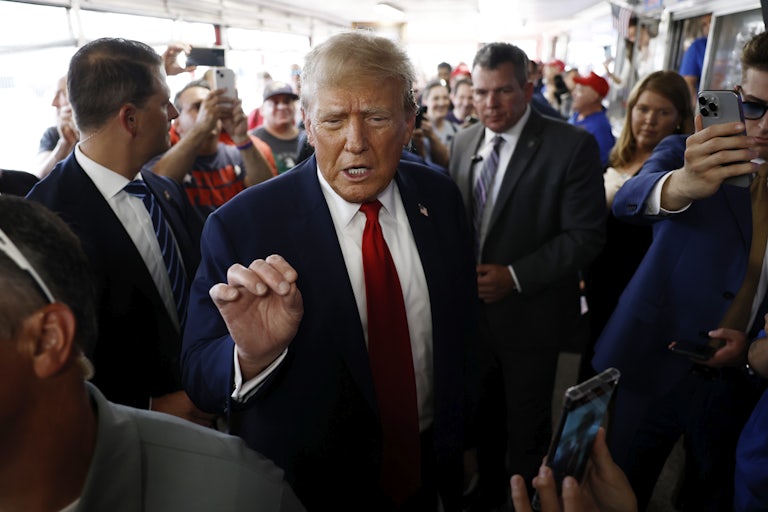
Donald Trump speaks in a crowd, eyes narrowed and making a hand gesture
Joe Raedle/Getty Images

Trump’s anti-Midas touch showed up strong on Tuesday, as three Trump-endorsed candidates lost bigly in their primaries in Utah, Colorado, and South Carolina. The 0 for 3 showing suggests that even in an election year where Trump is the presumptive Republican nominee, his endorsement is about as valuable as a Beanie Baby with its tag cut off.

In Utah, Trump had endorsed Riverton Mayor Trent Staggs to replace Senator Mitt Romney, despite polls showing Staggs’s victory was a total long shot. Trump’s stain of approval arrived just days before the primary, and Staggs ultimately received 30 percent of the vote—a big bump from previous polling data but certainly not a close race. Staggs’s winning competitor, moderate Republican Representative John Curtis, is heavily favored to win in November.

Conservative activist Jeff Crank also beat out Dave Williams in Colorado’s 5th congressional district. Trump had endorsed Williams, the state’s Republican Party chair and former state representative who earlier this month called for people to burn Pride flags and is under Federal Election Commission investigation for claims he used Republican Party money to fund his dead-in-the-water campaign. Instead of Pride flags burning this month, it was Williams’s campaign that was burned to a crisp: Crank ate Williams for lunch, pulling in 68 percent of the vote.

Trump had endorsed televangelist preacher Mark Burns in South Carolina’s 3rd congressional district against Air National Guard Lieutenant Colonel and board-certified nurse practitioner Sheri Biggs. Burns and Biggs battled it out in a runoff after each candidate pulled in 50 percent of the vote in their initial primaries. Burns had fashioned himself in Trump’s image, largely basing his campaign around repeating generic Trump talking points and claiming to be Trump’s pastor. Biggs, meanwhile, ran a conservative campaign that also aligns with Trump’s platform but adopted a less robotic tone. Turns out being a human still matters for conservative voters, as Biggs won the primary runoff 51 percent to Burns’s 49 percent.

Watch: Trump Appears to Short-Circuit During Interview

The former president was silent for an awkwardly long time while mocking Joe Biden’s performance.

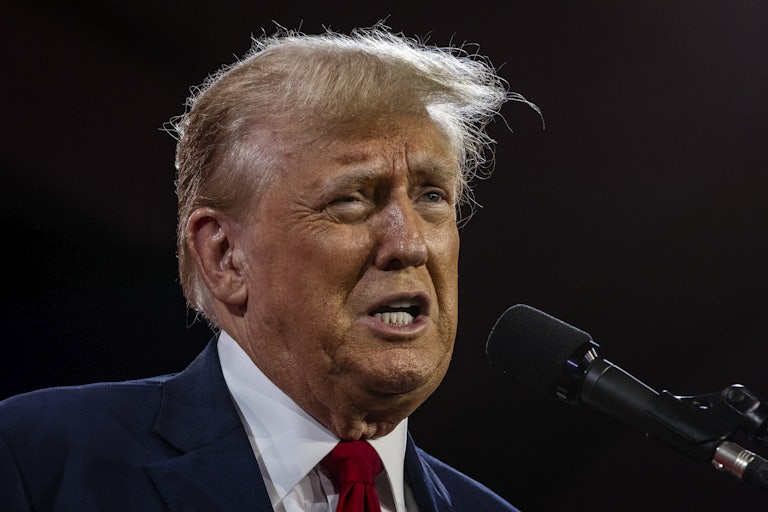
Donald Trump speaks into a microphone
Samuel Corum/Getty Images

Donald Trump appeared to blank for a few seconds during a phone interview before being jolted back to reality.

Trump called in to his former campaign manager Corey Lewandowski’s show on Newsmax Tuesday night. Lewandowski asked the former president and convicted felon about Joe Biden’s preparation for the upcoming debate, noting Trump has claimed that Biden would need to practice standing for 90 minutes and “might need a shot to stay up for the debate.”

Suddenly, Trump went silent for several seconds, as Lewandowski tried to fill the silence by repeating his question. When Trump finally spoke, he sounded groggy.

“Well, if I have to practice standing, we have ourselves a big problem,” Trump said. “No, I had heard that too; he’s practicing how to stand, or something, standing!”

It was just after 8 p.m. E.T. when the live interview took place, so it shouldn’t have been too late at night for Trump, although his usual routine reportedly is getting up at 5:30 a.m. every day and going to sleep at about midnight or 1 a.m. It’s possible that the silence may have been due to a technical glitch. But it could also have been Trump passing out, falling asleep, or even suffering from something he accuses Biden of having: cognitive decline.

Lately, Trump seems to be forgetting things such as eating a sandwich, and he has been fumbling during his rallies. He even appeared to blank during a speech to the National Rifle Association last month, and critics have made supercuts of his gaffes, where he confused people’s names. Is this why he and his allies are making excuses about Thursday’s debate, claiming Biden will be on drugs? Are they worried that Trump won’t be up to the task?

Desperate Mike Johnson Leads Wild Moves to Save Steve Bannon

The House speaker and his Republican colleagues are attempting to overturn Bannon’s jail sentence.

Mike Johnson looks to the side
Tom Williams/CQ Roll Call/Bloomberg/Getty Images

House Speaker Mike Johnson and other Republican leaders held a secret vote late Tuesday night, in a last-ditch effort to save Steve Bannon from having to report to jail.

High-ranking members of the House GOP voted to reject the previous Congress’s formal position on the January 6 committee, according to Politico. The House had found Bannon in contempt after he failed to comply with a congressional subpoena from that committee, leading to his subsequent indictment, conviction, and sentencing to four months in prison.

By changing the House’s formal position on the committee, lawmakers can now file a legal brief on behalf of Congress, though it’s unclear whether this brief would go to the appellate court or straight to the Supreme Court, which is currently weighing Bannon’s appeal. By undermining the committee’s legitimacy, Republicans are trying to keep the MAGA mastermind from serving out his jail sentence, which is set to begin July 1.

“Yeah, we’re working on filing an amicus brief in his appellate work there, in his case,” Johnson said Tuesday night on Fox News. “Because the January 6 committee was, we think, wrongly constituted.”

“We disagree with how Speaker Pelosi put all that together, we think it violated House rules, and so, we’ll be expressing that to the court. And I think it will help Steve Bannon in his appeal,” Johnson added.

The Department of Justice is expected to make a similar filing on Wednesday, urging the exact opposite.

Supreme Court Chief Justice John Roberts is expected to rule on Bannon’s appeal as soon as Wednesday afternoon, and it’s possible that this new position will help Bannon overcome the precedent set by former White House National Trade Council Director Peter Navarro, who tried a similar gambit with his appeal, which Roberts dismissed without even referring it to the full court.

Of course, it’s unclear whether Republicans’ attempts to hand Bannon a get-out-of-jail-free card will make any difference at all. The January 6 committee’s subpoenas were found to be valid by several federal judges.

Jamaal Bowman Becomes First Squad Member to Lose House Seat

George Latimer has won the primary election for New York’s 16th congressional district, after the most expensive House race ever.

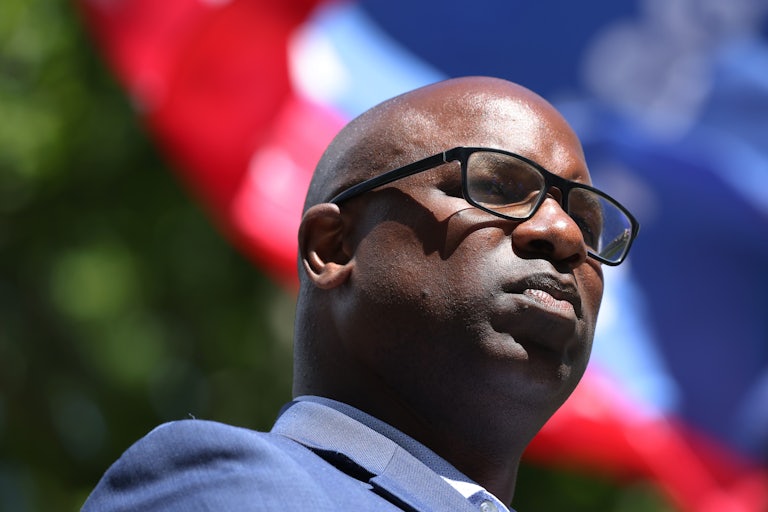
Jamaal Bowman
Michael M. Santiago/Getty Images

New York Representative Jamaal Bowman has become the first Squad member to lose his seat, after the most expensive House primary race ever.

Westchester County Executive George Latimer will almost undoubtedly be New York’s 16th congressional district’s newest representative come November. Latimer swept the historically blue district’s Democratic primary on Tuesday, winning 59 percent of the vote and leading nine points over incumbent Representative Jamaal Bowman, as of 9:38 p.m. E.T. when AP called the race.

The blow-up race became a temperature gauge on Democratic divisions over hot-button political issues, ranging from the Israel-Palestine conflict to contemporary race relations, after Latimer made a string of eyebrow-raising comments about Bowman’s race. It was the most expensive House primary in U.S. history, with Bowman raising $4.2 million and Latimer raising $5.7 million to usurp the seat. Outside spending also played a significant role in the race, with more than $23 million spent on advertising alone. Of that, more than $15 million came from pro-Israel lobbying groups attacking Bowman.

A huge chunk of cash came direct from the American Israel Public Affairs Committee, or AIPAC, which flooded funds to Latimer as backlash after Bowman accused Israel of committing genocide in Gaza. Latimer has since framed himself as a staunch supporter of Israel and an opponent to potential cease-fires on the basis that Hamas is a terrorist organization.

The divisions over the two candidates went all the way to the top of the party, with mainstream Democrat figureheads like Hillary Clinton endorsing Latimer while progressive titans, including fellow ”Squad” member Representative Alexandra Ocasio-Cortez and Senator Bernie Sanders, hosted rallies for Bowman in the Bronx.

Latimer, a former progressive sweetheart, won the race to be Westchester County executive in 2018. Prior to that, he spent the better part of three decades working in state politics, including the state’s legislature. This cycle, he pitched himself to voters as a no-nonsense candidate seeking to scoop up whatever reserves he could for Westchester—not to make a name for himself on cable TV. His inroads in the southern portion of the county, of which his website describes him as a “lifelong resident,” clearly benefited his campaign.

But in the final weeks of the race, Latimer made a series of controversial decisions, including claiming that Bowman had an “ethnic advantage” in a district where white, non-Hispanic residents outnumber Black residents by more than 2 to 1. During a debate in early June, Latimer claimed that Bowman’s “constituents are in Dearborn”—a remark that was interpreted as an Islamophobic and anti-Arab nod to the country’s first Arab-American majority city in the country, located in Michigan. Latimer has also received fierce blowback from critics for failing a federal mandate to desegregate the area—which constitutes the second wealthiest county in New York State, as well as one of the most racially divided.

Meanwhile, Bowman’s two-term tenure in the House has seen him back several progressive policy threads, including Medicare for All and the Green New Deal. In the last year, Bowman cut a higher profile, catching press for shouting at Republican opposition to gun restrictions, and after he pulled a fire alarm in a U.S. House office building in September, an action that resulted in a censure by House Republicans despite Bowman’s apology and claim that he had mistaken the alarm pulley for a mechanism to open the door. Bowman was also criticized in some quarters for subpar constituent service work. His district was redrawn after the 2020 census to include more of Westchester County.