Breaking News
Breaking News
from Washington and beyond

JD Vance Repeatedly Refuses to Admit Trump Lost in Alarming Interview

Watch how many times JD Vance refuses to answer the most basic question about the 2020 election.

J.D. Vance
Scott Olson/Getty Images

In an interview with The New York Times published Friday, JD Vance for nearly two minutes refused to answer a basic question: Does he believe  Donald Trump lost the 2020 election?

Journalist Lulu Garcia-Navarro posed the question to Vance, noting that he had refused to answer the question during his vice presidential debate with Tim Walz on October 1. Vance’s first response was similar to his answer at the debate: He and Donald Trump were focused on the future.

Vance also tried to deflect Garcia-Navarro’s question by claiming that the federal government backed social media censorship of Hunter Biden’s laptop, costing Donald Trump millions of votes. This conspiracy theory was in fact debunked by the Supreme Court in July. Garcia-Navarro pressed Vance again, with Vance again invoking social media censorship.

It took six questions for Vance to say that he wouldn’t have voted to certify the presidential election results in 2020. When asked if he would commit to a peaceful transfer of power, he replied “of course,” adding that he believed “that peaceful transfer of power is going to make Donald Trump the next president of the United States.

“But, if there are problems, of course, in the same way that Democrats protested in 2004, and Donald Trump raised issues in 2020, we’re going to make sure that this election counts, that every legal ballot is counted,” Vance continued, adding a giant asterisk to his answer.

Vance seems to give a convoluted answer every time he is asked about the 2020 election, which does not bode well for next month’s election. At one point, he was hounded by a comedian before admitting that he wouldn’t have certified the results. It shouldn’t come as a surprise, as he also said the same thing in February when he was still auditioning to be Trump’s running mate. Maybe that’s what sold the former president and convicted felon on selecting Vance.
Cards Against Humanity Launches Funniest, Maybe Most Effective PAC

Cards Against Humanity has launched a PAC to use Elon Musk’s own playbook against him.

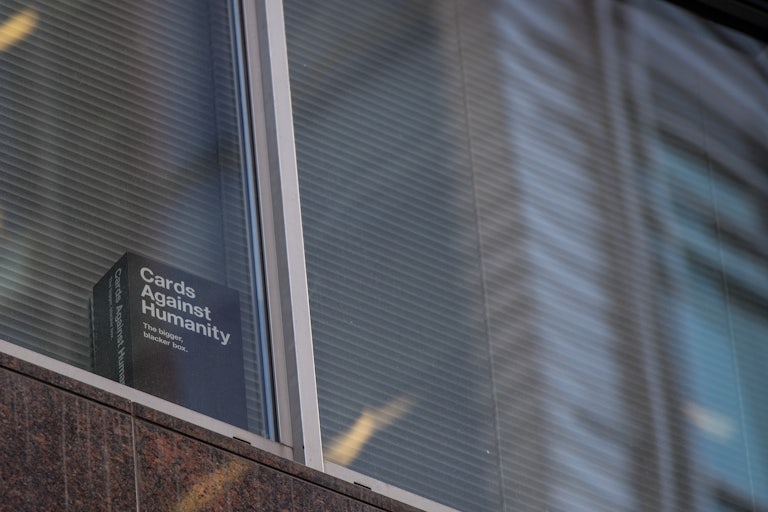
A large Cards Against Humanity box in the windowsill
Chris J Ratcliffe/Getty Images

The company behind the popular game Cards Against Humanity wants to beat Elon Musk at his own game.

In response to Musk’s America PAC offering to pay individuals $47 to recruit swing-state voters to sign an online petition pledging their support to Donald Trump, Cards Against Humanity has launched its own PAC to get cash into the hands of blue-leaning voters.

On Tuesday, the company announced they are looking to target eligible voters who didn’t cast a ballot in the 2020 election. In order to qualify for an up to $100 payment, the individual must be willing to write an apology, and they also must publicly post “Donald Trump is a human toilet” on social media.

Voters in seven swing states, Arizona, Georgia, Michigan, Nevada, North Carolina, Pennsylvania, and Wisconsin, will receive the biggest payouts.

According to their website, over 1,700 voters have “apologized” so far as of Friday afternoon.

The Trump campaign disparaged the effort to The New York Times. “Kamala has the backing of irrelevant card games,” said Karoline Leavitt, a spokeswoman for the Trump campaign.

This wouldn’t be the first time the card company has antagonized Musk or Trump. In September, the Chicago-based company filed a $15 million civil lawsuit against Musk’s SpaceX. They allege that SpaceX has been encroaching and trespassing on their property near the border in Texas, which they purchased in 2017 to block Trump from building his border wall on the land.

On the website for the Cards Against Humanity PAC, the company says it is explicitly “exploiting a legal loophole to pay America’s blue-leaning non-voters,” seemably the same loophole that Musk is using in his most recent data-collection scheme with America PAC.

“This whole thing should probably be illegal—so quick, give us your money before they change the law!”

You can view Cards Against Humanity’s PAC here.

Ex–Official Is Scared of Trump’s Fascist Revenge Plans

Retired General Mark Milley is worried he will be court-martialed if Donald Trump is elected in November.

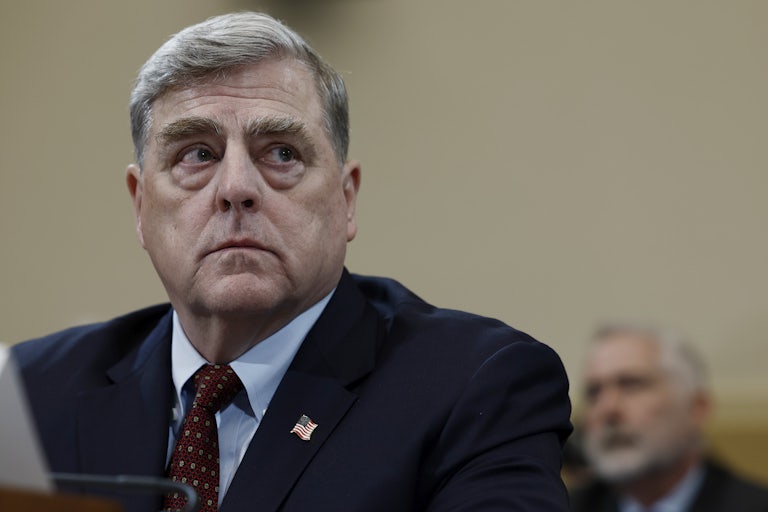
Retired General Mark Milley looks to the side during a House committee hearing
Anna Moneymaker/Getty Images

Donald Trump’s perceived enemies are legitimately afraid of retribution from the Republican presidential nominee should he win on election night.

They include retired U.S. Army general and former Joint Chiefs Chairman Mark Milley, whose tiffs with Trump include intense exchanges over critical race theory and serving as a witness against Trump during the House Select Committee’s January 6 investigation.

“He is a walking, talking advertisement of what he’s going to try to do,” Milley “warned” former colleagues, according to Washington Post reporter Bob Woodward’s upcoming book, War.

“He’s saying it and it’s not just him, it’s the people around him,” Milley said, fearing a potential court-martial, according to the book.

And there’s reason to be frightened. Steve Bannon, a Trump ally imprisoned for defying a federal subpoena, reportedly confirmed the target on Milley’s back, promising last November that “we’re gonna hold him accountable.” Bannon’s temporary War Room substitute host, Natalie Winters, took that threat a little further, vowing Thursday that Trump’s retribution tour will involve prosecuting his enemies for treason.

“If you want a definition of what justice or retribution looks like, it’s going to look like Steven K. Bannon sitting in this chair providing live commentary during the trials and eventual prison sentences of people like Victoria Nuland, Hillary Clinton, Joe Biden, Hunter Biden,” Winters said. “We’ll throw Jack Smith in there too. It will be Steve providing commentary on you guys going to prison. Opening bid is treason, but I’m sure we will find a lot more.”

Milley has gone head-to-head with Trump several times since he was instituted as the chair of the Joint Chiefs of Staff in 2019. In Trump’s final months in office, the ex-president posted on Truth Social that he considered a meeting between Milley and a Chinese general as a “treasonous act” that was “so egregious that, in times gone by, the punishment would have been DEATH!”

Last year, Milley highlighted the absurdity of Trump’s campaign and his administrative rule, which has placed a premium on loyalty to his vision and self above all else.

“We don’t take an oath to a king, or queen, or tyrant or a dictator, and we don’t take an oath to a wannabe dictator,” Milley told a military audience at Joint Base Myer-Henderson Hall at the time. “We don’t take an oath to an individual. We take an oath to the Constitution, and we take an oath to the idea that is America, and we’re willing to die to protect it.”

New Report Exposes How Many Minutes It Takes to Get Addicted to TikTok

It’s easy for children and teenagers to get hooked on TikTok, and the company higher-ups aren’t doing anything about it.

Screens show the TikTok logo
Jakub Porzycki/NurPhoto/Getty Images

TikTok is well aware of just how harmful it is to young users, according to internal documents included in a lawsuit filed Tuesday.

Thirteen states are separately suing TikTok for misleading the public about the app’s potential harmful effects. One of the lawsuits, filed by the Kentucky attorney general’s office, contained faulty redactions, revealing the confidential internal documents uncovered in the two-year investigation into TikTok, according to NPR. The information contained in the redactions was first reported by Louisville Public Media, before a judge resealed the suit.

State investigators found that it was possible to form a habit around using the app after watching 260 videos, which on a fast-paced app such as TikTok can take fewer than 35 minutes.

Internal research at TikTok found that “compulsive usage correlates with a slew of negative mental health effects like loss of analytical skills, memory formation, contextual thinking, conversational depth, empathy, and increased anxiety,” according to the suit.

This was not only the case with how teens were using the app but also with what they were being shown on it. TikTok actively demoted videos featuring people deemed unattractive, and boosted videos of those using beauty filters. It’s not difficult to imagine how imposing and rewarding unattainable beauty standards could be harmful to young users.

Internal documents in the suit also showed that TikTok would sort users into “filter bubbles” of content, where a user “encounters only information and opinions that conform to and reinforce their own beliefs, caused by algorithms that personalize an individual’s online experience.”

An internal document showed that users were “placed into ‘filter bubbles’ after 30 minutes of use in one sitting.”

This can be particularly harmful should a user end up in a bubble that is pushing negative content, such as pro-anorexia content disguised as “thinspiration,” which has recently had a major resurgence on the app. Videos featuring self-harm also made it past TikTok moderators.

Internal documents also showed just how easy it is for young users to be led down a depressing rabbit hole, after engaging with content in the filter bubbles “painhub” or “sadnotes.”

“After following several ‘painhub’ and ‘sadnotes’ accounts, it took me 20 mins to drop into ‘negative’ filter bubble,” one employee wrote. “The intensive density of negative content makes me lower down mood and increase my sadness feelings though I am in a high spirit in my recent life.”

When TikTok did tout new time-management tools to reduce kids’ usage, internal documents revealed that TikTok cared more about how the tools were perceived than how well they actually worked. The documents showed that executives rated the success of these tools by how they were “improving public trust in the TikTok platform via media coverage,” rather than how they were actually reducing usage. The tools themselves were found to have a negligible impact on usage.

One executive said that the app’s “break” videos, which encourage users to consider leaving the app after long periods of activity, were “useful in a good talking point” but “not altogether effective.” TikTok still decided to launch the features.

One executive gave a chilling description of what TikTok’s addicting algorithm could do to young users. “We need to be cognizant of what it might mean for other opportunities,” the unnamed executive said, according to court documents. “And when I say other opportunities, I literally mean sleep, and eating, and moving around the room, and looking at someone in the eyes.”

TikTok spokesperson Alex Haurek criticized NPR for publishing the now-redacted information.

“It is highly irresponsible of NPR to publish information that is under a court seal,” said Haurek. “Unfortunately, this complaint cherry-picks misleading quotes and takes outdated documents out of context to misrepresent our commitment to community safety.

“We have robust safeguards, which include proactively removing suspected underage users, and we have voluntarily launched safety features such as default screentime limits, family pairing, and privacy by default for minors under 16,” Haurek said.

Trump’s 2020 Fake Electors Are Even More Powerful This Time Around

A new report reveals that many of Donald Trump’s fake electors are making a comeback four years later.

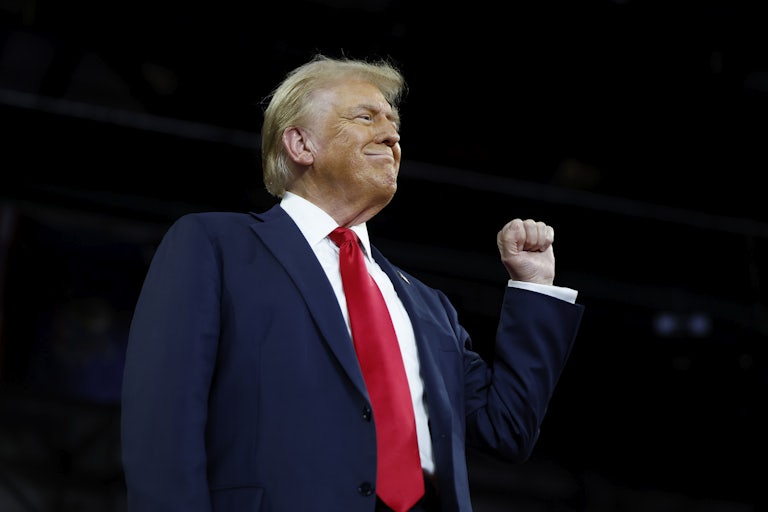
Donald Trump smiles and raises a fist as if in victory
Chip Somodevilla/Getty Images

The fake electors that tried to help Donald Trump overturn the 2020 presidential election are back in position to help in next month’s election.

NOTUS reports that out of 82 slated electors in Wisconsin, Pennsylvania, Arizona, Georgia, Michigan, New Mexico, and Nevada in this coming election, 14 took part in Trump’s fake elector scheme in 2020.

Of Nevada’s six fake electors in 2020, two are back for 2024, including Michael McDonald, the state’s Republican Party chair who is now also a Trump campaign senior adviser. Michigan has six fake electors who are returning for next month’s election.

New Mexico has one fake elector from 2020 returning for this election, while Pennsylvania is bringing back five of its fake electors, out of a total of 19, for the 2024 contest. But Arizona and Wisconsin are taking precautions to ensure that fake electors can’t come back.

In the Grand Canyon State, Arizona’s attorney general indicted 18 individuals who took part in the state’s fake elector scheme in 2020, and the 11 fake electors from back then, who include a Turning Point USA executive, two state representatives, and the executive director of the Arizona Republican Party, are not on the list of Arizona electors for 2024.

Wisconsin’s 10 fake electors were sued by a progressive law firm working with the Georgetown University Law Center, with the case reaching a settlement where they all agreed to publicly state that President Biden won the 2020 election and to never again serve as electors for Trump.

But even as many of the 2020 fake electors won’t be attempting to repeat their efforts in this election, some will be in more powerful positions in states including Wisconsin. One fake elector, Robert F. Spindell Jr., is on the Wisconsin Elections Commission until 2026 and says he’ll be “insuring that voters have confidence in the outcome of our elections.”

One fake elector in Michigan, Stanley T. Grot, refuses to resign as the clerk of Shelby Township, a Detroit suburb, even though he was indicted last year along with the state’s other fake electors. Worryingly, his job entails maintaining local voter registration files and administering November’s elections in the township.

In Georgia, one fake elector, Burt Jones, even became the state’s lieutenant governor, receiving support from Trump, who said Jones was a “conservative warrior” who would “get to the bottom of the Nov. 3 presidential election scam.”

President Biden signed Electoral College reform into law in 2022 to ensure that the chaos caused by Trump in 2020 couldn’t happen again. But as NOTUS’s report shows, the same pro-Trump conservatives are still in positions of power to cause chaos again in multiple scenarios.