Breaking News
Breaking News
from Washington and beyond

Stable Genius Trump Just Put Tariffs on a U.S. Military Base

Donald Trump imposed tariffs on an island inhabited only by American soldiers.

Donald Trump presses his lips together during a press conference in the White House Rose Garden
Chip Somodevilla/Getty Images

Donald Trump announced a range of tariffs on nearly every country in the world—including, inexplicably, some practically uninhabited islands, one of which is home to a U.S. military base.

The British Indian Ocean Territory, a small cluster of islands in the South Indian Ocean, was hit with 10 percent tariffs on U.S. imports from the Trump administration Wednesday as part of its Liberation Day announcement.

The islands are mostly uninhabited, save for approximately 3,000 U.S. and U.K. military personnel who are stationed at a joint Navy Support Facility on the island Diego Garcia. Trump’s tariffs would mostly affect the service members there. Another roughly 1,200 people live on the country’s Chagos Archipelago.

As one might expect from the name, the territory is owned by the United Kingdom, which Trump hit with a 10 percent tariff, relatively low compared to other countries.

Trump also announced 10 percent tariffs on the Heard Island and McDonald Islands, an uninhabited Australian territory that was listed as a Unesco World Heritage site for its “complete absence of alien plants and animals, as well as human impact.” Australia was saddled with a 10 percent tariff, as well.

It’s unclear whether the tariffs on these territories would compound to 20 percent. Crucially, it’s unclear that anyone thought about this at all.

Online, some speculated that the tariffs were doled out according to internet domains, and that because the Heart Island and McDonald Islands use a different domain (.hm) than Australia, (.au) they were considered different countries. That seemed to be the only explanation for levying a tariff on a territory that has no economy to speak of.
Trump Says Tariffs Could Have Stopped the Great Depression

Donald Trump has found a bonkers new defense for his extreme tariffs.

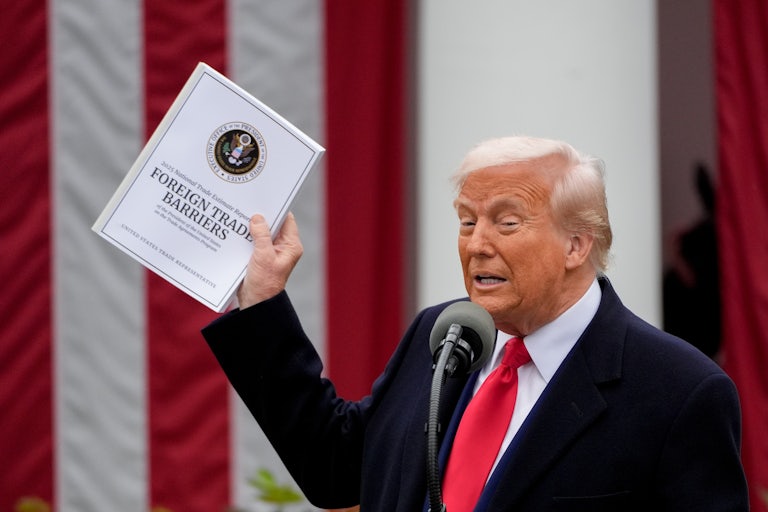
Donald Trump holds up a booklet on "foreign trade barriers" while speaking to reporters in the White House Rose Garden
Kent Nishimura/Bloomberg/Getty Images

Donald Trump claimed Wednesday that the United States entered the Great Depression as a result of turning its back on the policy of placing tariffs on other countries in favor of an income tax.

During a winding speech to mark the so-called Liberation Day, Trump presented an alternative history where steep tariffs, like the ones he’d come to celebrate, could have prevented the worldwide economic disintegration of the early twentieth century.

“From 1789 to 1913 we were a tariff-backed nation, and the United States was proportionately the wealthiest it has ever been,” Trump said, adding that the U.S. was “collecting so much money, so fast, we didn’t know what to do with it!

“Then, in 1913 for reasons unknown to mankind, they established the income tax so citizens, rather than foreign countries, would start paying the money necessary to run our government,” he said.

“Then in 1928 it all came to a very abrupt end with the Great Depression, and it would have never happened if they had stayed with the tariff policy; it would have been a much different story,” Trump said. “They tried to bring back tariffs to save our country, but it was gone. It was gone. It was too late, nothing could have been done.”

Trump’s revisionist history is designed to promote his economic agenda—not reflect what actually happened. Not only could tariffs not have prevented the Great Depression, they made it even worse.

In 1913, as the result of struggling farmers and Democrats advocating to establish an income tax, Republicans put up an income tax amendment, hoping that it would be rejected—it wasn’t, and the Sixteenth Amendment became law.

At the same time, Congress passed the Underwood Simmons Tariff Act that lowered tariff rates from 40 percent to 27 percent, in a Democrat-backed effort to promote free trade. Crucially, tariffs were raised again in 1921, after Republican President Warren Harding entered the White House and began a reinvigorated era of protectionism.

In 1930, Congress passed the Smoot-Hawley Tariff Act, which raised tariffs in all sectors and is considered to have exacerbated the worldwide economic downturn that lasted from 1929 until 1939, by undermining international trade and affording little protection to domestic producers.

Smoot-Hawley was disastrous not only for the U.S. economy, tanking U.S. exports to Europe from $2,341 million in 1929 to just $784 million in 1932, but also for global trade, which declined by a whopping 66 percent between 1929 and 1934, according to  the U.S. Office of the Historian. The effects of Smoot-Hawley were so awful that it marked the end of steep tariffs in American trade policy for the rest of the twentieth century.

Trump’s baseless insistence that lowered tariffs led to the Great Depression is representative of his entire economic policy, and just how untethered from reality it has become.

Read more about Trump’s tariffs:

Trump Announces Wild Breakdown of Tariffs on Closest Allies

Donald Trump is imposing a different set of tariffs on each country. And they’re all extreme.

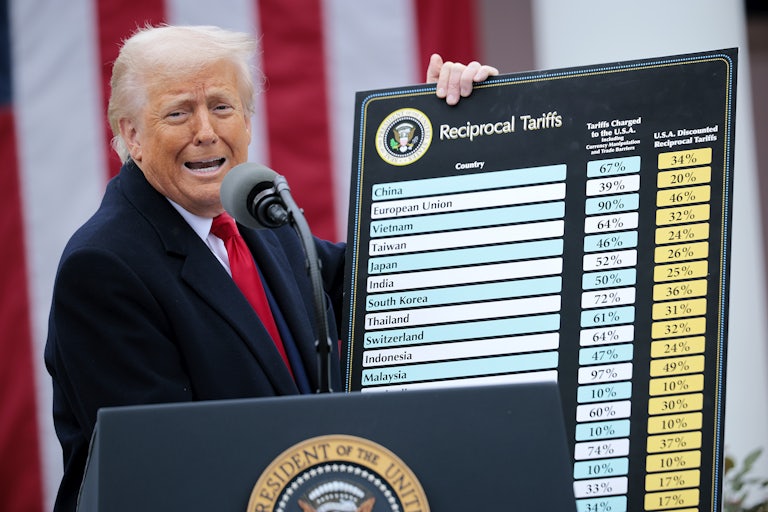
Donald Trump holds up a large chart labeled "Reciprocal Tariffs" for each country while speaking at his so-called “Liberation Day” event at the White House on April 2. The first rows are China, European Union, Vietnam, Taiwan, and Japan. The left column shows the tariffs that country imposes and the right column shows Trump’s proposed tariffs on the country.
Chip Somodevilla/Getty Images
Donald Trump holds up a chart on tariffs for each country while speaking at his so-called “Liberation Day” event at the White House on April 2.

President Trump pulled out a chart to help illustrate his aggressive, country-specific tariff plans during his “Liberation Day” speech on Wednesday.

“We’re gonna be charging a discounted reciprocal tariff of 34 percent [on China],” Trump said, holding up the large black, blue, and yellow chart that Commerce Secretary Howard Lutnick dutifully brought to him onstage. “In other words, they charge us, we charge them. We charge them less, so how can anybody be upset? They will be, because we never charge anybody anything. But now we’re gonna charge.”

Trump confirmed there will be 25 percent tariffs on all car imports, in addition to the specific tariffs he plans to levy against each of our trading partners on the grounds that they’ve been “ripping us off.”

The chart notes plans for tariffs on a list of countries including:

  • 34 percent tariffs on China
  • 20 percent tariffs on the European Union
  • 49 percent tariffs on Cambodia
  • 37 percent tariffs on Bangladesh
  • 44 percent tariffs on Sri Lanka
  • 46 percent tariffs on Vietnam

The tariffs will affect more than 100 U.S. trading partners, but Canada and Mexico are conspicuously left off the list. Many of the targeted countries are some of the poorest in the world.

“We’re going to build our future with American hands, with American heart, with American steel, and we’re gonna build it with American pride like we used to,” Trump said later in his speech.

These tariffs—intended to revitalize domestic manufacturing—have shocked the market and will likely make multiple goods much more expensive for those American manufacturers, and for consumers.

This story has been updated.

Trump Notches Huge Win as Yet Another Law Firm Caves

Law firms are lining up to bow to Donald Trump.

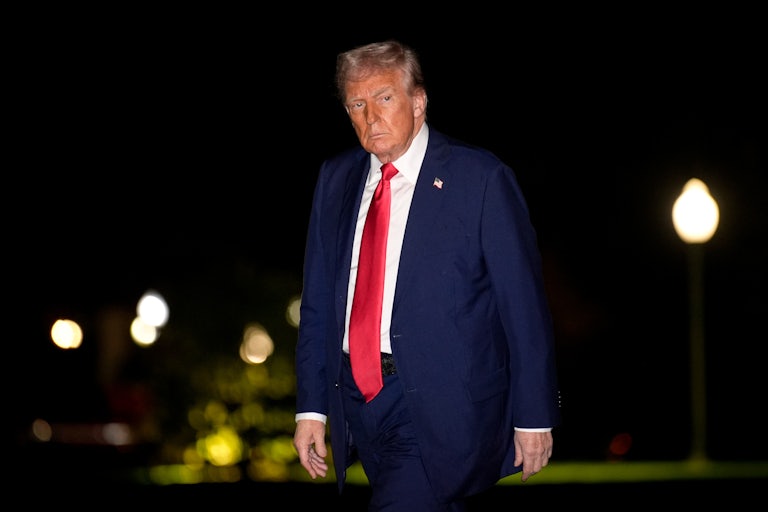
Donald Trump walks outside the White House
Yuri Gripas/Abaca/Bloomberg/Getty Images

Yet another law firm has come to an agreement with Donald Trump’s administration, after the president began targeting major law firms that hired lawyers he didn’t like or took up cases and clients he claimed went against his agenda.

Trump shared a statement on Truth Social Wednesday announcing that Milbank LPP agreed to perform $100 million worth of pro bono legal services on “initiatives supported by the president and Milbank,” including partners of “diverse political ideologies,” and representing the “full political spectrum, including Conservative ideals.

“Milbank shall not deny representation on the basis of the political affiliation of the prospective client, or because of opposition to any government official,” read the statement.

Similarly to the other firms that have struck a deal with the Trump administration, Milbank agreed not to engage in DEI hiring practices, in accordance with Trump’s executive order barring the supposedly discriminatory programs.

The deal comes as the Trump administration has targeted several other major law firms, alleging that they’d committed wrongdoing by defending clients in cases about racial discrimination, elections, and immigration. Trump threatened to have their security clearances revoked and government contracts terminated unless they complied with his demands.

Crucially, Milbank wasn’t targeted by the Trump administration but had “approached” the government stating its “resolve to help end the Weaponization of the Justice System and the Legal Profession,” according to the statement. Last week, Skadden, Arps, Slate, Meagher & Flom also preemptively agreed to bend the knee to Trump. Even though they hadn’t been the direct target of Trump’s vendetta, these law firms demonstrate the chilling effect of Trump’s executive orders.

Willkie Farr & Gallagher, another major law firm, which happens to employ Doug Emhoff, announced a similar deal earlier Wednesday, leading to calls for the former second gentleman to resign.

Two other major firms, WilmerHale and Jenner & Block, challenged the Trump administration’s threat to revoke their security clearances as an unprecedented attack on the Sixth Amendment and a blatant attempt to chill the legal profession from taking up cases that aren’t aligned with his political agenda. Another law firm, Perkins Coie, which was targeted for representing Hillary Clinton’s 2016 presidential campaign, challenged a similar order last month and was granted a temporary injunction against the Trump administration’s threat to revoke clearances and access.

Last month, Paul, Weiss, Rifkind, Wharton & Garrison caved to the administration and offered $40 million in free legal services, revoked its own DEI practices, and sold one of its own lawyers down the river, simply because he’d once investigated Trump for alleged financial crimes. Last month, Trump also targeted the firm Covington & Burling, suspending the security clearances of lawyers who had worked with former special prosecutor Jack Smith.

Here’s How Many Sketchy Signal Groups Mike Waltz Has

Donald Trump’s national security adviser is apparently a national security disaster.

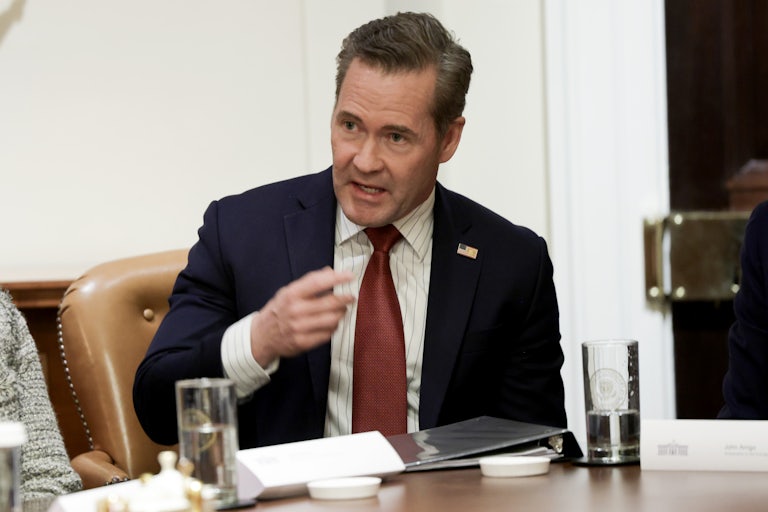
National Security Adviser Mike Waltz gestures while speaking in a meeting at the White House
Win McNamee/Getty Images

Signalgate seems to have been the norm for national security adviser Mike Waltz, rather than the exception.

Waltz’s team had set up at least 20 Signal group chats dedicated to discussing international crises, Politico reported Wednesday. His staff “regularly” leaned on the retail app to coordinate work on issues in Ukraine, China, Gaza, the Middle East, Africa, and Europe, according to four people who had been added to the chats.

All four sources that spoke with the publication said they witnessed instances of “sensitive information” being discussed, reported Politico’s White House bureau chief Dasha Burns.

Waltz’s emerging national security scandals have made him less than popular in the White House. Last month, Waltz made Donald Trump furious by accidentally inviting a journalist to a Cabinet group chat on Signal about bombing Yemen.

In the days after the initial scandal broke, Wired reported that an account sharing the intelligence official’s name had seemingly left his Venmo profile public. In doing so, Waltz disclosed the names of hundreds of his personal and professional associates, including government officials and lobbyists.

Last week, the German newspaper Der Spiegel reported that Waltz was among several senior administration officials who had their personal data, such as account passwords, email addresses, and personal cell phone numbers, listed online.

If that weren’t bad enough, The Washington Post reported Tuesday that Waltz and his team had been relying on Gmail—a platform even less secure than Signal—to discuss “sensitive military positions and powerful weapons systems relating to an ongoing conflict.”

A Harvard CAPS/Harris poll released Sunday suggested that 60 percent of polled Americans felt that the administration’s decision to use Signal to conduct highly sensitive government business was “wrong”—that included 73 percent of Democrats, 65 percent of independents, and 43 percent of Republicans.

A YouGov survey published last week found that 53 percent of nearly 6,000 polled Americans felt that the Trump administration’s Signal leak was “very serious,” while another 21 percent described it as “somewhat serious.”

It remains to be seen how Americans will feel about the other 19 Signal chats.