Breaking News
Breaking News
from Washington and beyond

Federal Reserve Crushes Dreams of a Lower Interest Rate—Blaming Trump

Fed Chair Jerome Powell says Trump’s tariffs are to blame for what’s happening in the economy.

Federal Reserve Chair Jerome Powell speaks at a podium.
Andrew Harnik/Getty Images

The Federal Reserve on Wednesday announced it will not lower interest rates, refusing once again to obey President Trump’s persistent demands to do so.

In explaining the decision, Fed Chair Jerome Powell pointed to Trump’s tariffs and their impact on the economy.

“Increased tariffs are pushing up prices in some categories of goods,” he said. “Near-term measures of inflation expectations have moved up on balance over the course of this year on news about tariffs.”

The decision is sure to upset the president, who has long called on the Fed to lower interest rates.

“We have a man who just refuses to lower the Fed rate,” Trump said last month, in one of his many attacks on Powell, a constant nemesis of his. “Maybe I should go to the Fed. Am I allowed to appoint myself? I’d do a much better job than these people.”

Trump has spent five straight meetings demanding interest rates be lowered, which suggests some insecurity about the future state of the economy on his part, especially as economists wait for the full scope of his trade war to reveal itself.

Two Trump-appointed Fed governors, Michelle Bowman and Christopher Waller, dissented from Powell’s decision on Wednesday, likely attempting to remain in the president’s good graces in the chance that he fires Powell, something he has alluded to countless times now.

The Fed lending rate will stay within the 4.25 percent to 4.5 percent range.

This story has been updated.
Trump Treasury Sec. Brazenly Gives Up the Game on Social Security

Scott Bessent is saying the quiet part out loud.

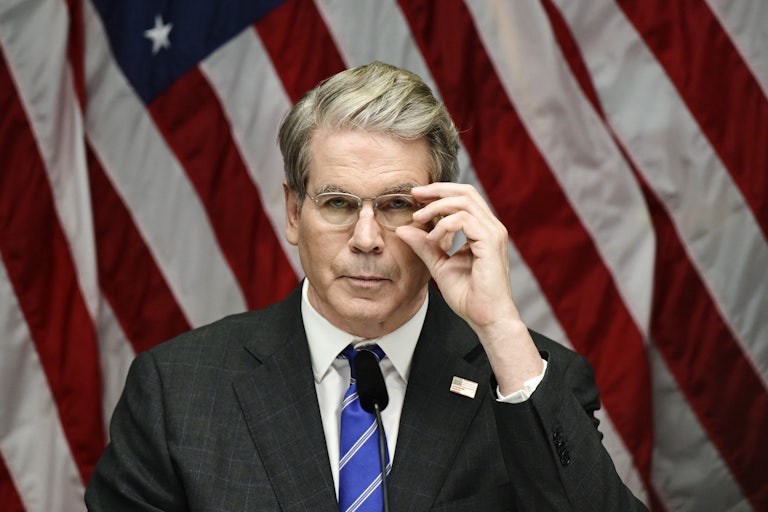
Treasury Secretary Scott Bessent adjusts his glasses
Magnus Lejhall/AFP/Getty Images

The Trump administration is working toward privatizing Social Security.

Speaking with Breitbart at the far-right media company’s policy event Wednesday, Treasury Secretary Scott Bessent referred to the “big, beautiful bill’s” “Trump accounts” as a “backdoor” for privatizing the public program.

As a stipulation of Trump’s tax bill, the U.S. government would deposit $1,000 in so-called “Trump accounts” for Americans born between 2025 and 2028. The investment, according to Bessent, would dually serve as a way to prevent young people from getting “disillusioned with the system” and voting for the likes of New York City Democratic mayoral candidate Zohran Mamdani, and a way to slyly privatize Social Security.

“So when you do this, you make everyone a shareholder. You make everyone a stakeholder. People who are part of the system do not want to bring down the system,” Bessent said.

Bessent then shared an anecdote about being asked to help manage a construction worker’s hypothetical lottery winnings, to which he claimed that the “best thing you can do is save that $20.”

“Now, with these accounts, they can be part of the system. What if they had put that money in the S&P? Or in Bitcoin? Or in anything? So, we’re making people part of the system, we’re increasing financial literacy,” Bessent said. “I think that at Treasury, we are going to push, with these accounts, that if you have the account we want you to learn about it and understand it.

“In a way, it is a backdoor for privatizing Social Security,” he continued. “Social Security is a defined benefit plan paid out to the extent that if, all of a sudden, these accounts grow and you have in the hundreds of thousands of dollars for your retirement, then that’s a game changer, too.”

Congressional Republicans pushed through Trump’s tax plan earlier this month without any Democratic support. The law is not expected to save the government any money, as Trump had initially promised. Instead, Trump’s key legislative victory—which will slice taxes on the ultrawealthy and corporations while gutting social programs such as Medicaid—is expected to add upward of $6 trillion to the debt, according to a projection from the Cato Institute, a libertarian think tank.

Republicans Turn On Hawley for Trying to Ban Stock Trading in Congress

Hawley’s fellow Republicans tore into him on the Senate floor.

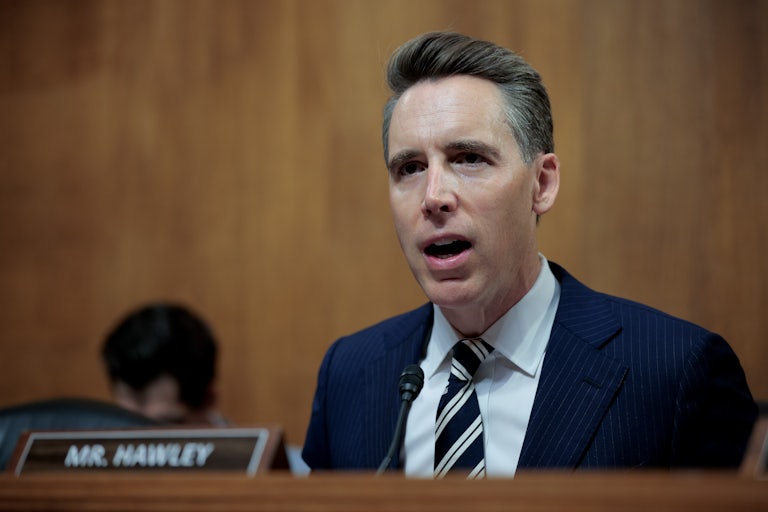
Senator Josh Hawley speaks in a Senate subcommittee hearing
Chip Somodevilla/Getty Images

Conservative lawmakers are fighting tooth and nail to retain their right to trade stocks while in office.

The caucus turned out in staunch opposition Wednesday to Republican Senator Josh Hawley’s proposed stock trading ban, causing a significant stir in the upper chamber after the White House flagged the bill as a bad idea.

In order to gain Democratic support and advance the motion through the Senate Committee on Homeland Security and Governmental Affairs, Hawley agreed to include text within the bill that would additionally subject Donald Trump and Vice President JD Vance to the parameters of the ban, just as members of Congress would be. But the White House’s Office of Legislative Affairs, and the executive branch’s Senate allies, were not in favor.

Senator Ron Johnson torched the effort as “legislative demagoguery,” claiming Wednesday that banning lawmakers and their spouses from trading stocks would “make it very unattractive for people to run for office.”

“I have no idea what we’re voting for,” said Senator Bernie Moreno. “I have not read the mountains of paper that are sitting in front of me.”

At one point, Senator Rick Scott condemned the effort as “disgusting,” accusing Hawley of denigrating billionaires. But Hawley, seated next to Scott, had a firm response.

“I don’t mind anyone being rich, I mind people getting rich while they’re here and trading stocks,” the Missouri senator said.

Committee Chair Rand Paul similarly opposed the bill, positing that any such ban would have made it impossible for Trump to be president. The Kentucky lawmaker admitted that he had scheduled a vote on the bill in a quiet quid pro quo: “To get two bills that I want passed through without being beleaguered by amendments,” he said in an interview with Axios.

The White House, meanwhile, argued that its opposition to Hawley’s bill had little to do with its contents.

“This was a last-minute deal struck to include the Executive Branch equities without touching base with the White House to discuss potential Article II concerns,” a White House official told Axios. “Any pause comes purely from potential Article II infringement, not the Congressional ban.”

The president, however, attacked Hawley personally hours later, claiming that the senator’s decision to “block” a review of Representative Nancy Pelosi’s stock trading was “sabotage.”

Hawley had introduced the original bill in 2023 after Pelosi’s husband came under increased scrutiny for his extensive trading practices, though the accusations festered without any evidence of insider trading. By the end of the day, the committee had voted 8-7 to advance the bill, with all Republicans except Hawley voting against it.

“The Democrats, because of our tremendous ACHIEVEMENTS and SUCCESS, have been trying to ‘Target’ me for a long period of time, and they’re using Josh Hawley, who I got elected TWICE, as a pawn to help them,” Trump wrote on Truth Social. “I wonder why Hawley would pass a Bill that Nancy Pelosi is in absolute love with—He is playing right into the dirty hands of the Democrats. It’s a great Bill for her, and her ‘husband,’ but so bad for our Country!”

“I don’t think real Republicans want to see their President, who has had unprecedented success, TARGETED, because of the ‘whims’ of a second-tier Senator named Josh Hawley!” Trump added.

This story has been updated.

Read more about congressional stock trading:

Trump Has Turned House Freedom Caucus Into a Total Laughingstock

The embarrassing nickname is a sign of how much power Donald Trump wields over the Republican Party.

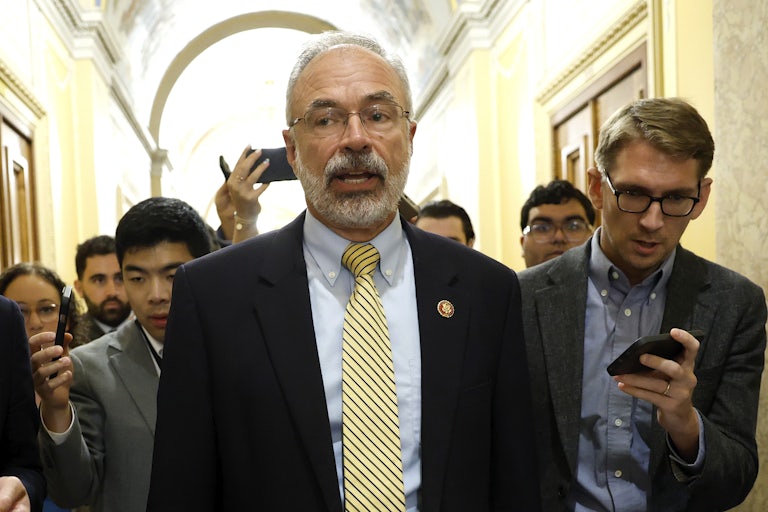
House Freedom Caucus Chair Andy Harris speaks to reporters while walking in the Capitol
Kevin Dietsch/Getty Images
House Freedom Caucus Chair Andy Harris

Since Donald Trump entered the White House, the supposedly hardline fiscal conservatives of the House Freedom Caucus appear to have softened that line to a malleable putty—and everyone on Capitol Hill knows it.

The Bulwark reported Wednesday that as members of the HFC left for summer break, they were “all over the place” following a series of toothless concessions to the president’s sweeping spending agenda. Now, the House Freedom Caucus has even earned a new nickname among reporters and lawmakers: the House Folding Caucus.

Although they had initially criticized the Senate’s version of Trump’s behemoth budget bill at the beginning of July, HFC members ultimately fell in line to support the president’s bill that would explode the national deficit by trillions of dollars. A few weeks later, they momentarily stalled Trump’s GENIUS Act, arguing that the cryptobill went against an executive order banning central bank currency. But once again, they conceded to the president’s demands after the GOP leadership promised to tie the ban into the Pentagon’s policy bill later this year.

HFC Chairman Andy Harris said that the group should start working on a one-year continuing resolution that would allow them to freeze federal funding, but the group’s position remains unclear. Four members are currently staging their exits from Congress, with Representatives Ralph Norman, Byron Donalds, and Andy Biggs all preparing gubernatorial campaigns in their respective states, and Representative Mike Collins launching a Senate bid in his state.

With a president who just does whatever he wants regardless of what Congress thinks, a far-right attack dog is no longer required—and has been left neutered and freezing in the doghouse.

Texas Republicans Unveil Alarming Map Stealing Democratic Seats

The Texas GOP has a plan to erase any chance of Democrats retaking the House.

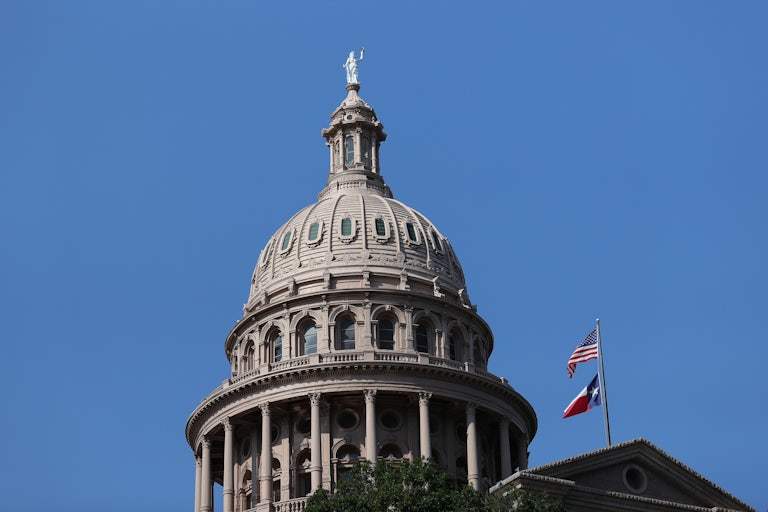
Texas state Capitol
Reginald Mathalone/NurPhoto/Getty Images

Texas Republicans are moving forward with their gerrymandering plan that will essentially create new pro-Trump districts in a state that already has an overwhelming GOP majority.

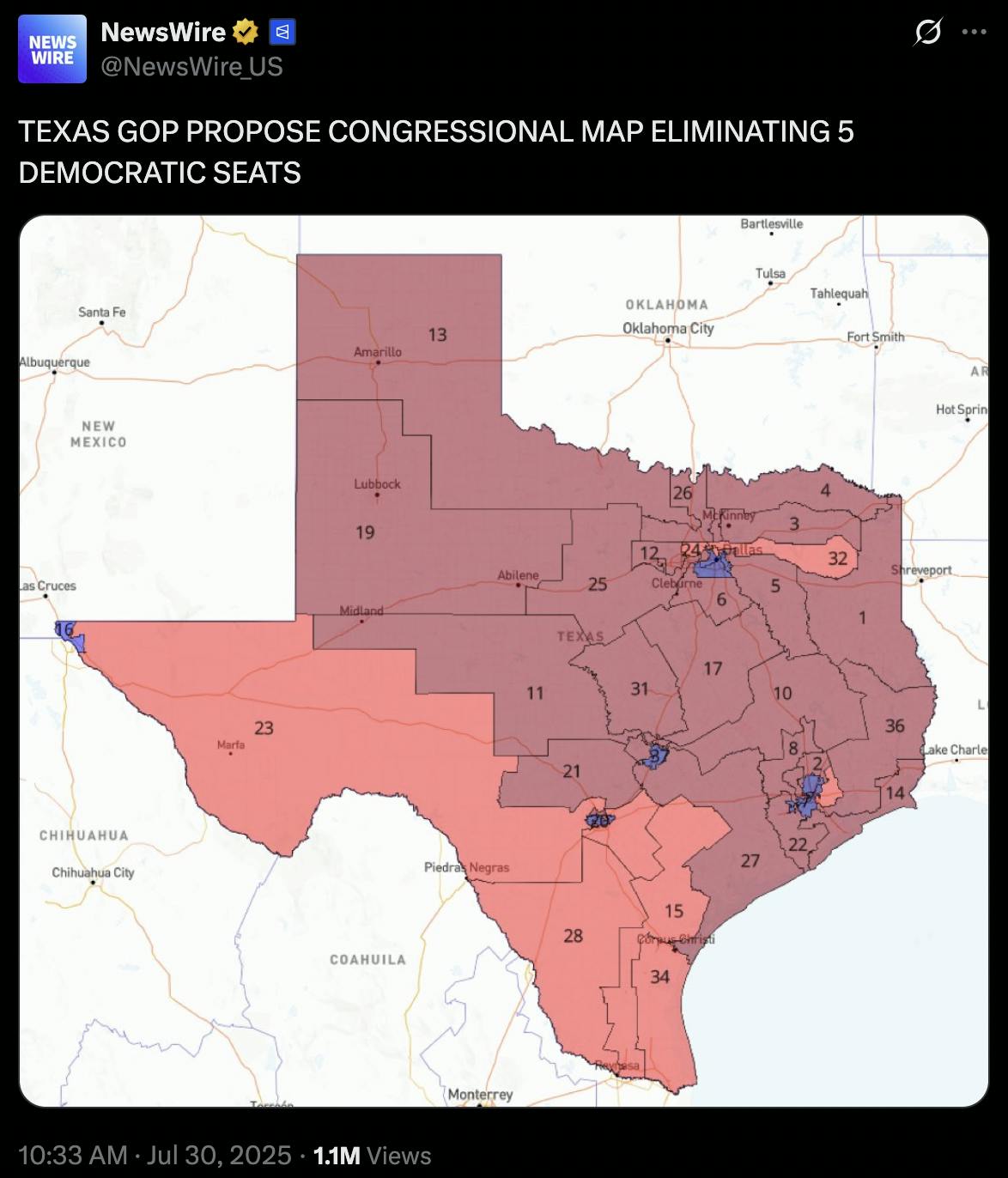
The new map, revealed Wednesday, will create five new GOP-skewed districts, which could very well help Republicans grow their majority in the House in 2026. The map puts districts currently held by Democratic Representatives Henry Cuellar and Vicente Gonzalez at risk of becoming more red, while isolating blue districts to create even more Republican-leaning ones.

Texas's new congressional map

The map’s new districts will contain three regions that Trump carried by 10 to 15 percentage points last election, shamelessly rigging the game to seize power in a thinly divided Congress. It will also create six districts without incumbents—making 2026 an even more critical race.

House Minority Leader Hakeem Jeffries is reportedly headed to Texas on Wednesday for a sit-down with Democratic leaders, while the map is set for final approval in a committee hearing on Friday.