Breaking News
Breaking News
from Washington and beyond

NIH Chief Breaks With RFK Jr. on Key Question From Bernie Sanders

This is, unfortunately, a very big deal.

NIH Director Jay Bhattacharya sits during a Senate committee hearing
Tom Williams/CQ-Roll Call, Inc/Getty Images

The health secretary is at odds with his own agency.

The director of the National Institutes of Health, Jay Bhattacharya, appeared before the Senate Committee on Health, Education, Labor, and Pensions on Tuesday to discuss efforts to modernize the public health sector.

But his appearance spilled a deeper truth when ranking member Senator Bernie Sanders insisted that Bhattacharya clarify his position on Health Secretary Robert F. Kennedy Jr.’s deeply held belief that vaccines are linked to autism.

“Do you think that deep distrust … has something to do—when you have an organization like the American Medical Association telling us that vaccines do not cause autism, but you have a secretary of HHS who says the very opposite? Do you think that causes concern and mistrust among parents?” asked Sanders.

“In 2024 there was a study published in the Journal of the American Medical Association that said that only about 40 percent of patients still trust their doctors,” Bhattacharya said, noting the study was published before Kennedy’s appointment. “As someone who went to medical school myself, that’s absolutely shocking.”

“Let me ask you a simple question.… Do vaccines cause autism? Tell that to the American people: Yes or no?” pressed Sanders.

“I do not believe that the measles vaccine causes autism,” replied Bhattacharya.

“Nah. Uh uh. I didn’t ask measles,” insisted Sanders. “Do vaccines cause autism?”

“I have not seen a study that suggests any single vaccine causes autism,” Bhattacharya said.

Combating autism supposedly caused by vaccines is the cornerstone of Kennedy’s public health policy. Kennedy is a leader in a growing movement of anti-vax parents who refuse to provide their children with the same public health advantages that they received in their youth, mostly in fear of thoroughly debunked conspiracy theories that, at one point, falsely linked autism to the jab.

The researcher who sparked that myth with a fraudulent paper lost his medical license and eventually rescinded his opinion. Since then, dozens of studies have proven there’s no correlation between autism and vaccines, including one study that surveyed more than 660,000 children over the course of 11 years.

Since Kennedy took the reins at HHS, he has replaced independent medical experts on the Center for Disease Control’s vaccine advisory panel with a hodgepodge of vaccine skeptics. He warned against the use of the MMR vaccine during Texas’s historic measles outbreak, recommending that suffering patients instead take vitamin A. And just last month, he overhauled the child vaccination schedule without notifying his staffers, potentially affecting vaccine access and insurance coverage for millions of American families in the coming years.

As a reminder: Since their invention, vaccines have proven to be one of the greatest accomplishments of modern medicine. The medical shots are so effective at preventing illness that they have effectively eradicated some of the worst diseases from our collective culture, from rabies to polio and smallpox—a fact that has possibly fooled some into believing that the viruses and their complications aren’t a significant threat to the average, health-conscious individual.

DHS Hunts Down 67-Year-Old U.S. Citizen Who Criticized Them in Email

The Department of Homeland Security is using a little-known tool to go after its critics.

Silhoutte of a man looking at his phone while in front of the Gmail logo.
Mateusz Slodkowski/SOPA Images/LightRocket/Getty Images

The Trump administration is targeting free speech with a little-known legal tool: administrative subpoenas.

The Washington Post reports that a retired Philadelphia man, Jon, 67, found himself in the government’s crosshairs after he emailed a lead prosecutor at the Department of Homeland Security, Joseph Dernbach, who was handling the deportation case of an Afghan refugee, identified as H, asking him to consider that the man’s life was in danger from the Taliban.

“Mr. Dernbach, don’t play Russian roulette with H’s life,” Jon wrote from his gmail account. “Err on the side of caution. There’s a reason the US government along with many other governments don’t recognise the Taliban. Apply principles of common sense and decency.”

Later that day, Jon received an email from Google notifying him that an administrative subpoena had been sent to them from the Department of Homeland Security “compelling the release of information related to your Google Account.” Federal agencies can issue such subpoenas without an order from a judge or grand jury, and Google gave Jon, who withheld his last name to protect his family from the government, one week to challenge it.

Laws are supposed to restrict the use of administrative subpoenas, but DHS has used the tool against dissent protected under the First Amendment to the Constitution. Jon could not find who in the agency issued the subpoena, let alone a record of it to show an attorney.

Days later, DHS agents showed up at Jon’s door. A naturalized U.S. citizen originally from the U.K., Jon was worried about potential violence. The agents showed him a copy of the email and asked to see his side of the story. They didn’t know about the administrative subpoena but said they received orders to interview Jon by DHS headquarters in Washington, D.C.

Eventually, the agents agreed that Jon had committed no crimes after he told them he found Dernbach’s email address through a simple Google search. Jon secured pro bono representation by ACLU attorneys, who argue that the government is violating a statute that limits how administrative subpoenas can be used for “immigration enforcement” and that the government targeted Jon for protected speech.

“It doesn’t take that much to make people look over their shoulder, to think twice before they speak again,” said Nathan Freed Wessler, one of Jon’s attorneys. “That’s why these kinds of subpoenas and other actions—the visits—are so pernicious. You don’t have to lock somebody up to make them reticent to make their voice heard. It really doesn’t take much, because the power of the federal government is so overwhelming.”

Both Google and Meta received a record number of subpoenas in the United States during the first half of 2025 as Trump’s second term began, with Google receiving 28,622, a 15 percent increase over the previous six months. Jon was fortunate to have his case picked up by the ACLU and later reported on by a national media outlet. How many others in the U.S. haven’t been so lucky and face legal challenges for exercising their right to free speech?

Mike Johnson Unconcerned by Trump’s Threat to “Take Over” Voting

The Republican leader doesn’t care whatsoever about Trump’s extreme suggestion.

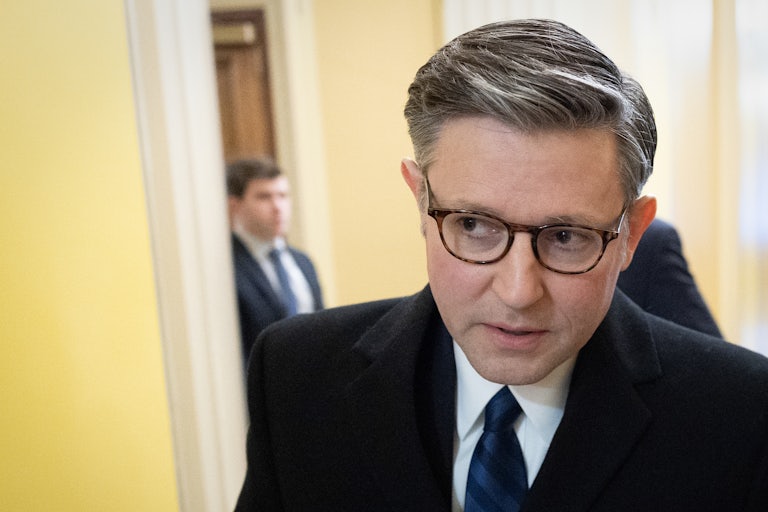
House Speaker Mike Johnson in the Capitol.
Win McNamee/Getty Images

On Monday, President Trump suggested that Republicans should “take over” and “nationalize” voting. But House Speaker Mike Johnson isn’t too concerned.

“The Republicans should say, ‘We wanna take over, we should take over the voting in at least 15 places’; the Republicans ought to nationalize the voting,” Trump said on former Deputy FBI Director Dan Bongino’s podcast Monday. “We have states that I won, that show I didn’t win … like the 2020 election, I won the election by so much. Everybody knows it.”

CNN’s Manu Raju made sure to ask Johnson about the president’s statements the next day.

“Mr. Speaker, the president had called yesterday for a takeover of federal elections; [he] said to nationalize in some states, is that something that you think he should do?” Raju asked.

Johnson proceeded to claim that Trump just didn’t really mean that.

“The president is expressing his frustration about the problems that we have in some of these blue states, where election integrity is not always guaranteed,” Johnson said, making a baseless claim about election security in blue states in order to defend a man who still lies about winning the 2020 election. “So we have to figure out solutions to that problem, and that’s what I think—”

“Take over?!” Raju interrupted, not allowing the speaker to ramble on without acknowledging the actual question.

“No, no,” Johnson said.

The U.S. Constitution orders that elections be governed by states and locales, not the executive branch. Even still, it’s hard not to hear Trump’s comment about taking over elections without immediately thinking about January 6. This time we should take his threats seriously—especially given the recent FBI raid of an election office in Georgia’s Fulton County.

Maryland County Abruptly Revokes Permit for Planned ICE Facility

The change came after local pushback.

A sign that says, "ICE out now" stands at a memorial for Alex Pretti
CHARLY TRIBALLEAU/AFP/Getty Images

A Maryland community has nixed a previously issued building permit for a private detention center that local officials said would be used by Immigration and Customs Enforcement.

The Howard County government revoked the permit Monday, ending construction for the proposed detention facility at 6522 Meadowridge Rd. in Elkridge, just across the road from a quiet residential neighborhood and within half a mile of several schools.

“The retrofitting of private office buildings for detention use without transparency, without input, without clear oversight, is deeply troubling,” said county executive Calvin Ball during a Monday press conference. “In this case, the proposed detention center sits in an existing office park in close proximity to health care providers, schools, parks, and neighborhoods.”

The Howard County Council introduced two pieces of emergency legislation later that evening intended to formally prevent private entities from operating detention centers within county lines.

The five-person council will hold an emergency public hearing on the bills Wednesday, which will be followed by a vote.

“Since there are four co-sponsors on the bill, it is about 99.99 percent likely to pass,” County Council chair Opel Jones said to a standing ovation, WTOP News reported.

The proposed Elkridge detention center is the latest ICE contract to be killed in light of the agency’s escalating violence. Landowners in Oklahoma City backed out of a similar deal with the federal agency late last month, citing community safety concerns should ICE move in following the extrajudicial killings of two U.S. citizens at the hands of federal agents.

It is far from the end of ICE’s encroachment in Maryland, however. The “Free State” already has three primary detention facilities, one of which is in Howard County. And last week, the Department of Homeland Security purchased a warehouse near Hagerstown, sparking concerns that the site could be used as yet another detention center for deportations.

ICE detained more than 3,200 people in Maryland in 2025, doubling the number of arrests of previous years, according to figures from the Deportation Data Project. Just one-third of the detainees had criminal convictions, while more than 50 percent had no criminal history whatsoever.

Russia Strikes Ukraine Hours After Trump Bragged About Deal With Putin

Donald Trump boasted about getting Vladimir Putin to agree to a pause in hostilities.

The upper floors of a building in Kyiv, Ukraine, burn after a Russian attack
Yan Dobronosov/Global Images Ukraine/Getty Images

You’ll never guess which country launched a massive attack just hours after President Donald Trump announced yet another supposed temporary ceasefire between Russia and Ukraine.

Sitting at his desk in the Oval Office Monday, Trump repeated his claim that Russian President Vladimir Putin had “agreed” to pause Moscow’s repeated strikes on Ukraine’s energy infrastructure, as the temperatures in Europe dropped dangerously low.

“I asked him if he wouldn’t shoot for a period of one week, no missiles going into Kyiv or any other town, and he’s agreed to do it, so it’s something,” said Trump, the king of wishful thinking—or more just utter bullshit.

Trump had initially claimed there would be a weeklong ceasefire during a Cabinet meeting Thursday, sparking some confusion in Kyiv about when the pause would actually begin, or what it would entail. Kremlin spokesperson Dmitry Peskov clarified that Russia had only agreed to pause strikes until February 1 “in order to create favorable conditions for negotiations,” which are set to resume Wednesday in Abu Dhabi.

That would mean Trump’s supposed weeklong ceasefire was only in effect for two days.

True to its word, Russia resumed strikes overnight Monday, launching 450 attack drones and more than 70 missiles, hitting power plants in at least six regions and leaving more than 1,000 residential buildings in Kyiv without power. So, as much as Trump would like to play-act like he has Putin’s ear, that’s clearly not the case.

“Taking advantage of the coldest days of winter to terrorize people is more important to Russia than turning to diplomacy,” Ukrainian President Volodymyr Zelensky wrote on X, early Tuesday.

Ukraine’s Energy Minister Denys Shmyhal said the attacks on “purely civilian” targets amounted to “another Russian crime against humanity.”