Breaking News
Breaking News
from Washington and beyond

Trump Prepares to Scrap 50-Year-Old Radiation Safety Rule

The Trump administration is ready to get rid of a key radiation safety standard.

The Idaho National Laboratory DOME
Natalie Behring/Getty Images
The Idaho National Laboratory DOME, or Demonstration of Microreactor Experiments of the National Reactor Innovation Center, west of Idaho Falls, Idaho, on June 24

The White House wants to get rid of a radiation safety rule that is over 50 years old and has been adopted by other countries.

The Nuclear Regulatory Commission is looking at eliminating the “as low as reasonably achievable” principle, which mandates that hospitals, nuclear plants, and other facilities keep radiation levels at an absolute minimum, even when they are already below legal limits. The rule would be replaced with a “graded approach” that puts different safety measures in place based on expected radiation exposure levels.

The legal limits for workers and the public would stay the same, and the NRC said that the public would not be any less safe.

“We’re just removing the ambiguity,” NRC Chair Ho Nieh said. “But the standard for exposure to workers and the public, those are not changing. We’re just putting in place greater clarification.”

The nuclear industry is in favor of the move, with its main trade association, the Nuclear Energy Institute, claiming that safety is still a priority.

“We will always continue to look at what we can do to reduce the dose to workers, and maintain our doses to the off-site public as low as possible,” Doug True, chief nuclear officer at the NEI, said to the Associated Press. “It’s not like we’re just going to throw open the doors and let everything run up to the limits.”

But other experts are concerned about what will happen given that the new rule raises permissible radiation limits. Edwin Lyman, director of nuclear power safety at the Union of Concerned Scientists, told the AP that the new proposal could raise radiation doses.

President Trump wants four times as much domestic nuclear energy production to satisfy the growing electricity demand from new data centers powering artificial intelligence. He issued four executive orders in May last year to boost government funding for nuclear power and overhaul nuclear regulations. In doing so, though, the president may get rid of some guardrails that protect Americans from the downsides of nuclear energy.

Trump Confirms He’s Hoarding Billions From Venezuelan Oil

President Trump is refusing to say what happened to the billions his administration took from Venezuelan oil sales.

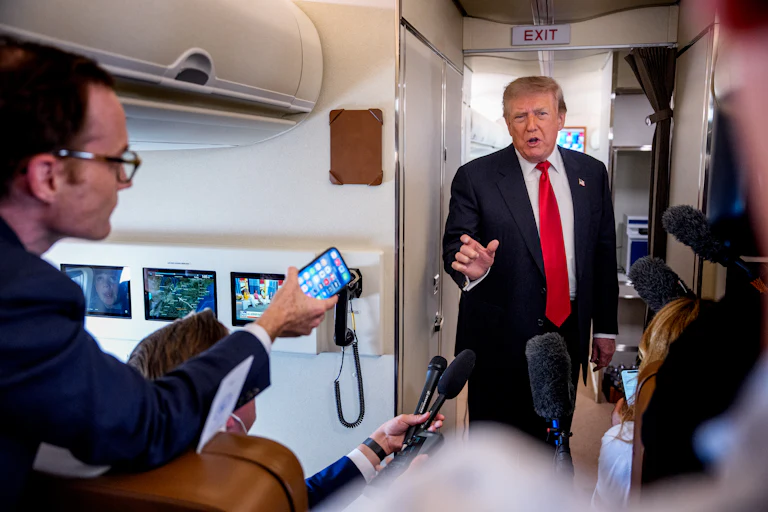
Donald Trump speaking to reporters aboard Air Force One
Andrew Harnik/Getty Images
President Donald Trump speaks to reporters on Air Force One during a trip to Michigan on July 27.

President Trump still won’t say where exactly the $13 billion of Venezuelan oil revenue that his administration collected has gone.

“There’s some reports that the United States has taken in $13 billion from Venezuela,” a reporter asked Trump at the Air Force One press gaggle on Monday afternoon. “Where is that money going?”

“Thirteen billion from Venezuela? I think even more than that,” Trump replied. “Venezuela, we paid for that war many times over. And that’ll happen with Iran also. We paid for the war many times over.”

“But where’s that money going?”

“No other president can say that for a long time,” Trump continued, ignoring the question. “We had a cost.... We paid for it many many times over. And now, as you know, we have a very good relationship with Venezuela.”

“But where is the money going?” the reporter asked yet again.

“It goes toward running the country.”

“No … the money that the U.S. is taking in, where is that money going?”

“From Venezuela?”

“Yes.”

“Towards running the country. It can go to the military. Congress has to approve it.... We’re taking in a lot of money. Billions and billions of dollars from Venezuela.”

The president couldn’t offer anything close to a straight answer on where those billions went. First, the story was that it’d go back to the Venezuelan people, whom Trump pretends to care about very much. But last week, the Financial Times reported that after six months and two devastating earthquakes, the money is still nowhere to be found. The publication reported that the Trump administration must have collected an estimated $13 billion, though Trump’s statement on Monday is the first hint at an actual number.

The last solid lead we had on that money was when Semafor reported that Trump would be keeping proceeds from the first sale in an offshore bank account based in Qatar. Maybe that has something to do with his nonanswer.

MAGA Either Hates Trump’s Signature Bill—or Has Never Heard of It

Bad news for Trump: Even his biggest fans aren’t a fan of his “big beautiful bill.”

An attendee wears a “Make America Great Again” t-shirt while speaking to a younger woman whose shirt likely reads "Republicah Girl."
Oliver Contreras/AFP/Getty Images
A kick-off celebration for the “Great American State Fair” on the National Mall in Washington, D.C., on June 2

President Trump’s “One Big Beautiful Bill Act” has barely made a dent with American voters, which doesn’t bode well for Republicans in the midterms. 

Almost half of all Americans either can’t explain what it is or have not heard of it, according to a new Politico poll. Those who have heard about it don’t like it, saying that it benefited other people, like wealthy Americans.

With affordability a major political issue, Republicans have tried to rebrand the bill, which doled out tax cuts for rich Americans at the expense of programs like health care, as “Working Families Tax Cuts,” without much success.

“Putting more money in Americans’ pockets. Helping them seize opportunities to get ahead, and creating new pathways to success,” Senate Majority Leader John Thune said Wednesday on the Senate floor. “That is the Working Families Tax Cuts at work.”

Only about 25 percent of people who voted for Trump in 2024 believe that the bill gave the working class big tax breaks. The fact that the bill included tax deductions for tipped wages and overtime pay, as well as Trump Accounts for children, hasn’t swayed opinions. 

Meanwhile, more than half of Americans—57 percent—believe the Iran war has made things more expensive, according to the poll. Iran’s closure of the Strait of Hormuz has had ripple effects affecting everything from gas prices to fertilizer shortages, hurting farmers along with average Americans. Trump hasn’t done much to defend or even mention the bill in his regular speeches, either. 

This has opened the bill up to attacks from Democrats, who merely have to point to bad economic news to discredit any potential gains. Democratic candidates have also rightfully connected the tax cuts to cuts to food stamps, Medicare, and Medicaid. Politico’s poll found that many Americans say they prefer funding health care and nutrition assistance over some tax breaks. Trump is not doing much to address that sentiment, dismissing affordability as a made-up word and opposing a bipartisan affordable housing bill last week.  

“Trump cuts food assistance and health care. Billionaires get another tax break,” Senate Minority Leader Chuck Schumer said on the Senate floor last week. That seems to be a winning message for November’s midterms for Democrats. 

McConnell Laments Missing a Picnic in Useless Update on His Health

The MIA senator did share a new photo of himself, though.

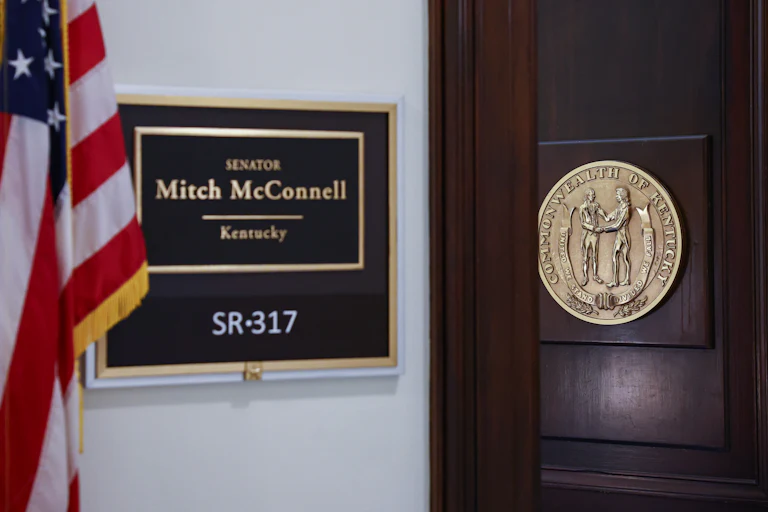
Senator Mitch McConnell's office door
Finn Gomez/Getty Images

Senator Mitch McConnell’s office has finally addressed the lawmaker’s ongoing absence—insofar as it relates to his ability to chow down on some red meat at Kentucky’s annual Fancy Farm picnic.

“There’s no place I’d rather be on the first Saturday in August than with the good people of western Kentucky, feasting on pork and mutton,” his office wrote in a statement Monday to the Bluegrass State’s Hellbender Newsroom. “When I first attended forty-two years ago, Fancy Farm was a pretty lonely place to be a Republican. But, my, how times have changed. Today, western Kentucky is a conservative Republican sea of red.

“So I hate that I’ll miss the fun this year, but I’m sending my best wishes to the St. Jerome community for a successful picnic,” the message ended.

His team also released a new photo of McConnell and his wife, Elaine Chao.

Screenshot of a tweet
Screenshot

The Kentucky senator has been missing in action for more than a month after he was found unconscious in his Washington residence and rushed to the hospital on June 14. For weeks, McConnell’s office has refused to explain his extended hospitalization or elaborate on his eventual return to Capitol Hill.

The media blackout briefly ended on July 12, when the senator’s office shared a photo of McConnell sitting upright in a chair beside his wife, holding a copy of that day’s Washington Post sports section in his lap.

A statement released by his office alongside the image, written in the first person so as to suggest it was penned by McConnell himself, specified that while the 84-year-old had not broken bones, suffered a concussion, or had a heart attack or stroke, he had dealt with a “mild case of pneumonia” during his time in the hospital.

He did not offer a projection for when he might return to work, noting that he moved to a rehabilitation facility and is still “working closely” with legislative staff.

McConnell’s team has not provided any further explanation or evidence supporting McConnell’s improving health condition in the weeks since, despite demands from his constituents and local lawmakers.

On Saturday, West Virginia Senator Shelley Moore Capito told independent journalist Nicholas Ballasy that she had spoken to someone the day before who visited McConnell and said that “he’s clear-minded, and he just needs to get stronger.”

Read more about McConnell:

Trump Team Overhauls Asylum Process to Speed Up Deportations

Asylum officers can now deny applications without an interview.

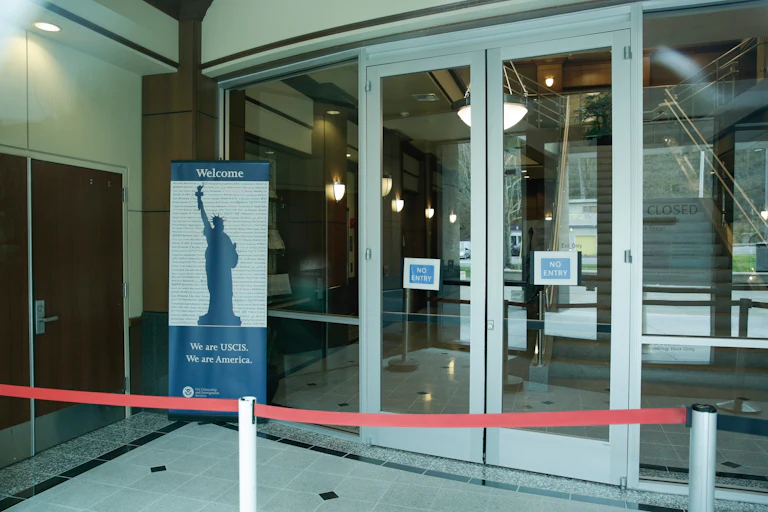
A USCIS field office
JASON REDMOND/AFP/Getty Images

President Donald Trump’s administration has found a new way to gut due process and fast-track deportation for asylum applicants.

U.S. Citizenship & Immigration Services, or USCIS, the agency that manages visas, green cards, naturalizations, and other aspects of the legal immigration process, published a new regulation Monday allowing officers to refer hundreds of thousands of asylum applicants directly to deportation proceedings without interviewing them.

The rule would scrap USCIS’s long-standing practice of offering interviews to asylum applicants already in the United States. The agency claimed that it had previously offered interviews despite there being “no statutory right to an interview or requirement to conduct one.” The rule would also remove references in Department of Homeland Security materials to a “right” to an interview and language asserting that asylum officers would review cases “in an interview.”

“This means many people will never get a chance to argue their case,” Aaron Reichlin-Melchick, a senior fellow at the American Immigration Council, wrote on X Monday. In order to receive asylum, applicants must demonstrate a well-founded fear of persecution in their home country.

The filing states that the new rule will “more quickly place certain aliens into removal proceedings” with immigration judges at the Executive Office of Immigration Review, or EOIR. Once asylum applicants are passed to the EOIR, the cases that are deemed “legally deficient” may be pretermitted, meaning those applicants can be deported without a hearing.

No interview and no hearing? That sounds like a clear violation of due process—which the Trump administration has been angling to obliterate for more than a year.

In addition, the new rule would allow asylum officers to “determine that the alien does not merit a grant [of asylum] as a matter of discretion without first making an eligibility determination,” and would also stop requiring a letter communicating that the basis for referral of asylum should include an assessment of the applicant’s credibility.

The rule was published Monday, to be implemented Tuesday without prior warning or public comment period—and will likely invite a slew of legal challenges under the Administrative Procedures Act.