
I managed to find one person in Coos County, New Hampshire, who would admit to voting for Bernie Sanders in the 2016 primary and Donald Trump in the general. Don Couture, 79, is a Berlin native who spent most of his career as a salaried worker at the town’s long-gone Converse plant. “I like pretty much everything about Bernie and will support him in the primary again,” said Couture, who registered as an independent in 2016 after a lifetime of voting Democratic. “People should work, not expect handouts, but I think everybody should have Medicare. The drug companies have gone berserk, making money hand over fist—what about this guy who raised the price of that drug a thousand percent? That’s ripping off the American people. When Bernie says something, he means it. He reminds me of Ross Perot.”
Sanders, Trump, Perot—wildly different politicians who shared an outsider’s sensibility and appeal. It was Sanders’s outsider status, his demands to tear down a rigged and unequal system, that delivered New Hampshire so decisively to his campaign four years ago against Hillary Clinton. That same message will likely deliver the state to him again, even against a full slate of rivals. If New Hampshire was the first great proving ground of Sanders’s campaign in 2016—the moment when he demonstrated he was more than a protest candidate and capable of slaying the establishment dragon—this time it’s the key test of a strategy to shorten the competitive primary. The campaign has for months been pressing its advantage in community contacts and issue expertise, deploying an army of volunteers and surrogates to deliver its message directly to the state’s politically unpredictable, overwhelmingly white population. The Sanders operation’s network of grassroots allies gives it an edge everywhere but perhaps especially in places like Coos County, which has recently seen great socioeconomic tumult and political drift.
If people outside of New Hampshire know anything about Coos, it’s the quaint quadrennial story of the first “midnight votes” cast during the presidential primary by the residents of the far northern village of Dixville Notch. For much of the last century, the region fit the stereotype of the wholesome Rockwellian New England democracy. Coos (pronounced Koh-oz) was once the prosperous center of the U.S. paper industry. Nestled inside the White Mountain range, it was home to several large mills that produced much of the nation’s newsprint and cardboard and provided union jobs for life to generations of French-Canadian immigrants and their descendants. A streetcar connected the red-brick downtowns of Berlin and Gorham, busy with shops, theaters, and restaurants. In the valleys, small farmers built a thriving local dairy industry.
The further this world recedes into the past, the harder it is to believe it ever existed. But the old-timers can testify that this fairy-tale of stakeholder capitalism in paradise was real enough. A recent headline of The Berlin Sun solemnly announced the death at age 94 of James C. Wemyss, whose family owned and operated the Groveton Paper Company for 60 years. My interview with the paper’s editor was interrupted when an elderly man stopped by to pick up a dozen copies. “I know a lot of people who will want to read this,” he said. “James Wemyss and his family did a lot for the community. When I was a boy, if somebody needed some food, or a handout, they went and saw Mrs. Wemyss. If you needed a Christmas tree, just go to their land and cut it down.”
When the mills were strong, so was the Paperworkers Union. Coos County was as solidly Democratic as any county in New Hampshire. “When I was growing up, my grandparents, who emigrated from Quebec, hung a five-by-seven picture of FDR in the living room,” said Paul Grenier, Berlin’s 64-year-old mayor. “The Democratic Party was revered here. The GOP was looked on as the snotty rich party.”
Coos’s affiliation with Democrats weakened as the paper industry began to contract in the 1990s, and many blamed the region’s economic decline at least partly on an out-of-touch Democratic Party that was signing trade deals and touting globalization. As the empty mills crumbled, in the late 1990s and 2000s, a Walmart went up, plans were announced for the construction of a new state prison, and opioids hit the Great North like the plague. Today, amid a generally bleak job market, counseling work at family services and addiction treatment centers is a rare Coos County growth field. The opioid scourge, meanwhile, is in a third wave, made up mostly of Suboxone and fentanyl. In the offices of the HOPE counseling center, opened in downtown Berlin in 2016, a young staffer named Lisa Kenney tells me that the overdoses in town increasingly require as many as four or five Naloxone injections to counteract. Like several other Berlin-area counselors I spoke with, Kenney is supporting Bernie Sanders.
“We need universal health coverage that includes addiction and includes recovery services, and we have to hold the companies who started this epidemic accountable,” she said. “I think Sanders would try and get after the originating issues, not just tell people what they want to hear, like Trump. We need to fix this. More and more of our clients aren’t eligible for state insurance and can’t afford private insurance to cover MAT [Medically Assisted Treatment].”
Four years ago, Sanders received 3,637 votes in Coos County on high turnout in the open primary (which allows independents to vote)—nearly 1,500 more votes than Trump received in his primary. In November, Coos County broke for Trump in the general by nearly 1,400 votes, roughly half of Clinton’s slim statewide margin of victory. There’s no way to tally how many Coos County voters supported Sanders in the primary, then switched to Trump in the general. But the numbers suggest Sanders would have won Coos County had he been on the November ticket, and won New Hampshire by a much wider margin than Clinton did.
The question that Coos County can help answer is whether Sanders is the candidate best positioned for success in critical Rust Belt regions that share its problems—and that broke hard for Trump in 2016. A strong showing there would constitute something of a rebuttal to establishment Democrats sounding the alarm over Sanders’s “electability.”
But Sanders has bigger stakes riding on New Hampshire than the balloting in a small postindustrial county that resembles so many others in different regions of the country. New Hampshire is the first test of a mature movement campaign, in a state bordering Sanders’s own, within commuting range for many in a region full of grassroots organizations that not only admire Sanders but also understand how to do the work. It’s a favorable location, in other words, for a statement about what a movement campaign can do, and how.
The close finish between Sanders and Pete Buttigieg in Iowa looks like a messier version of Sanders’s rounding-error loss to Hillary Clinton four years ago. If next Tuesday’s primary in New Hampshire follows the same basic script as 2016, any lingering firestorm over the caucus mess will be drowned by the sound of a Sanders victory speech. The last time Sanders was on a New Hampshire ballot, he didn’t just win; he smashed most of the state’s standing primary records, including highest margin (plus 22) and total votes (nearly 152,000). He swept all 10 counties and fell 108 votes shy of sweeping its several hundred polling stations. He outperformed Clinton four-to-one with a record number of first-time voters and three-to-one with independents. Were it a prize fight, the ref would have stopped it.
Because the 2020 field is busier, including a competitor for progressive votes in Elizabeth Warren, another bloodbath is unlikely. It’s also a different state this cycle. New Hampshire has one of the country’s highest rates of population turnover, and more than a fifth of next week’s potential primary voters were too young to vote or living in another state four years ago, according to the University of New Hampshire’s Carsey Institute.
What hasn’t changed is Sanders’s status as the movement candidate, as well as his broad support across New England’s membrane of grassroots groups and networks. These groups showed up in 2016 but are better prepared this time, and stronger. Many of the voters who discovered politics because of Sanders four years ago are returning to the campaign as experienced organizers and canvassers.
Though the members of this grassroots mobilization represent a tiny percentage of the population, they are potent force multipliers, and their closer involvement in the 2020 campaign has already led to a correction of one of the biggest weaknesses of Sanders’s 2016 campaign. “Last time, the campaign was limited by a sense that it didn’t fully understand the issues impacting communities of color, but this time Bernie did a tremendous amount of work eliciting feedback from our affiliates,” says Ana Maria Archila, co-executive director of the Center for Popular Democracy, a network of community organizations that has endorsed Sanders and is active in 34 states, plus Puerto Rico and Washington, D.C.
“Now when I look at our network, every single immigrant group that can endorse candidates has endorsed Sanders,” she adds. “Usually in presidential elections, it’s the unions that attract the attention, but they’re sitting out the most important election of all. It’s a huge vacuum that community organizations have stepped into.”
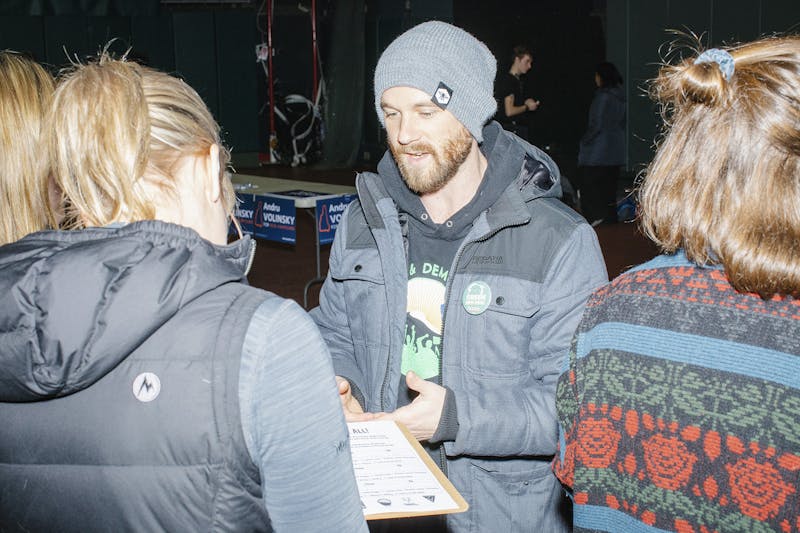
One of the CPD affiliates active in New Hampshire during the run-up to Tuesday’s vote is Rights & Democracy, or Rad, a 12,000-member grassroots group with chapters across Vermont and New Hampshire. On a gray morning two days before the Iowa caucus, in the basement of the Nashua Public Library, a few dozen people had gathered for an event called “Jobs, Justice, Climate.” It featured talks by Sanders’s surrogate for the Green New Deal, Varshini Prakash of the Sunrise Movement, and his surrogate for local environmental issues, Mindi Messmer, a scientist, whistleblower, and activist who gave a dark accounting of the cancer rates and pediatric cancer clusters that are the mounting cost of New Hampshire’s anything-goes approach to business dumping toxins in the air and water.
Along the wall, a 10-foot Sanders campaign banner hung next to an equally large Rad banner. The usual campaign event formalities were few, and Sanders’s name was hardly mentioned. No one bothered to explain whether the campaign was hosting the local grassroots organization or vice versa, because the question is mostly tautological. This was the campaign slogan, “Not me, us,” in action: a community event focused on the substance of local and planetary environmental emergencies, conducted on the assumption that engagement is the precondition for the sustained mass mobilizations required to achieve structural change.
The Nashua event included a number of activists who first encountered this theory of change during Sanders’s 2016 run and continued to put it into action well after Sanders dropped out of the race. Messmer, the scientist-activist, decided to challenge the state’s biggest corporate polluters when the campaign ended. The following year, she blew the whistle on the multinational conglomerate 3M for dumping toxins in the local water—resulting in stronger regulations and a 3M countersuit—and founded the New Hampshire Safe Water Alliance. As Sanders’s New Hampshire co-chair, she embodies the fusion-driven tactics at the core of the campaign. “The grassroots and the campaign have the same goals,” she says. “All of this builds on the coalitions that Bernie helped bring together in 2016.”
Another attendee in Nashua who is returning to the campaign as a seasoned organizer is a 46-year-old postal worker named Regan Lamphier. Until her teenage son dragged her to a Sanders rally a week before the 2016 primary, she’d never given much thought to politics. She’s since become active in Rad and her local of the American Postal Workers Union, whose 200,000 members endorsed Sanders in January. Lamphier sees her campaign work as a natural extension of her year-round activism. “Bernie has brought so much energy to the grassroots—labor, the environmental and social justice groups—and we put it right back into the campaign,” she says. “No one has gotten us excited like this.” She’s also living proof of another Sanders campaign theory: that it can turn out voters who had previously sat out elections because they had written off politics as a hopeless cause.
The grassroots aspect of Sanders’s campaign, somewhat paradoxically, can be most appealing to contrasting voter types: the most engaged and the least. But the Sanders campaign is also poised to benefit from a spreading ambient anxiety about the state government’s apparent eagerness to make New Hampshire a hub for fracked gas infrastructure, from terminals on the seacoast to crisscrossing pipelines headed to neighboring states.
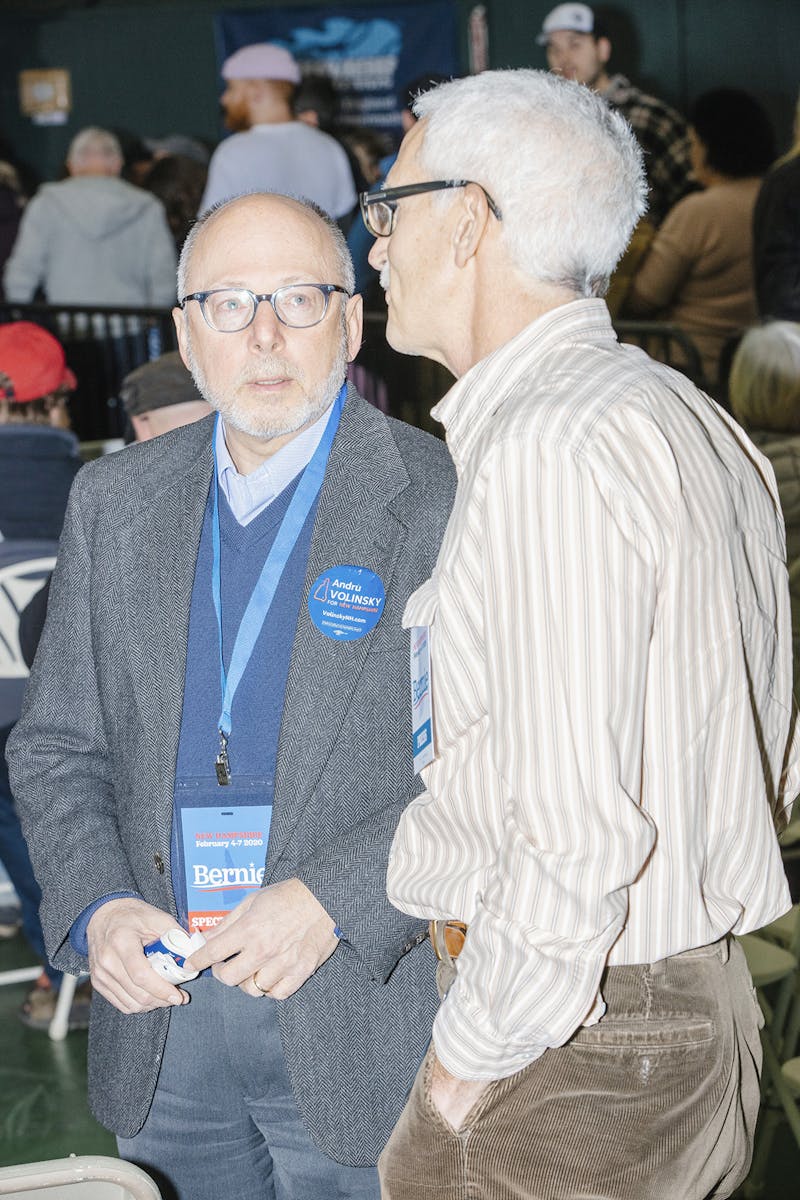
In New Hampshire, popular opposition to a series of controversial energy projects has in recent years raised the profile of the fracking issue. Andru Volinsky, a Sanders surrogate and gubernatorial candidate, says Sanders endeared himself to a lot of otherwise moderate Democrats when he sided with communities over corporations in 2016. “Sanders came down against a Northeast Energy pipeline planned for south New Hampshire that was later stopped because of public uproar,” says Volinsky, a Nashua lawyer who defeated a 2015 attempt to deny Sanders a spot on the New Hampshire ballot on grounds that he wasn’t a Democrat. “Hillary was silent on the pipeline, tacitly supported it. It made a difference, and Bernie did really well in the south. People remember his principled opposition.”
And if any New Hampshire voters now seem likely to forget the 2016 pipeline battle, a number of groups are on the ground throughout the state to remind them. The community opposition to the Northeast Energy pipeline project hatched a number of anti-fracking groups, the largest of which—the Pipe Line Awareness Network, ECHO Action N.H., and the N.H. Pipeline Health Study Group—continue to function and grow as part of a nationwide coalition of more than 200 similar organizations. They now promote clean energy and mobilize communities against industry-sponsored projects designed to counter groundswells of opposition. It’s a vivid example of how the Sanders campaign is able to connect local politics to national politics and tie both in turn to the ultimate global issue of our time, climate change and the end of the fossil fuel era.
It won’t hurt Sanders, then, that for the last year another fracking gas project has been roiling southern New Hampshire and the coastal city of Portsmouth. “Anti-fracking is like a gateway drug for people,” says Josh Fox, a filmmaker and Sanders surrogate. “When communities bind together against huge corporations to fight for their children, they learn quickly who their allies are. They’re exposed to the other movements. They all tilt to Bernie because he’s been with them from the beginning. The fracking movement is a spiderweb of thousands of mom-and-pop groups. Every other campaign has to weave them. Bernie just inherits them.”
Which isn’t to say the Sanders campaign has been sitting around waiting for groups to walk through the door. Sanders’s New Hampshire campaign strategy has for years involved monitoring the news for the appearance of new community organizations, wherever they spring up and whatever their size.
These include groups in rural back roads deep inside the White Mountains near the Canadian border. Two years ago, in Coos County, rural communities rose up in opposition to a Canadian firm’s proposal to run 192 miles of high-voltage power lines through the mountains and into Massachusetts. Before the state Supreme Court quashed the project last July, a veteran lawyer and campaigner for progressive candidates and causes named Ted Bosen followed news about the rural opposition closely from the Coos County farm where he raises chickens and goats. Though he’s now retired from his law practice, Bosen never stopped being active in politics and currently serves as vice chair of the Coos County Democrats. He is a senior member of the Sanders campaign’s New Hampshire steering committee.
“If people are standing up and doing something in their communities, we identify and try to organize them,” he says. “They may not be traditional party people, but neither is Bernie Sanders.”
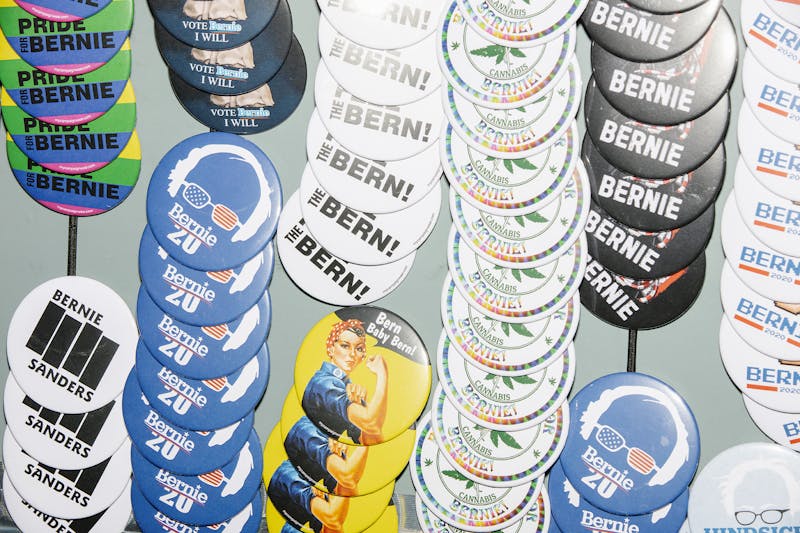
Other than the window display in the Sanders campaign office, the only campaign sign on view in downtown Berlin is a sticker on the door of Middle Earth, an unlikely head shop in the middle of a mostly cobwebbed Main Street. The proprietor is also unlikely: a Berlin native whose environmental engineering career at Brown Paper was cut short by a marijuana arrest in 1969. Where most people would have left town, Richard Poulin opened Middle Earth in 1969 “as an F.U.” to the local cops and proceeded to spend the next 50 years becoming the area’s most effective environmental gadfly and campaigner. His successes include passing local renewable energy incentives and the establishment of a municipal power authority.
“For decades, a foot of toxic foam coated the Androscoggin downriver from the mills,” he says. “They just dumped PCBs into the river. Nobody touched the water or fish for decades. This was the most polluted city in New England. You could smell Berlin 25 miles away.”
A longtime admirer of Bernie Sanders since his days as mayor of Burlington, Poulin signed up for the campaign when Sanders announced in 2015. He was content that Sanders would exert some amount of pressure from Clinton’s left. Then he attended an overflow event downstate and realized the campaign had legs. “I thought, ‘Holy shit, we may actually do this,’” he remembers.
Poulin wasn’t surprised that Sanders did well in the county, or that it broke for Trump in the general. He suspects the Sanders-to-Trump voters are the people he grew up with: union Democrats who lost their jobs in middle age, then watched everything fall apart. “Bernie is the one person who could credibly speak to these people and take a chunk of them back,” he says.
The first death of the New Hampshire paper industry occurred during the Great Depression. Soon after the crash of 1929, the regional economy contracted violently. In 1931, the region’s second-biggest employer, International Paper, shut down. The following year, the Brown Paper Company, Berlin’s leading employer, laid off all unmarried men, and eventually all married men without children. In 1933, 150 unemployed mill workers founded the Coos County Workers Club. Like other labor groups beginning to emerge across New England and the Midwest, it took inspiration from the Minnesota Farmer-Labor Party’s socialist manifesto and clean break with the Democratic Party.
Welcoming barbers and cooks under the same tent as the craft unions, the Club group quickly grew to 4,000 members. In March 1933, it launched the Berlin Labor Party with a slate that dominated the 1935 city elections—a political revolution in the Great North. With control of the mayor’s office and city council, the renamed Farmer-Labor Party provided social relief, conditioned loans to the mills on higher wages, and organized the local dairy farmers into a cooperative that managed boycotts of nonlocal milk and forced the state dairy board to institute price controls.
For the speed and scope of its victory, the Berlin FLP punched far above its weight in the growing intra-labor debate over the need for a national FLP that could challenge the Democrats for Senate seats and the presidency. “From their power base in Berlin they attempted to expand not only throughout the entire state of New Hampshire, but also nationally,” write Eric Leif Davin and Staughton Lynd in The Forgotten History of the Local Labor Movement. Gearing up for his reelection campaign, Franklin Roosevelt watched with mounting alarm as the papermakers and dairy farmers in New Hampshire started to consider forging their own reformist agenda. The region’s fledgling coalition of socialist-minded insurgents began to discuss fielding third-party national candidates on a platform of progressive taxation, union power, nationalizations, social welfare, and public spending.
If that policy mix sounds familiar, it’s because FDR stole most of it for the 1936 platform on which he won a landslide reelection—and in the process dispatched the FLP into a steep slide into the history books, though its legacy endured at the center of what became known as the Second New Deal.
Eighty-four years after a political revolution in the mill towns of Coos County midwifed the New Deal, it’s impossible not to savor the possibility, however remote, that the votes of a few thousand descendants of FLP firebrands could tip fortune’s scales in favor of Sanders’s political revolution and the Green New Deal. If this scenario unfolds in Tuesday’s primary vote, Berlin may yet see a revival that reminds residents of happier times, even if the fairy tale was never quite what it seemed. No matter who wins, Coos County may undergo a revival of sorts anyway: A grassroots alliance has begun organizing for a regional Green New England Deal. It will hold its first canvass on Friday in the parking lot of St. Anselm’s College, the site of the Democratic presidential debate. Everybody there will be rooting for Sanders.