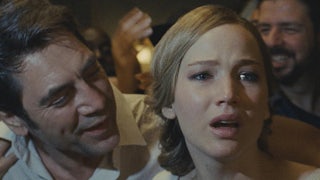
I’m a big fan of Tom Hooper’s 2008 HBO miniseries John Adams. Perhaps it’s because I’m a dad. Its genre is very much that of Dad Cinema classics like Master and Commander, in that it offers a granular, somewhat sentimental depiction of military history, an emphasis on neat, easily repeatable historical fun facts, and a wide-ranging account of the exploits of Great Men. And sea battles! It has a sea battle! It’s also based on David McCullough’s biography of the founding father, a very popular book in the genre of Dad History—or Airport Nonfiction, as Anne Trubek calls it. Imagine the experience of falling asleep with your bedside lamp still on, having read six pages of a 750-page work of popular history that lies heavily on your rising and falling belly. They made a TV show of that!
But I also like to think that I admire John Adams for other reasons. The best way I can describe this show, if you haven’t seen it, is that it is very, very gross. Hooper—famous for his Oscar-winning snot-drenched close-ups of Anne Hathaway in his film adaptation of Les Miz—loves reminding us how nasty the eighteenth century was, and how gnarly and smelly and damp life in the new republic could be. His frame is full of intimate images of rotting teeth and sweaty wigs and shit-smeared boots and bloody streets. In this show, we see a man tarred and feathered, the gruesome process of a family being inoculated against smallpox, a sailor have his leg amputated, a young woman undergo a mastectomy, John Adams nearly die of fever in Holland, and George Washington lose a tooth at dinner. The ideas are important to Hooper, and so are the historical narratives (true and false), but what’s most important is the bodies.
These choices make John Adams aggressively, and appealingly, a story about how the foundations of American democracy were laid by a group of extremely physically vulnerable human beings. They were vulnerable to violence, to illness, to infection, to weather. It was just as easy to die as it was to stay alive in New England in the 1770s. And while much of the show is grisly, it can also be quite moving. To think that this nation was built by such fragile creatures.
As a fan of John Adams and its pungent, provocative physicality, I was dismayed to watch the new Revolutionary War documentary miniseries, On This Day … 1776. Commissioned by Time magazine, produced by Darren Aronofsky, and airing in serial installments on YouTube, On This Day is one of the highest-profile TV projects yet to be produced with generative AI tools. On This Day is a predictably, but still shockingly, disembodied affair. Watching the episodes that have aired thus far is a surreal experience, a work of national memory that feels more like hallucination than history. If John Adams’s vulgar bodiliness told a story of how vulnerable the revolutionaries were, this new series inadvertently tells a story about how very vulnerable we all still are.
It’s surprising that Darren Aronofsky is involved with this. From Pi to Black Swan, Requiem for a Dream to The Wrestler, Aronofsky has made great and gory films of varying quality, but their uniting factor is their obsession with bodies. I remember so many moments from his filmography, and I’m hard-pressed to identify one that doesn’t live, paired in my mind, with the visceral sensation I felt when I first saw it. His early work through Black Swan was mostly shot on 16mm film, lending those films a grainy materiality that, in many ways, defined his aesthetic. So it was surprising to a lot of people last year when he announced that he was founding a studio—Primordial Soup—to explore the possibilities of AI technology.
The first really striking moment in On This Day is a close-up of King George III. The general format of the series is that each mini-episode—the episodes thus far are all under five minutes—dramatizes a particular pivotal event that occurred on the day it was released back in 1776. The first episode, released on January 1 of this year, is about George Washington’s decision to fly the Continental Colors flag on Prospect Hill, on January 1, 1776. Before we turn to Washington, though, the episode begins with the king addressing his Parliament, declaring the colonies to be in rebellion against the throne. Aronofsky and his team are adamant to point out that all voice actors hired for the series were SAG-AFTRA members and that their performances were recorded, as we might say, old-school. But the voices throughout are bizarrely mismatched with the movement of the characters’ animated mouths. For as advanced as this technology is, it has some of the telltale problems that digital animators have long ironed out in the years since Robert Zemeckis’s uncanny-valley motion-capture odyssey, The Polar Express. This series, in other words, bears the marks of both new and old digital technology.
Our vision of George begins in a medium shot, alternating with frames of bewigged lords whispering scandalously with each other. Despite the undulating synthetic background, George moves twitchily, glitchily as he speaks. When not represented in extreme close-up or in slow motion, the series has a hard time replicating the natural movements of human heads, if that’s something you think would bother you. Then we cut to a head-on close-up of George, dead eyes looking directly into camera, and, with a thump, we get an on-screen chyron telling us who he is. The series uses this stylistic signature in every episode when we meet a new, key character. It reminded me most of the pulpy grind-house character intros in Kill Bill, and much of the series’s cinematography draws on that particular style of late-’90s, post-Tarantino self-conscious visual bravado.
But it’s the next shot, a close-up of George in profile, that struck me most. Here we get our longest, lingering view of his face, and it’s a strange face indeed. His skin is rubbery. His ear is uncannily crisp, but his cheek is blurry and scaly, almost fishy. His eyes and nose and forehead, though, are unique. Despite our close view, they are poreless, marked instead by fine topographic lines that look like a cross between the etching marks that trace the portraits on our money and fingerprints. Many of the focal-point characters of the series are marked this way. Later in this episode, as Washington rallies his troops, the frame mimics a camera lens focusing on his face, but instead of rendering a clearer image, the frame merely emboldens his cavernous crow’s feet. With the video paused, the lines resemble fissures in cracked clay, the branching capillaries of silt in a river delta. The dude looks like a lizard. They are recognizable contours, but not the contours of a human face.
Technology is choppy, especially in its early days. And if the main complaint against this series was that it looks like garbage—which it does—then that would be a thin complaint, indeed. What’s almost more bothersome than the visual failure of this show is its failure of imagination. Recently, the tech blogger and entrepreneur Anil Dash wrote of the disconnect between AI boosters, who are enlivened by hype for this new technology, and artists, who can’t conceive of its utility. “For coders, AI eliminates the drudgery so they can focus on the creative/expressive part,” he wrote. “In every other creative discipline, it has the opposite effect.” Watching this series, it’s hard to imagine what AI allowed the filmmakers to do that they wouldn’t have otherwise been able to do. The sheer work of mounting this project using this technology seems to have superseded any other creative decision.
In nearly every aspect of traditional filmmaking, this series makes choices that are either utterly conventional or downright nonsensical. Each episode is cut together in a feverishly quick, often arhythmic editing style. The narrative contained in each short moves at such an unsettlingly fast pace that nearly every line of dialogue needs to be exposition. Outside of a handful of sweeping aerial shots that begin the shorts, like that of the “Guns of Ticonderoga” episode, there are precious few establishing shots to root us in physical space. It’s almost as if this is a concession to the immateriality of the medium—nothing we’re seeing is real, so the filmmakers feel absolved of the duty to construct any kind of physical world on-screen. Instead, we get fast jump cuts, from tightening ropes to shouting mouths to hands dragging across musty books or the coarse fabric of flags. The visual point of view of this series is a floating, falling one, and what little information or detail the episodes wish to communicate to us drifts away untethered.
When the series does decide to stop and spend a moment with an important conversation between historical actors, the resulting two-handers—like the first meeting between Benjamin Franklin and Thomas Paine—are staged, written, and acted like video game cutscenes. At worst, they feel like the cursory scripted flirtations between a pizza delivery boy and a lonely housewife in a low-budget porno. It’s unavoidable, watching these episodes, to observe that nearly every visual referent or echo in this cutting-edge animated series recalls some older, cruder vision of our technological future.
In 1915, the filmmaker D.W. Griffith offered a prophecy of the future of the cinematic arts. “The time will come, in less than ten years, when the children in the public schools will be taught practically everything by moving pictures,” he said. This filmic education, he envisioned, would come to replace, to render obsolete, the written word itself. “Certainly, they will never be obliged to read history again,” he declared. No longer needed as repositories of books, libraries would be filled with long rows of single-occupant stalls, Griffith predicted. Curious minds who wished to “read up” on particular historical events, like the exploits of Napoleon, for instance, would pick a stall and press the appropriate button. He continued:
Instead of consulting all the authorities, wading laboriously through a host of books, and ending bewildered, without a clear idea of exactly what did happen and confused at every point by conflicting opinions about what did happen, you will merely seat yourself at a properly adjusted window, in a scientifically prepared room, press the button, and actually see what happened.… You will merely be present at the making of history.
Watching Aronofsky’s own take on the birth of a nation, I found myself thinking back to Griffith’s prophecy. Griffith was wrong about the future of film. At the moment he gave this interview, film was still a relatively young medium. Many of the things we associate reflexively with cinema—the kind of continuity editing Aronofsky inexplicably defies in On This Day, for instance—had only been common practices for a decade or less. So, understandably, the question of what film might one day become decades and decades into the future was a somewhat fanciful one.
But, reading his statement in 2026, it eerily recalls the manifestos of today’s AI optimists. Griffith’s rhetoric of replacement and obsolescence—his framing of literacy as a burdensome task and research as an impossible obstacle to truth; his vision of cinema as a technology that will smooth these processes, make them supernaturally easy, transform the labor of learning into an instantaneous magic trick—would not be out of place in a viral Substack post from a Silicon Valley CEO. Why must the future of cinema necessitate the vandalizing of our libraries? Why must the future of AI slicken and impoverish our vision of history, or even just of historical film?
I try hard to imagine who the audience for On This Day is supposed to be. Is it the curious but time-strapped student eager to slurp down a quick digest of historical facts in preparation for a test? Is it the film student curious to explore the creative possibilities of new transformative tech? Is it an ordinary person, looking for entertainment, education, diversion, intimacy with the figures of the past? In each case, this seems more and more unlikely. But what if this series is not designed for an already existing audience but for an audience that the show itself and all the other experimenters in the field of AI cinema wish to bring into being? Who would that be? This would be a viewer who both knows and expects less. It would be someone whose experience and understanding of film does not stretch back even as far as Darren Aronofsky’s 16mm era. It would be somebody who would not perceive the sheer gaping absence at the center of this project as an absence at all. When I imagine the creation of that type of viewer, then, and only then, do I at last feel myself present at the making of history.