The scope of Jeffrey Epstein’s reach into the byways of global power has been revealed to be so thorough and dark that it presents a real challenge for even seasoned conspiracy theorists to keep up. Spanning borders both geographic and partisan, his web of intrigue is a seamless garment. Figures on the right and the left all find purchase on it for their arguments. Partisans in all directions have also found themselves implicated in the unraveling sordid story.
Recently, I heard a conservative podcaster note that the word “pizza” is mentioned in the files over 800 times. My immediate thought was not, “Well, that’s a coincidence, even pedophiles get hungry.” No, I just wondered if the “Pizzagate” of urban legend—and very real urban mayhem—had been adopted to lived reality. Think of the cheeky Satanists turning the ravings of paranoid Christians into ugly statues.
I’ve still not been able to completely let go of the idea that Epstein and his cohort transformed the fanciful into the unspeakable. When Epstein’s assistant says, Jeffrey wants pizza from Patsy’s after he comes back from visiting Woody Allen, is there such a thing as an innocent explanation?
Every new file drop brings at least a whisper of validation to QAnon’s core contentions. Even the absurd grotesque of financial vampires leaching adrenachrome from young bodies acquires grounding upon the news that Epstein cast about for “life extension” techniques and had lively and lascivious communications with Peter Attia, “longevity craze” influencer and newly minted CBS contributor. (A keto diet enthusiast, Attia once confirmed to Epstein, “Pussy is, indeed, low carb. Still awaiting results on gluten content, though.”)
Epstein has few defenders. But his penpals and dinner guests have minimized their contacts as incidental, as though they too were as tangential to Epstein’s life as popular Italian American foodways. This is especially clear among the academics with whom Epstein regularly corresponded.
Antonio Damasio, a neuroscientist at the University of Southern California who pitched research projects to Epstein, told The New York Times that he was originally informed that Epstein was “interested in science.” Steven Pinker rationalized his appearance in numerous photos at Epstein gatherings as a function of his own popularity: “I was often the most recognizable person in the room.” Sure, it’s not their fault the pedophile wanted a piece of you. Who doesn’t like pizza?
But Epstein’s overtures to Damasio and Pinker weren’t neutral. Damasio originally came up in Epstein’s emails with multiply disgraced primatologist Marc Hauser. (Prior to the discovery of his friendship with Epstein, Hauser had already resigned from Harvard over research misconduct.) Hauser recommended Damasio to participate in a study of psychopathology, as Damasio had written about the ways that impairment of the frontal lobe impairs empathy. For his part, Hauser eventually published the book Evilicious, an exploration of “why seemingly normal people torture, mutilate, and kill others for the fun of it.” He shared an early draft with Epstein, “for your reading entertainment.”
And Pinker, of course, contributed a semantic analysis of the solicitation statute to Alan Dershowitz’s defense of Epstein in the 2008 case that brought Epstein’s crimes to the public eye.
UCLA neuroscientist Mark Tramo kept in touch with Epstein about his research on music and the brain—a focus that loses neutrality when we learn that Epstein was intrigued by how music might decrease the amount of pain felt by infants during medical procedures; Tramo once passed on the tidbit that “newborns will suck on a pacifier more vigorously” when they hear a woman’s voice. Tramo also forwarded student résumés to Epstein, and when Epstein asked if any of them were “cute,” Tramo responded, “We’ll see! (you’re terrible!).”
And these are just the academics. Just some of them. As Naomi Oreskes observed in Scientific American six years ago, Epstein “focused his largesse on research on the genetic basis of human behavior,” clearly looking to buttress his passion for self-centered eugenics. I’d argue he also had a clear obsession with bad behavior and inflicting pain. In one cryptic exchange with Harvard evolutionary biologist Martin Nowak, Epstein prompted, “Our spy was captured after completing her mission.” Nowak responded: “Did you torture her.”
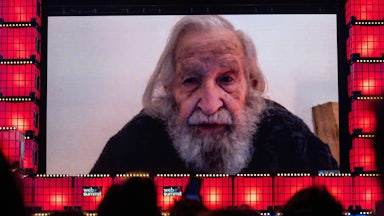
The back-and-forth with Nowak illustrates the most important continuity in the Epstein academic society: He may have started relationships based on what looked like a mere intellectual pursuit, but many of his interlocutors revealed themselves to be leering perverts and sexist reactionaries too. Noam Chomsky (another frequent pen pal of Epstein’s) wasn’t emailing Epstein about colorless green ideas sleeping furiously. He commiserated about the media’s unfair treatment of the pedophile, bemoaning “the hysteria that has developed about abuse of women, which has reached the point that even questioning a charge is a crime worse than murder.”
There’s a pattern to Epstein’s consumption of ideas and to the kinds of people he found compatible. It wasn’t a wish to brush shoulders with the famous and well-regarded—generic star-fucking. Epstein didn’t collect people for status; he identified and aligned himself with the intellectual machinery now justifying our current dystopia, including the academic rationalizations and motivated reasoning that hover behind the most terrible excesses of the Trump administration: glorified phrenology, violent misogyny, genetic determinism, and elite impunity.
It is not a coincidence that Epstein was also interested in crypto, in AI, in right-wing populism, in trad Cath extremists, and anti-trans ideology, in addition to creepy experiments in pain tolerance, psychopathology, and advantageous genetics. Epstein gravitated toward fields and figures that rank humans, explain away cruelty, or biologize inequality. He did not forge connections with these people: He saw they were already in alignment. And with each one of them, the question “Why them?” is almost as important as, “Did they know?” I don’t believe everyone who was in Epstein’s orbit is secretly and knowingly rushing us toward a patriarchal eugenicist regime. One of them, Elon Musk, certainly is. The rest simply have ideas that are useful to that project.
Epstein is less the thread that connects the rich and powerful than a lens through which all of those existing connections snap into place: the common denominator for the cursed ideas—white supremacy and patriarchy, a cheapening of human life and human values and human choice—propelling the apocalypse forward.
The “Epstein class” is a brilliant formulation, but we need to be clear it is not made up of literal pedophiles and slightly less disgusting sex pests. The Epstein class is defined by whom Epstein brought into his circle. And if we excuse them for not knowing in the moment of contact who he was and what he had been convicted of (and these claims of ignorance are so often dubious), we must demand they examine their place in the constellation Epstein has revealed.
“I didn’t know who he was,” is an insufficient response. “I am doing serious self-examination as to why he invited me” is better.
One cannot control who your fans are. I’m certain there are horrible people who admire my work. But if that person also was interested in some of the same things and people Epstein was interested in, I would grow concerned that perhaps my work had been at least misconstrued, that I’d left some kind of logic door open that needs to closed—or nailed shut.
I had been thinking of Epstein’s presence in all the worst places as making him a kind of Zelig of our collective nightmares. But that sounds like an absolution of agency. I’m revising my hypothesis: No one just happened to be there. Epstein also didn’t pull people into his web and then corrupt them. The club existed. He fit right in.