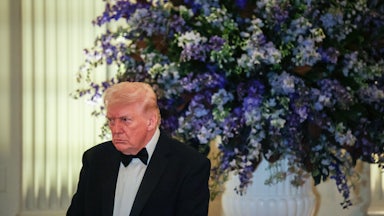
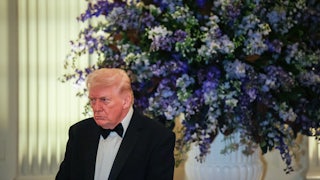
On Tuesday night, Donald Trump delivered his State of the Union address. On Wednesday morning, I have an unsophisticated analysis of an unsophisticated speech: I fucking hate this guy. We can try to top each other with clever ways to communicate our disgust, but the president is really just a greasy fleshhole of hate. He’s rancid and powerful, he’s a sadistic goon; he’s also inescapable—and that is the State of Our Union.
Trump strutted onto the dais, smacked his lips, grimaced and wobbled his way through two hours of white-supremacist wolf whistles—not dog whistles—leering insults, lies, and puffery. There was no substance to anything he said. I could lay out the fake proposals, the nonsense about inflation or the housing market or record-setting 401(k)s. He said something about a health care situation, I think. But this was not a speech designed to showcase new policy tweaks or even goose the national mood.
Here’s my topline reaction: It felt like preparation for a lynching. Violence and resentment washed over everything. It’s February, but the spirit of January 6 was in the room.
Trump could not stop dwelling on the intimacies of injury and suffering: the recovery of the bodies of Israeli hostages. The murder of Iryna Zarutska, lingering on the method and outcome even as her mother sobbed on the balcony. (Her murderer, by the way, was not an immigrant and crossed no border to get here.) Even the uplifting stories of heroism Trump muscled up when doling out medals were limned with the possibility of terrible harm: shootings, stabbings, “CRIME.”
No wonder he is so taken with the U.S. men’s hockey team and Jack Hughes’s missing tooth. Sure, Trump craves the kind of worn-in familiarity and affection that comes from spending long hours together and working toward a shared goal. But what he really wants is conflicts to end in “sudden death” and a piece of flesh on the floor.
But Trump’s lust for cruelty isn’t what made the atmosphere so uncomfortably familiar. A lynching needs more than ambient threat.
Trump gave it direction toward all the familiar targets. He boiled up his usual stew of xenophobia and race-baiting, at one point referring to the Minnesota Somali community as “pirates.” He berated and taunted the Democrats in the chamber too, with persistent references to how they “wouldn’t stand” to applaud him. He called them “crazy” after the obligatory trans-panic portion of the program. He said, “We’re lucky we have a country with people like this. Democrats are destroying our country, but we stopped it, just in the nick of time.” The venue’s history and power might have deepened his call for judgment and retribution beyond the usual bleat and whine, but his biggest advantage was having the Democratic lawmakers there at all.
The speech was streaked with Stephen Miller effluvia: the racism, sure; also some too-clever oration party tricks, like when Trump asked the audience to rise if they believed that a country should protect its citizens before immigrants. The Democrats remained seated; I don’t think it was quite the campaign-ad footage Miller or whoever thought it would be. It was cinematic only in how the crowd reaction echoed in the chamber; it was the first time I realized that elected officials and guests were jeering and *hooting* their approval. They’re all Pete Hegseth now.
He transformed the Senate chamber—where history and tragedy and farce have all been made—into the rotten dregs of a frat party. Cheering, whistling, fist pumping. There’s going to be literal cheerleaders at the next State of the Union: big-breasted blondes in spangles leaping through pretend derricks spouting real oil. Flashing lights, gold hardware. A brass band.
That said, I am vigorously pro-stunt. Democrats should do more of them. Representative Al Green was tossed from the venue because he brandished a sign reading “Black People Are Not Apes” as Trump took the floor. Fantastic. Be the show, not the staff, I say. And above all, in this tawdry media environment, get the headlines.
There were Epstein survivors at the State of the Union: over a dozen of them. They couldn’t be stacked around Pam Bondi or presented as a group, so Trump didn’t see them, obviously. But you could put each survivor across the table from Trump one at a time and I don’t think Trump would see them. He’s never seen them. He may have been in a room with them once—he may have been more than in the room—but predators don’t see individuals. They see an audience.
Maybe that’s why watching Trump feels corrosive and contaminating all on its own; why the debate over whether paying attention to Trump itself only serves to legitimize him has whipsawed for a decade. It was once a principled stand to pretend he wasn’t serious and ignore him. That didn’t work. Witnessing him and reporting in real time doesn’t feel like it works, either.
Today, I believe it’s not binary. Some people can refuse the spectacle entirely. Some of us volunteer for the shift. I do this for a living. I show up. And sometimes I wake up feeling burned out, ashes in my mouth, wondering why I gave him my attention again.
As of this morning, I believe that the reason I choose to bear witness to Trump’s tantrums is to check on the wound that won’t heal until he’s gone: press the bruise with my thumb, hard. Knowing he still exists and what he’s up to is well and good, but actually seeing his freakish, clowning visage and experiencing that rage? Has to be done. Direct exposure is the true test—I want to make sure I’m not numb. We have work to do.