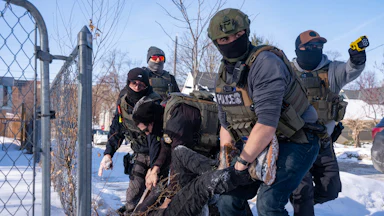
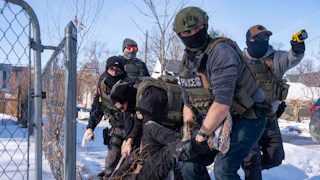
On Wednesday morning, Homeland Security agents entered a Columbia University dormitory and detained student Elaina Aghayeva. ICE claimed that the reason for the detention was Aghayeva’s failure to attend some classes 10 years ago—an already outrageous notion—but what really captured public attention was the manner in which her arrest was conducted.
In a public statement, Columbia acting president Claire Shipman claimed that “federal agents made misrepresentations to gain entry to the building to search for a ‘missing person.’” Word quickly spread that agents had allegedly represented themselves as NYPD officers to Columbia staff in order to gain access to Aghayeva’s dorm without a warrant signed by a judge, along with the more far-fetched rumor that they had used spoofed NYPD badges.
That Immigration and Customs Enforcement agents undertook this fakery seemed to have been confirmed by Manhattan Borough President Brad Hoylman-Sigal, who tweeted that agents had “impersonated NYPD with fake badges” before backtracking with an update that called this “unconfirmed.” In a separate press release, House Minority Leader Hakeem Jeffries also referenced ICE agents “impersonating NYPD officers.”
The whole story reminded me of an investigation I published almost eight years ago on ICE’s use of so-called ruses and misrepresentations to make arrests, a tactic that not only was long-standing but had been explicitly included in the agency’s Fugitive Operations Handbook. Yet even then, the question of how legal these tactics were was far from clear. As NYU Law professor Nancy Morawetz told me at the time, “There is a pretty strong argument, I think, that it is impersonating a police officer,” when a federal agent implies that they are NYPD.
Still, even the cases I looked at then weren’t quite as clear-cut as the allegations here. There’s little doubt that federal personnel are allowed to represent themselves generally as “police” or “law enforcement,” and have been doing so for many years. What could set this incident apart are two factors: First, if the agents described themselves as NYPD in particular, that moves from vague insinuation to direct impersonation, and second, if the agents used that impersonation to gain access to private property and a private residence without a judicial warrant, they’ve now used that impersonation to violate due process rights pretty clearly.
In the ruses I covered years ago, agents were mostly trying to get people to leave their homes or meet them places where they could then make an arrest in at least a semi-public area. A misrepresentation like the one alleged in the Columbia case, which is used to evade what would otherwise be a requirement to present a warrant, could well be a Fourth Amendment violation—even if they did not claim to be local police. Think about it like this: If the FBI wanted to search your home but did not have a warrant to do so, they couldn’t just pretend to be the electric company to gain access. A judge would bat that down in an instant.
The potential constitutional violation is something that would be up to Aghayeva to pursue, but the impersonation aspect is easy fodder for at least an inquiry by the NYPD and local prosecutors, likely in Manhattan District Attorney Alvin Bragg’s office. If it remains unconfirmed whether this happened, it would seem like a clear priority for investigators to find out conclusively. I have a hard time imagining almost any other circumstance in which a credible allegation of people falsely claiming to be members of the NYPD would not be exhaustively investigated.
That Aghayeva has been released (apparently at least in part as a result of Mayor Zohran Mamdani’s personal entreaty to Trump, whom he’d been visiting earlier in the day) does not make this a moot point. If agents claimed to be NYPD in order to arrest someone in a private building, they fulfilled both requirements under New York Penal Law § 190.26 for a class E felony, regardless of what happened next. This is not as visceral a crime as the daylight fatal shootings of Renee Good and Alex Pretti in Minneapolis, but it remains a serious crime that is quite corrosive to local governance.
The other two citywide elected officials seem at least tentatively on board. Standing outside Columbia’s gates on Broadway, Public Advocate Jumaane Williams told me that the question of whether ICE agents impersonated NYPD officers “needs to be investigated.” Comptroller Mark Levine emphasized that he had not received any confirmation of whether the impersonation had indeed happened, but “if it did, I would find that to be outrageous and probably illegal.”
Levine also brought up that agents entering private property under false pretenses for immigration enforcement could violate other local statutes, and “if, in fact, as it appears to be the case, they violated city law, there absolutely must be a full investigation and accountability” that could, in theory, include arrests. Mamdani himself has yet to say anything definitive on the matter, and Bragg’s office did not return a request for comment about whether it would be opening an inquiry into it. Still, this would seem like an obvious opportunity for the city to draw a line in the sand and defend the integrity of its own law enforcement and sanctuary provisions.
The overarching story of the second Trump term has been a kind of relentless tire-kicking to see just how far it can get away with running roughshod over everything from separation of powers to constitutional constraints. Columbia itself paid a $221 million settlement and implemented changes to its admissions and programs in what was widely understood to be a shakedown by the Trump administration, yet here it is being deceived and having one of its students detained by the very same government to which it had already kowtowed.
Mamdani may enjoy a bizarrely warm relationship with Trump—whose Achilles’ heel seems to be charismatic men—but it’s the viziers like Stephen Miller and Tom Homan who are running the enforcement policy on the ground. If they get the message that NYC won’t do anything about agents impersonating the NYPD, they’ll just keep looking to find out what else they can get away with.