Newsletter
Power Mad
A weekly review of the rogues and scoundrels of American politics

Bad Bunny’s Neighborliness Is the Antidote to Ring’s Dystopian Vision

More and more Americans are turning against the surveillance state—and embracing each other.

Bad Bunny performs onstage during the Apple Music Super Bowl LX Halftime Show at Levi’s Stadium in Santa Clara, California.
Kevin Mazur/Getty Images
Bad Bunny performs onstage during the Apple Music Super Bowl LX Halftime Show at Levi’s Stadium in Santa Clara, California.

Sunday’s Super Bowl was mostly an exercise in foregone conclusions: Bad Bunny’s halftime show would show off his talent and creativity, the Seahawks would grimly dominate the pitiable Patriots, and I would shout “Get fucked!” at the television when the inevitable commercial for ICE aired. But there was one surprise discussion that sprang to life the morning after the big game—involving lost dogs, the all-encompassing surveillance state into which we’ve gotten locked, and what it means to be a neighbor.

The proximate cause of all this agita was the commercial for Ring, whose doorbell cameras are among the most popular in the country. In their Super Bowl spot, Ring touted a feature called Search Party, a new(ish) AI-enabled “familiar faces” tool that the Amazon-owned company has billed as a way for lost pets to be easily recovered: Just upload a picture of the missing pet into Ring’s database, and it will deploy all the Ring cameras in the area as a dragnet to search for the wayward animal. As Mashable’s Chance Townsend reported in July 2025, these AI tools were the brainchild of recently returned founder Jamie Siminoff—who, perhaps not coincidentally, reversed the company’s previous decision to back away from working hand in glove with law enforcement.

Against that backdrop, it was perhaps inevitable that Ring’s commercial went over so badly with viewers. In fact, one of the few nice things I can say about the ad was that it was the first thing in a long while to invite unified criticism from voices all across the political spectrum. That included Matt Nelson, of WeRateDogs fame, who published a blistering video critique of the ad: “Neither Ring’s products nor its business model are built around finding lost pets,” and even if they were, it’s a job that Ring does very badly: “Ring claims that the ‘Search Party’ feature finds one dog a day,” Nelson said. “This would equate to roughly .03 percent of the over one million lost or found pet reports posted to the Ring app annually.” If this is something Ring is touting as a core competency, it could be that they’re pulling the wool over your eyes.

What Ring is, Nelson observed, is “a lucrative mass surveillance network” that turns “private homes into surveillance outposts and well-meaning neighbors into informants.” Jason Koebler of 404 Media concurs:

With Ring’s recent partnership with Flock, which will further facilitate the sharing of video footage with police, and its new Search Party feature, the message is clear: Ring is still, again, and always will be in the business of leveraging its network of luxury surveillance consumers as a law enforcement tool. After years of saying it wasn’t doing facial recognition and that it was focused more on “object recognition,” it has now explicitly launched “friendly” versions of facial recognition and facial recognition-adjacent technologies.

CNBC reported on Thursday that Ring canceled its partnership with Flock because of the public backlash over this Super Bowl advertisement. The report noted further friction building at other tech companies, with Salesforce employees pressuring company CEO Marc Benioff to “cancel ICE opportunities,” and employees at Google making similar demands that the firm “divest itself from ICE and U.S. Customs and Border Protection.”

The transformation of “friendly” tech into tools for the police state has been something of a trend lately. Flock security cameras deployed at schools across the country, ostensibly for the purpose of keeping kids safe, have been used to “assist Donald Trump’s mass immigration enforcement campaign,” according to a recent report from The Guardian. And while firms like Ring and TikTok go to extravagant lengths to say that they do not directly feed your data to law enforcement agencies, the fact is that data originating from these firms can frequently find its way into the hands of partners, data brokers, and other third parties who’ve made no such commitment. From there, as TNR contributor Logan McMillen pointed out this week, the government can simply purchase that data, circumventing your constitutional rights. It’s always best to assume that any technology firm not explicitly against the surveillance state will eventually become a tool of it.

With more and more of us reading stories about ICE’s predations—or experiencing them firsthand—it’s not a surprise that Ring’s happy puppy commercial landed the way it did. As I’ve said before, ICE and Customs and Border Protection aren’t actually doing immigration enforcement. They are a tentacle of the war on terror that’s been turned against the American people, armed with cutting-edge technology. People are slowly waking up to the dystopian nature of these arrangements.

But there’s another awakening happening in the cities and towns currently facing down the threat of state violence and terror. People are rediscovering what it means to be a neighbor and to live in a community. In places like Springfield, Ohio, faith communities are banding together to protect those targeted by Trump’s mass deportation machine. In Minneapolis, neighbors are assisting one another in keeping their kids safe, bringing food to those who fear venturing out, and raising rent money for people who can’t go to work with federal agents lurking around. Here’s a fun fact: This sort of neighborliness is how we used to find lost dogs.

We talk all the time about how Trump and his minions are shredding the fabric of democracy and tearing apart the civic institutions that have served us in good stead. But wherever Trump’s hammer has fallen the hardest, good people have responded by working together as neighbors, to reknit what has been torn asunder and reinforce their bonds to one another and their commitment to our patriotic values. As The Atlantic’s Adam Serwer observed: “Minnesotans have shown that their community is socially cohesive—because of its diversity and not in spite of it. Minnesotans have found and loved one another in a world atomized by social media, where empty men have tried to fill their lonely soul with lies about their own inherent superiority. Minnesotans have preserved everything worthwhile about ‘Western civilization,’ while armed brutes try to tear it down by force.”

It’s an auspicious coincidence that Sunday’s Super Bowl offered a counterargument to Ring’s dystopian vision in the form of Bad Bunny’s halftime spectacle, which featured the “La Casita” concept that made his recent San Juan residency so critically acclaimed. In his vision, the front porch isn’t some fortress ringed by fear and suspicion; it’s a window to a wider world of neighbors, community, and joy, all washing up on one’s doorstep, inviting us out.* I know which neighborhood I’d rather live in—and I know which one I’d trust to find my dog, as well.

* This article previously misstated the location of Bad Bunny’s residency.

This article first appeared in Power Mad, a weekly TNR newsletter authored by deputy editor Jason Linkins. Sign up here.

When Will Democrats Decide to Join the Resistance?

The party needs to forge a closer connection with the people fighting for democracy in the streets. Here’s how to do it.

In an aerial view, demonstrators gather to march for an end to ICE operations in Minneapolis.
John Moore/Getty Images
Demonstrators gather to march for an end to ICE operations in Minneapolis.

Lately I’ve been wondering what it might be like for the residents of the embattled Twin Cities to receive one of those trademark email solicitations from the Democratic Party. You know the ones: The sender is Chuck Schumer, the subject line reads “THIS IS THE END,” and the body of the email explains how the gyre is widening and the falcon can’t hear the falconer and it’s up to you to send $5 to hold back the blood-dimmed tide. These are annoying during whatever times we might have once considered to be “normal.” With federal agents wilding on the streets and kidnapping children, to hear our problems reframed as something that we can fix by handing the nearest Democrat the change in our couch cushions is anger-inducing.

I’ve heard and read enough accounts from Minneapolitans to know that they’re feeling little connection to Beltway lawmakers, and that by and large they feel abandoned by most Democrats in Washington. This can only go on so long before something breaks: Ordinary people are showing remarkable valor protecting their communities from a corrupt and violent federal presence, egged on by a senescent and (allegedly) incontinent president and his ghoulish hangers-on. Democrats have the power to recognize this effort to protect democracy, provide it with material support and media cover, and thus knit up the fabric between themselves and these brave Americans. 

Let us acknowledge that the answer will not come with a legislative fix. Senate Democrats held the funding of several executive branch agencies hostage over demands to reform the Department of Homeland Security, precipitating a partial government shutdown, but earlier this week a deal was struck to fully fund those other agencies while only keeping the lights on at DHS for another two weeks as lawmakers negotiate reforms.

One Democratic lawmaker to whom Axios granted the veil of anonymity suggested that Democrats expect the base to “get upset” but believes the discontent will wash away because “then you’re going to have the real fight in two weeks.” Whether or not that period ends with any meaningful change in the status quo remains to be seen. Much of what Democrats seek would merely require various federal agents to obey rules and regulations that they’re already supposed to follow as a matter of agency directive—though enshrining these policies as laws would be a step in the right direction.  

That said, there’s still the thorny matter of enforcing any new constraints that are imposed on ICE and Border Patrol. I hope I’m wrong about this, but by the time all is said and done, I don’t expect much in the way of material change where the president’s paramilitaries are concerned. At best, perhaps, people will see the faces of the thugs who are beating them—though not always, if Schumer has his way

I think people, by and large, can accept that when it comes to enacting policies, Democrats have little room to maneuver given their minority power. Moreover, the revival of arguments over the party’s unwillingness to use what leverage it has out of fear that closing the government on a long-term basis will lead to larger downside liabilities is, by now, parlor-room talk. Looking toward the future, Democrats must pivot to combat an even greater danger, which Senator Chris Murphy articulated on the podcast of TNR’s Greg Sargent: “I think if people don’t see us fighting on something as existential as whether we condone the federal government murdering our own citizens, then there will be a mass withdrawal from politics altogether.”

Murphy continues:

I do think this is a critical moment. The whole country is seized by what they have seen—the statistics suggest that 80 to 90 percent of Americans have seen these videos—and they desperately want somebody to stand up for the rule of law. So, yes, if we do not make a fight right now, I think it could result in just a massive withdrawal of participation in our civic life. 

And that is how democracies die. Democracies die not often simply by force—it would be totalitarian—but by citizens deciding that there’s no one that is willing to stand up and save them.

Democrats, stymied as they are on Capitol Hill, have a freer hand to act in other venues—to undertake the necessary work of standing up for the people and proving that they are all on the same team. They must fight on these remaining fronts with an eye toward forging a greater connection with the broader civil resistance, providing it with rhetorical and material support. There are a number of ways in which Democrats can interact with those fighting to protect their families and neighbors from Trump’s predations that aren’t subject to a presidential veto.

First and foremost, Democrats should play the leading role in waging a campaign for the truth. In the past two weeks, the media has been suckered into front-running for the Trump administration, presenting a favorable narrative that spins a gauzy story: Forces are being drawn down, and the temperature is being lowered in Minneapolis. None of this is true: Minneapolitans are still living with the same brutal fear they were experiencing before Border Patrol commander Greg Bovino was sent packing. People with legal citizenship are being abducted from the streets of the Twin Cities and sent to Texas, where they are released and abandoned without the means to get home. Democrats are uniquely positioned to echo and amplify the voices on the ground that are simply saying that the Trump administration is lying; that its abuses are escalating.  

Democrats should ignore calls to keep their distance from the people who are impacted by Trump’s mayhem. That doesn’t mean we need every septuagenarian lawmaker in front of Border Patrol truncheons outside Minneapolis’s Seventh Street Entry, but being present and visible in any way makes a big difference. New York congressional candidate Brad Lander trekked to Minneapolis to help locals protect their neighbors in the same way he’s helped those in his home stateJoaquin Castro and Ilhan Omar made personal intercessions to return the abducted Liam Conejo Ramos home. Castro personally made the trip home with the 5-year-old; his efforts garnered a ton of well-deserved positive attention from the media. 

Democrats have able-bodied staff, connections to important and influential people, and a bully pulpit. All of these resources can be mobilized to help embattled citizens survive Trump’s onslaught, whether it’s getting more media attention on the daily abrogations of our constitutional rights, helping organizers on the ground with logistical support, or kickstarting fundraising efforts to help the mutual aid organizations central to the fight. They can also bring these efforts home to their own districts: As TNR contributors Ana Marie Cox and Sarah Jaffe separately reported, Minneapolitans were well positioned to offer a stern resistance to ICE because they’d prepared for it in advance. Knowing that the president views any Democratic district as a potential venue for ICE violence, lawmakers should get their own communities prepared for the worst by building the necessary resilience now. 

This is, of course, a midterm campaign season, and there’s no better way to reconnect with those suffering under Trump’s bootheel than to make the solemn promise to hold him and his cronies accountable; impeach them, remove them, forever discredit them, block their paths to power indefinitely. And look, if you’re a one-note Democratic lawmaker who feels like the only thing you can freely talk about is affordability, you too can suck it up and play a role: ICE violence is currently one of the primary drivers of the affordability crisis. 

Recently, Indivisible’s Ezra Levin said something interesting about the kind of email missives I made fun of at the top of the piece. Today’s “political system,” Levin wrote, “largely treats people like small-dollar ATMs that vote every two years. Everybody gets deluged with emails asking for money. It feeds cynicism and burnout. Rarely do you get a ‘help me organize our community’ email.” To Levin’s reckoning, it may not be the case that Democrats are asking too much, it’s that they are asking for “too little.”  

People under tremendous pressure and mortal fear have spontaneously spun up a vibrant civil resistance that puts the lie to so many of the assumptions upon which Trumpism was built. The democracy movement already has leaders. It would be to the benefit of all if Democrats find new and novel ways to join them.

This article first appeared in Power Mad, a weekly TNR newsletter authored by deputy editor Jason Linkins. Sign up here.

This Year’s First Big Stupid Idea: “Retrain ICE”

Some things get so evil that they forfeit their right to exist. Trump’s rogue paramilitary gangs are one of them.

Ron Haviv/VII/Redux for The New Republic
ICE agents pepper-spray protesters during a protest in Minneapolis, on January 17.

One of the consequences of covering American politics is that it forces you to have frequent close encounters with some of the dumbest people alive and their terrible ideas. Cutting taxes on wealthy people will eventually enrich the middle class. Invading and occupying Iraq will spread democracy throughout the Middle East. Michael Bloomberg should be president. The list goes on. Anyway, here’s the latest, greatest hit from the terminally stupid: We can fix ICE by retraining them.

The idea that a right-wing goon squad can somehow be reformed through the magic of Powerpoint presentations is squarely rooted in the fear among the Beltway-brained that proposing to abolish this rogue agency is going to cost Democrats a winnable election. I’m not sure where these fears find their foundation given that when “Abolish ICE” was in vogue, Democrats did great: They won in 2018 and 2020 and surprisingly overperformed in 2022. Then they got to 2024 and lost, not long after they took a rightward turn on immigration in an attempt to prove that they could be tougher on migrants than Trump was, as if his main failing was that his draconian immigration policies weren’t dressed up in enough management consultant–speak.

The Searchlight Institute, the Beltway consultant class’s latest rebrand of gelatinous centrism, recently released a sternly worded memo tsk-tsking everyone who believes that it was a mistake to resurrect the Stasi and turn it loose to terrorize liberal cities. “Let’s be clear that advocating for abolishing ICE is tantamount to advocating for stopping enforcement of all of our immigration laws in the interior of the United States—a policy position that is both wrong on the merits and at odds with the American public on the issue,” the memo bleated. “Instead, Democrats should embrace an aggressive plan to rebuild ICE based on two concepts: Reform and Retrain.”

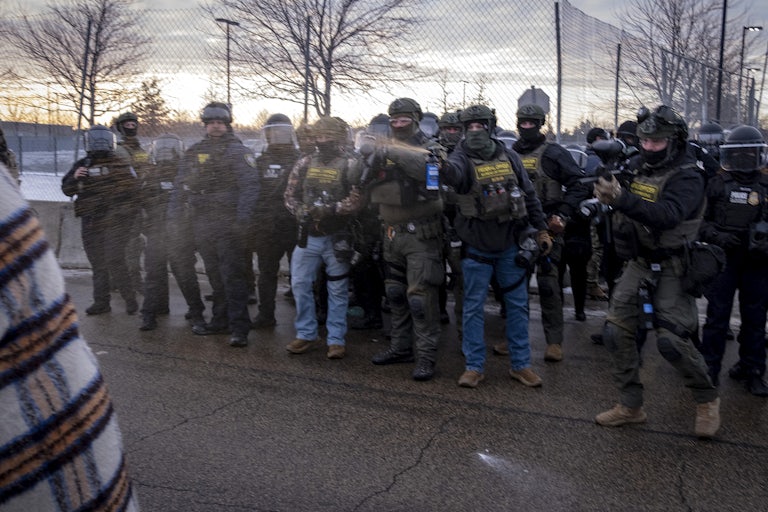
This is all written at a significant remove from what’s actually happening in places like Minneapolis or even Washington, D.C.—and it’s no mean feat to be out of touch with a community of which you’re ostensibly a member. To have a real-world understanding of what ICE has been doing makes calls for its reeducation land in the ears with a cloddish thud. These are marauding, fascist thugs who enjoy terrorizing people. They’re in their dream job. They raid churches. They abduct people. They abduct children. They use children to abduct other people. They shot a woman in the face. They tear-gassed a car of children. They grabbed an elderly man from his house and dragged him outside in his underwear in the freezing cold simply because he wasn’t white. They detained a 5-year-old, used him to bait his parents, and then took them all away.

Here’s a disturbing fact: When Minneapolis parents started putting stuffed animals on their dashboards so that kids could identify safe cars driven by the volunteers assigned to ferry them safely home from school, ICE started doing the same thing. What I’m trying to say is that ICE—from Secretary Kristi Noem down to the lowliest desk jockey—really, really has a fixation on abducting children. This is irredeemable beyond measure.

ICE misrule isn’t happening because someone skipped a meeting during their onboarding process. This is a deeply ingrained and incurable corruption—not that anyone at ICE wants to be “cured.” ICE agents already receive comprehensive training, which they comprehensively ignore. In the latest instance, we’ve learned from a whistleblower that agents have claimed the right to break into homes without a judicial warrant, directly countermanding their vaunted legal training. No one can or should trust a retrained version of this agency. A root-and-branch teardown is in order. Mass firings are in order (I guess the leakers and whistleblowers can stay in some capacity). The clawback of billions of dollars is in order. Damnation, in every sense of the word, is in order.

One of the problems with the argument that this mob of sickos can be retrained into something sane and decent begins with the fact that people misconstrue what ICE actually is and does. Searchlight’s statement, for instance, assumes that ICE is performing the task of enforcing immigration law. But ICE is not an immigration enforcement agency. It’s a rotted tentacle of the war on terror that’s been turned against the American people. A real immigration enforcement agency would be operating in places like Texas or Florida, which have large numbers of undocumented immigrants, and not Minnesota, which has relatively few. It also wouldn’t be targeting Minnesota’s Somali population, most of whom are American citizens and thus not subject to immigration enforcement. In addition, a real immigration enforcement agency would have a decent working relationship with local law enforcement. As Brooklyn Park Police Chief Mark Bruley recently explained, ICE is impeding Twin Cities cops from doing their jobs—and harassing them to boot.

The road back to a competent, humane, and lawful immigration enforcement agency necessarily begins with the elimination of the agency that’s absorbed all the money to perform those tasks while putting it toward an army of jackbooted thugs who harm innocent people. Don’t want to call this “Abolish ICE”? That’s fine, I’m invested in action, not slogans. Whatever gets us to the point where we’re firing all of the paramilitaries doing enforcement and removal operations, re-vetting all the people doing laptop jobs so that we can fumigate the agency of all its cryptofascists, and perhaps housing the enforcement agency at the Justice Department, alongside a bunch of other lawyers and bureaucrats working on immigration and naturalization processes—some kind of Immigration and Naturalization Service, maybe?—would do the trick.

Retraining ICE isn’t just a stupid idea from an intellectual or moral perspective. It’s also really bad politics. A recent Economist/YouGov poll found that for the first time, a bare majority of respondents—46 to 43 percent—were in favor of abolishing ICE. But what’s more important, from the perspective of Democrats, is that 80 percent of Democrats were in favor of it. That puts “Reform ICE” at the business end of an electoral shellacking. The wine moms Democrats need to win anywhere aren’t having it with going soft on Trump’s hoodlums. If you bring a timid, half-measure response on ICE to the people whose bonds to one another have been forged in the fires of protecting their own neighbors from state violence, I promise: You will eat no small amount of shit.

It’s no wonder that a pretty broad swath of Democratic officials, from New York City Mayor Zohran Mamdani to Massachusetts Representative Seth Moulton, have reached the correct conclusion that ICE is beyond redemption. Here we have a simple example of people who have seen what this agency is all about and understand what needs to be done. To be out here making the case that an outlandishly malevolent gang of brownshirts can be reformed will require a lot of explaining. And when you’re explaining, you’re losing.

The salient fact is this: What most of us see in ICE are people who are not fit to serve in any governmental capacity, many of whom should probably be in jail for serial violations of citizens’ constitutional rights and lawless corporal violence on the residents of major American cities. If you want sane and effective immigration enforcement that doesn’t shame the nation on a daily basis—well, ICE is standing in the way of that. They are a force for misrule. I’m not going to entertain the stupid notion that any of ICE’s current workforce can be meaningfully reeducated, and neither should you. It’s like suggesting a rabid dog can be retrained.

This article first appeared in Power Mad, a weekly TNR newsletter authored by deputy editor Jason Linkins. Sign up here.

The Residents of Minneapolis Are Fighting for All of Us

The sights of Minneapolitans defending their community have been inspiring. But underneath these displays of heroism, there is despair, fear, and hurt.

People gather in front of the Minnesota State Capitol during a demonstration over the fatal shooting of Renee Good.
Charly Triballeau/Getty Images
People gather in front of the Minnesota State Capitol during a demonstration over the fatal shooting of Renee Good.

For as long as Donald Trump has deployed his ICE brownshirts in the “Democrat” cities he so despises, Americans have been out in the streets, confronting his masked goons and making sure the rest of the world sees what’s going on. One of the first witness videos I saw was in Washington, D.C., in the Mount Pleasant neighborhood where my father grew up. A woman espied three Immigration and Customs Enforcement agents loitering in the area, harangued them, ran them off their roost, and then followed them around until they finally piled in their car and drove off.

ICE confrontations have necessarily evolved since then, as agents have become more wantonly violent. The New Republic has been chronicling the community response to ICE, from Los Angeles to Chicago to Minneapolis. But one thing we haven’t done, and which I feel compelled to do, is simply say this: I think the people risking their lives and livelihoods to protect their neighbors are the best of us, and I feel like we all owe them a debt of gratitude.

I’m thankful for all the people who’ve filmed ICE agents slipping and falling on Minneapolis’s icy streets. Fascism is more a set of aesthetics than it is a legible system of political beliefs, so it actually matters that we make fun of these jabronis—humiliation pushes our lines forward. Creativity is needed, as well. I’ve thrilled to the sight of Minnesotans gathered outside the hotels harboring these hoodlums, banging on drum kits late into the night. And ordinary citizens seem very composed and ready to protect their city. One especially inspiring sight came this week when ICE agents pounded on the door of the Wrecktangle Pizza shop in Minneapolis’s Lyn Lake neighborhood: There’s a “tweet tweet” blast on a whistle, and suddenly scores of people swarm the sorry ICE agents and run them off.

While we should be rightly delighted by these sights, they might be occluding a darker part of this story. The murder of Renee Good has engendered a righteous fury in the people of Minneapolis, but if my friends there are any guide, it’s also sparked genuine sorrow and spiky, persistent fear. People that I know normally to be rocks of confidence are communicating a despair that I’ve never heard them express.

In my group chats, I’ve been told about restaurant workers who’ve disappeared from their workplaces. Those friends of mine with kids have had to go to exhausting lengths to protect them. One told me about how his daughter’s preschool had to close because the Methodist Church that hosted it was tipped off that ICE would be executing a raid on its property that day—the day of the church’s food pantry. And the reason ICE was rumbling Wrecktangle Pizza, I was told, was because the chain raised $85,000 to help area restaurants cope with the strain of their agents’ presence in the city. ICE knows who the most vulnerable Minneapolitans are, and also the ones who’ve done them the most damage, and they are targeting both, with state-of-the-art surveillance technology and the tacit permission of the Trump administration to terrorize.

Minneapolis truly can be likened to a city under siege from a foreign threat. As The Minneapolis Star Tribune recently reported, the Trump administration’s plans to deploy as many as 3,000 ICE or Customs and Border Protection agents to the Twin Cities would make the occupying force “equivalent to five times the manpower of the Minneapolis Police Department.” Moreover, they report, it would be “close to the total headcount of sworn officers among the region’s largest 10 law enforcement agencies and equals nearly one agent for every 1,000 of the Twin Cities’ 3.2 million residents.”

This is an important side of the story to tell for many reasons, not the least of which is that ICE cannot deploy enough people to put every American city in check. So for the moment, Minneapolis is really taking it on the chin for most of the rest of us. The reason the streets of my own dense liberal enclave are not ringing out with shouts and whistles is because Trump’s “day of reckoning” isn’t being fought here—yet. When this fight does come to our own neighborhoods, we will have Minneapolitans—like the Chicagoans, Portlanders, Los Angelenos, and Washingtonians before them, among others—to thank for cheering our hearts, deepening our knowledge of how to fight back, and making these ICE deployments more costly.

The people of the Twin Cities feel isolated and alone; local officials have lamented that they are literally outgunned, and politicians in Washington have offered little respite beyond the occasional galaxy-brained idea. We owe a debt to the people of this besieged city. We should take some time to comfort friends and loved ones who are under fire. We should share their stories, good and bad, widely, with an eye toward building a repository of evidence that a future federal government can use to prosecute lawless ICE agents and those who gave them marching orders. In the meanwhile, to everyone putting your bodies on the line in this fight, you have my thanks. And to the ICE agents out there causing violence and mayhem, let me say—from the heart—get fucked.

For those interested in ways to help the people of Minneapolis, there are a number of organizations to which you can donate. Unidos MN has been helping to train Minneapolitans to observe and report on ICE activity and run the city’s rapid response hotline. Take Action MN is constructing a hub for mutual aid groups in the city. Families Helping Families has organized 120 parents to do grocery and rent relief, student transportation, school patrols, and more. Isaiah is a multiracial organization of faith communities that has organized rallies to remember Renee Good. There are a number of national civil rights organizations operating in the city, including the Immigrant Defense Network, the Council on American-Islamic Relations of Minnesota, and the Minnesota Immigrant Rights Action Committee. There are a number of legal aid organizations, as well, including the Midwest Immigration Bond Fund, the Immigrant Law Center of Minnesota, and the Minnesota chapter of the National Lawyers Guild.

This article first appeared in Power Mad, a weekly TNR newsletter authored by deputy editor Jason Linkins. Sign up here.

The Case for Impeaching Donald Trump

No, Democrats don’t have the votes to convict. But they should brandish their convictions in the court of public opinion.

Donald Trump looking like death
Alex Wong/Getty Images

I think Philadelphia Inquirer columnist Will Bunch has summed up the past week in American life more succinctly than I ever could: “We are going to look back fondly on 2025 as ‘the sane year’” of Trump’s second term.

Here’s where we left off in 2025: Trumpism isn’t working, ordinary people are being crushed under the wheels of elite impunity, the cost of everything is going up, the administration either has no answers for it or doesn’t care, and the president is deteriorating before our eyes, dogged by obvious health concerns and the slow-rolling Jeffrey Epstein affair. And as the year drew to a close, it looked for all the world that the president—an inveterate telegrapher of his own punches—was about to launch a regime-change war in Venezuela.

When the news finally came, on January 3, that the invasion had begun, it was even more chaotic and loopy than one might have imagined. The U.S. has abducted a head of state on cocaine-trafficking charges, an offense that would not seem to warrant either military intervention or the wholesale destabilization of a state. Trump has given the strong impression that the objective was the plunder of Venezuela’s oil, but that makes very little sense from either a business or an economic perspective—and, in a weird move for an “America First” movement, it will seem to require a pillage of taxpayer money to finance. Meanwhile, the administration’s tantrums have already moved on to other targets—Greenland and Mexico among them.

Just as the nation was contending with the possibility of going to war with another country, one of Trump’s ICE goons gunned down a Minneapolis woman in cold blood. The context of this crime cannot be shorn from all the other aforementioned ones. Everything is connected: Trump’s war machine is seizing territory for his mass deportation scheme (that was another goal in Venezuela); his goons plunder the country’s mineral resources with one hand while abducting our friends and neighbors off the streets with the other (some of them to be sent to Venezuela, presumably). It’s a vertically integrated autocracy—tearing a hole in the heart of the American civic fabric while funneling wealth to his plutocratic masters.

As Trump withers in his dog-wagging fugue, casting about for sundry distractions to occupy our attention while his administration fails to deliver peace, prosperity, or liberty to the American people, the rest of us can cut through the confusion: This administration is a criminal enterprise, first and foremost. These are impeachable offenses, plain as day. They must be treated as such. And a recent report from NOTUS finds that a number of Democrats seem to share this view.

Let’s dispense with the obvious: No, there are not enough votes to convict Trump in the Senate. And it’s a heavy enough challenge to get articles of impeachment out of the House—though the passing of California Republican Representative Doug LaMalfa has shrunk Speaker Mike Johnson’s majority to 218–213, leaving us on the cusp of tantalizing possibilities. But the salient point is this: Given the devotion of Trump’s cult in Congress, there’s no way an impeachment effort will end with the removal of the president.

Do it anyway. The rule of law is meaningless if you only take it up when it’s easy. The point of doing the right thing isn’t to merely experience the catharsis of success—it’s to assert standards, uphold values; to acknowledge the existence of moral authority and answer its call for redress courageously. Trump’s lawlessness has to be opposed, if only because the times demand it. This being an election year, Democrats are in need of some simple ideas on which to anchor a national campaign. “The president is a degenerate criminal, and if you send enough of us to Washington we will bring the madness to an end” is a message Democrats should be sending. Even if an impeachment effort hits the skids, it will signal to voters that Democrats have the political courage to defend our values.

Even a doomed-to-fail impeachment effort offers Democrats some distinct advantages. Remember: Democrats are in a content-creation war with the Trump regime. The news media thirsts for conflict and controversy; Democrats going all in on an impeachment effort sets the table for a feeding frenzy. Frankly, the fact that this is never getting to the Senate for a trial should free Democrats from having to strictly tether a case to statutory realities or tailor it to the austere sensibilities of doddering senators. There’s no reason an impeachment effort can’t be a kaleidoscopic panoply of Trumpian misdeeds presented with an eye toward capturing tabloid headlines.

Regardless of whether Democrats want to pursue the formal impeachment process, the larger idea—to hinder the Trump regime by calling attention to misconduct and lawlessness—is critical to Democrats’ messaging in this election year. Their campaign should be a thorough indictment of the president, the dismantling of his credibility, and the exposure of his every misdeed. Criminality is the Rosetta Stone that translates the Trump presidency, and as I’ve said before, the Democratic leaders of the future should be ready to speak fearlessly about putting the members of this lawless cabal in jail.

So let the prosecution of the president begin today. And if the Democrats, bolstered by that message, win back the House in the November midterms, then they can impeach him in earnest next year. Even Trump himself wouldn’t expect anything less.

This article first appeared in Power Mad, a weekly TNR newsletter authored by deputy editor Jason Linkins. Sign up here.