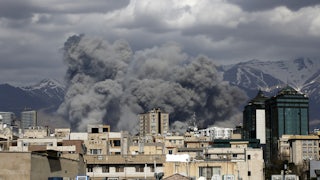
American and Israeli strikes are hitting Iran hard. Through both naval and air power, much of the country now finds itself engulfed in a near-constant barrage, with air superiority close to being secured across the entire country. Ayatollah Khamenei is dead, as are various high-ranking officials and more than 1,000 civilians, including over 100 young children. Iran’s missile and drone supplies have also been partially depleted, with swaths of them being shot down within the Gulf and the areas surrounding Israel. Simply put, no military path to victory exists for Iran or its regional proxies.
And yet, despite clearly having the upper hand, U.S. leaders’ rhetoric seems to be increasingly escalatory, if not downright panicked. Donald Trump and Defense Secretary Pete Hegseth have both indicated an openness to on-the-ground troop deployments, with U.S. force increases already being sent to the region alongside expanded air and naval assets. The timeline of the campaign has also been extended, with Trump claiming that four to five weeks of operations will likely be necessary in order to achieve victory. Hegseth, diverging from the president, is now claiming eight weeks is necessary. The overall objective against Iran is by no means clear, nor are we even certain what kind of regime change the U.S. is looking for—if that is indeed the goal.
But one thing is clear: The economic and social effects of this conflict are going to be far-reaching, and also well beyond the scope that was initially laid out by Trump. As the war is prolonged, oil and gas infrastructure is being bombed, with production either halted or the resources redirected to storage. Fuel storage infrastructure is now rapidly approaching capacity. Cuts to production, if not full shutdowns, are going to have to occur within the next several days. Global energy prices will skyrocket, causing massive ripple effects throughout various industries.
Fossil fuel–intensive sectors, such as automobiles, semiconductors, manufacturing, aviation, and agriculture, will all face severe supply shocks as energy costs and other inputs jump in price. Bonds and financial assets will also come under increased scrutiny, with the likely effect being a credit crunch that limits liquidity and investment. The sorts of conditions that tend to lead to job losses will flow from these events, alongside other forms of economic insecurity. Akin to the stagnation crisis of the 1970s, the economy will face inflationary pressures and job losses concurrently, delivering a crisis that lingers far beyond the individual acts of the war.
For Gulf allies like the UAE, Qatar, and Bahrain, anxiety is growing as supplies and stockpiles dwindle. Up until this point, an overwhelming number of Iranian barrages in the region have been downed or struck, impeding them from their intended target. But this can’t continue indefinitely—and with the Strait of Hormuz closed and air travel sharply curtailed, many regional partners are now experiencing a complete economic pause, particularly for trade and exports.
Iran’s military strategy is now centered around attrition and disruption. Through drawn-out and unrelenting attacks, Iran is attempting to degrade both munition supplies and energy resources and cause strain through a thousand cuts. Security expert Kelly Greico at the D.C.-based Stimson Center recently estimated that for every $1 Iran spends on drones, the UAE spends “roughly $20–28 shooting them down.” The asymmetry in costs here is rather stark, and when replicated regionally, the level of anxiety emerging from America’s partners does indeed make sense.
Iranian leaders don’t need to win militarily; they just have to inflict enough damage and buy time until supply pressures and shocks become too substantial. They can’t out-bomb the U.S., but they can cause pain to allies and markets that will eventually force Trump to the negotiating table. The U.S. and Israel now need to figure out how to help themselves and regional allies absorb these shocks—and the financial and political turmoil they’re causing.
Bahrain is now facing internal Shia, pro-Iran protests, which have historically led to Saudi intervention. The country’s energy sector has also been paralyzed through drone and missile barrages. Both the UAE and Qatar have had their energy markets and influencer-playground status shattered. Many residents have begun to flee, with some driving overnight to find safe flights out of the region. Luxuries and status symbols have been replaced with sirens and drone attacks, and energy market worries. These emerging shutdowns are only expected to increase in their severity in the coming weeks as shortages continue and shipments remain endangered. Qatar’s own Minister of Energy Saad Al Kaabi has warned that the region is weeks away from a comprehensive shutdown in production. Even if the war ended up concluding soon after these cuts, the ripples from this would endure for months.
Global energy and fuel prices have jumped massively from their prewar levels. In the United States, per-gallon prices at the pump have risen by 34 cents since the war began—and that’s only for unleaded. Diesel, the primary fuel for the trucks that transport goods across the country, has risen even faster. In Europe, price increases for oil and gas have also risen precipitously, already reaching records set during the initial reaction to the Russian invasion of Ukraine in 2022. For much of Asia, especially China and India, the disruptions are bound to cause concentrated problems within fossil fuel–intensive sectors, likely resulting in further price increases as the ripple effects of this war are felt. Increased shipping costs will lead to more expensive production. As production costs rise, this will only make goods and services more expensive for the consumer. Any and all things that are grown, shipped, or manufactured will take a hit, leaving durable price increases that will persist beyond the end of the war.
These rising energy prices will almost certainly result in political backlash and opposition, both in the U.S. and abroad. Shortages and exorbitant prices will cause queues and declines in spending. Financial markets will be tasked with maintaining their balance sheets while also not completely stopping credit allocation. Debts and interest rates could rise as inflation and financial leverage become too much to bear. Countries will have to ration and actively choose which constituencies deserve more support. Electorally, it will be a disaster for many parties in power. And as the conflict further degrades markets stability, and as refugees flee a worsening situation, this potential for disruption will only grow fiercer. Friends and clients alike will indeed begin to react differently as their direct interests are threatened or upended, especially if in response to a war that was voluntarily launched with no long-term plan.
Trump has attempted to assuage these concerns by claiming, for example, that U.S. air and naval power will protect oil and natural gas shipments through the Strait of Hormuz, while U.S. funds might cover the maritime insurance costs for ships within the region. This, however, would put the U.S. on the hook for a now $350 billion market that is on fire. It is unclear whether the U.S. will be able to sustainably cover these costs, even in the short term. The administration has also announced plans for Treasury Department interventions, monetary policy efforts, and tapping our oil reserves. But with energy production facing an existential crisis, these efforts have yet to soothe markets or their growing fears.
As Trump has indicated, the U.S. can sustainably pull munitions and supplies from other bases throughout Asia and North America for an extended period. But this reorientation of resources will take time and would need to cover large swaths of the Middle East, including their economic-industrial bases. Thus, what the U.S. faces here is a military conflict that needs to be ended before stockpiles and markets are whittled down to dust. Much of the Gulf is already clamoring for some kind of negotiated settlement.
The scope of war is expanding every day. American and Israeli attacks against Iran will continue apace, and their effects will indeed cause significant damage to Iranian leadership and the IRGC. But if Iran can sustain its attacks, more drones will manage to slip through defenses, resulting in casualties and upended lives. Critical infrastructure and trade nodes will be damaged, as will the region’s energy outputs. In the short term, we’ll likely see rising tensions over resources, with long-term risks of a global energy crisis. The U.S., as exhibited by today’s lackluster job report, is in no position to absorb a series of economic shocks or perpetuate a war that is only providing bad options. The war will not mitigate affordability issues, nor will it magically bring down health care costs and save lives. Simply put, at a time of intense insecurity and inequality, the Trump administration seems determined to continue with a war that is rapidly exacerbating America’s own internal crises.