What Does Kristi Noem’s Firing Mean for a Hobbled FEMA?
Her tenure coincided with unprecedented upheaval in disaster preparedness grants and staffing. Experts would like to see her successor, Markwayne Mullin, indicate where he stands on all that.

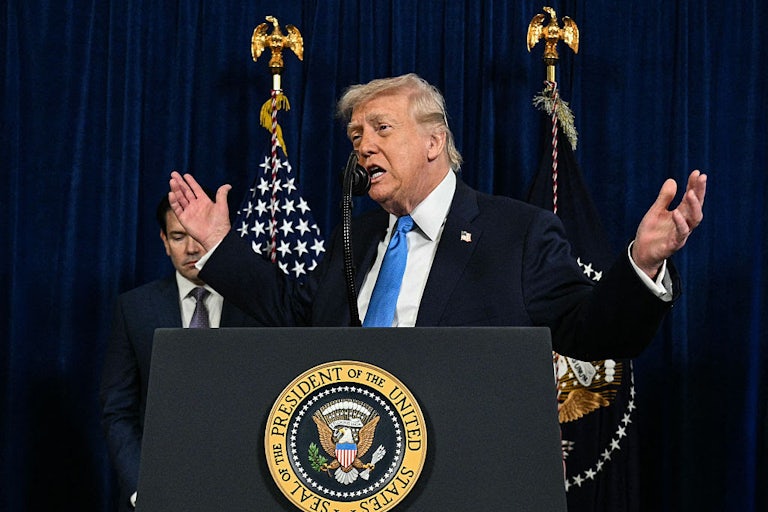
In the days since President Trump announced that he was firing Kristi Noem as homeland security secretary and replacing her with Oklahoma Senator Markwayne Mullin, much of the focus has understandably been on what this means for the brutal, chaotic, and lawless immigration policy that Noem has spearheaded. But there’s another area within DHS where Noem’s departure raises rather urgent questions about a possible change in policies. And that’s at FEMA.
Noem was in the middle of a project to shrink the Federal Emergency Management Agency significantly, having announced large staffing cuts in January. She’d also floated the idea of dismantling it entirely.
Her firing last Thursday came only a day after Senate Democrats released a report showing that Noem’s policy of requiring sign-off on any expenditure over $100,000 had resulted in “at least 1,034 FEMA contracts, grants, or disaster assistance awards” being held up—among them, disaster aid for survivors of Hurricane Helene and Texas’s deadly floods last summer (which killed at least 135 people, including 27 at a girls’ summer camp). And the day after Noem’s firing was announced, a judge gave FEMA 14 days to inform states about the status of their Building Resilient Infrastructure and Communities grants, a multibillion-dollar program that a court in December ordered reinstated—with no sign of compliance from FEMA.
Meanwhile, FEMA remains largely shuttered due to the DHS shutdown. And the administration recently spent “more than half of the balance in the nation’s disaster relief fund,” according to Politico, “pointing to that dwindling aid as [a] means to pressure Democrats into yielding in Department of Homeland Security funding negotiations.”
What exactly does Markwayne Mullin intend to do about all this? I asked two experts what they would be watching for in the coming weeks to determine whether Mullin would represent a serious shift from Noem’s policies, and whether FEMA would be able to handle disasters this year.
“Shutdowns come and go,” said Bryan Koon, president and chief executive officer at global emergency management consulting firm IEM and former director of the Florida Division of Emergency. “We tend to find ways to work around whatever issues are associated with that.” But he pointed to the FEMA Review Council report that the president ordered last year to determine policy changes at the agency. “It’s been now a year of uncertainty,” Koon said. “We’ve heard ideas about what might be in it, but frankly I would like to have some certainty, some insight into what the council’s going to recommend.” He noted that Trump already extended the timeline through the end of March. “I’m concerned that the transition between Noem and Mullin as secretary, combined with the shutdown, is going to delay that even further or even potentially render it moot,” he said.
Koon would consider the release of the report as one indicator of FEMA’s overall health at present. “A second would be an actual emergency or disaster that required FEMA to be all in. We were remarkably, as a nation, pretty lucky in 2025, and thus far in 2026—I mean, we had no landfalling hurricanes.”
Tim Manning, a former deputy administrator at FEMA, agreed. “I think they dodged a bullet,” he said, regarding last year’s hurricane season. “I and most of the emergency management community have great concerns for FEMA’s readiness. It is a collection of the most selfless, dedicated people in the government,” he said, “but there’s no getting around that they’ve been decimated over the past year and a half.” He pointed to layoffs, the firing of most senior leadership, the “onerous level of review” for grants, and more. “At every turn, the Noem administration has made decisions that dramatically degrade FEMA’s readiness and capabilities.”
If Markwayne Mullin is formally nominated and sits for confirmation—a big if, given that Trump’s first administration was marked by an unprecedented number of acting Cabinet secretaries working without Senate confirmation—Manning suggested that senators ask him about that directly. “I think the question I would ask Mullin during his confirmation hearing would be a question that I’ve tried to get people to ask Noem for the last year: The law explicitly says that the secretary does not have the authority to degrade FEMA’s mission or move resources,” he said. “I would be curious to get any nominee on the record: Will you follow the Post-Katrina Emergency Management Reform Act and restrict yourself from impacting the FEMA budget?” And as a secondary question: “Will you rescind any of the policies that have prevented the deployment and travel of FEMA’s employees to disaster sites?”
In the meantime, the current readiness of state and federal emergency agencies has people worried. “I went through at least one shutdown as a state director,” Manning said. And state directors need to know of FEMA, “Will they be on the other end of the phone when I need them?”
This is also hurricane preparation season. “Most states are going to do a state-wide hurricane exercise,” said Koon. “They’re going to do a large-scale event that allows them to test their plans and processes and coordinations and look at who their partners are and contracts are and who’s going to do what in what scenarios.” In Florida, where he has experience, it’s “a weeklong event sometime in May,” which requires some advance planning.
Perhaps it’s better, Koon said, for the impact of the shutdown to be felt now, in March, rather than in May or when a hurricane hits. But there’s never an ideal time. Wildfire season isn’t a season anymore. Earthquakes and other disasters can happen at any time, Manning noted. “There’s no seasonality to disasters,” he said. “Preparedness is a year-round thing.”
Stat of the Week
0.35 degrees per decade
That’s the rate of warming we’ve been experiencing since 2015, according to a new paper. It’s almost twice the previous rate—0.2 degrees per decade. In other words, as several scientists have warned, climate change is accelerating—although exactly how much is the subject of some debate.
What I’m Reading
How Trump’s EPA rollbacks give states new tools in climate suits
The Guardian’s Dharna Noor reports on a fascinating implication of the administration’s decision to kill the so-called “endangerment finding”—it may actually help state-based climate laws in court:
Trump’s justice department has asked a judge to kill a first-of-its-kind 2024 Vermont “climate superfund” policy requiring major polluters to pay for damages caused by their past planet-heating pollution, partly on the grounds that federal law, not state law, governs greenhouse gas emissions. But last month, Trump’s Environmental Protection Agency (EPA) repealed the endangerment finding, the scientific determination giving federal officials the authority to control those very pollutants.
“They’re trying to talk out of both sides of their mouths,” said Kate Sinding Daly, senior vice-president for law and policy at the environmental legal non-profit Conservation Law Foundation (CLF).
Read Dharna Noor’s full report at The Guardian.
This article first appeared in Life in a Warming World, a weekly TNR newsletter authored by deputy editor Heather Souvaine Horn. Sign up here.