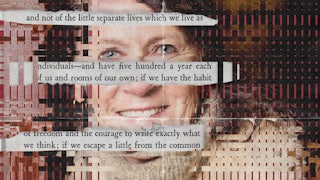
“The cruel, gray facts,” unlike the “truths in your heart,” are a matter of record, the Danish writer Tove Ditlevsen writes in Childhood (1967), the first volume of her trilogy of memoirs, known in English as The Copenhagen Trilogy. “No one can change them. Therefore: I was born on December 14, 1918, in a little two-room apartment in Vesterbro in Copenhagen.” Except that is not the fact. She was born in 1917.
What to make of this blatant falsehood, undercutting the seeming guilelessness of this spectacular trilogy? Perhaps 1918 seemed a more auspicious start, marking her as the child of a new era—“the year that the World War ended and the eight-hour day was instituted.” Perhaps, as Sophia Hersi Smith and Jennifer Russell, two of her English translators, suggest, it was so that she would “seem extra precocious!” by placing the publication of her first, well-received book of poetry in her twentieth year, rather than her twenty-first.

Either way, this mischievous, self-aggrandizing lie is characteristic of Ditlevsen and her understanding of the function of literature. “Everything written in books,” her mother, Alfrida, scornfully tells a young Tove in Childhood, “is a lie.” Alfrida, whose captivating, contradictory presence looms large in Childhood and the rest of the trilogy, “doesn’t care for facts.” Later, after her brother remarks that her early poems are skillful but dishonestly based on experiences she had not had, Ditlevsen reflects that “you sometimes have to lie in order to bring out the truth.” When it comes time to publish her first novel, she writes that “in one way or another it’s about me, even though I may never experience the things the people do in the book.”
Her final novel, Vilhelm’s Room (1975), translated by Sophia Hersi Smith and Jennifer Russell, explicitly takes up these questions of narrative, emotional, and biographical truth. As the book opens, the narrator proclaims, “I want to write a book about Vilhelm’s room and the events which took place in it, or arose from it; those that led to Lise’s death, which I have survived only so that I might write down the story of her and Vilhelm.” But almost immediately, the narrative voice starts to blur. Describing a photo of Vilhelm and Lise, the narrator comments, “We are young and happy, and so obviously in love.” Soon, she is promising that she will “tell you my story, only because I must. And, of course, because no one else rightfully can.”
The narrator both is and isn’t the already-dead woman Lise Mundus, who is and isn’t Ditlevsen. In its funereal narration, its concern with women in the aftermath of a disastrous marriage, and its suicidal force, the novel bears some resemblance to Susan Taubes’s Divorcing, the recently rediscovered twentieth-century classic. But Ditlevsen is hardly little-known: In Denmark, she was a household name in her lifetime, writing poetry, fiction, memoir, children’s books, and even contributing an advice column to a popular newspaper. She remains one of the country’s most famous writers today, her work included on school syllabi.
In English, she is best known for her crystalline, unsentimental memoirs. In 2024, The New York Times named the trilogy, the last volume of which was published in translation in 2021, one of the best books of the twenty-first century. The Copenhagen Trilogy is a clear influence on the Scandinavian autofiction being written today and has much in common with the work of the French novelist and memoirist Annie Ernaux. Both Ditlevsen and Ernaux share a commitment to writing with unflinching precision about growing up working-class, gendered oppression, and the link between writing and wanting. But where Ditlevsen’s memoirs are clear-sighted and unselfconsciously confessional, her fiction is more slippery, continually playing with the idea that her writing is closely aligned with her life. Vilhelm’s Room, in particular, is about the border between truth and fiction, public personas and private selves, writing and life, and where that border breaks down.
Ditlevsen was unusually well acquainted with forms of literature that can expose and distort the details of a person’s life: She was not only a writer of memoir and of fiction that drew on her own experiences, but she was also married to the editor of a tabloid newspaper, and saw up close the fine line between the confessional and the salacious, the difficulties of being an admired public figure and an object of prurience.
As she describes it in her memoirs, her entry into the world of literary celebrity feels both unlikely and fated, the result of natural talent and indomitable will. Ditlevsen grew up working-class in Copenhagen’s red-light district. Her father was a stoker who was frequently unemployed, the family scraping by on union benefits. She began writing poetry as a young girl, in the small apartment she shared with her parents and brother, but as soon as she finished middle school, she had to begin working a series of odd jobs. She spent time as a maid in a boarding house, working in the stockroom at a medical supply company, and as a secretary in a state grain office. “I was someone whose physical strength they’d bought for a certain number of hours each day for a certain payment,” Ditlevsen writes in Youth (1967), the second volume of The Copenhagen Trilogy, reflecting on these menial jobs. “They didn’t care about the rest of me.” She was sexually harassed at the medical supply company, and her boss at the grain office fired her after he read one of her first published poems (it was published in a journal called Wild Wheat—he bought it believing it to be a trade publication).
She published her first collection of poems at 21 and married her first editor, Viggo Møller. Her career thrived, even as the marriage fell apart. The couple divorced in 1942, and she quickly married Ebbe Munk, an economics student who struggled to adapt to her growing fame, and with whom she had her first child. She left him too, for Carl Ryberg, the doctor who provided her second illegal abortion and her first shots of Demerol. She remained married to him for five years, during which she gave birth to a second child and adopted a third, had the first of several psychiatric hospitalizations, and nearly died of the painkiller addiction she would continue to struggle with for the rest of her life. When she was 33, she fell in love with and married Victor Andreasen, an editor who would go on to run Ekstra Bladet, one of Denmark’s largest tabloid newspapers, and with whom she would have one son. Dependency (1971), the final volume of her memoirs, depicts the hopeful beginnings of their relationship, though their 22-year marriage ended in a rancorous divorce.
The aftermath of her break from Andreasen echoes through Vilhelm’s Room, which reads as an attempt to reckon, formally, with the disassembly of the self. When the novel opens, Lise’s husband, Vilhelm, “Denmark’s tabloid mogul,” has recently left her for another woman, and Lise has been taken, not for the first time, to a psychiatric hospital. This latest crisis is a disquietingly calm one; Lise is merely “no longer present within herself.” While hospitalized, Lise places a lonely-hearts ad in the newspaper:
Recently escaped a long, unhappy marriage—aged 51, but youthful in spirit—wonderful son, aged 15—household literary name—summerhouse—large flat in the city centre—temporarily incapacitated by a nervous breakdown—prefers a motorist.
This is, essentially, an edited version of a newspaper ad Ditlevsen herself placed in Andreasen’s newspaper after their once-happy relationship dissolved. Lise’s morbid, macabre upstairs neighbor, the elderly Mrs. Thomsen, sees the ad and shows it to her lodger, Kurt. Mrs. Thomsen is a tabloid addict who spends her mornings reading stories of murder and scandal to Kurt, while he masturbates beneath her dead husband’s sheets, foreplay for the culmination of their sexual games. Sensing that a relationship with a famous, lonely woman is “the chance of a lifetime” for a down-at-heel young man, she encourages Kurt to reply to the ad. His overtures are successful, and when Lise returns from the hospital, Kurt installs himself in Vilhelm’s recently deserted room.
This lurid setup dramatizes Ditlevsen’s own relationship with the press. As Olga Ravn writes in her introduction to a translated collection of Ditlevsen’s poems, There Lives a Young Girl in Me Who Will Not Die (2025), Ditlevsen was “incredibly famous”; indeed, perhaps Denmark’s “most photographed” writer in her lifetime, appearing in the press “almost weekly.” The public consumed details of her life, just as Kurt and Mrs. Thomsen do.
Ditlevsen cultivated fame out of financial necessity, Ravn writes, but she also excelled at a confessional artistic mode. Her memoirs don’t shy away from self-revelation; The Copenhagen Trilogy includes a remarkable depiction of drug addiction and the toxic marriage Ditlevsen stayed in to enable it, as well as unsparing accounts of her illegal abortions and her stays in psychiatric institutions. She is candid about her self-interested pursuit of fame, acknowledging that she married Møller in large part because she believed it would grant her access to rarefied literary circles and that her primary fear of the Nazi occupation of Denmark in World War II was that it would delay publication of her first book. In service of this literary experiment in forthright disclosure, it seems clear that she is willing to air the most intimate details of her life to anyone who cares to read.
Yet in her fiction, Ditlevsen writes of the depredations of fame and self-exposure. In her 1968 novel The Faces, the protagonist—also named Lise Mundus—is a famous writer who reflects, “She no longer belonged to herself. No matter where she sought refuge, people had unashamedly formed an image of her over which she had no control.” For Lise, “peace meant not existing in other people’s consciousness,” but “fame had brutally ripped away the veil that had always separated her from reality.” Lise is hounded by calls from reporters asking her inane questions, including whether she thinks fame comes with obligations. She replies that she “didn’t win it in a national election.” Lise’s wish for a private existence is echoed in Ditlevsen’s poem “Self-Portrait 4,” in which she writes:
This picture of me
inserts itself
and distorts
like when
a photograph is taken
on top of another.I fear the place
I hold in other people’s
memory.
The structure of Vilhelm’s Room, then, reads as commentary on the public’s prurient interest in Ditlevsen’s personal life, and as a pointed critique of her ex-husband’s line of work, though the critique is also a consciously self-indicting one. Ditlevsen furnishes the novel with the trappings of tabloid fodder: a high-profile divorce, a fortune-hunter preying on a mentally unstable woman, the death of someone famous. She even includes a chapter in the form of a series of confessional articles about her marriage that Lise writes for a rival magazine. Then, she sharply resists satisfying any voyeuristic desire. Her narrator calls attention, over and over again, to the book’s status as fiction—“It’s no concern of mine whether Mrs Thomsen ever existed or not. She is a fragment of my dissolved consciousness,” the narrator explains, and Kurt “never really lived.”
This metafictional strategy allows Ditlevsen to affirm that, for all the novel’s resemblance to its author’s life, it is a work of artistic control. In this, the novel is a mirror image of her memoirs, in which Ditlevsen’s clarity and unsentimental honesty resist the reading of confessional literature as mere scandal. It is easy, and not altogether incorrect, to read Lise as an analogue for Ditlevsen, to read her pain as the author’s pain. But this is also incomplete, as the narrator points out, in an echo of Ditlevsen’s comments on her first novel; of the characters that populate Vilhelm’s Room, from the “vile” Mrs. Thomsen to Vilhelm’s mistresses, she writes, “I exist in all of them. I watch over them while the night sleeps.”
Vilhelm’s Room is a novel of decomposition: It rots, slithers, oozes, smells. Mrs. Thomsen’s “vile, slimy thoughts seep through the ceiling”; the streets of a drizzly Copenhagen are “slippery and shiny like eels”; worries crawl “like white tapeworms”; compassion “rises” in Kurt “like nausea”; inside Lise and Vilhelm’s son, Tom, “squirmed grey worms of dread and decay”; and when Vilhelm vomits at an important function he attends with Lise, “it was as if all his bitterness and disgust for life kept gushing out of him.”
In one chapter, titled “(Open letter to my Vilhelm),” Lise reflects on a moment when she and Vilhelm were on vacation and she first realized, “He’s no longer young! It was in the way you carried yourself and the hesitancy of your movements, a faint whisper of decay.” The narrator remarks, too, on the “nascent decay” of Vilhelm’s healthy, young lover. This necrotic mood is brought on by the end of Lise’s marriage but also by the recent deaths of her father and brother, and the lingering wounds of her childhood and her mother’s death (“This was true loneliness,” the narrator explains, “there was no one left to talk to about her childhood”).
Above all, it is Lise’s imminent death, announced in the very first paragraph, that haunts the novel, giving it its atmosphere of both diffuse dread and perverse fascination. The narrator suggests that Lise might have been murdered, perhaps by Kurt. At one point, Mrs. Thomsen, driven in part, perhaps, by her sense of abandonment in Kurt’s absence, but just as much by her desire to participate in the scandal-soaked world of her tabloids, calls a detective inspector to report her suspicions about Kurt’s potential for violence. His motives for moving in with Lise are certainly suspect. But soon, the narrator refutes this suspicion, a little ruefully: “I now realize that I may have at one point implied that Kurt would become a murderer. For such ends, however, I have made him far too stubborn and willful to be used for anything that does not benefit or please him. He didn’t even want to stick around until the end of the book.”
Still, there is a murder of sorts in the book. A resentful and embittered Vilhelm views Lise’s poetry as stolen and derivative. During their marriage, she recalls, he accused her of lacking “literary audacity” and tore into her poems line by line. During one such attack, she reports, he tells her that the poem “falls apart in the middle, at the word ‘heart.’” With that, the page “stiffened and died in his hand as he murdered her poem, a cold corpse shrouded in white lace.”
It is because Vilhelm stabs Lise’s poetry in the heart that the narrator “must bestow upon this woman a new language, the audacity of which Vilhelm will no longer have reason to question.” Vilhelm, here, seems to stand not only for the man Ditlevsen married but also for critics who frequently dismissed her talent.
The cruel irony is that the narrator tells us that Lise finds this new language in her “final book.” In the novel’s closing pages, Lise dies after taking an overdose of sleeping pills—the same method by which Ditlevsen would take her own life a year after the book’s publication, in a final, fateful collision of author and character. But it is incorrect, or at least incomplete, to call the novel a suicide note, as some have. With this book, Ditlevsen has avowed that her work was not merely confessional but consciously crafted. As she wrote in Youth about her feelings upon her first book’s publication, the book “will always exist, regardless of how my fate takes shape.” In the space between confession and creation, between cruel facts and the truths of the heart, Ditlevsen created a lasting literature.