In January 2017, Jordan Neely checked in at Bellevue Hospital in Manhattan. He was schizophrenic and addicted to the synthetic drug K2, and he didn’t have a place to live. Bellevue treated him for five weeks but couldn’t offer much long-term help. One professional wrote in Neely’s file that he ought to attend recovery meetings—“to identify at least 2 triggers for substance use,” as if the triggers weren’t already clear. Eventually the hospital turned him back out to the streets.
Several months later, Neely, who was 24, showed up at Mount Sinai Morningside. He’d been smoking K2 and sleeping at a Popeyes restaurant before he arrived. This was a brief visit—but in the fall he showed up there again, after a three-week stay in another facility. He said he was suicidal because had “nowhere to live and no girlfriend.” The hospital fed him dinner then discharged him.
Neely rounded out the year with two stays at Gracie Square Hospital on the Upper East Side. Again he told staffers he was suicidal because he was homeless and had no income. The hospital ultimately recommended (among other measures) that Neely “attend daily therapeutic groups,” hoping these would promote “stable mood, optimistic thinking and compliance with treatment.” Again it sent him “home.”
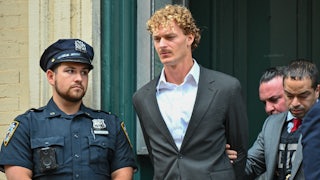
These experiences were typical of what Neely went through every year. And yet he managed to survive for six years longer. If his name is familiar, it’s because of the way he died. On a Saturday afternoon in 2023, he was pacing around on a subway car, ranting loudly. “I don’t care if I die,” one person remembered him saying. “I don’t care if you die. Kill me. Lock me up.” Daniel Penny, a fellow passenger who had been in the Marine Corps, decided Neely posed an imminent threat. Penny put him in a chokehold, wrestling him to the floor and not letting go for several minutes. By the time Penny released his grip, Neely’s pulse was faint, and he was soon declared dead.
Penny was indicted on a charge of manslaughter, and the case became a Rorschach test for how Americans thought about crime and mental illness in major cities. For some, it looked like a clear case of criminal homicide, in which a white man had strangled a Black man who was in crisis—while to others, Penny’s actions seemed justified amid rising fears of crime on the subways. (Ultimately, in December 2024, a Manhattan jury acquitted Penny.) This was a rare moment when conservatives blamed structural problems and deemphasized Penny’s personal responsibility. But most everyone agreed that in the months and years leading up to that incident, Neely deserved better treatment. Someone, or some institution, should have done more to help him.
In his new book The Man in the Mirror, the journalist Anand Giridharadas takes on the unwieldy story of Neely’s death and its aftermath. The book is at once an examination of the events that led to the killing, a study of the government policies that failed Neely, a narrative account of the trial, and a portrait of the divisions that have taken hold in American society. In its intensive reporting and its focus on the lives of normal people—from the streets of Manhattan to the suburbs of Long Island—it represents a turn for Giridharadas, who is best known for his 2018 bestseller Winners Take All, a polemic focused squarely on the rich and powerful (though his first two books were also traditional works of narrative journalism).
Ultimately The Man in the Mirror ends up being too panoramic. Instead of tracking closely with Neely and Penny’s lives, the perspective shifts between dozens of characters, some of whom appear for just a few pages. Nor does Giridharadas make any explicit argument, though the narration often calls out for one. However, at its most illuminating, the book’s efforts to show the longer story of Neely’s life help restore a sense of Neely as an individual, far beyond the awful events of that day on the subway. It also gives glimpses, here and there, of what a better system—one that could have saved Neely’s life—might look like.
One of the most memorable sections in The Man in the Mirror is a flashback to a morning in 2007 when Neely woke up alone. He was 14, two months away from finishing eighth grade. Normally his mother, Christie Neely, went into his bedroom and made sure he was ready to catch the bus at 7 a.m. He wondered if she was still asleep.
For two years mother and son had been living in Bayonne, New Jersey. Their lives together had been rough, but seemed to be on the upswing. Christie Neely had grown up in Washington Heights, where her father was a carpet cleaner. Jordan, her only child, was born in 1992. As of 2007, when she was in her mid-30s, she had charges on her record for drug possession and prostitution; but she had turned her life around and found a steady job in telemarketing in Manhattan.
Shawn Southerland, her boyfriend, was awake that morning. Southerland had been part of the Neelys’ lives, off and on, since the early-2000s—but he and Christie fought constantly, and at one point she and Jordan had decamped for a domestic-violence shelter. Now Southerland was living with them again.
Before Jordan Neely caught the bus, he wanted to say goodbye to his mother, but Southerland blocked him from the bedroom. Later that day, when Jordan got home from school, Southerland packed up all his belongings and left, saying he needed to go stay with a sick aunt. And in the evening, Christie Neely did not come home. Several days later, police found her body beside the Henry Hudson Parkway in the Bronx. It turned out Southerland had left her there after strangling her.
Christie’s death was understandably a shattering event for Jordan Neely. He did finish high school, with support from relatives, but he floundered after graduation. The one passion he latched onto was dancing like Michael Jackson as a “tribute artist.” Moses Harper, an older dancer who became Neely’s mentor, explains to Giridharadas that Neely wanted to be “active in his healing,” and dancing became a medium for that. However, Harper also counseled Neely that performing would never be enough to sustain him; he needed some kind of larger plan or vision for his life.
The advice never took. Neely drifted away from the group, and the last time Harper saw him—on a subway, in 2016—he was “visibly homeless.” Harper gave him her shirt and stuffed some money into his pocket. “When you’re ready to get clean,” she told him, “I got your back.”
But by this time, Neely was already cycling in and out of psychiatric wards. All told, from 2015, when he was 22, until his death eight years later, he was hospitalized at least 14 times. He was also arrested repeatedly, sometimes on violent charges.
Neely’s last chance to escape this cycle came in April 2023. Homeless outreach workers found him at the Coney Island subway station, drug-addled and with holes in his clothes. He exposed himself and urinated in front of the workers. They worried that he might hurt himself or someone else, so they consulted NYPD officers, who persuaded Neely to accept a shelter placement. The cops took him to a waiting van. But the driver, who worked on a contract with the city, refused to take Neely unless he had an escort. While the driver was arguing with the police, Neely wandered off.
As of that spring, Daniel Penny, who was 24, had been living in New York City for the better part of a year. He was taking architecture classes and teaching swimming lessons at a gym. Giridharadas, in the course of his reporting, visited West Islip, the Long Island suburb where Penny grew up. Over lunch, the editor of a local newspaper described the town as “the Long Island version of a flyover state.” Like much of Nassau County, it’s a haven for families who decided, at one point or another, to trade the excitement of city life for backyard barbecues and little league games.
In Penny’s case, that choice was made a couple generations earlier. The high school he graduated from, West Islip High, is the same one his grandmother and his father attended. But he found the town stifling. When he joined the Marine Corps, immediately after high school, he did so “in search of adventure,” as he later said. He was inspired by Don Quixote—who, as Penny put it, left “his ‘normal’ life to pursue his dreams despite [being] called a madman.” Penny spent four years in the military, much of that time deployed on a ship in the Mediterranean, before returning to civilian life.
It was around 2:30 p.m. on May 1, a Saturday, when Penny and Neely found themselves on the same subway car. The story of their encounter is well known, and much of it was captured on a cellphone video that played countless times on broadcasts and in social media feeds.
Penny’s trial doesn’t begin until the last third of The Man in the Mirror, but even so, it generates most of the book’s narrative momentum. Anyone who followed the news coverage will go in knowing the outcome: In December 2024, Penny was acquitted of criminally negligent homicide, after the jury deadlocked on a manslaughter charge. And yet Giridharadas still creates a sense of suspense. One reason is that we want to understand why the jurors voted the way they did.
One factor was that as of 2024, even seasoned New Yorkers felt that subway crime had gotten out of control (even though, by the numbers, it was at a historic low). For context, Penny’s trial wrapped up only five weeks after the 2024 presidential election, in which Donald Trump made surprising gains in New York City. There may have been a correlation. In the book’s jarring final scene, Penny is standing outside a bar, smoking, in the hours right after his acquittal. Numerous people who recognize him come up to thank him.
However, it’s likely that the biggest factor in Penny being freed was the jury selection. Months before the trial, the defense team hired a jury consultant—“one of the leading jury whisperers in the world,” per Giridharadas. She convened a focus group in downtown Manhattan, trying out several arguments to see how participants would react. One key takeaway was that Black people were far more likely than whites to think Penny was guilty. With that in mind, defense lawyers used almost all of their peremptory challenges to keep Black people from serving on the jury—and the judge upheld this arrangement. In a city that is 20 percent Black, only one Black person ended up serving on a jury of twelve, and his answers during voir dire suggested that he had a problem with drug users.
The Man in the Mirror is principally about two themes: first, the ways in which our society has failed people like Jordan Neely, the homeless and the mentally ill; and second, the polarization that has taken hold in our country. In a recent New York Times essay, Giridharadas brought these themes together in a pithy thesis statement. “A death on the subway that seemed to prove that Americans now inhabit perfectly sealed, irreconcilable moral universes,” he wrote, “actually revealed one of the last things we have in common—abandonment.”
But for whatever reason, Giridharadas doesn’t engage in this kind of interpretation in the book itself. There’s no thesis statement, and even teasing out the main themes requires some discernment on the reader’s part. Resisting interpretation was clearly a deliberate choice by Giridharadas, who is fabulously skilled at pressing arguments when he wants to.
The author has said he drew inspiration from two classic works of narrative journalism: Adrian Nicole LeBlanc’s Random Family, which was published in 2003, and Katherine Boo’s Behind the Beautiful Forevers, from 2012. Neither of those books makes an explicit argument either; instead the takeaways emerge naturally from the storytelling. But that doesn’t happen as successfully in The Man in the Mirror. The narration in this book is diffuse. We find ourselves inhabiting the perspectives of many different characters—from unhoused people to social workers, from defense lawyers to prosecutors. Giridharadas’s empathy is commendable, and there’s value in this kind of sweep; but ultimately the book fails to say enough about anything in particular.
It turns out that a fresh look at Neely’s death, and Penny’s trial, reveals little that wasn’t already expressed in the commentary at the time. We already know New York has a dire housing shortage, that the closure of America’s psychiatric hospitals in the 1960s and ‘70s left a void in the infrastructure that has never been entirely filled, and that poor people are treated cruelly here—despite the best efforts of many activists, bureaucrats, and nonprofits. Nor is there anything novel about the notion that we’re polarized. The social ills reflected in this case are already all too familiar.
However, the book does have a scene, situated midway through, that points toward a possible solution for some of those problems. Giridharadas visits a facility in Midtown operated by the organization Fountain House. It’s a place where mentally ill people can go for therapy and other services—but also where they can find community and a sense of purpose. Together the members run a cafe, an art studio and gallery, a newspaper, and a literary magazine (The Fountain Pen). They have a gardening unit and a research unit that produces reports on mental health. The list goes on.
One of the book’s heroes is Ashwin Vasan, who was the president and CEO of Fountain House before Mayor Eric Adams hired him as the city’s health commissioner. Throughout the book, Vasan tries to convince other policymakers that these “clubhouses” represent a solution hiding in plain sight. On the day of Giridharadas’s visit, an envoy from Joe Biden’s administration is also there for a tour. Vasan tries to persuade her that Fountain House’s model ought to be scaled up dramatically. But the organization’s loose, voluntaristic approach doesn’t square with the technocratic, data-driven methods she’s been trained in, and she’s visibly bored. The meeting amounts to nothing. “It was easier to count overdoses than the social contacts that might blunt the despair of addicts,” Giridharadas writes.
Admittedly, the notion that “community is the therapy”—the central idea behind these clubhouses—might sound a little misty-eyed and naive. But it’s hard to dismiss the portrait Giridharadas presents of a young woman he meets at the facility. She tells him her mother had a breakdown when the woman was young, and she was later abused in foster care. By age 18, she was living in a shelter. In addition to cerebral palsy, she was diagnosed with major depressive disorder and PTSD. In other words, her background is remarkably similar to Neely’s. But as a young adult, she found her way to Fountain House—and through its education unit, she earned two bachelor’s degrees and a master’s. She now works as a “peer specialist,” helping other people navigate the mental health system. “When I’m here, I don’t remember that I have a mental illness, because here your focus isn’t your illness,” she says of the clubhouse. But in general, people on the outside “don’t consider, outside of the illness, how people live their lives. They only see when someone’s not doing well, and that’s all they can see.”