Last summer, Bruno was in a Chinese class when he found out that three of his close friends—Ines Soto, Elizabeth Soto, and Savanna Battan—were among those arrested after a noise demonstration the day before, outside an Immigration and Customs Enforcement detention camp in Alvarado, Texas. While Bruno was working to locate his friends in the jail system, federal prosecutors were telling the public that the demonstration was “a planned ambush.” When Bruno found the Sotos and Battan in a county jail database, he was able to read the charges himself: attempted murder of a federal officer. “I saw the charges and was just shocked,” he told me. “What the hell happened at the protest?” Lurid details provided by prosecutors began to spread through otherwise slight news reports: Investigators reportedly found flyers reading “Fight ICE Terror With Class War,” and seized masks, “tactical gloves,” a “cache of weapons,” and “insurrectionist material” from the home of one “suspect.” Officers were descending on the residences not just of those arrested, but those of friends and families, too. Bruno worried he could be next. “I couldn’t sleep for days,” he remembered, “and would just stay up all night, mentally preparing myself.”
What had happened? Some of that is still up for debate, and some trials are pending, but a few important facts are generally accepted. On the night of July 4, 2025, around a dozen people converged on the immigrant detention camp known as Prairieland. They had planned a noise demonstration, gathering near enough so that those inside could hear them as they chanted supportive slogans through bullhorns, waved flashlights, and set off fireworks. One person vandalized a few cars in the parking lot. Some security cameras were damaged. The camp’s officers told the demonstrators to leave, and most of them did. A local police officer arrived and saw, at a distance, someone wearing a neon green neck gaiter and carrying a rifle. The officer drew his weapon. The person in green fired, striking and wounding the officer. More law enforcement swarmed the scene and arrested everyone they could find.
In the ensuing days, law enforcement sought anyone they thought was involved. There were raids, more arrests, and a hunt for Benjamin Song, who fired the rifle. On July 8, federal prosecutors announced the first round of arrests and charged 10 people with attempted murder of a federal officer. A few months later, after the president declared war on what he called “antifa,” federal prosecutors began describing those arrested as an “antifa cell.” Then they charged them with “providing material support to terrorists.” In the end, some 22 people were swept up in this case, facing a range of federal and state charges. This June and July, 15 people were sentenced by federal judges to prison sentences spanning 30, 50, and 100 years.
Beyond the shooting, beyond the demonstration, the political activities prosecutors pointed at to justify charging these activists were utterly ordinary. The government deemed the protests defendants organized, the zines they made, and their shared interests in antifascism and anarchism the incriminating features of a (nonexistent) antifa terror cell. Importantly, some of the people who were first to come to the defendants’ aid were engaged in those political acts, too. They shared those political interests. This meant that from the beginning, supporters faced the reality that their actions could also be characterized as criminal. They knew that the Trump administration was not interested in merely prosecuting individual acts of violence or even vandalism, but rather in casting a group of people as a threat to the nation.
The boundaries of that group extended beyond the July 4 noise demonstration. Prosecutors got indictments for people who weren’t even there: someone who moderated a group chat on Discord, someone who gave a defendant a Faraday bag (meant to block a phone signal) that she had crafted herself, and someone who moved a box of zines from a home he’d shared with a defendant (who was also his wife). If the government was already going this far to target activists in its crackdown on dissent, was there any kind of organizing that could be considered safe?
“It’s obvious to me that the prosecution optimized for the headline,” said Lydia Koza, whose wife, Autumn Hill, was sentenced to 50 years. “They optimized for the shock and awe.” We spoke just after the anniversaries of the noise demonstration and the raid on her home with Hill. For months after the arrests, Koza explained, the defendants remained in detention, unindicted, some in “administrative segregation”—solitary confinement—“while the Justice Department scrambled to try and put together a theory of the case that served their ends.”
What the case was supposedly about—the purpose and nature of a noise demonstration—was something that could be easily mischaracterized, a fact the government’s case arguably benefited from. Noise demonstrations, recalled Autumn Hill in a recent rare interview she gave from prison, are “a pretty typical form of protest”: “Fireworks and megaphones and bells and whistles and all that are extremely common.” While a noise demo is one form of protest, it can also be an expression of care and connection. “My goal,” Hill said, “was to let the people inside, the detainees, know, ‘Hey, we’re here, we know that you are there, you haven’t been forgotten, and we understand that what is happening to you is unjust.’” In that sense, a noise demo has more in common with sending a letter to a person in prison than it does with a march or a rally. It’s not merely a symbolic action; it’s a way of showing those incarcerated that people on the outside are looking out for them and paying attention to what happens to them. Showing up and connecting with others is the point.
The day after the noise demonstration, on July 5, Autumn Hill was arrested in a raid on the Dallas home she shared with Koza. “They tried to present this house as being like a commune, or a compound,” Koza told me. In the government’s telling, the house was linked to what prosecutors called “the attack.” At a pretrial hearing, FBI Special Agent Joseph Clark Wiethorn, testifying for the government, was asked what the house meant to “the group.” “It’s been referred to as different things,” Wiethorn replied. “I’ve heard the term as a commune for multiple individuals.” As he put it, “This place was used for holding meetings, for organizing.” Then he called the house “a staging location” that had been “used for pre-attack planning.” It was if by being the scene of an organizing meeting, the house they shared was something sinister in disguise. “You know, we’re living together for fundamentally economic reasons, because this economy is brutal, and because sharing a house is literally the only way to get by,” Koza explained. “This is not as weird as the prosecution wants to make this sound.”
Meanwhile, the “planning” the government offered as evidence of conspiracy appeared to involve discussions of the necessary and complex logistics of organizing a demonstration in the midst of ICE raids. People at anti-ICE protests were facing violence from police as well as political repression through wildly reaching criminal charges brought by federal prosecutors (many of which, across the country, have since been thrown out, from the cases involving D.C. Sandwich Guy and labor leaders to the Broadview 6). This escalation in criminal charges was a pattern already becoming clear in mid-2025, and it was directed from the top.
About two weeks before the Prairieland arrests, the Justice Department had issued a directive to all U.S. attorneys to step up cases against anti-ICE demonstrators. Federal prosecutors, a memo from Associate Deputy Attorney General Aakash Singh stated, should prioritize investigations to do with alleged “rioting, looting, arson, destruction of property, assaults on officers (federal, state, and local), and obstruction of federal immigration enforcement efforts,” and should publicize their efforts. “Push out press releases whenever you file charges in these matters,” Singh instructed.
That July, after the arrests, as federal prosecutors rolled out their case against the Prairieland defendants to the media and the defendants sat in jail, their supporters were at work just trying to find each other. These efforts were the beginnings of what became the DFW Support Committee, a group started, Bruno explained, “to connect everyone who’s part of this wider and pretty small radical community in the [Dallas-Fort Worth] metroplex area.” It wasn’t easy, he said, because people had typically tried to remain “as anonymous and disconnected from each other as possible.” The size of their community, compared to the local opposition, along with the opposition’s increasing access to mainstream political power, had already led people to isolate themselves and take precautions, even before the more punitive climate took hold. The political repression driving the case could give them more reasons to disconnect from one another. It was difficult to verify the names and dates of birth for the defendants, information that was necessary in order to locate them in jail and communicate with them there. Some people may have deleted the Signal app off their phone, Bruno said, or changed their usernames. It could take weeks or months before participants connected names they knew on a screen to faces they knew from an organizing meeting.
Those kinds of meetings, tying this somewhat diffuse community together, were also made suspect in the government’s case. Ines Soto, Elizabeth Soto, and Savanna Battan—Bruno’s friends—were the driving force behind the Emma Goldman Book Club, which Bruno had been attending as far back as 2016, “not when it started, but damn near close,” he told me. “Emma Goldman Book Club. It sounds very innocuous,” said Assistant U.S. Attorney Shawn Smith. “It’s camouflage for what it is.” Prosecutors put anarchist books and zines that might be read in the club—or at least, their covers—in press materials.
Alexandra Edwards first went to the book club in 2023, she told me, when she was new to the DFW activist scene. “Ines made room for me,” she wrote in a recent essay on the case. Edwards, a writer and academic who teaches about anarchism and researches fascist movements and networks, was at the time working to support the Stop Cop City defendants, who had been organizing against a planned $90 million police megafacility in Atlanta. The Georgia attorney general charged more than 60 people with racketeering for their involvement, and more than a dozen with domestic terrorism. (These defendants were characterized by prosecutors as “militant anarchists.”) “I wanted to host a letter-writing night for the Cop City defendants—people then reading their mail in jail,” Edwards wrote, and when she brought this idea to the book club, “Ines folded it into the evening.” Three years later, Ines Soto was among those jailed for participating in the noise demo, and the book club was demonized in the government’s case.
The government was convinced, or at least wanted the jury to be convinced, that the book club was a front for plotting insurrection. “Emma Goldman is a known anarchist. And in these book clubs, this is a place for people to come together and share and spread this type of literature, this anarchist material,” testified FBI Special Agent Joseph Clark Wiethorn at one pretrial hearing. “And where they read, they set up what’s called tabling events. And it’s a place for these people to come together to discuss these ideas.” In other words, it was an ordinary book club, with one distinguishing characteristic: the nature of the ideas under discussion. “All right,” replied Assistant U.S. Attorney Smith. “And these are really kind of violent, overthrow-the-government-type things?” The FBI agent answered simply, “Correct.”
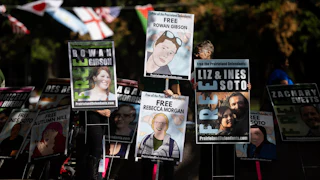
The noise demo itself, meant to express solidarity with people locked away in an immigrant camp, has resulted in a bitter symmetry. The demonstrators who organized to show support for detainees are now imprisoned, and others are now organizing and demonstrating to support them.
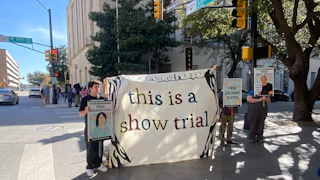
On days when the trial was in session, members of the support committee staffed a table at the courthouse; people shared zines and pamphlets about the case. Bruno told me that he gave essays about the case to anarchists in Greece and South Korea. The types of networks that had been made to sound suspicious in the government’s arguments were put to use raising money for lawyers and supporting defendants’ family members. It is the kind of network that could grow, as Bruno and others have put it, the mass movement that it would take to free the Prairieland defendants—broad and strong enough to put the necessary pressure on a future president to pardon and release them.
Early on, Bruno said, the government’s aggressive roundups and violent raids had unfortunately been “pretty successful in scattering everyone.” It took concerted effort to get them back together, he explained, “and understand that these are battles that have to be fought in community, have to be fought collectively, instead of trying to hide.” The risks they face remain very real. But for Bruno, there’s a deeper lesson here, one for the future: “Repression is harder when we’re all together—when we all stick together, when we are all in community with each other—than when we’re separate.”