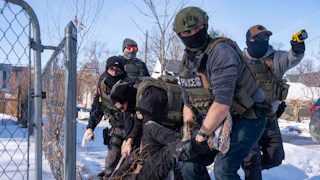
It’s rare for a judge to acknowledge that they are handing down a prison sentence for political reasons. But that is precisely what Chief District Judge Reed O’Connor stated from the bench in a North Texas federal courtroom this week, during the sentencing of eight defendants in one of the Prairieland cases, so named for the defendants’ participation last year in a July 4 demonstration at the Prairieland Detention Facility, a federal immigrant detention camp in Alvarado, Texas. In a hearing on Tuesday, as O’Connor handed down sentences of decades in prison, the judge said he was ordering the maximum allowed in each case because “the state wants to send a message to anyone who shares a similar ideology,” according to a support committee for the defendants.
The bluntness of the sentiment struck some of the defendants’ supporters hard. “We’ve always known the U.S. government has punished dissent every chance possible, but for it to be so blatantly pointed out was such a hit,” said Kels Menchaca, a member of the DFW Support Committee, which provides practical support to the defendants and works to educate the public about these cases. The group is now preparing for the long-haul support the defendants will need over what may be decades in federal prison, pending appeals or possibly pardons. The Prairieland cases are an emergency in their own right, but they are also a warning. This is not the last time the Trump administration will try to severely punish dissent. Opposing these sentences could help us stop the next one.
The Prairieland cases should be understood as the government’s effort to heroize ICE in the face of community defense efforts to stop mass deportations, and to shift the blame for political violence from federal officers to the left. Last summer, in Los Angeles and other cities, people took to the streets in massive numbers to demand an end to the flood of federal officers assaulting and abducting people profiled as immigrants in chaotic operations that were often captured on video by teams working for the government. As people organized regular demonstrations at federal sites used for the mass detention of immigrants, Trump threatened to send in troops to stop them. No one knew how these events would escalate, but it was clear the administration was looking for scapegoats.
On July 4, 2025, community members held a demonstration outside the Prairieland Detention Facility. As the demonstrators made noise and set off fireworks outside that night, hoping the people locked up inside would hear them, a few split off. A security booth and some employees’ cars were graffitied, and a security camera was broken. The detention center guards told the demonstrators to leave; most did. A police officer arrived on the scene, his weapon drawn. One of the remaining demonstrators was open-carrying a rifle. An officer was shot in the shoulder. He was briefly hospitalized and survived. Within hours, what followed was garnering breathless coverage in right-wing media as an antifa assault on a federal facility.
There was no such assault. But the facts weren’t enough to stop the government from punishing eight people with effective life sentences, convicting them of “providing material support to terrorists” for acts such as printing and distributing leftist zines, joining an anarchist book club, communicating on the same messaging app, or having visited the same shooting range. These people are now facing 30-, 50-, 70-, and 100-year prison sentences. “These are friends,” Menchaca said. “These are people’s family, and they’re being given extraordinary sentences for things that are supposed to be protected actions. Fireworks on the Fourth of July being called explosives and terrorism? Political literature is something worth taking 30 years of someone’s life?”
In all, 21 people were arrested for their alleged connection to the Prairieland demonstration, some that night but many much later. In a press release on July 8, ICE claimed that “nearly a dozen violent assailants equipped with tactical gear and weapons attacked the Immigration and Customs Enforcement’s Prairieland Detention Facility.” Todd Lyons, then the acting director of ICE, used the arrests to hammer home the administration’s narrative. “This is precisely what we have been warning against, as disinformation and dangerous politically motivated rhetoric spreads,” Lyons said. The department promised terrorism charges, and “vowed” to charge “anyone obstructing ICE operations or assaulting federal law enforcement officers.”
The government’s story diminished before any of the defendants made it to court. Multiple shooters became one, and up to 30 rounds fired dropped to fewer than a dozen, as Steven Monacelli found in an investigation for The Barbed Wire. Months passed before the defendants, some of whom remained in custody, were arraigned. But in that interval, the president issued an executive order claiming to designate “antifa” as a “domestic terrorist organization” (there is no such designation), and signed a national security memo authorizing sweeping investigations for alleged “political violence” from the left. Finally, when grand jury indictments were made public, the official story had settled: The Department of Justice had taken down a “North Texas antifa cell” that had “created and distributed insurrectionary material called zines,” “dressed in ‘black bloc’—dark clothing with head and face coverings,” and used “an encrypted messaging app to coordinate with each other that had auto-delete functions.”
Now, just shy of one year after the demonstration, we are witnessing the part of the government’s narrative in which the administration thinks it has won. Its position is clear, Menchaca said: “Not allowing the government to abuse people will cost you most of your natural life. Not allowing the police to murder an unarmed protester fleeing means your life is now forfeit to the state.”
But since the Prairieland defendants were indicted and as their trials wound on, we’ve seen many of the government’s attempts to charge people for disrupting ICE operations fall apart, some in now high-profile scandals such as that involving the former Broadview Six, a group of demonstrators at an ICE facility near Chicago, who were indicted on charges of conspiracy to impede a federal agent. (The charges were dropped after prosecutorial misconduct came to light.) Still, such failures have not slowed the government down. Last week, 15 people in Minnesota were indicted on federal conspiracy charges related to allegedly impeding federal officers.
The lesson here is not that the Prairieland defendants did something uniquely dangerous, but that they faced the same political repression any number of us could. The government, Menchaca said, is “trying to set the stage to criminalize every person who doesn’t agree to their atrocities. And our loved ones are suffering for their compassion.”