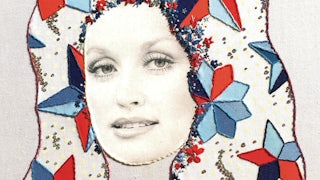
Was she a saint? A goddess? An angel with a hairspray halo? Dolly Parton knew how people saw her, and embraced her role as pop culture fairy godmother. She had her wings on-screen at least, having worn them in no fewer than three roles over the years (two of them Christmas movies, naturally). When “What would Dolly do?” became a cliché, Parton used it for the name of a podcast. Divine or not, she never turned down a good branding opportunity.
Those who ascribe to Dolly Parton a supernatural strength got a sad reminder that she was all too human when she died at age 80 earlier this week. Especially in recent years, the deaths of celebrities tend to prompt a public rehashing of their work, personal life, and any unsavory offenses. Not so with Parton; no caveats, no complications, no questions. Just adoration and sadness, much more often citing her philanthropic work and various good deeds than anything about her career as an artist and entertainer. Below the grief there’s a sense of losing something endangered, the idea that while we’ve got a fair number of great musicians, paragons of virtue and kindness feel harder and harder to come by.
The road to Saint Dolly, though, was a longer one than it might feel given how overwhelming Dolly-mania has been, especially over the past decade or two. Before that, especially during the period of her greatest artistic and commercial success, she was patronized and mocked—known better as a punch line than as the virtuoso she’s been all along. She owned the boob jokes from the beginning—who knows, maybe she even started them—but either way they were relentless, from all corners. She handled them and all the other patronizing comments and questions about her background and looks with grace and good humor, offering gentle retorts that would, decades later, become memes. If we like and share them enough maybe we can prove we’ve been Team Dolly from the start, pure and true rather than snarky and superficial. After all, Dolly was the same all along, from the apocryphal day she stepped off a Greyhound bus in Nashville to the very end. The rest of us just finally caught up.
“Find out who you are and do it on purpose.” It’s one of Parton’s most famous quotes, one recycled into something pat—but there’s no question that she lived that mantra. Her steadiness, certainty, and self-assurance made all those around her, the would-be detractors and skeptics, seem weak and small. Everything she did was a choice: the devotion to music and songwriting, the country wit of her public persona, and of course, the style she cribbed, according to her, from a local sex worker. “When people would say, ‘She ain’t nothing but trash,’ I would always say, ‘Well, that’s what I’m gonna be when I grow up,’” Parton told The Guardian in 2023.
That last choice proved to be a mirror for American pop culture, one that reflected nothing good. By the late 1970s, Parton had more or less conquered Nashville on her own terms—including the sexy ones (“It does things to people,” read a 1965 ad for her second single, next to a picture of a sultry young Parton). She’d escaped the long shadow of Porter Wagoner, whose variety show served as her jumping-off point—even then, women needed duets with men to get their start on the country charts—and gotten a string of country No. 1 hits that included the iconic “Jolene” and “I Will Always Love You” (she later distanced herself from the claim that they were written in the same day, a trivia tidbit beloved by those posting Dollybait). When she sought to raise her star higher with a pointed pop crossover, she almost instantly succeeded with “Here You Come Again,” which reached No. 3 on Billboard’s all-genre Hot 100 chart (a feat Parton would never match). Yet in the press, her looks were the beginning and end of the story; her music, talent, and general beneficence landed somewhere in the middle.
To some degree, the fixation was to be expected. This was Nashville (Robert Altman, 1975)–era Nashville, and Parton supersized all the clichés about gaudy country glam. Still, it was the start of another perennial Dolly conundrum: the way people have projected their hopes, dreams, and insecurities onto her. “A certain amount of fantasizing is impossible to avoid,” wrote Chet Flippo in the lede of a 1977 Rolling Stone profile of the singer, one of her biggest national media portraits to that point. He went on to describe imagining swimming naked with her in a river, spilling a few hundred words about his horniness before getting to anything about her career or art (the way she inspired “quasi-religious experiences” and “cleansings of the soul” did wind up making the story, though). She could flaunt her virtuosity on Johnny Carson, but not until after he offered up some random innuendo; Barbara Walters, in an interview that is perennially, posthumously, getting dunked on online, asked her if she’d had such big boobs when she was “11, 12, 13.”
But she never wavered. The wigs stayed high, the rhinestones remained abundant, the backwoods Barbie attitude unequivocal. “I’ll save you the trouble of askin’,” Dolly Parton said in a 1978 interview with Playboy. “Why do I choose to look so outrageous?” (Yes, she posed in the classic bunny garb with all the critical bits covered; she also made good on a promise from that interview and reprised the look at 75.) The answer, again, came back to that same hard-fought agency: “I have to look the way I choose to look, and this is what I’ve chose.”
Following that first peak of national visibility in the late ’70s and early ’80s, however, Parton did slightly recede into her fanbase—mostly the Venn diagram of women and the LGBTQ community—with both musical pop crossover and the releases of 9 to 5 and The Best Little Whorehouse in Texas. A series of health issues forced her offstage for extended periods; her releases and the opening of Dollywood in 1986 were then framed as “comebacks” rather than the latest moments in the reign of an untouchable pop icon. They were covered mostly by women’s magazines, whose focus remained on her body via how much weight she had or hadn’t lost rather than how much the author wanted to touch it. Parton still responded with typical self-deprecation and candor, even sharing that she had been so deep in depression during her convalescence that she had contemplated suicide. “I got close once,” she told Ladies Home Journal in 1986. “I put the gun down. Then I prayed.”
The Dolly of the late ’80s and ’90s was a little quieter; perhaps, in her ever-abundant self-awareness, Parton realized how little use American pop culture has historically had for women between the ages of 30 and 60 (Taylor Swift and Beyoncé, as they approach middle age, are both currently pushing against this grain). She was never a massive film star and no longer a fixture of country radio but she kept doing Dolly things, expanding her empire, embracing camp, launching the Imagination Library—her best-known philanthropic effort, sending free books to children under five to encourage the literacy her father never had—and most critically, writing and releasing music even through stretches of dormancy, never waiting for the tide to turn but, maybe, trusting that it would.
It ultimately did, right around her sixtieth birthday—the age when women either get forgotten completely or become beloved mascots (her fellow mononymous country star Reba has had a similar, albeit even more social media–driven late-era renaissance). She got back to touring arenas and amphitheaters, and she composed a Broadway musical version of 9 to 5. Somewhere along the way, the boob jokes got a lot less funny while Dolly kept being Dolly; by the time she headlined Glastonbury in 2014, it seemed the consensus had come back around in her favor—even if it was one based more on her image, five biggest hits, and country-fried witticisms than remarkable musical talent and prolific output. She embraced the streamlining of her persona, the glitter and pink and blonde, always giving people what they came for.
Considering how much she gave, it is shocking how much she also kept to herself. Her marriage, chiefly, and other aspects of her personal life (whether or not her entire body is covered in tattoos has been subject of considerable debate). She was candid about putting on the costume of Dolly Parton, about the world knowing the one version of her that she was OK with sharing and only her intimates knowing all the rest. It is hard to fathom that with all she was for her fans and popular culture as a whole, there was still so much that she intentionally left a mystery—a mystique that only made her seem more superhuman. She left space for people to make her whatever they needed her to be, and they certainly used her that way up until the end. Two of the biggest recent Dolly books, Sarah Smarsh’s She Come By It Natural and Lynn Melnick’s I’ve Had to Think Up a Way to Survive—are as much about what her fans got from witnessing her as the icon herself.
That projection is how we get over-the-top conceits like Dolly Parton’s America, and the idea that she’s our last “great unifier” or some kind of supernatural presence right here on earth—almost overcompensating for all those years of snide comments. “It took me probably years longer to be taken serious, but I wasn’t willing to change,” Parton said. She tried to defuse some of the reverence—“There ain’t nobody that good. I’m not all that.… I’m not even all there,” she said in the same interview—but it only grew, and probably will grow faster now that she’s gone.
The fact is, her only superpower (besides the ability to pick a banjo with acrylic nails) was her sheer humanity, her insistence over and over that she and the rest of us were the same. “The biggest freaks in the world for me are my favorite people, like you, like me,” she told Andy Warhol and Maura Moynihan in Interview magazine in 1984. She rejected Dolly exceptionalism, and we should try to as well, as tempting as it might be—instead, may we all find our own larger-than-life characters, our biggest, brightest, most generous selves in her honor.