A corruption scandal involving an 83-year-old religious leader accused of gifting a diamond necklace, two Chanel handbags, and a ginseng root to the president’s wife can seem almost quaint from the other side of the Pacific. But it turns out it comes with some consequence, albeit arguably inconsequential. On Monday, a Korean court handed Han Hak-ja, the leader of the church that most know as “the Moonies,” a two-year sentence for embezzlement of church funds that were used for political bribery. The case has cast a dark shadow over religious influence in Korean politics, and has raised questions about the dwindling church’s continued influence in the Trump administration.
Prosecutors had sought a 13-year sentence, which would have essentially meant life behind bars for the aging leader of the Family Federation for World Peace and Unification, or FFWPU, formerly known as the Unification Church. The sentence was something of a surprise, as the church had expected the court to agree to the prosecutors’ request. Han was found guilty of political bribery of former first lady Kim Keon Hee and another conservative politician, with the church apologizing for causing “big concerns and disappointment to the people” but vowing to appeal Han’s conviction.
Han, her chief of staff, Won-ju Jeong, and former church deputy Yoon Young-ho were accused of embezzling over $7 million in church funds through false accounting between 2017 and 2025, with investigators seizing a further $26 million in funds hidden in a safe in Han’s bedroom. Han was acquitted of these charges, leading to the greatly reduced sentence. The church has repeatedly sought to place blame on Yoon for the corruption, claiming that Han had been drawn into a case driven by religious persecution. Jeong was given a suspended sentence, while Yoon received an additional six months to the 18 months he received in a separate trial.
Adding to the intrigue, the two women at the center of it all were brought together by Jeon Seong-bae, a court shaman known as Geon Jin, in a web of quid pro quo that saw an exchange of money and political backing, such as inflating membership lists and attending rallies, in order to further the church’s business activities. Geon Jin is a self-proclaimed Buddhist monk who draws on ancient Korean shamanistic practices and specializes in geomancy—the interpretation of markings in the ground as a form of fortune telling. According to prosecutors, Geon Jin approached the first lady and her husband, former conservative President Yoon Suk Yeol, seeking favors for the church’s business empire, given the church’s long-stated goal of achieving “unity of politics and religion”—that is, bringing all world governments under the rule of the church.
Ostensibly an investigation into Korea’s former president and his wife, it instead revealed two women up to their necks in a scandal of their husbands’ making. Thirty-two people in all were indicted over the wider corruption affair, including another controversial sect leader, Lee Man-hee of the Shincheonji Church, which is more infamously known as the epicenter of one of the first outbreaks of Covid outside of China.
The affair came to light after Yoon spectacularly declared martial law in a late-night television address in December 2024, sparking mass protests. He said his “self-coup” was a response to what he claimed was a North Korean conspiracy to overthrow him, but it was widely seen as a bid to save his unpopular presidency from protests, a Congress controlled by the opposition, and mounting corruption scandals, many of them relating to his wife’s perceived hand in government and suggestions that she could be bought. Said to have been conceived over a night of heavy drinking, a related plot reportedly saw Yoon and his defense minister order drones flown into North Korea in a bid to provoke conflict, unbeknownst to the military.
Eleven days later, he was impeached by the country’s national assembly. In January this year, he was sentenced to five years in prison after being found guilty over the decree, and he awaits further trials that could result in the death penalty if he is found guilty of insurrection.
Much of the intrigue surrounding the affair is to do with his wife, Kim Keon Hee, who styled herself as a first lady cosplaying as a Korean Jackie Kennedy–Hillary Clinton type but was viewed as a Lady Macbeth by many Koreans. Twelve years younger than her husband, she took an unprecedented, outsize role as a first lady in Korean politics, even once claiming she was “the man” of her household, shocking a deeply patriarchal society. Her critics were wide-ranging: She made enemies as she helped ban dog meat as food in the country and defended a politician accused of sexual assault. More lurid allegations proliferated in tabloids, which reported that she met her husband when she worked as a nightclub hostess under the name “Julie.” After vigorously denying the claims as fictional sleaze, asserting that she was an academic and a “workaholic,” she was later embarrassed into apologizing for embellishing her résumé and had two of her degrees retracted for plagiarism.
The scope of her role as the hand behind the throne is contested, even by prosecutors. On the night of Yoon’s failed self-coup she was at a plastic surgeon’s office and, they say, screamed at her husband for “ruining everything.” Facing three separate criminal trials, she has so far been sentenced to a total of 11 years in prison.
In a similar vein, Han Hak-ja’s notoriety, and criminality, stems from her role as wife of a man of immense power and influence. Han, who was detained in September last year, was helped from a car into her wheelchair and into a Seoul courtroom, eyes closed against the barrage of flashing cameras and the cries from supporters of “I love you, Mother Han.” She is the wife and successor of the late Sun Myung Moon, founder of the Unification Church.
Moon famously declared himself the Messiah, blending Christianity with Eastern spirituality, placing Moon and his family at the center of God’s third attempt to perfect humans after the failure of Adam and Jesus before him. In this interpretation, God’s will also means accumulating exceptional wealth and power, which for decades saw Moon play an outsize role in politics in the United States, Korea, Japan, and several South American countries. The church is infamous for its mass weddings, sexual rituals, and exploitation of members’ labor and donations, particularly in Japan, as well as for its political activities and its multinational business empire, which involves everything from sushi ingredients to military arms.
Moon married Han, his second wife, when he was 40 and she was just 17, and she bore him 14 children. After Moon’s death in 2012, she became the bitterly contested heir to his empire, battling several of her children for control of the church and its considerable business holdings. Today, Moon’s legacy continues to haunt all three nations where its political imprint is greatest.
Throughout Moon’s life, the church was most popular in Japan, where it exploited postwar guilt to trick the bereaved into donating huge sums, which it used for political influence and to build a multinational business empire. The full nature of that relationship was brought to light in 2022, when former Japanese Prime Minister Shinzo Abe was assassinated by Tetsuya Yamagami, whose mother had given away the family fortune to the church, a substantial backer of Abe’s party. Earlier this year, the church was stripped of its religious status in Japan, losing its tax exemption and forcing the liquidation of its assets—although some members are already moving behind the scenes to reestablish the church under a different name.
In a twist of fate, just as Yamagami’s trial was taking place last October, so too was Han’s. Knowing she was likely to be convicted, Han made public appeals for leniency that went well beyond potential well-wishers in Seoul. The church has embarked on a campaign to convince the Trump administration to intervene on the grounds of Christian persecution, a cause it has frequently embraced around the world. Unlike many other petitioners, Han’s pleas rest on more than her faith. They bring into focus the church’s 50-year ties to the Republican Party and the fact that many senior figures in the Trump court—including the president himself—have been lavished with the church’s largesse in recent years for appearances at its conferences.
Moon’s fervent anti-communism and seemingly endless pots of money helped the church gain substantial influence during the Cold War across Korea, Japan, Latin America, and the United States. The Moonies came to prominence in the United States in the 1970s through their support for Nixon during the depths of Watergate; they maintained their allegiance to the Republican Party throughout a rolling series of scandals that reflected poorly on, but benefited, all involved. They were mired in a corruption scandal of their own, known as Koreagate, in the 1970s, which exposed ties to Korean intelligence and to both political parties in Washington, and which faded from collective memory thanks to its complexity and its embarrassment to both sides of the aisle.
The church publishes The Washington Times, a precursor to Fox News during its heyday in the Reagan administration, when the president proclaimed it the first thing he read each day. Despite being imprisoned for 13 months in 1984 for tax evasion, Moon’s influence extended into the George H.W. Bush administration; after leaving office, Bush and his wife toured the world with Moon and Han, preaching peace, love, family values, and robust American capitalism—lending their reputation to the rehabilitation of the wildly unpopular church leader, netting millions in the process with speaking fees of $80,000 a pop.
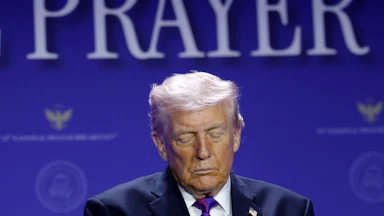
Trump gave three speeches for the church’s front group, the Universal Peace Federation, between 2021 and 2022, for which he was paid $2.5 million—including one appearance that took place just 17 days after Abe’s assassination. At a church conference in 2021, Trump appeared in a prerecorded message to praise Han as a “tremendous person” who had done “incredible work on behalf of peace all over the world.” Last year, Trump denounced the “vicious raids on churches” involved in the scandal, while the conservative media star Charlie Kirk visited the country shortly before his death and spoke out about the perceived persecution of Christians.
Newt Gingrich remains the star columnist at The Washington Times and posts frequently on X about the case. Paula White Cain, the senior adviser to the Trump White House’s Faith Office, continues to attend church conferences where she calls Han “Holy Mother Han,” the title used by her followers, and has acted as an intermediary between Trump and the current Korean administration.
Two of Han’s estranged sons, Sean and Justin, were present at the January 6 insurrection and are Mar-a-Lago regulars. They run the offshoot Sanctuary Church. Based in Pennsylvania, the church is also known as Rod of Iron Ministries, infamous for worshippers clutching semiautomatic rifles—and for Sean wearing a crown of bullet casings on his head. The two brothers host MAGA events that have been attended by figures including Michael Flynn and Donald Trump Jr.
Trump’s recent re-embrace of Kim Jong Un hasn’t helped matters for any side. The current administration in Seoul feels ever more isolated from its greatest ally, and Korea’s powerful conservative Christian right is dismayed that the president is embracing its great foe and the longtime source of its strong military alliance with Washington. Last week, Trump further inflamed tensions with a Truth Social post attacking South Korea for refusing to join his war against Iran, noting that he has “a very good relationship” with Kim Jong Un.
For the church, however, their position is clear: Their multibillionaire leader should continue to enjoy her lifestyle on the backs of church members’ work and donations. In a statement, the president of the American church, Demian Dunkley, said that “the Mother of Peace should be free to travel the world.” Following her arrest last September, her estranged son Sean, who has called her the “Whore of Babylon,” said in a statement that “this is only the beginning of the Judgment.”
For many church critics, Han’s conviction has the air of Al Capone to it: She’s been nailed for relatively minor charges, while long-standing allegations about embezzlement of church funds and exploitation of members’ labor continue to go unexamined by courts under the guise of religious freedom. So far, Han’s allies in Washington have remained conspicuously quiet—but given their long-standing financial arrangements, that’s unlikely to last long.