Breaking News
Breaking News
from Washington and beyond

Trump Admin Covering Up Number of U.S. Troops Killed in Iran War

U.S. officials say the Trump administration is hiding the real death toll from the war.

President Donald Trump listens as Defense Secretary Pete Hegseth speaks during a Cabinet meeting
Kent NISHIMURA/AFP/Getty Images

The Trump administration may be hiding exactly how many American troops have died in the Iran war. 

The Washington Post, citing six anonymous U.S. officials, reports that more U.S. service members have died than the Department of Defense has publicly disclosed. Five of these officials told the newspaper that there have been 22 military deaths during the war, four more than the 18 currently appearing in the Defense Casualty Analysis System, the DOD’s public database. 

Another unnamed official says that 23 service members have been killed since February 28, when the U.S. and Israel first launched airstrikes on Iran. Not all of the alleged undisclosed deaths are directly tied to the war, this official reportedly said, but all of the deceased soldiers were in the Middle East while the war was going on. 

This official also told the Post that three American contractors based in the region have also died since the start of the war. The details behind the undisclosed deaths are unclear, including who they were and how, when, and where they died. The Pentagon refused to answer the newspaper’s inquiries about the disputed death figures.  

The Iran war is extremely unpopular with the American people, with the risk to U.S. troops among one of many reasons why. If Secretary of Defense Pete Hegseth and the rest of the Trump administration are hiding military casualties, that raises questions as to the circumstances of their deaths and what incentive White House officials have to keep them secret. 

President Trump, Hegseth, and everyone else in the administration continue to insist that the Iran war is going well, despite the Strait of Hormuz remaining closed and Iran’s allies in Yemen, the Houthis, taking over the Bab al-Mandeb Strait on the other side of the Arabian Peninsula. Hiding American deaths further exposes the White House’s attempts to fool the American people that the war has been a success.  
Pentagon Says Iran War Cost $45 Billion—if You Don’t Count Everything

U.S. Central Command gave an incomplete estimate of the Iran war cost to Congress.

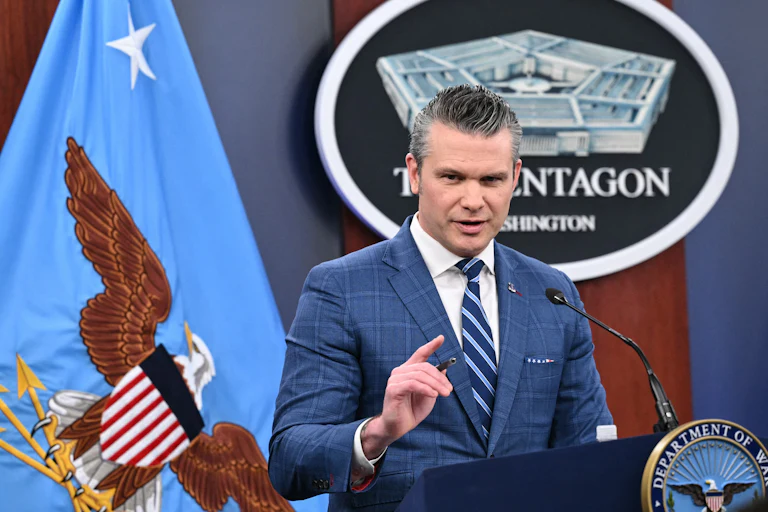
Defense Secretary Pete Hegseth speaks at a podium
Defense Secretary Pete Hegseth
Mandel NGAN/AFP/Getty Images
Defense Secretary Pete Hegseth

President Trump’s seven-month war on Iran has cost the American taxpayer $45.1 billion, according to estimates the United States Central Command gave Congress this week. They also estimate that they’ll require another $28 billion to cover the cost to replace lost munitions.

According to the CENTCOM estimate, $28.1 billion went toward replacing spent munitions, $11.2 billion went toward general operations, and $4.3 billion went to weapons and tools that were “lost.” Another $1.5 billion went toward fuel. The estimate tracks up until September 3. It does not, however, account for the massive damage to U.S. military bases in the Middle East. There was also not a more detailed breakdown of the costs.

In July, Defense Secretary Pete Hegseth estimated that the Pentagon had already spent $37.5 billion on the war at that point. That total has quickly been eclipsed, and the war has no end in sight.

Literally no one voted for this war. Trump moved on his own, at the behest of the Israeli government. Now everyday Americans are paying for it, even as the vast majority disapprove of the war and how the president has handled it. And yet Republicans don’t seem to care, even as gas prices spike and midterms draw closer.

Trump Bans Three Major News Outlets From the White House

It is unclear if he has the power to do this.

Donald Trump points and speaks
Charles McQuillan/Getty Images

Donald Trump announced Friday he was banning several of America’s most prominent national news institutions from the White House, claiming that the prohibition was the result of “FAKE NEWS.”

He specified that he would bar CNN, MS NOW, and Politico, though it is unclear if Trump actually has the power to ban their reporters from the White House grounds. It is also unclear if the ban extends to other government buildings, such as the Capitol.

“Media Outlets shouldn’t be able to constantly write or report FICTION and LIES when they’re covering the President of the United States, the Trump Administration, or the United States of America,” Trump wrote on Truth Social. “Other Fake News Media Outlets to follow.”

Trump did not identify specific stories that he felt fell into that category, though earlier in the day, Trump lamented online that “CNN is so dishonest.”

“Everything they say is slanted against the Republican Party,” Trump wrote Friday morning. “They are truly FAKE NEWS!”

The news industry is an essential component of a healthy democracy. Questioning authority figures, dispelling untruths, shedding light on injustice, and disseminating verified information to the public are functions of that job in play, and tools to hold power to account.

But Trump has made it his mission since he first descended the golden escalator at Trump Tower in 2015 to sow public distrust in America’s news institutions. Time and again he has said the less-than-devotional coverage of his political campaigns, his fraudulent business practices, his dubious personal connections, and his presidential administrations are tantamount to “fake news.”

In recent years Trump has aggressively pursued legal action against several major news entities, including The New York Times, The Wall Street Journal, The Washington Post, ABC News, and CBS News (as well as the broadcaster’s parent company, Paramount). He also sued the Des Moines Register, its parent company Gannett, and pollster J. Ann Selzer in December 2024, retroactively claiming that presidential polls the paper had published prior to Election Day were election interference.

This story has been updated.

It’s Not Just Matching Shoes. Trump Team Has Matching Rolexes Too.

But where the shoes were a gift, the watches are a status symbol.

Steve Witkoff and Susie Wiles sit next to each other at a dinner
Steve Witkoff and Susie Wiles
Al Drago/Bloomberg/Getty Images
Steve Witkoff and Susie Wiles

Custom Rolex watches have become the ultimate symbol of status for President Donald Trump’s White House staff, Vanity Fair reported Friday.

The so-called “White House Rolex” watches come in two styles: a gold Day-Date Presidential and a GMT Pepsi. The two designs have blue faces and a gold presidential seal on the dial. At the 45- and 47-second marks sits a blue star. On the back is an engraving of the White House. Rolex doesn’t technically make custom watches, so the ones Trump staffers wear are purchased and then modified by a bespoke business in London.

Sounds expensive, right? “There’s no one fucking rich enough in the West Wing to actually buy the watch!” one insider joked to Vanity Fair. But in an administration made up of wealthy lobbyists and former real estate investors, that’s not always true.

Unlike the ugly dress shoes Trump scared all his Cabinet members into wearing, these aren’t a gift—White House staff are shelling out thousands and thousands of dollars to own a Trumpian timepiece. Those in possession of such a grotesque display of both wealth and sycophancy include Steve Witkoff, the U.S. special envoy fumbling peace negotiations across the world; Susie Wiles, the chief of staff who trashed her entire team; and Will Scharf, the White House counsel who’s begged the administration not to violate the Constitution.

Several members of Vice President’s JD Vance staff also wear these watches, including Nick Luna, his chief of staff, and Cliff Sims, his national security adviser. Those with White House Rolexes outside of the actual White House include Chris LaCivita, Trump’s former campaign manager, and Tony Fabrizio, the president’s personal pollster.

Kash Patel’s FBI Briefly Stopped Cooperating With Canada in Petty Move

The FBI director made the decision because he was pissed at the Canadian Broadcasting Cooperation.

FBI Director Kash Patel waves after taking his seat in a congressional hearing
FBI Director Kash Patel at a Senate Judiciary Committee hearing on September 15
Roberto Schmidt/AFP/Getty Images
FBI Director Kash Patel at a Senate Judiciary Committee hearing on September 15

FBI Director Kash Patel temporarily paused cooperation with the FBI’s counterpart in Canada earlier this month over how the country’s national public broadcaster referred to the September 11 attacks.

The New York Times reports that after the Canadian Broadcasting Company reminded its journalists not to refer to 9/11 as “terrorism” if not citing an expert (a long-standing policy for coverage of all attacks), Patel halted some cooperation with the Royal Canadian Mounted Police. The pause apparently didn’t last long, and wasn’t a total shutdown. Other agencies in the U.S. government continued working with the Canadian government normally.

But the FBI works closely with the RCMP on everything from terrorism to cybersecurity, and Patel’s pettiness threatens to jeopardize the already shaky relationship between the U.S. and Canada. During the pause, bureau officials canceled meetings with their Canadian opposites and said they would not be in contact for a while. This, coupled with Patel attacking the CBC’s editorial decision in multiple posts on X last month, wasn’t a positive step for the bureau’s relationship with the RCMP.

“Any agency in Canada that doesn’t publicly reject this bastardization of history, and an insult to the souls lost during our largest terrorist attack in US history will no longer have friend in this FBI.… Not to mention our heroes that responded in the aftermath 🇺🇸,” Patel posted at least twice on August 28, in replies to articles and video clips about the policy. “WE WILL NEVER FORGET 9-11.”

Later that day, CBC’s head of standards adjusted the network’s guidance, saying that terrorism now could be used to describe the attacks without attribution. The pause in cooperation still happened days later, with things reportedly going back to normal around the twenty-fifth anniversary of the attacks. According to the Times, FBI officials wanted some kind of apology, and it’s not known if they got one.

Canadian Culture Minister Marc Miller said that the new editorial guidance brought a “welcome change to what was a piece of pedantic and foolish guidance that caused legitimate anger.” Why Patel chose to raise a stink over this is anyone’s guess, but he has a history of slavish loyalty to Trump, and dramatic indignation over anything related to 9/11 is a conservative tradition at this point.